What is the Impact of Social Media on Mental Wellness?
Complete guide • Step-by-step explanations
Social Media Mental Health Impact:
Show Impact CalculatorThe impact of social media on mental wellness is complex and multifaceted, involving both positive and negative effects. Research shows that social media can enhance connection and support, but also contribute to anxiety, depression, and low self-esteem. The effects depend largely on usage patterns, content consumption, and individual vulnerabilities.
Key areas of impact include:
- Social Comparison: Constant exposure to idealized versions of others' lives
- Validation Seeking: Reliance on likes, comments, and followers for self-worth
- Sleep Disruption: Blue light exposure and late-night scrolling
- Information Overload: Exposure to overwhelming amounts of content
- Positive Connections: Maintaining relationships and finding support communities
Understanding these impacts is crucial for developing healthy social media habits and protecting mental wellness in our digital age.
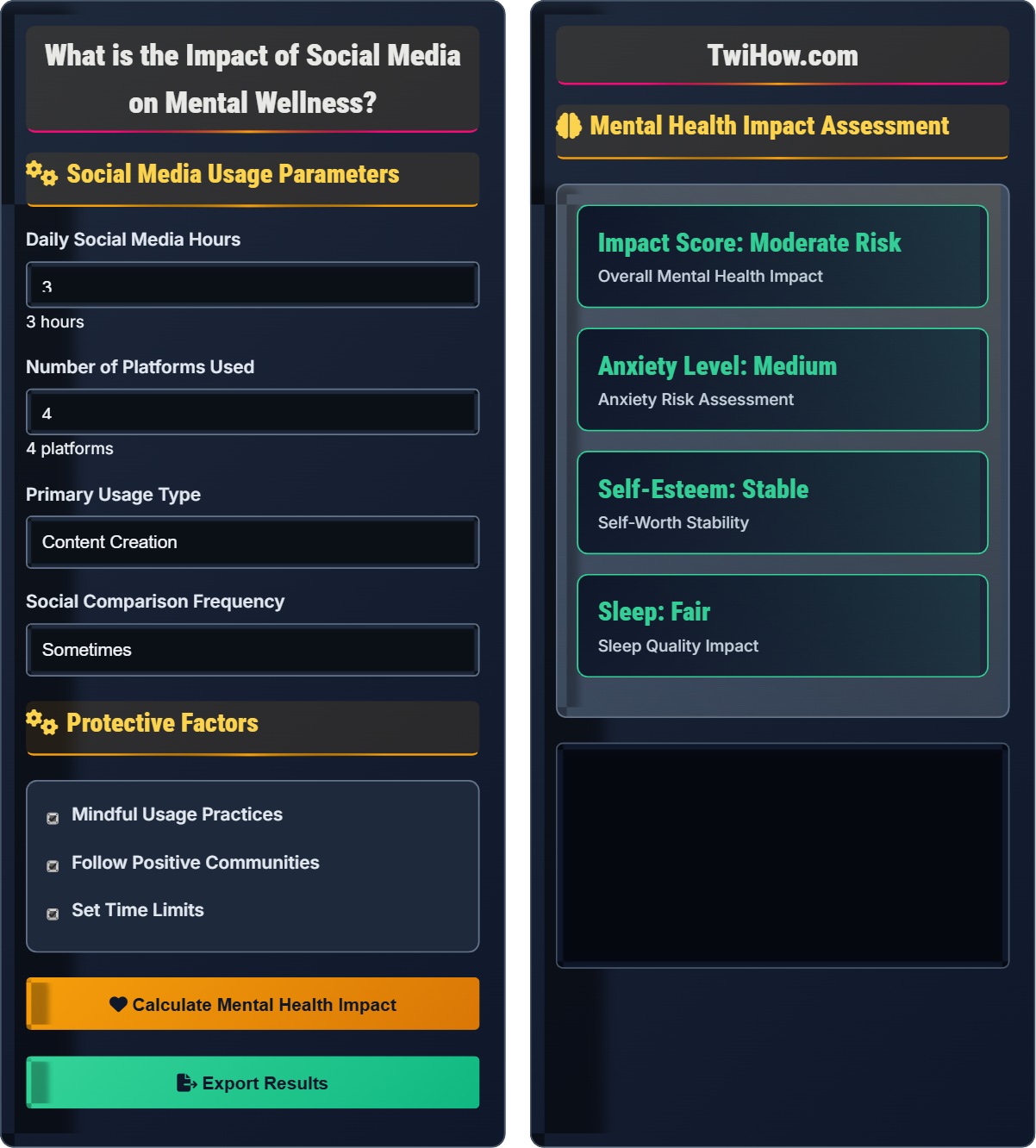
Social Media Usage Parameters
Protective Factors
Mental Health Impact Assessment
| Area | Score | Risk Level | Recommendation |
|---|---|---|---|
| Social Comparison | 60% | Moderate | Limit exposure to idealized content |
| Validation Seeking | 50% | Low | Focus on internal validation |
| Sleep Impact | 70% | High | Stop 2 hours before bed |
| Information Overload | 65% | Moderate | Curate your feed |
| Positive Connections | 40% | Medium | Join supportive communities |
Healthy Usage Strategies
- Implement time limits and stick to them
- Curate your feed to include positive content
- Take regular digital detoxes
- Focus on real-world relationships
- Practice mindful scrolling
Social Media Impact on Mental Wellness Explained
Research has revealed that social media's impact on mental wellness is complex and depends on various factors including usage patterns, content consumed, and individual characteristics. The relationship between social media use and mental health is bidirectional - while social media can influence mental health, pre-existing mental health conditions can also affect how someone uses social media.
The mental health impact of social media can be conceptualized as:
Where:
- Usage Time: Duration and frequency of social media engagement
- Comparison Tendency: Likelihood to engage in upward social comparisons
- Vulnerability: Individual susceptibility to negative influences
- Protective Factors: Mindfulness, positive communities, time limits
Despite the risks, social media can also have positive effects on mental wellness:
- Social Connection: Maintaining relationships and finding support communities
- Education: Access to mental health resources and awareness
- Self-Expression: Creative outlets and identity exploration
- Advocacy: Participating in meaningful causes and movements
- Entertainment: Humor and positive content for stress relief
- Professional Growth: Networking and career opportunities
- Heavy Usage: Studies show correlation with increased anxiety and depression
- Passive Consumption: More harmful than active engagement
- Age Differences: Adolescents more vulnerable than adults
- Platform Variations: Different platforms have varying impacts
- Gender Differences: Women more affected by appearance-focused content
- Intervention Effectiveness: Digital wellness practices show promise
Fundamentals
Social comparison, validation seeking, FOMO, cyberbullying, digital wellness, information overload, body image, mental health literacy.
Mental Health Impact = (Usage Time × Comparison Tendency × Vulnerability) - Protective Factors
Where each component is weighted based on research findings and individual factors.
- Context matters more than quantity of usage
- Individual differences significantly affect outcomes
- Protective factors can mitigate negative effects
Strategies
Setting boundaries, curating content, mindful usage, seeking support, digital detoxes, positive engagement.
- Set specific time limits for social media use
- Unfollow accounts that trigger negative emotions
- Follow accounts that promote positivity and education
- Take regular breaks from social media
- Focus on real-world relationships and activities
- Practice mindfulness while using social platforms
- Personalize strategies to your needs
- Start with small, manageable changes
- Monitor your emotional responses
- Seek professional help when needed
Social Media Mental Health Quiz
According to recent studies, which social media usage pattern is most strongly associated with negative mental health outcomes?
Research consistently shows that passive social media consumption (scrolling through feeds without active engagement) is more strongly associated with negative mental health outcomes than active engagement. Passive consumption increases social comparison, envy, and feelings of inadequacy without the benefits of social connection or meaningful interaction. This pattern often leads to the "compare and despair" phenomenon where users measure themselves against idealized versions of others' lives.
The answer is B) Passive scrolling and consumption.
This finding challenges the assumption that more social media use is always worse. The quality of engagement matters more than quantity. Passive consumption involves one-sided observation without reciprocal interaction, creating a power imbalance where users consume others' curated content without contributing to meaningful exchanges. This creates a sense of distance and inadequacy without the social rewards of genuine connection.
Passive Consumption: Viewing content without active participation
Social Comparison: Evaluating oneself relative to others
Compare and Despair: Negative emotional response to others' perceived success
• Quality of engagement matters more than time spent
• Passive consumption increases negative outcomes
• Active, meaningful interactions are beneficial
• Comment meaningfully on posts rather than just scrolling
• Engage in genuine conversations
• Limit time spent in passive consumption modes
• Assuming all social media use is equally harmful
• Focusing only on duration of use
• Not considering the nature of interactions
Explain the concept of social comparison on social media and describe how it affects mental health. Provide specific strategies to reduce harmful social comparison.
Social Comparison Theory: People evaluate themselves by comparing to others. Social media amplifies this by providing constant access to others' highlight reels.
Effects on Mental Health: Upward comparisons (to those perceived as better off) can lead to decreased self-esteem, increased anxiety, and depression. Downward comparisons can provide temporary relief but may also foster guilt or shame.
Strategies to Reduce Harmful Comparison:
1. Curate Your Feed: Unfollow accounts that trigger negative emotions and follow accounts promoting authenticity
2. Practice Gratitude: Focus on your own journey and accomplishments rather than others' successes
3. Reality Check: Remember that social media represents curated moments, not complete realities
4. Limit Exposure: Reduce time spent on platforms that trigger comparison
5. Focus on Internal Validation: Develop self-worth independent of external validation
Social comparison is a natural human tendency that social media intensifies by providing constant access to others' achievements. The problem isn't comparison itself, but the direction and frequency of comparison. Social media creates an environment where upward comparisons are frequent and downward comparisons rare, leading to persistent feelings of inadequacy. Understanding this mechanism helps develop targeted interventions.
Social Comparison: Evaluation of oneself relative to others
Upward Comparison: Comparing to those perceived as superior
Downward Comparison: Comparing to those perceived as inferior
• Everyone curates their online presence
• Comparison is often unfair and inaccurate
• Focus on your own growth journey
• Keep a personal achievement journal
• Follow accounts that share authentic experiences
• Practice mindfulness during social media use
• Taking social media content at face value
• Comparing your behind-the-scenes to others' highlight reel
• Not curating your feed intentionally
Emma, a 22-year-old college student, notices that she feels anxious and inadequate after spending time on Instagram. She compares her life to influencers and classmates who post perfect photos and achievements. She finds herself checking Instagram obsessively and seeking validation through likes. Describe Emma's situation, identify the specific social media-related mental health risks she faces, and recommend a comprehensive plan to address her concerns.
Emma's Situation: Emma is experiencing classic signs of social media-induced anxiety and low self-esteem, characterized by upward social comparison and validation-seeking behavior.
Identified Risks:
• Increased Anxiety: From constant comparison to idealized content
• Decreased Self-Esteem: From measuring herself against unrealistic standards
• Validation Dependency: Relying on external approval for self-worth
• Compulsive Behavior: Obsessive checking indicating potential addiction
Comprehensive Plan:
1. Immediate Actions: Unfollow triggering accounts, set app time limits
2. Reframe Perspective: Remember social media shows curated content
3. Build Internal Validation: Focus on personal values and achievements
4. Real-World Activities: Engage in offline hobbies and relationships
5. Professional Support: Consider counseling if symptoms persist
Emma's case represents the classic progression from normal social media use to problematic patterns. The obsessive checking indicates a behavioral pattern that may be difficult to break without intervention. The validation-seeking behavior creates a feedback loop where self-worth becomes tied to external metrics. This scenario demonstrates how social media can hijack natural reward systems and create dependency patterns similar to other addictive behaviors.
Social Media Anxiety: Anxiety triggered by social media use
Validation Seeking: Need for external approval and recognition
Compulsive Behavior: Repetitive actions despite negative consequences
• Early intervention prevents escalation
• External validation is unreliable
• Professional help may be necessary
• Use apps to track and limit usage
• Create an "authenticity" folder with real-life photos
• Practice the 24-hour rule before posting
• Trying to quit social media completely without support
• Not addressing underlying self-esteem issues
• Continuing to follow triggering accounts
Your friend has expressed concerns about their social media use affecting their mood and sleep. They spend 4-5 hours daily on various platforms and often scroll late into the night. Propose three evidence-based digital wellness strategies specifically designed to address their concerns.
Evidence-Based Strategies:
1. Blue Light Management: Implement blue light filters and stop all screen use 2 hours before bedtime to improve sleep quality. Research shows blue light suppresses melatonin production.
2. Time Blocking: Schedule specific times for social media use (e.g., 2 x 30-minute sessions daily) to reduce mindless consumption and regain control over usage patterns.
3. Mindful Transition Rituals: Create physical and mental rituals before and after social media use (e.g., deep breaths, intention setting) to increase awareness and reduce automatic scrolling.
These strategies address both the sleep disruption and excessive usage concerns with practical, research-backed approaches.
Effective digital wellness interventions target specific behavioral and physiological mechanisms. Blue light management addresses the circadian disruption that affects sleep. Time blocking creates structure around otherwise unstructured behavior. Mindful transitions interrupt automatic patterns and increase conscious choice in digital behavior. These approaches work synergistically to create sustainable changes in digital habits.
Digital Wellness: Healthy relationship with technology and digital devices
Blue Light: High-energy visible light that affects sleep hormones
Time Blocking: Scheduling specific time periods for activities
• Changes must be sustainable long-term
• Address both behavioral and environmental factors
• Monitor effectiveness and adjust strategies
• Use phone's built-in screen time tracking
• Charge phone outside the bedroom
• Replace scrolling with a book before bed
• Attempting too many changes simultaneously
• Not addressing environmental triggers
• Failing to track progress and adjust
Which of the following is the most effective protective factor against negative social media impacts on mental health?
Mindful and intentional usage is the most effective protective factor because it allows individuals to maintain awareness of their emotional responses, set appropriate boundaries, and make conscious choices about their social media engagement. This approach helps people recognize when usage becomes problematic and adjust accordingly. Having many followers or following celebrities may actually increase social comparison and validation-seeking behaviors. Entertainment-only usage doesn't address the underlying mechanisms that drive negative outcomes.
The answer is C) Practicing mindful and intentional usage.
Mindfulness creates meta-cognitive awareness that allows individuals to observe their thoughts and emotions without being controlled by them. In the context of social media, this means noticing the urge to scroll, recognizing the emotional states that trigger usage, and making conscious choices about engagement. This awareness is the foundation for all other protective strategies and helps individuals develop a healthier relationship with digital platforms.
Mindfulness: Awareness of present moment experiences
Protective Factors: Elements that reduce risk of negative outcomes
Intentional Usage: Purposeful and conscious engagement
• Awareness precedes change
• Conscious choice reduces automatic behavior
• Meta-cognitive skills are protective
• Take a mindful pause before opening apps
• Notice your emotional state during use
• Set intentions before engaging
• Using social media on autopilot
• Not paying attention to emotional responses
• Engaging without clear purpose
FAQ
Q: How can I tell if my social media use is negatively affecting my mental health?
A: Warning signs that social media may be negatively impacting your mental health include:
1. Emotional Responses: Feeling anxious, sad, envious, or inadequate after using social media
2. Compulsive Behavior: Checking social media constantly, even during inappropriate times
3. Sleep Disruption: Staying up late scrolling or having trouble falling asleep
4. Self-Worth Issues: Measuring your value based on likes, comments, or followers
5. Time Distortion: Losing track of time while on social media
6. Real-World Impact: Neglecting responsibilities, relationships, or activities you enjoy
If you notice these patterns, consider reducing usage or seeking professional support.
Q: How can I help my teenager develop healthy social media habits?
A: Helping teenagers develop healthy social media habits requires a collaborative approach:
Open Dialogue: Discuss social media use openly without judgment, focusing on understanding rather than restriction
Education: Teach about the psychology of social media, including how algorithms work and the reality behind curated content
Modeling: Demonstrate healthy social media habits in your own behavior
Boundaries: Establish reasonable limits together, such as no phones during meals or before bedtime
Positive Alternatives: Encourage offline activities and face-to-face social interactions
Monitoring: Stay aware of their online activities while respecting privacy as appropriate for their age
Remember that education and collaboration are more effective than authoritarian restrictions.