How to Reduce Stress and Anxiety?
Complete mental health guide • Step-by-step explanations
Mental Health Fundamentals:
Show Stress Management ToolsManaging stress and anxiety is crucial for mental health and overall wellbeing. Stress and anxiety are natural responses to challenges, but when they become overwhelming or persistent, they can significantly impact daily life. Effective management involves various techniques including breathing exercises, mindfulness, physical activity, and lifestyle changes.
Key stress and anxiety management techniques:
- Breathing Exercises: Controlled breathing to calm the nervous system
- Mindfulness Meditation: Present-moment awareness to reduce worry
- Physical Activity: Exercise to release tension and boost mood
- Healthy Sleep: Quality rest to support emotional regulation
- Social Support: Connection with others for emotional comfort
Modern approaches combine evidence-based techniques with personal customization to create effective stress management plans tailored to individual needs and circumstances.
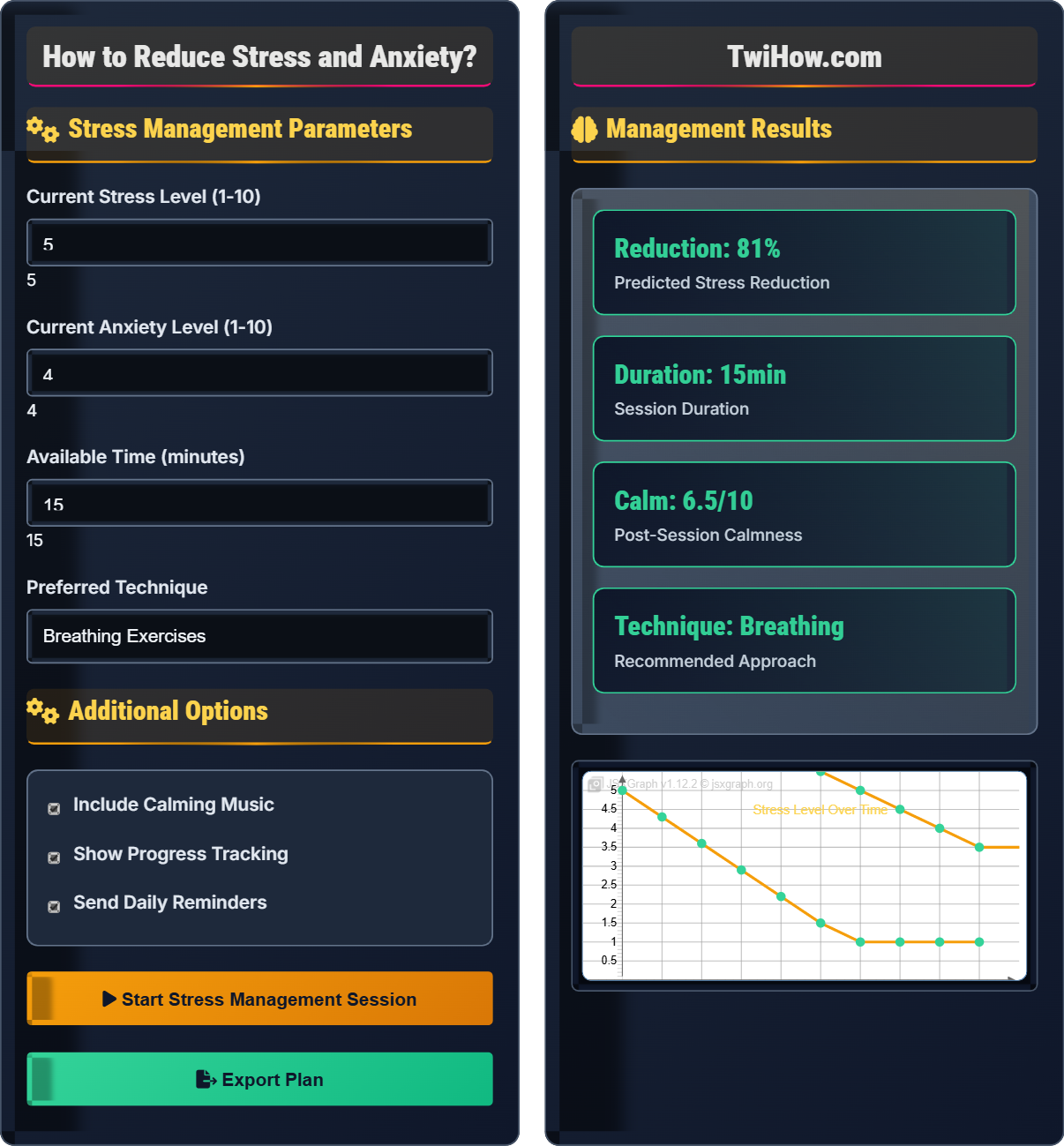
Stress Management Parameters
Additional Options
Management Results
| Day | Stress | Anxiety | Calmness |
|---|---|---|---|
| 1 | 8 | 7 | 3 |
| 2 | 7 | 6 | 4 |
| 3 | 6 | 5 | 5 |
| 4 | 5 | 4 | 6 |
| 5 | 4 | 3 | 7 |
How to Reduce Stress and Anxiety Explained
Stress is the body's response to any demand or challenge, while anxiety is a feeling of fear, worry, or unease about something with an uncertain outcome. Both are natural reactions that have evolved to help us respond to threats, but they can become problematic when they persist or become overwhelming.
When we experience stress or anxiety, our bodies release hormones like cortisol and adrenaline, which prepare us for a "fight or flight" response. This can cause physical symptoms like increased heart rate, muscle tension, and rapid breathing.
Effective stress management follows the principle of balancing stressors with coping resources:
Where:
- Stressors: External and internal triggers that cause stress
- Coping Resources: Techniques, support systems, and personal strengths
- Consistency: Regular practice of management techniques
Proven techniques for managing stress and anxiety:
- Deep Breathing: 4-7-8 technique, diaphragmatic breathing
- Meditation: Mindfulness, guided meditation, progressive relaxation
- Physical Activity: Yoga, walking, exercise, stretching
- Healthy Lifestyle: Proper sleep, nutrition, limiting caffeine
- Social Connection: Talking to friends, support groups
- Time Management: Prioritization, scheduling, setting boundaries
- Improved Physical Health: Lower blood pressure, reduced inflammation
- Better Mental Clarity: Enhanced focus, memory, and decision-making
- Emotional Regulation: Better mood stability and resilience
- Stronger Relationships: Improved communication and empathy
- Increased Productivity: Better focus and energy management
Stress Management Fundamentals
Stress response, anxiety, fight-or-flight mechanism, relaxation response, homeostasis.
1. Inhale through nose for 4 counts
2. Hold breath for 7 counts
3. Exhale through mouth for 8 counts
Repeat 3-4 cycles to activate parasympathetic nervous system.
- Consistency is more important than perfection
- Start with short sessions and gradually increase
- Combine multiple techniques for best results
Practical Applications
Workplace stress, social anxiety, public speaking, financial worries, relationship conflicts.
- Preparation and planning
- Real-time stress management
- Recovery and reflection
- Long-term resilience building
- Practice techniques when calm
- Personalize your approach
- Seek professional help when needed
- Be patient with yourself
Stress and Anxiety Management Quiz
Which of the following is NOT part of the body's immediate stress response?
During the stress response, the body releases stress hormones including cortisol and adrenaline. Cortisol production increases, not decreases, during stress. The other options (increased heart rate, dilated pupils, and muscle tension) are all part of the body's "fight or flight" response.
The answer is C) Decreased cortisol production.
Understanding the physiological stress response helps us appreciate why stress management techniques work. When we're stressed, our sympathetic nervous system activates, preparing the body for action. Techniques like deep breathing and meditation activate the parasympathetic nervous system, which counteracts this response and promotes relaxation.
Stress Response: Body's automatic reaction to perceived threats
Cortisol: Hormone released during stress that increases alertness
Parasympathetic Nervous System: System that promotes relaxation
• Stress response is evolutionary and protective
• Chronic activation can be harmful
• Relaxation techniques counteract stress response
• Notice your physical stress symptoms
• Use them as cues to practice relaxation
• Remember stress is temporary
• Thinking stress response is always negative
• Ignoring physical signs of stress
• Believing stress cannot be managed
Explain the 4-7-8 breathing technique and why it's effective for reducing anxiety. Include the physiological mechanism behind its effectiveness.
4-7-8 Technique Steps: Inhale through your nose for 4 counts, hold your breath for 7 counts, and exhale completely through your mouth for 8 counts. Repeat this cycle 3-4 times.
Why It's Effective: This technique works by activating the parasympathetic nervous system, which promotes relaxation. The extended exhale (8 counts) is particularly important because it stimulates the vagus nerve, which controls the relaxation response.
Physiological Mechanism: The technique increases oxygen saturation in the blood, slows the heart rate, and reduces the production of stress hormones like cortisol. The longer exhale also helps shift the balance from sympathetic (stress) to parasympathetic (relaxation) nervous system activity.
Controlled breathing techniques are among the most accessible and effective tools for managing stress and anxiety. They work quickly because they directly influence the autonomic nervous system. The 4-7-8 technique is particularly effective because it's easy to remember, has a specific rhythm that promotes relaxation, and can be practiced anywhere without equipment.
Parasympathetic Nervous System: "Rest and digest" system that promotes relaxation
Vagus Nerve: Major nerve that connects brain to organs and regulates relaxation
Autonomic Nervous System: Controls involuntary body functions
• Practice regularly for best results
• Focus on slow, controlled breathing
• Maintain consistent rhythm
• Practice when calm to build skill
• Use as prevention, not just intervention
• Combine with visualization for enhanced effect
• Rushing through the counts
• Not practicing consistently
• Expecting instant results
Sarah works in a high-pressure corporate environment with tight deadlines and demanding clients. She experiences chronic stress, difficulty sleeping, and frequent anxiety attacks. Design a comprehensive stress management plan for Sarah that addresses her workplace stress, includes daily practices, and considers her work schedule. Include specific techniques she can use during work hours and explain why these approaches would be effective for her situation.
Daily Practices: 10-minute morning meditation, evening journaling, regular exercise, and consistent sleep schedule.
During Work Hours: Micro-breaks every 90 minutes, desk stretches, deep breathing exercises between meetings, and boundary-setting with colleagues.
Weekly Activities: Longer meditation sessions, yoga classes, and social activities for stress relief.
Effectiveness: This multi-faceted approach addresses both acute stress (during work) and chronic stress (through lifestyle changes). The micro-breaks prevent stress accumulation, while evening practices help reset the nervous system. Consistent practices build resilience over time.
Effective stress management for high-pressure environments requires both preventive and reactive strategies. Preventive strategies (like micro-breaks) interrupt stress accumulation, while reactive strategies (like evening practices) help recover from daily stress exposure. The key is creating a sustainable routine that fits within existing commitments.
Micro-Breaks: Short pauses (1-5 minutes) to reset and refocus
Boundary Setting: Establishing limits on availability and workload
Stress Accumulation: Building up of stress without adequate recovery
• Consistency is more important than duration
• Address both work and life stressors
• Build practices gradually
• Use calendar reminders for breaks
• Keep stress-relief tools at work
• Communicate boundaries clearly
• Trying to manage everything alone
• Neglecting physical health for work
• Not seeking support when overwhelmed
Michael experiences severe social anxiety that prevents him from attending networking events, giving presentations, or participating in team meetings. He wants to overcome his social anxiety to advance his career. Propose a gradual exposure therapy approach combined with cognitive restructuring techniques. Explain how Michael can practice these techniques in low-stakes situations before applying them to high-stakes professional scenarios.
Gradual Exposure: Start with imagining social situations, then role-playing with trusted friends, then small group discussions, then larger groups, finally professional settings.
Cognitive Restructuring: Challenge catastrophic thoughts ("Everyone will judge me") with realistic alternatives ("Most people are focused on themselves").
Low-Stakes Practice: Practice speaking in family dinners, volunteer opportunities, or hobby groups before professional settings.
Combination Approach: Use breathing techniques before exposure exercises, practice positive self-talk, and celebrate small victories.
Gradual exposure therapy works by systematically desensitizing anxiety responses while building confidence. Cognitive restructuring addresses the thought patterns that fuel anxiety. Combining both approaches is more effective than using either alone, as it addresses both the emotional and cognitive components of social anxiety.
Gradual Exposure: Systematic approach to facing feared situations incrementally
Cognitive Restructuring: Identifying and changing negative thought patterns
Systematic Desensitization: Gradual reduction of anxiety through exposure
• Progress at your own pace
• Use safety behaviors sparingly
• Practice regularly
• Prepare talking points in advance
• Focus on listening to others
• Remember that others are often supportive
• Avoiding situations entirely
• Setting unrealistic expectations
• Not seeking professional help when needed
Which of the following is the most important factor for long-term success in stress management?
While having advanced techniques, perfect circumstances, or eliminating all stressors would be ideal, these are neither realistic nor necessary for successful stress management. The most important factor for long-term success is consistency in practicing stress management techniques. Regular practice builds resilience and makes techniques more effective when truly needed.
The answer is B) Consistent daily practice.
Like physical fitness, mental resilience requires regular exercise. Consistent practice of stress management techniques builds "muscle memory" and makes these responses more automatic. Over time, regular practice also helps regulate the nervous system baseline, making individuals less reactive to stressors overall.
Mental Resilience: Ability to bounce back from adversity
Stress Inoculation: Building resistance through regular practice
Baseline Regulation: Maintaining stable nervous system activity
• Small, consistent actions beat sporadic efforts
• Build habits gradually
• Focus on process, not perfection
• Start with 5-minute daily practices
• Link practices to existing habits
• Track progress for motivation
• Expecting immediate results
• Giving up after occasional skips
• Overcomplicating the approach
FAQ
Q: I'm constantly busy with work. How can I find time for stress management techniques?
A: The key is integrating stress management into your existing routine rather than adding new time-consuming activities. Try "micro-practices" - 30-second breathing exercises between meetings, 2-minute desk stretches, or mindful moments while drinking coffee. Research shows that brief, consistent practices can be more effective than longer, infrequent ones. Also, remember that taking care of your mental health actually improves productivity and focus, so you're not losing time - you're investing in better performance.
Q: I've tried meditation apps but can't seem to quiet my mind. What am I doing wrong?
A: You're not doing anything wrong! The goal of meditation isn't to "quiet" your mind completely - that's nearly impossible and not the point. Instead, meditation is about noticing when your mind wanders and gently bringing attention back to your focus point (breath, sound, etc.). Start with shorter sessions (3-5 minutes) and try techniques like counting breaths or body scanning. Also, consider that anxiety might be making it harder to meditate initially, so be patient as you build the skill. The act of trying to bring your attention back is the practice itself.
Q: My stress comes from parenting responsibilities. Are there stress management techniques that work while taking care of kids?
A: Absolutely! Many stress management techniques can be adapted for parents. Try "mindful parenting" - staying present during routine activities like feeding or playing. Practice deep breathing while children are napping or engaged in quiet play. Use "parallel processing" - do calming activities alongside your children (family yoga, nature walks). Consider involving older children in stress-reduction activities like cooking together or gardening. Remember, modeling healthy stress management teaches your children valuable skills. Also, don't hesitate to ask for help from family, friends, or childcare services to create pockets of time for your own stress management.