How to Sleep Better?
Complete sleep guide • Sleep improvement strategies
Sleep Fundamentals:
Assess My SleepSleep is essential for physical health, mental wellbeing, and cognitive function. Quality sleep involves falling asleep easily, staying asleep throughout the night, and waking up refreshed. Sleep hygiene practices, environmental factors, and lifestyle choices significantly impact sleep quality.
Adults typically need 7-9 hours of sleep per night, though individual needs vary. Poor sleep can lead to various health issues including impaired cognitive function, weakened immunity, and increased risk of chronic diseases.
Key sleep improvement strategies:
- Consistent Schedule: Same bedtime and wake time daily
- Environment: Cool, dark, quiet bedroom
- Preparation: Relaxing bedtime routine
- Lifestyle: Regular exercise and stress management
- Diet: Avoid caffeine and heavy meals before bed
Understanding sleep patterns and hygiene practices is crucial for optimal health and performance.
Sleep Profile
Sleep Habits & Environment
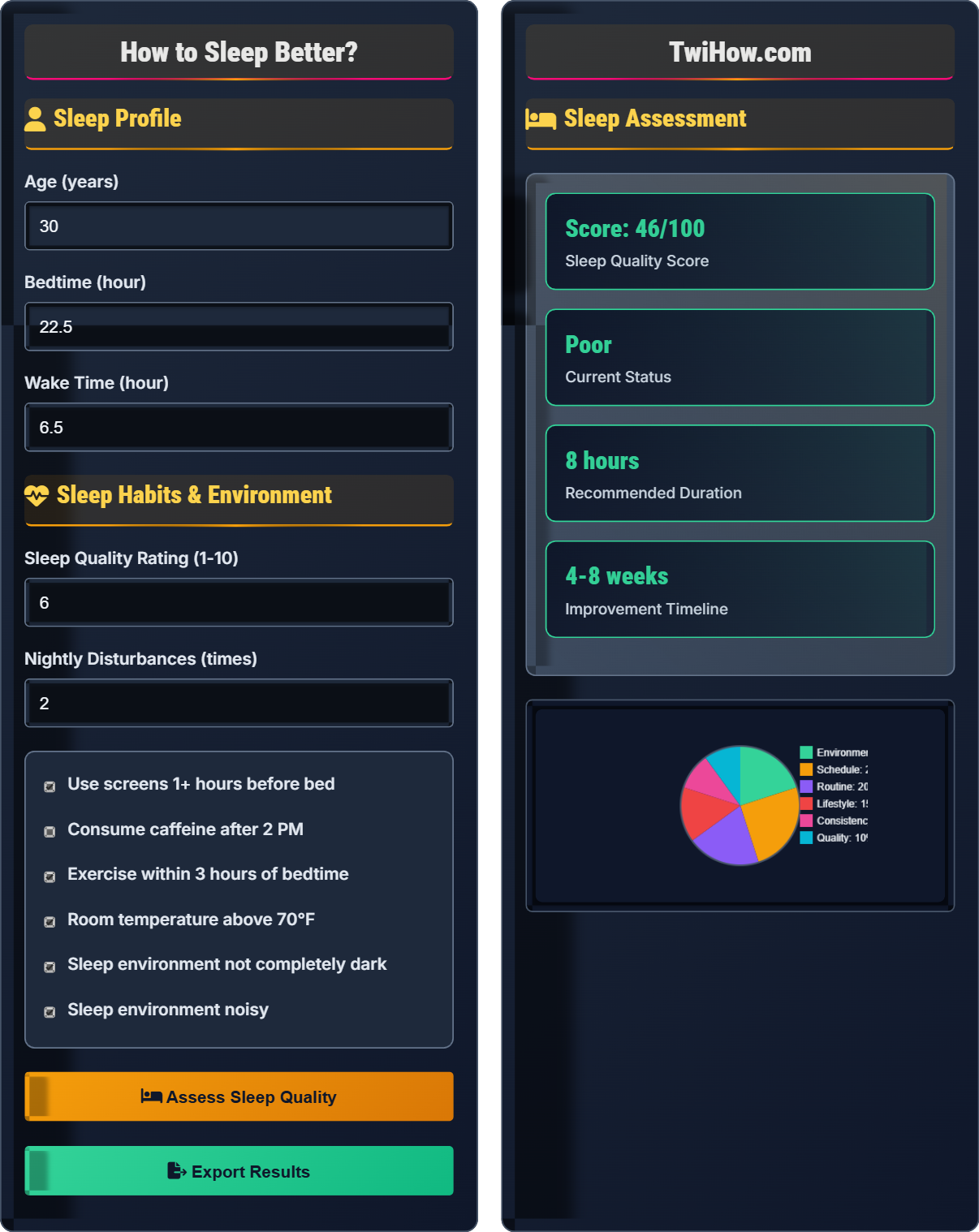
Sleep Assessment
| Action | Priority | Impact | Timeline |
|---|---|---|---|
| Reduce screen time before bed | High | 25% | Immediate |
| Improve room darkness | High | 20% | 1-2 weeks |
| Lower room temperature | Medium | 15% | Immediate |
| Adjust exercise timing | Medium | 10% | 1 week |
Understanding Sleep Science
Sleep occurs in cycles of 90-120 minutes, alternating between REM (Rapid Eye Movement) and non-REM sleep. Non-REM sleep has three stages: light sleep (N1, N2) and deep sleep (N3). REM sleep is when most dreaming occurs.
Deep Sleep: Critical for physical restoration, immune function, and memory consolidation. Most deep sleep occurs in the first half of the night.
REM Sleep: Important for emotional regulation, memory processing, and learning. Increases in the second half of the night.
Healthy sleep includes 4-6 complete cycles per night, with appropriate amounts of each stage.
Sleep Quality Score = (Duration × 0.30) + (Consistency × 0.25) + (Environment × 0.20) + (Routine × 0.15) + (Lifestyle × 0.10)
Each factor is rated on a scale of 1-10, with 10 being optimal. Duration refers to adequate sleep hours, consistency to regular sleep schedule, environment to bedroom conditions, routine to bedtime practices, and lifestyle to habits affecting sleep.
Additional modifiers include age (sleep patterns change with age), health conditions, and medications.
Key actions to improve sleep:
Optimal sleep environment includes:
- Temperature: 65-68°F (18-20°C)
- Light: Complete darkness or dim lighting
- Noise: Quiet or consistent white noise
- Comfort: Supportive mattress and pillows
- Technology: Minimal electronic devices
Environmental factors can account for 20-30% of sleep quality variance.
- Pre-Sleep: Avoid screens 1-2 hours before bed
- Timing: Stop caffeine 6+ hours before bedtime
- Exercise: Finish exercise 3+ hours before bed
- Food: Avoid large meals 2-3 hours before bed
- Winding Down: Engage in relaxing activities
Sleep Fundamentals
Sleep cycles, REM sleep, deep sleep, circadian rhythm, sleep hygiene, sleep debt.
Sleep Score = Σ(Factors × Weights) where each component contributes differently to overall sleep quality
- Consistency beats perfection
- Environment matters significantly
- Small changes can have big effects
Sleep Optimization
Duration, timing, consistency, environment, routine, lifestyle, stress management.
- Assess current sleep patterns
- Identify environmental factors
- Establish consistent schedule
- Develop bedtime routine
- 7-9 hours for most adults
- Same schedule daily
- Bedroom for sleep only
- Relaxing pre-sleep routine
Sleep Knowledge Quiz
Which sleep stage is most important for physical restoration and immune function?
Deep sleep (N3 stage) is most important for physical restoration, tissue repair, immune function, and memory consolidation. During deep sleep, the body releases growth hormone, repairs tissues, and strengthens the immune system. This stage is most prominent in the first half of the night and is crucial for feeling refreshed and restored.
The answer is C) Deep Sleep (N3).
Understanding sleep stages helps appreciate why sleep quality matters beyond just quantity. While REM sleep is important for cognitive function and emotional processing, deep sleep is critical for physical health. This is why sleep deprivation affects immune function and recovery more severely than other aspects of health.
Deep Sleep: Stage 3 non-REM sleep, most restorative
REM Sleep: Rapid eye movement sleep, associated with dreaming
Delta Waves: Slow brain waves during deep sleep
• Deep sleep is most restorative
• Occurs mainly in first half of night
• Essential for physical health
• Alcohol reduces deep sleep
• Exercise increases deep sleep
• Consistent sleep promotes deeper sleep
• Thinking all sleep stages are equal
• Not understanding stage importance
• Believing quantity matters more than quality
Explain the circadian rhythm and how it affects sleep. What factors can disrupt this natural cycle and how can it be optimized?
Circadian Rhythm: The body's internal 24-hour clock that regulates sleep-wake cycles, hormone release, and other physiological processes. It's controlled by the suprachiasmatic nucleus in the hypothalamus.
Effect on Sleep: Releases melatonin in response to darkness, promoting sleepiness. Disruption leads to sleep difficulties and daytime fatigue.
Disruptors: Irregular sleep schedules, bright screens at night, shift work, jet lag, caffeine, alcohol, and inconsistent meal times.
Optimization: Consistent sleep schedule, morning sunlight exposure, dimming lights before bed, avoiding screens, and maintaining regular meal times.
The circadian rhythm is like an internal master controller that coordinates various body systems. Understanding this helps explain why irregular schedules cause sleep problems. The rhythm is sensitive to light exposure, which is why morning light and evening darkness are so important for sleep regulation.
Circadian Rhythm: 24-hour biological clock
Suprachiasmatic Nucleus: Brain region controlling circadian rhythm
Melatonin: Sleep-promoting hormone released in darkness
• Light is the strongest circadian cue
• Consistency is more important than perfection
• Circadian rhythm takes time to adjust
• Get morning sunlight exposure
• Dim lights 2 hours before bed
• Keep consistent schedule even on weekends
• Inconsistent sleep schedules
• Not considering circadian timing
• Ignoring light exposure patterns
Sarah is a 28-year-old nurse who works rotating shifts. She sleeps 5-6 hours on average, uses her phone in bed, and drinks coffee until 4 PM. She often has trouble falling asleep and wakes up feeling tired. Create a sleep improvement plan that accounts for her shift work and lifestyle.
Phase 1 (Days off): Establish consistent sleep schedule for 2-3 days to reset rhythm. Stop phone use 1 hour before bed, use blackout curtains, and avoid caffeine after 2 PM.
Phase 2 (Shift transitions): Use bright light therapy when waking up for night shifts, wear sunglasses when coming home to minimize light exposure, and maintain consistent sleep timing regardless of shift.
Phase 3 (Environment): Invest in blackout curtains, white noise machine, and cooling fan. Create "sleep cave" that's dark, quiet, and cool regardless of time of day.
Phase 4 (Routine): Develop consistent pre-sleep routine with relaxation techniques, keep bedroom temperature below 68°F, and use sleep mask if needed.
This example shows how to adapt sleep hygiene principles to challenging circumstances. Shift workers face unique challenges because they're fighting their natural circadian rhythm. The key is creating a consistent, optimal sleep environment regardless of the time of day and using light strategically to manage circadian disruption.
Shift Work Sleep Disorder: Circadian rhythm disruption from rotating shifts
Light Therapy: Using bright light to adjust circadian rhythm
Sleep Hygiene: Practices promoting good sleep
• Consistency is crucial for shift workers
• Use blue light blocking glasses
• Take melatonin supplements strategically
• Plan naps around work schedule
• Inconsistent sleep schedule on days off
• Not optimizing sleep environment
• Ignoring circadian rhythm management
Research shows that blue light from screens suppresses melatonin production. Explain the mechanism by which screen exposure affects sleep, and suggest evidence-based strategies to minimize this effect while acknowledging that people need to use screens for work.
Mechanism: Blue light (wavelength 460-480nm) directly suppresses melatonin production by affecting photoreceptors in the retina that signal to the suprachiasmatic nucleus. This delays sleep onset and reduces sleep quality.
Evidence-based Strategies: 1) Blue light blocking glasses (30% melatonin preservation), 2) Screen filters/applications that reduce blue light emission, 3) Reducing screen brightness in evening, 4) Taking breaks from screens every 20 minutes, 5) Using voice assistants for nighttime tasks instead of screens.
Work Accommodations: Blue light filters during work hours, scheduled breaks from screens, and compensatory sleep strategies on days off.
This demonstrates the conflict between modern life and biological needs. The solution isn't to eliminate screen use entirely but to strategically manage exposure. The effectiveness of blue light blocking varies, but any reduction is beneficial compared to no intervention.
Melanopsin: Photoreceptor sensitive to blue light
Chronotype: Individual tendency toward morning/evening preferences
Blue Light: Short wavelength light that affects circadian rhythm
• Blue light is most disruptive in evening hours
• Any reduction is better than none
• Individual sensitivity varies
• Use built-in night mode on devices
• Take screen breaks before bed
• Use voice commands instead of screens
• Using screens right up to bedtime
• Not adjusting settings for evening
• Assuming all light has same effect
According to sleep research, what is the optimal sleep duration for most healthy adults?
Research consistently shows that 7-9 hours of sleep is optimal for most healthy adults. This range is associated with the lowest risk of mortality, cognitive impairment, and chronic diseases. While some individuals may function adequately with slightly less or more sleep, the majority of adults need 7-9 hours for optimal health and performance.
The answer is B) 7-9 hours.
This range represents the sweet spot where health benefits are maximized and risks are minimized. Both insufficient and excessive sleep are associated with health risks, showing a U-shaped relationship between sleep duration and health outcomes.
Optimal Sleep: Duration associated with best health outcomes
U-Shaped Relationship: Risk increases at both extremes
Individual Variation: Some people need slightly more/less
• 7-9 hours is optimal for most adults
• Individual needs may vary slightly
• Both too little and too much can be problematic
• Pay attention to how you feel after different durations
• Consistency matters more than exact hours
• Quality is as important as quantity
• Believing that less sleep is more efficient
• Not recognizing individual variations
• Focusing only on quantity not quality
FAQ
Q: Is it okay to take naps during the day?
A: Short naps (20-30 minutes) before 3 PM can be beneficial for cognitive performance and alertness. However, longer or later naps can interfere with nighttime sleep. If you have trouble sleeping at night, avoid napping or limit to 10-20 minutes early in the day. Naps should supplement, not replace, adequate nighttime sleep.
Q: Does alcohol help you sleep better?
A: Alcohol may help you fall asleep faster but significantly disrupts sleep quality. It suppresses REM sleep, causes fragmented sleep, and can worsen sleep apnea. The sedative effects wear off during the night, often causing awakenings. Avoid alcohol 3-4 hours before bedtime for optimal sleep quality.
Q: How long does it take to see improvements after changing sleep habits?
A: Most people notice improvements in sleep quality within 1-2 weeks of consistent sleep hygiene changes. Significant improvements in sleep patterns typically occur within 2-4 weeks. However, it can take 4-8 weeks for new sleep habits to become automatic. Consistency is more important than perfection during the adjustment period.