What are Relaxation Techniques?
Complete guide to mental wellness • Step-by-step explanations
Mental Wellness Fundamentals:
Show Relaxation SimulatorRelaxation techniques are methods designed to help you achieve a state of calmness and reduce stress. These practices involve consciously triggering your body's relaxation response, which counteracts the harmful effects of stress hormones like cortisol and adrenaline.
At their core, relaxation techniques work by activating your parasympathetic nervous system, which promotes rest, digestion, and recovery. Regular practice can lower blood pressure, reduce anxiety, improve sleep, and enhance overall well-being.
Key relaxation concepts:
- Deep Breathing: Conscious control of breath patterns
- Meditation: Mindful awareness and focus
- Progressive Muscle Relaxation: Tensing and releasing muscle groups
- Visualization: Creating calming mental imagery
Modern research shows that consistent practice of relaxation techniques can significantly reduce symptoms of anxiety, depression, chronic pain, and other stress-related conditions. These practices help reset your nervous system and build resilience against daily stressors.
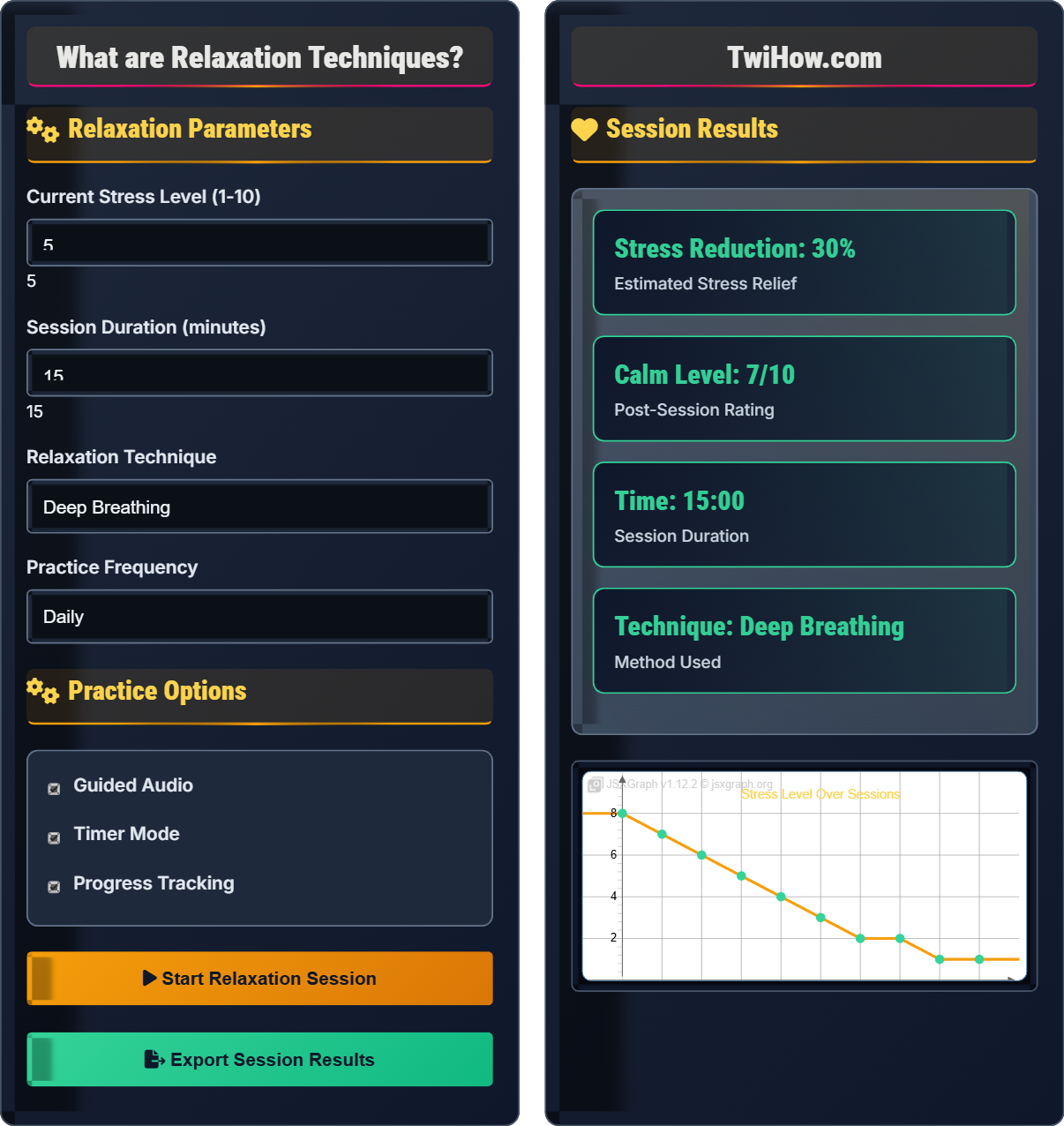
Relaxation Parameters
Practice Options
Session Results
| Date | Pre-Stress | Post-Stress | Technique |
|---|---|---|---|
| Jan 1 | 8 | 5 | Breathing |
| Jan 2 | 7 | 4 | Meditation |
| Jan 3 | 9 | 6 | PMR |
| Jan 4 | 6 | 3 | Visualization |
| Jan 5 | 8 | 5 | Breathing |
Follow the 4-7-8 breathing pattern: Inhale for 4 counts, hold for 7 counts, exhale for 8 counts.
How Relaxation Techniques Work
Relaxation techniques are practices designed to help you achieve a state of calmness and reduce stress. These methods work by triggering your body's relaxation response, which counteracts the harmful effects of stress hormones like cortisol and adrenaline. Regular practice can lower blood pressure, reduce anxiety, improve sleep, and enhance overall well-being.
Relaxation techniques work by activating your parasympathetic nervous system, which promotes rest, digestion, and recovery:
Where:
- Sympathetic System: Triggers fight-or-flight response
- Parasympathetic System: Promotes rest and recovery
- Balance: Relaxation techniques tip the balance toward calm
Key benefits of consistent relaxation practice:
- Physical: Lower blood pressure, reduced muscle tension, improved immune function
- Mental: Reduced anxiety, better focus, enhanced emotional regulation
- Sleep: Improved sleep quality, faster onset, deeper rest
- Relationships: Better patience, empathy, communication skills
- Performance: Increased productivity, creativity, decision-making
- Resilience: Greater stress tolerance, faster recovery from challenges
- Deep Breathing: Controlled breathing patterns for immediate relief
- Progressive Muscle Relaxation: Systematically tensing and releasing muscles
- Mindfulness Meditation: Present-moment awareness without judgment
- Guided Imagery: Creating peaceful mental scenarios
- Autogenic Training: Self-induced relaxation through verbal cues
Relaxation Fundamentals
Deep breathing, progressive muscle relaxation, meditation, guided imagery, autogenic training.
Relaxation = Focus + Breath + Awareness + Acceptance
Where Focus = directed attention, Breath = controlled breathing, Awareness = present moment consciousness.
- Consistency is more important than duration
- Start with short sessions and gradually increase
- Find what works best for your lifestyle
Applications
Stress management, anxiety reduction, sleep improvement, pain management, performance enhancement.
- Daily morning routine
- Before bedtime ritual
- During stressful moments
- As part of therapy
- Individual preferences vary
- May take time to see results
- Should complement professional care
- Environment matters for effectiveness
Relaxation Techniques Learning Quiz
Which physiological changes occur during the relaxation response?
During the relaxation response, the parasympathetic nervous system activates, leading to decreased heart rate, lower blood pressure, reduced muscle tension, and slower breathing. This is the opposite of the stress response, which increases these parameters.
The answer is B) Decreased heart rate and muscle tension.
The relaxation response is the body's natural counterbalance to stress. When activated, it promotes healing, restoration, and energy conservation. Understanding these physiological changes helps us appreciate why relaxation techniques are effective for managing stress and promoting health.
Parasympathetic Nervous System: Part of the autonomic nervous system that promotes rest and recovery
Relaxation Response: Physiological state opposite to stress response
Stress Hormones: Chemicals like cortisol released during stress
• Relaxation triggers parasympathetic activation
• Heart rate decreases during relaxation
• Muscle tension reduces with practice
• Notice your pulse to feel relaxation effects
• Pay attention to muscle tension changes
• Practice in quiet environments for best results
• Expecting immediate dramatic changes
• Confusing relaxation with sleep
• Ignoring physical sensations
Explain the 4-7-8 breathing technique, including the steps, benefits, and why it's effective for reducing anxiety.
Steps: 1) Exhale completely through your mouth, making a whoosh sound. 2) Close your mouth and inhale quietly through your nose to a mental count of 4. 3) Hold your breath for a count of 7. 4) Exhale completely through your mouth, making a whoosh sound to a count of 8. 5) Repeat for 3-4 cycles.
Benefits: Reduces anxiety, promotes relaxation, helps with sleep, increases oxygen flow.
Effectiveness: The longer exhale activates the parasympathetic nervous system, while the counting provides mental focus that prevents anxious thoughts.
The 4-7-8 technique combines breath control with cognitive distraction. The counting aspect keeps the mind focused on the exercise rather than anxiety-provoking thoughts, while the extended exhale signals to the body that it's safe to relax. This dual approach makes it particularly effective for anxiety management.
4-7-8 Technique: Specific breathing pattern for relaxation
Parasympathetic Activation: Rest and recovery nervous system response
Cognitive Distraction: Mental focus to interrupt anxious thoughts
• Always exhale longer than inhale
• Maintain consistent counts
• Practice regularly for best results
• Start with shorter counts if difficult
• Use before bedtime for better sleep
• Practice during calm moments to learn
• Rushing through the counts
A busy executive experiences high stress levels during work hours and struggles with insomnia. Design a relaxation plan that incorporates multiple techniques throughout the day, considering their schedule constraints and specific needs.
Morning Routine: 5-minute breathing exercise before starting work to set a calm tone for the day.
Midday Reset: 2-minute progressive muscle relaxation at desk during lunch break to release accumulated tension.
End-of-Day: 10-minute guided meditation to transition from work mode to personal time.
Bedtime: 4-7-8 breathing technique to calm the mind and prepare for sleep.
Emergency: Quick breathing exercises during stressful meetings or deadlines.
Effective stress management requires multiple touchpoints throughout the day rather than a single long session. Short, frequent interventions are more sustainable and can prevent stress from accumulating. The key is matching the technique to the available time and situation.
Micro-Interventions: Short relaxation techniques that fit busy schedules
Stress Prevention: Managing stress before it becomes overwhelming
Transition Rituals: Techniques to shift between different life contexts
• Match technique to available time
• Practice consistently across day
• Adapt to changing circumstances
• Set reminders for regular practice
• Keep techniques simple for busy times
• Track stress levels to measure effectiveness
• Planning only long sessions that don't get done
• Not adapting to schedule changes
• Expecting perfection in practice
Explain how to properly perform progressive muscle relaxation (PMR), including the sequence of muscle groups, timing, and safety considerations. Why is this technique particularly effective for people with chronic tension?
Sequence: Start with feet/toes, move up to calves, thighs, abdomen, chest, arms, shoulders, neck, and face.
Process: Tense each muscle group for 5 seconds, then relax for 10 seconds. Focus on the contrast between tension and relaxation.
Safety: Avoid excessive force, stop if experiencing pain, and consult a doctor if you have muscle injuries.
Effectiveness: PMR helps people become aware of physical tension they weren't noticing, and the release phase triggers relaxation. It's particularly effective for chronic tension because it addresses both awareness and physical release.
Many people live with chronic muscle tension without realizing it. PMR creates conscious awareness of this tension and provides a method for deliberate release. The technique works by creating a contrast that makes relaxation more noticeable and achievable.
Progressive Muscle Relaxation (PMR): Systematic tensing and releasing of muscle groups
Muscle Awareness: Conscious recognition of physical tension
Tension-Release Contrast: Sensory experience that enhances relaxation
• Tense gently, not forcefully
• Focus on sensation differences
• Move systematically through body
• Practice the sequence until it becomes automatic
• Use visualization of melting tension
• Start with shorter sessions and build up
• Tensing too forcefully
• Skipping muscle groups
• Not focusing on the release sensation
Which of the following is NOT a documented benefit of regular relaxation technique practice?
Regular relaxation practice reduces stress hormone production (like cortisol and adrenaline) rather than increasing it. All other options are well-documented benefits of consistent relaxation practice, including improved immune function, better emotional regulation, and enhanced sleep quality.
The answer is C) Increased stress hormone production.
Relaxation techniques work by reducing the body's stress response, which includes lowering the production of stress hormones. This is why these practices are so effective for managing stress-related conditions and promoting overall health. The goal is to achieve homeostasis by balancing the stress response system.
Homeostasis: Balanced physiological state
Stress Hormones: Cortisol, adrenaline, and related chemicals
Immune Function: Body's defense system against illness
• Relaxation reduces stress hormones
• Benefits accumulate with practice
• Individual responses may vary
• Track your stress levels over time
• Notice improvements in other areas
• Be patient with the process
• Expecting immediate dramatic changes
• Not maintaining consistency
• Comparing results to others
FAQ
Q: How long does it take to see benefits from relaxation techniques?
A: Some benefits, like immediate calm and reduced tension, can be felt within minutes of practicing relaxation techniques. However, lasting benefits require consistent practice over time:
• Immediate: 5-10 minutes for acute stress relief
• Short-term: 1-2 weeks of daily practice for mood improvements
• Medium-term: 4-8 weeks for significant stress reduction
• Long-term: 3+ months for lasting changes in stress response patterns
Consistency is more important than session length. Even 5-10 minutes daily is more beneficial than longer, irregular sessions.
Q: What's the difference between meditation and relaxation techniques?
A: While related, meditation and relaxation techniques have distinct purposes and approaches:
Relaxation Techniques: Specifically aim to reduce physical and mental tension, often with a therapeutic goal of stress relief. Includes breathing exercises, progressive muscle relaxation, and visualization.
Meditation: Broader practice focused on developing awareness, attention, and mental clarity. May include relaxation as a byproduct but isn't always the primary goal.
Many relaxation techniques incorporate meditative elements, and vice versa. The distinction is primarily in intention: relaxation techniques target stress reduction, while meditation targets awareness development.
Q: Can relaxation techniques help with chronic pain?
A: Yes, relaxation techniques can be very effective for managing chronic pain through several mechanisms:
1. Muscle Relaxation: Reduces tension that can worsen pain
2. Stress Reduction: Lowers stress hormones that amplify pain perception
3. Attention Control: Helps redirect focus away from pain sensations
4. Endorphin Release: Promotes natural pain-relieving chemicals
Research shows that techniques like progressive muscle relaxation, guided imagery, and mindfulness meditation can significantly reduce pain intensity and improve quality of life. These should complement, not replace, medical treatment for chronic pain conditions.