How Do I Balance Macros for My Fitness Goals?
Complete macro balancing guide • Step-by-step explanations
Macronutrient Balancing Overview:
Show Macro CalculatorMacronutrients (macros) are the three main nutrients your body needs in large amounts: protein, carbohydrates, and fats. Balancing these nutrients according to your fitness goals is crucial for optimizing performance, recovery, and body composition. The ideal macro ratio varies based on individual factors including activity level, body composition goals, and metabolic health.
Proper macro balance supports muscle growth, energy levels, and overall health while helping achieve specific fitness objectives.
Key principles of macro balancing:
- Protein: Essential for muscle repair and growth
- Carbohydrates: Primary energy source for workouts
- Fats: Support hormone production and nutrient absorption
- Caloric Balance: Total intake aligned with goals
Successful macro balancing requires understanding your needs and consistently tracking intake.
Macro Balancing Calculator
Additional Factors
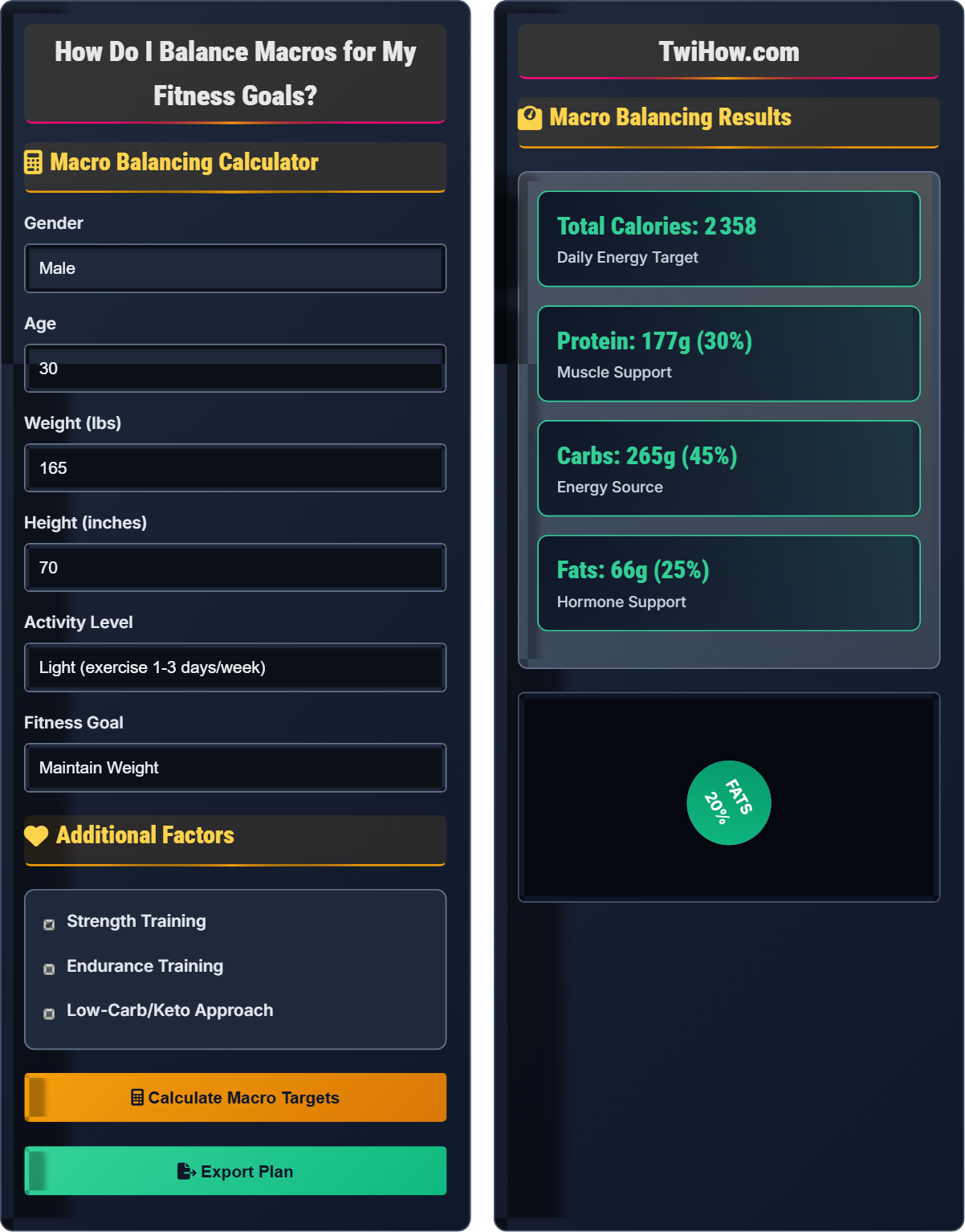
Macro Balancing Results
30%
50%
20%
Daily Macro Targets
Based on your profile, here are your recommended daily targets:
- Protein: 165g (660 calories) - Supports muscle repair and growth
- Carbohydrates: 275g (1,100 calories) - Provides energy for workouts
- Fats: 73g (657 calories) - Supports hormone production and absorption
- Total: 2,200 calories per day
Adjust portions based on hunger, energy levels, and progress toward goals.
Macro-Rich Foods
- Protein Sources: Chicken breast, fish, lean beef, tofu, eggs, Greek yogurt
- Carb Sources: Rice, oats, quinoa, sweet potatoes, fruits, vegetables
- Healthy Fats: Avocados, olive oil, nuts, seeds, fatty fish
Combine foods to meet your macro targets while ensuring micronutrient needs.
Macro Balancing for Fitness Goals
Macronutrients are nutrients your body needs in large amounts. Each macronutrient serves specific functions and provides different amounts of energy:
Protein provides 4 calories per gram and is essential for muscle repair and growth. Carbohydrates also provide 4 calories per gram and serve as the body's primary energy source. Fats provide 9 calories per gram and are crucial for hormone production and nutrient absorption.
The total caloric needs are calculated first, then allocated to macronutrients:
Where:
- BMR: Basal Metabolic Rate (calories at rest)
- Activity Factor: Sedentary (1.2), Light (1.375), Moderate (1.55), Active (1.725), Very Active (1.9)
- Goal Multiplier: Lose (0.85), Maintain (1.0), Gain (1.15)
Typical macro ratios for different goals:
- Weight Loss: 30% Protein, 40% Carbs, 30% Fats
- Muscle Gain: 30% Protein, 45% Carbs, 25% Fats
- Performance: 25% Protein, 50% Carbs, 25% Fats
- Keto: 20% Protein, 5% Carbs, 75% Fats
- General Health: 25% Protein, 45% Carbs, 30% Fats
- Strength Training: Higher protein (1.0-1.2g/lb) and carbs for recovery
- Endurance Training: Higher carbs (5-7g/kg body weight) for fuel
- Weight Loss: Higher protein to preserve muscle, moderate fats
- Muscle Gain: Higher calories overall with adequate protein
Macro Balancing Fundamentals
Protein, carbohydrates, fats, caloric balance, BMR, TDEE, macronutrients.
Total Calories = BMR × Activity Factor × Goal Multiplier
Where BMR is calculated using Mifflin-St Jeor equation.
- Protein should be prioritized in all goals
- Carbs are important for active individuals
- Fats are essential for hormone production
Practical Implementation
Tracking, meal planning, food logging, portion control.
- Calculate daily macro targets
- Plan meals around targets
- Track intake using apps or logs
- Adjust based on progress
- Consistently monitor results
- Adjust for activity level changes
- Track consistently for accuracy
- Allow flexibility for special occasions
Macro Balancing Knowledge Quiz
How many calories does each gram of protein, carbohydrate, and fat provide respectively?
Protein provides 4 calories per gram, carbohydrates provide 4 calories per gram, and fats provide 9 calories per gram. This is a fundamental concept in nutrition that helps calculate total caloric intake from different macronutrients. The higher caloric density of fats (more than double that of protein and carbs) explains why fat intake needs to be carefully monitored.
The answer is A) 4, 4, 9.
Memorizing these caloric values is essential for anyone tracking macros. Understanding that fats are more than twice as calorie-dense as protein and carbs helps explain why small portions of fats can contribute significantly to daily caloric intake.
Calorie: Unit of energy measurement
Gram: Metric unit of mass
Caloric Density: Energy content per unit of weight
• Protein = 4 calories per gram
• Carbs = 4 calories per gram
• Fats = 9 calories per gram
• Remember "4-4-9" for quick recall
• Fats are more calorie-dense than protein/carbs
• Small amounts of fat can add significant calories
• Confusing the caloric values
• Underestimating fat calories
• Overestimating protein requirements
Explain the protein requirements for different fitness goals and the physiological reasons behind these recommendations.
General Health: 0.8g per kg of body weight (0.36g per lb). This meets basic needs for sedentary individuals.
Weight Loss: 1.0-1.2g per lb of body weight. Higher protein helps preserve lean mass during caloric restriction and increases satiety.
Muscle Gain: 0.8-1.0g per lb of body weight. Supports muscle protein synthesis and recovery.
Strength Training: 1.0-1.2g per lb of body weight. Repairs muscle damage from intense training.
Physiological Reasons:
• Protein provides amino acids for muscle repair and growth
• Higher protein increases thermogenesis (calories burned digesting food)
• Protein has the highest satiety value among macros
• Adequate protein prevents muscle loss during dieting
• Muscle protein synthesis requires sufficient amino acids
The protein requirements vary based on activity level and goals because muscle protein synthesis and breakdown rates change with training and dietary conditions. During caloric deficits, higher protein helps preserve muscle mass. During surplus, adequate protein supports muscle growth.
Protein Synthesis: Process of building new proteins
Satiety: Feeling of fullness after eating
Amino Acids: Building blocks of protein
• Higher activity requires more protein
• Dieting requires higher protein percentages
• Aim for 20-30g protein per meal
• Include protein in every meal
• Choose complete protein sources
• Not consuming enough protein when dieting
• Concentrating protein in one meal
• Ignoring protein quality
A 180lb male who lifts weights 4 times per week wants to maintain his weight. He is 6 feet tall and 28 years old. Calculate his daily caloric needs and macro targets assuming a 30% protein, 45% carb, and 25% fat split. Show your work and provide the final macro grams.
Step 1 - Calculate BMR (Mifflin-St Jeor):
BMR = 10 × weight(kg) + 6.25 × height(cm) - 5 × age + 5
Weight: 180 lbs = 81.6 kg
Height: 6 ft = 72 inches = 183 cm
BMR = 10(81.6) + 6.25(183) - 5(28) + 5 = 816 + 1,143.75 - 140 + 5 = 1,824.75 calories
Step 2 - Calculate TDEE:
Activity factor for moderate exercise (4 days/week) = 1.55
TDEE = 1,824.75 × 1.55 = 2,828 calories
Step 3 - Calculate Macros:
Protein: 30% of 2,828 = 848.4 calories ÷ 4 = 212g
Carbs: 45% of 2,828 = 1,272.6 calories ÷ 4 = 318g
Fats: 25% of 2,828 = 707 calories ÷ 9 = 79g
Answer: Daily target of 2,828 calories with 212g protein, 318g carbs, and 79g fats.
This problem demonstrates the multi-step process of calculating macros. First, we calculate the body's baseline energy needs (BMR), then adjust for activity level (TDEE), and finally allocate the total calories among the three macronutrients based on the desired ratios.
BMR: Basal Metabolic Rate - calories at rest
TDEE: Total Daily Energy Expenditure
Mifflin-St Jeor: Equation for calculating BMR
• Use correct activity multiplier
• Convert units properly
• Verify calculations sum correctly
• Round to reasonable numbers
• Use online calculators for verification
• Adjust based on actual results
• Using wrong activity multiplier
• Not converting pounds to kg
• Calculating fat macros incorrectly
An athlete preparing for a competition needs to reduce body fat while preserving muscle mass. They currently weigh 170 lbs and have a TDEE of 2,700 calories. Design a macro plan that creates a 500 calorie deficit while maintaining high protein intake. Explain the rationale for your choices and potential challenges.
Caloric Target: 2,700 - 500 = 2,200 calories per day
Protein Target: 1.0g per lb body weight = 170g (680 calories)
Remaining Calories: 2,200 - 680 = 1,520 calories for carbs and fats
Carb/Fat Split: 50/50 split for flexibility = 760 calories each
Final Macros: 170g protein, 190g carbs, 84g fats
Rationale:
• High protein preserves muscle mass during deficit
• Adequate carbs support training performance
• Sufficient fats maintain hormone levels
Potential Challenges:
• Hunger and cravings during deficit
• Decreased energy for intense training
• Difficulty adhering to strict targets
• Possible metabolic slowdown over time
Regular adjustments may be needed as body weight and metabolism change.
This scenario demonstrates the delicate balance required during contest preparation. The key is maximizing fat loss while minimizing muscle loss, which requires precise macro manipulation and close monitoring of performance and body composition changes.
Deficit: Consuming fewer calories than burned
Preservation: Maintaining lean body mass
Metabolic Adaptation: Body's response to caloric restriction
• Maintain high protein during deficit
• Monitor performance and adjust
• Gradual changes are more sustainable
• Increase non-starchy vegetables for volume
• Plan meals in advance
• Track consistently
• Too aggressive caloric deficit
• Not enough protein
• Ignoring training performance
When is the most important time to consume carbohydrates for someone doing strength training?
Post-workout carbohydrate consumption is most important for strength training because muscles are primed for nutrient uptake after exercise. Glycogen stores are depleted and need replenishment, and insulin release from carbs helps shuttle amino acids into muscles for recovery. The post-workout period (especially within 2 hours) is when the body is most receptive to nutrients for recovery and adaptation.
While carb timing isn't as critical as total daily intake, post-workout timing can optimize recovery and performance.
The answer is B) Post-workout (within 2 hours).
Carb timing takes advantage of the body's enhanced nutrient sensitivity after exercise. During this period, muscle cells are more receptive to glucose uptake and protein synthesis, making it an optimal time for nutrient intake to support recovery and adaptation.
Glycogen: Stored form of carbohydrates in muscles
Insulin: Hormone that helps transport nutrients
Nutrient Timing: Strategic consumption of nutrients
• Post-workout is optimal timing window
• Total daily intake is most important
• Combine carbs with protein for best results
• Include simple carbs post-workout
• Pair with protein for recovery
• Don't neglect other meals
• Skipping post-workout nutrition
• Only focusing on timing, ignoring totals
• Not pairing with protein
FAQ
Q: Should I eat more protein than recommended if I'm trying to build muscle?
A: There's a limit to how much protein the body can utilize for muscle protein synthesis at one time. Research shows that intakes above 1.0-1.2g per lb of body weight don't provide additional muscle-building benefits for most people.
Optimal Protein Distribution:
• Aim for 20-30g of high-quality protein per meal
• Distribute intake evenly across 3-4 meals
• Focus on leucine-rich proteins (whey, casein, eggs)
Why More Isn't Always Better:
• Excess protein may be oxidized for energy
• Can displace other important nutrients
• May increase kidney workload unnecessarily
Higher protein intakes are most beneficial during caloric restriction to preserve muscle mass.
Q: How do my macro needs differ from someone doing strength training?
A: Endurance athletes have different macro requirements:
Carbohydrates:
• Endurance: 6-10g per kg body weight (higher demand)
• Strength: 4-6g per kg body weight (moderate demand)
Protein:
• Endurance: 1.2-1.4g per kg body weight
• Strength: 1.6-2.2g per kg body weight (higher demand)
Fats:
• Both: 20-35% of total calories
Key Differences:
• Endurance athletes rely more heavily on carbohydrates for fuel
• Strength athletes prioritize protein for muscle building
• Endurance athletes may benefit from strategic carb periodization
• Timing becomes more critical for endurance performance
Your total caloric needs are also typically higher due to longer training sessions.