How Do I Eat Mindfully to Improve My Relationship with Food?
Complete mindful eating guide • Step-by-step explanations
Mindful Eating Overview:
Show Mindfulness AssessmentMindful eating is a practice that involves paying full attention to the experience of eating and drinking, both internally and externally. It helps you develop a healthier relationship with food by connecting with your body's natural hunger and fullness cues, appreciating the sensory experience of food, and eating without distraction or judgment.
Mindful eating can help break cycles of emotional eating, overeating, and restrictive dieting while promoting better digestion and overall satisfaction with meals.
Key principles of mindful eating:
- Present Moment Awareness: Focus on the current eating experience
- Non-Judgmental Observation: Notice thoughts and feelings without criticism
- Hunger and Fullness Cues: Listen to your body's natural signals
- Sensory Engagement: Appreciate taste, texture, smell, and appearance
Developing mindful eating habits takes practice but can significantly improve your relationship with food and overall well-being.
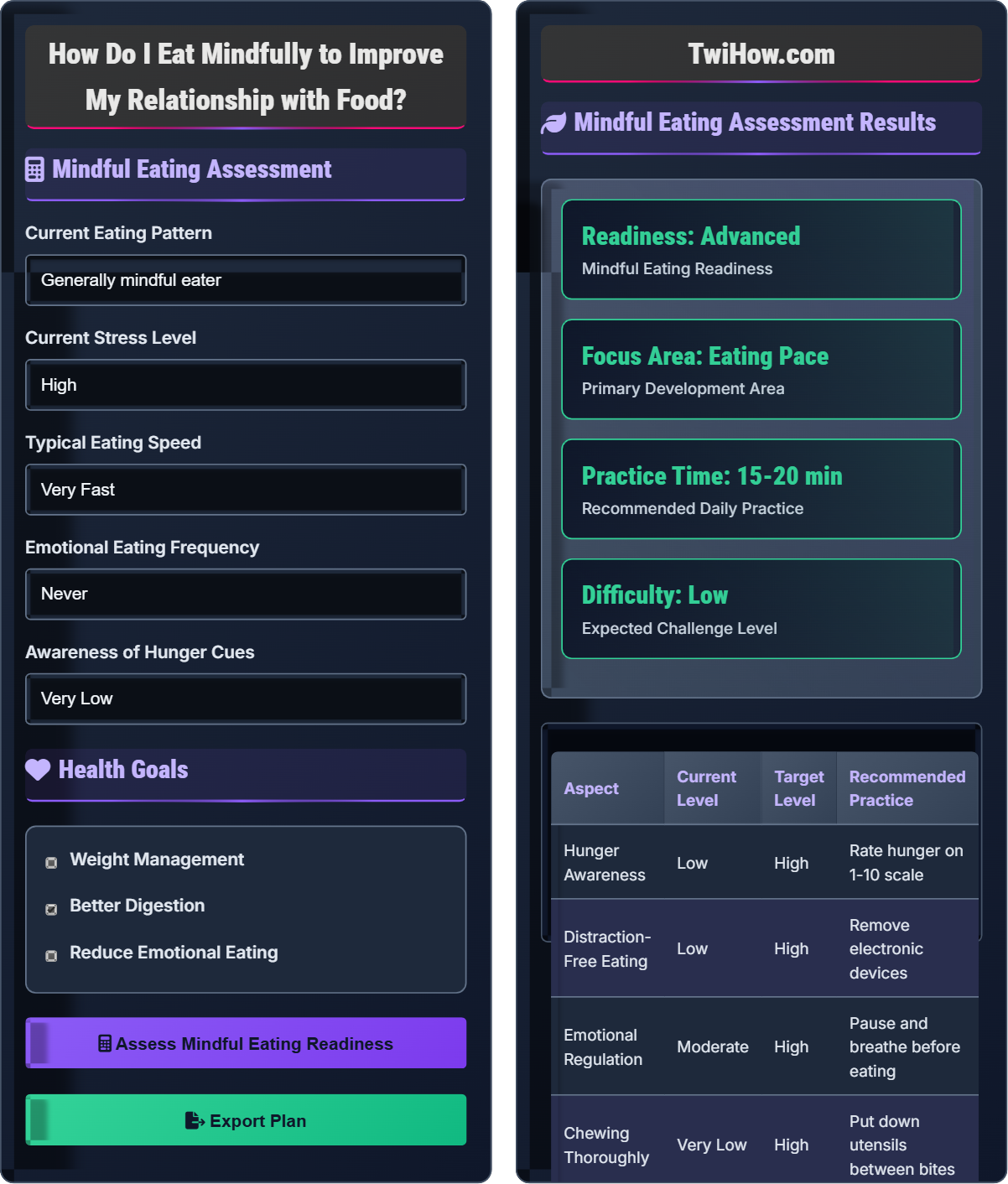
Mindful Eating Assessment
Health Goals
Mindful Eating Assessment Results
| Aspect | Current Level | Target Level | Recommended Practice |
|---|---|---|---|
| Hunger Awareness | Moderate | High | Check hunger scale before meals |
| Distraction-Free Eating | Low | High | Remove electronic devices |
| Emotional Regulation | Moderate | High | Pause and breathe before eating |
| Chewing Thoroughly | Low | High | Count to 20 before swallowing |
Mindful Eating Techniques
Based on your assessment, focus on these techniques:
- Stop and Breathe: Take 3 deep breaths before eating
- Engage Senses: Notice colors, smells, textures, and tastes
- Chew Slowly: Put down utensils between bites
- Remove Distractions: Turn off TV, phones, and other devices
- Check In: Pause mid-meal to assess hunger/fullness
Start with one technique and gradually incorporate others.
Daily Practice Exercises
- Raisin Meditation: Spend 5 minutes examining and eating a raisin mindfully
- Hunger Scale: Rate your hunger from 1-10 before eating
- Five Senses: Identify 5 things you notice about your food
- Gratitude Moment: Express gratitude for your meal before eating
- Pause Practice: Stop halfway through your meal to check in
Practice one exercise daily for 1-2 weeks before adding more.
Mindful Eating Explained
Mindful eating is a practice that involves paying full attention to the experience of eating and drinking, both internally and externally. It's about being present with your food, noticing the colors, smells, textures, flavors, temperatures, and even the sounds of your eating. Mindful eating also involves recognizing your responses to food (likes, dislikes, or neutral reactions) without judgment.
Unlike dieting, which focuses on what and how much to eat, mindful eating focuses on how you eat and your relationship with food. It helps you become more aware of your eating patterns and make conscious choices about what and when to eat.
Mindful eating follows a simple but effective formula:
Where:
- Attention: Focused presence during eating
- Awareness: Recognition of hunger/satiety cues
- Acceptance: Non-judgmental observation of thoughts
- Judgment: Critical evaluation of food choices
Research has demonstrated numerous benefits of mindful eating:
- Improved Digestion: Better chewing and slower eating
- Weight Management: Better recognition of fullness cues
- Reduced Emotional Eating: Increased awareness of triggers
- Enhanced Enjoyment: Greater appreciation of food flavors
- Stress Reduction: Calming effect of focused eating
- Better Blood Sugar Control: Slower eating and portion awareness
- Present Moment Awareness: Focus on the current eating experience
- Non-Judgmental Observation: Notice thoughts without criticism
- Body Wisdom: Listen to natural hunger and satiety signals
- Sensory Engagement: Appreciate taste, texture, and smell
- Emotional Awareness: Recognize emotional triggers for eating
- Gratitude Practice: Appreciate the nourishment provided
Mindful Eating Fundamentals
Present moment awareness, non-judgmental observation, hunger cues, satiety signals, sensory engagement.
Mindful Eating Success = (Attention + Awareness + Acceptance) / Judgment
Where higher values indicate greater mindful eating success.
- Pay attention to hunger and fullness
- Eat without distractions
- Chew slowly and thoroughly
Practical Implementation
Preparation, environmental setup, routine establishment, reflection practices.
- Prepare eating environment (remove distractions)
- Take 3 deep breaths before eating
- Notice food's appearance, smell, and texture
- Take first bite and pause to notice taste
- Put down utensils between bites
- Check in with hunger level mid-meal
- Start with one meal per day
- Be patient with yourself
- Focus on the process, not perfection
Mindful Eating Knowledge Quiz
Which of the following is a core principle of mindful eating?
One of the core principles of mindful eating is eating without distraction and focusing on the experience. This involves removing electronic devices, paying attention to the sensory aspects of food, and being present during the eating experience. Mindful eating is about awareness and attention, not following external rules or restrictions.
The practice emphasizes internal cues (hunger, fullness, satisfaction) rather than external factors like calories or time constraints.
The answer is B) Eating without distraction and focusing on the experience.
This question highlights the fundamental difference between mindful eating and dieting approaches. Mindful eating focuses on the process of eating rather than external outcomes like weight loss or calorie counting. The key is developing awareness of the internal experience during eating.
Mindful Eating: Paying full attention to the eating experience
Distraction-Free: Eating without external interruptions
Present Moment: Focusing on current sensory experience
• Remove electronic devices while eating
• Focus on sensory experience
• Pay attention to internal cues
• Create a calm eating environment
• Take deep breaths before eating
• Put down utensils between bites
• Eating while watching TV or using phone
• Rushing through meals
• Not paying attention to fullness cues
Explain the difference between physical hunger and emotional hunger, and describe how mindful eating can help distinguish between them.
Physical Hunger:
• Develops gradually over time
• Can wait to eat without distress
• Any food seems appealing
• Stops when satisfied
• Accompanied by physical sensations (stomach growling, low energy)
Emotional Hunger:
• Comes on suddenly and urgently
• Cannot wait to eat
• Craves specific comfort foods
• Continues even after eating
• Often accompanied by stress, boredom, or sadness
How Mindful Eating Helps:
• Pausing before eating to check in with the body
• Asking "Am I physically hungry?"
• Identifying the emotion driving the eating
• Using breathing or other techniques to address emotions
• Developing awareness of the difference between physical and emotional cues
By practicing mindfulness, you can learn to recognize these different types of hunger and respond appropriately.
This question addresses one of the most important aspects of mindful eating - recognizing the difference between physical and emotional hunger. Many people struggle with emotional eating because they haven't learned to distinguish between these two types of hunger. Mindful eating provides tools to develop this awareness.
Physical Hunger: Body's natural need for nourishment
Emotional Hunger: Eating in response to emotions
Body Wisdom: Natural ability to regulate eating
• Distinguish between physical and emotional hunger
• Pause before eating when emotional
• Address emotions directly
• Use the hunger scale (1-10) before eating
• Wait 10 minutes when urge to eat emotionally
• Identify the emotion driving the eating
• Not recognizing emotional eating patterns
• Eating to suppress emotions
• Confusing emotional needs with physical hunger
A busy professional eats lunch at their desk while working. They often feel unsatisfied after meals and find themselves snacking throughout the afternoon. Design a mindful eating plan that incorporates their work schedule and addresses their dissatisfaction with meals.
Immediate Changes:
• Take lunch break away from desk (even if just 10 minutes)
• Put phone on silent and close laptop
• Take 3 deep breaths before starting to eat
Meal Preparation:
• Choose foods that are satisfying and nutrient-dense
• Pack lunch in a way that makes it enjoyable to eat
• Include protein and fiber to promote satiety
Mindful Eating Practices:
• Chew each bite 20 times
• Put down fork between bites
• Check in with hunger level halfway through meal
• Notice flavors, textures, and temperatures
Addressing Afternoon Snacking:
• Ensure lunch contains adequate protein and fiber
• If snacking urge arises, pause and assess true hunger
• Choose nutrient-dense snacks when truly hungry
Implementation Strategy:
• Start with one meal per week and gradually increase
• Focus on one practice at a time (like putting down fork)
• Set calendar reminder to practice mindful eating
Answer: Focus on creating a mindful eating environment during lunch breaks, starting with removing distractions and gradually incorporating mindful eating techniques.
This problem demonstrates how to adapt mindful eating practices to real-world constraints. The key is making small, sustainable changes that work within existing routines. The solution shows how to address both the environmental factors (desk eating) and the behavioral patterns (unsatisfying meals).
Satiety: Feeling of fullness and satisfaction
Environment: Physical setting where eating occurs
Implementation: Putting practices into action
• Create distraction-free eating environment
• Focus on one practice at a time
• Make changes sustainable
• Set calendar reminders for mindful eating
• Start with easiest practice first
• Be patient with the process
• Trying to change everything at once
• Not addressing environmental factors
• Expecting immediate results
A parent wants to practice mindful eating during family dinners but struggles with distractions from children and conversation. How can they incorporate mindful eating principles while still engaging with their family?
Modified Mindful Eating Approach:
• Focus on one bite at a time during quieter moments
• Engage in mindful listening during conversations
• Use family meal as opportunity to model healthy eating
Practical Strategies:
• Take a moment to appreciate the meal before eating
• Chew more slowly when possible
• Notice the flavors when you can focus
• Practice gratitude for family time
Teaching Opportunities:
• Involve children in mindful eating practices
• Discuss food's origin and preparation
• Encourage everyone to share what they're grateful for
Alternative Practices:
• Practice mindful eating during solo meals
• Focus on mindful conversation as form of mindfulness
• Appreciate the social nourishment of family time
Long-term Integration:
• Create family traditions around mindful eating
• Designate one meal per week as "mindful meal"
• Balance mindfulness with family connection
Mindful eating doesn't have to mean complete silence - it can include mindful engagement with family.
This question addresses the practical challenge of implementing mindful eating in social contexts. The solution shows how to adapt the principles rather than abandon them entirely. Mindfulness can extend to social interactions, making the family dinner a form of mindful practice in its own right.
Social Nourishment: Emotional and social benefits of shared meals
Adaptation: Modifying practices for real-world situations
Integration: Combining mindfulness with other activities
• Adapt practices to fit your life
• Don't sacrifice family connection
• Balance mindfulness with engagement
• Involve family in mindful eating
• Create special mindful meal traditions
• Focus on quality of interaction
• Believing mindful eating requires silence
• Sacrificing family time for practice
• Not adapting practices to context
Which of the following is the most reliable indicator of satiety (fullness)?
The most reliable indicator of satiety is decreased desire to continue eating. This represents the internal cue that your body has received adequate nourishment. True satiety occurs when your body signals that it's satisfied, which typically manifests as a diminishing interest in continuing to eat.
Feeling completely full often means you've eaten past satiety. Satisfaction with taste doesn't necessarily correlate with physical fullness. An empty plate doesn't indicate internal satisfaction - it might just mean you ate everything available.
Mindful eating emphasizes recognizing the subtle shift from "I want to eat" to "I'm satisfied" before reaching complete fullness.
The answer is C) Decreased desire to continue eating.
This question highlights the importance of recognizing internal satiety cues. Many people have lost touch with these natural signals due to habitual eating patterns. Mindful eating helps restore awareness of the body's natural fullness indicators, which are more reliable than external cues like stomach fullness or an empty plate.
Satiety: State of being satisfied and no longer hungry
Internal Cues: Body's natural signals for hunger/fullnessExternal Cues: Environmental factors influencing eating
• Listen to internal satiety cues
• Stop eating when satisfied, not stuffed
• Recognize diminishing interest in food
• Pause mid-meal to assess satisfaction
• Notice when food starts to taste less appealing
• Use the 80% full rule
• Eating until completely full
• Finishing all food on plate
• Not recognizing satiety cues
FAQ
Q: I tend to eat when I'm stressed or anxious. How can mindful eating help with emotional eating?
A: Mindful eating can be very effective for managing emotional eating:
Pause and Notice:
• When you feel the urge to eat, pause and ask: "Am I physically hungry?"
• Notice the emotion driving the eating urge
• Take 3 deep breaths before deciding whether to eat
Alternative Responses:
• Try other stress-relief activities: walking, deep breathing, calling a friend
• Journal about the emotion instead of eating
• Practice a brief meditation or mindfulness exercise
Mindful Emotional Eating:
If you do choose to eat, do so mindfully - notice the taste, texture, and your emotional state
This creates awareness that can eventually lead to healthier coping strategies.
Remember, the goal is awareness, not perfection. Be kind to yourself as you develop new patterns.
Q: I love food and enjoy eating quickly. Will mindful eating take away the joy of eating?
A: Actually, mindful eating can enhance your enjoyment of food:
Enhanced Flavor:
• Slower eating allows you to fully taste and appreciate flavors
• You notice subtle flavor notes that are missed when eating quickly
• Food becomes more satisfying because you're fully present
Better Digestion:
• Proper chewing improves digestion and reduces discomfort
• You can eat less and feel more satisfied
• No more rushing and feeling guilty about eating
Greater Appreciation:
• Mindful eating helps you appreciate the effort that went into your meal
• You develop a deeper connection with food
• Eating becomes a pleasurable ritual rather than just fuel
Getting Started:
Begin with just one meal per day where you slow down and savor your food. You may find that you actually enjoy food more than ever before!