How to Evaluate Nutrition Advice and Avoid Fads
Complete guide • Step-by-step explanations
Evaluating Nutrition Claims:
Show Nutrition Evaluation ToolThe field of nutrition is filled with conflicting advice, fad diets, and pseudoscience. Learning to evaluate nutrition claims critically is essential for making informed health decisions. Scientific nutrition advice is based on rigorous research, peer review, and reproducible results. Fad diets often promise unrealistic results and lack scientific backing.
Red flags for nutrition fads include promises of rapid weight loss, claims that seem too good to be true, elimination of entire food groups without justification, and reliance on testimonials rather than scientific evidence. Evidence-based nutrition focuses on whole foods, balanced macronutrients, and sustainable practices.
Key evaluation criteria include:
- Source Credibility: Credentials of the person making claims
- Scientific Evidence: Peer-reviewed research supporting claims
- Study Quality: Sample size, methodology, funding sources
- Reproducibility: Results replicated by independent researchers
- Expert Consensus: Agreement among qualified professionals
Developing critical thinking skills for nutrition information helps protect against scams and promotes long-term health.
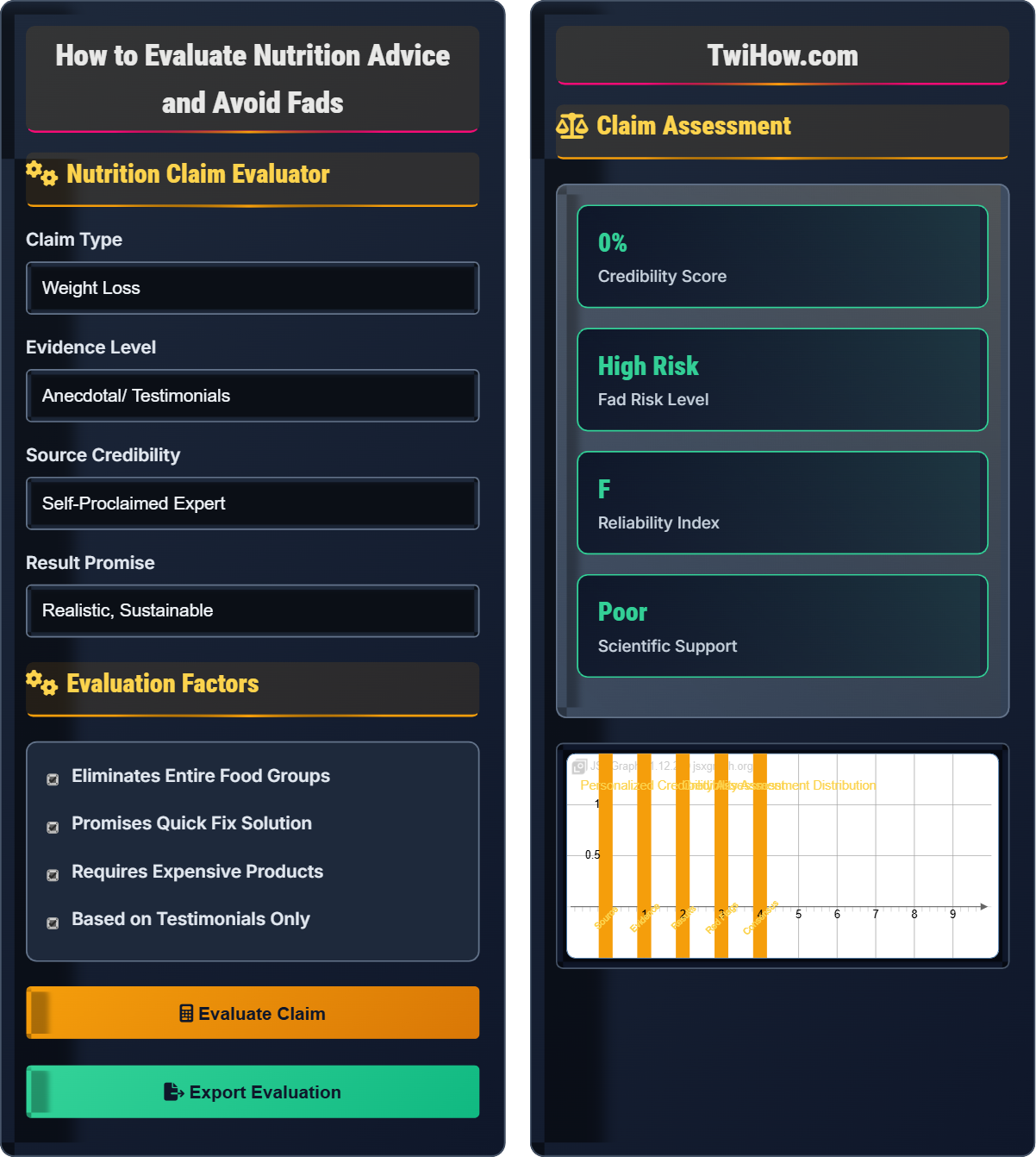
Nutrition Claim Evaluator
Evaluation Factors
Claim Assessment
| Factor | Score | Weight | Impact |
|---|---|---|---|
| Source Credibility | 70% | 25% | Moderate |
| Scientific Evidence | 60% | 30% | High |
| Result Promises | 50% | 20% | High |
| Red Flags | 40% | 25% | High |
| Expert Consensus | 80% | 15% | Moderate |
Evaluating Nutrition Advice Explained
Nutrition science relies on the scientific method to establish evidence-based recommendations. The hierarchy of evidence in nutrition research includes: randomized controlled trials (RCTs), systematic reviews and meta-analyses, observational studies, and mechanistic studies. Understanding this hierarchy helps evaluate the strength of nutrition claims.
Warning signs that indicate unreliable nutrition advice include:
- Miracle Claims: Promises of rapid weight loss or cure-all solutions
- Food Group Elimination: Unjustified removal of entire food categories
- Testimonial-Based: Claims based on personal stories rather than research
- Secret Formulas: Proprietary blends without ingredient disclosure
- Detox/ Cleansing: Claims about removing "toxins" from the body
- Restrictive Diets: Extreme dietary restrictions
Trustworthy sources for nutrition information include:
- Government Agencies: USDA, FDA, CDC dietary guidelines
- Professional Organizations: American Dietetic Association, Academy of Nutrition and Dietetics
- Academic Institutions: Harvard T.H. Chan School of Public Health, Johns Hopkins
- Peer-Reviewed Journals: Journal of Nutrition, American Journal of Clinical Nutrition
- Registered Dietitians: Licensed professionals with nutrition education
- Medical Professionals: Physicians with nutrition training
- Correlation vs. Causation: Understanding that association doesn't prove causation
- Sample Size: Recognizing the importance of adequate study participants
- Study Duration: Considering the length of research studies
- Publication Bias: Acknowledging that positive results are more likely to be published
- Conflict of Interest: Identifying potential financial motivations
- Individual Variability: Recognizing that nutrition needs vary by person
Red Flags & Warning Signs
Miracle claims, secret formulas, testimonial-based evidence, detox promises, restrictive protocols, proprietary blends.
Verify credentials, search databases, check expert consensus, examine funding, look for peer review.
- If it seems too good to be true, it probably is
- Trust science over marketing
- Look for reproducible results
Reliable Information Sources
Government agencies, academic institutions, professional associations, peer-reviewed journals, licensed professionals.
- Cross-reference multiple sources
- Check publication dates
- Verify author credentials
- Look for citations
- Assess study methodology
- Not all published research is high quality
- Conflicts of interest may not be disclosed
- Individual responses to nutrition vary
- New research may contradict old findings
Common Nutrition Fads
Nutrition Evaluation Learning Quiz
Which of the following is NOT a reliable indicator of nutrition pseudoscience?
Peer-reviewed research publications are a sign of legitimate science, not pseudoscience. Peer review is a process where independent experts evaluate research quality before publication. All other options are common red flags for nutrition pseudoscience: rapid weight loss promises, testimonial-based claims, and unjustified food group elimination.
The answer is C) Peer-reviewed research publications.
This question tests the ability to distinguish between legitimate scientific indicators and red flags. It emphasizes the importance of peer review in scientific validation and helps learners recognize trustworthy markers of credible research.
Peer Review: Evaluation of research by independent experts
Pseudoscience: Claims presented as scientific but lacking scientific rigor
Red Flags: Warning signs indicating unreliable information
• Peer review indicates scientific credibility
• Rapid weight loss promises are often unreliable
• Testimonials don't constitute scientific evidence
• Look for peer-reviewed research
• Check for scientific consensus
• Be wary of extreme promises
• Confusing marketing claims with science
• Accepting testimonials as proof
• Not verifying source credentials
Explain the hierarchy of evidence in nutrition research and why it matters for evaluating claims.
Hierarchy of Evidence in Nutrition:
1. Systematic Reviews and Meta-Analyses: Highest level, combine results from multiple studies to provide the most robust evidence.
2. Randomized Controlled Trials (RCTs): Gold standard for testing interventions, randomly assign participants to treatment or control groups.
3. Cohort Studies: Follow large groups over time to observe outcomes, establish temporal relationships.
4. Case-Control Studies: Compare individuals with and without a condition to identify potential risk factors.
5. Cross-Sectional Studies: Snapshot of population at one point in time, cannot establish causation.
6. Case Reports/ Testimonials: Lowest level, individual experiences that cannot establish generalizability.
Why It Matters: Higher-level evidence is more reliable for making health decisions. Understanding this hierarchy helps prioritize the most robust evidence when evaluating nutrition claims.
This question introduces the fundamental concept of evidence hierarchy in nutrition science. Understanding this concept is crucial for making informed decisions and recognizing the relative strength of different types of research evidence.
Randomized Controlled Trial: Study with random assignment to treatment groups
Systematic Review: Comprehensive summary of research on a topic
Meta-Analysis: Statistical combination of results from multiple studies
• Systematic reviews provide strongest evidence
• Testimonials are weakest form of evidence
• Randomization reduces bias in studies
• Prioritize systematic reviews for health decisions
• Be cautious of single studies
• Look for replication of results
• Treating all research equally
• Accepting testimonials as scientific proof
• Not considering study limitations
You come across a social media post claiming that drinking a special green juice every morning will "detox your body and help you lose 20 pounds in 2 weeks." The post includes several before/after photos of people who say they followed the program. How would you evaluate this claim using critical thinking skills?
Evaluation Steps:
1. Source Credibility: Check if the poster has relevant credentials in nutrition or medicine. Social media posts often lack proper credentials.
2. Red Flags: Several warning signs: "detox" claim (body has natural detox systems), rapid weight loss promise (unrealistic), before/after photos (could be manipulated or temporary).
3. Scientific Evidence: Search for peer-reviewed research on the specific juice blend. "Detox" diets lack scientific support.
4. Mechanism: The claim contradicts physiology - the liver, kidneys, and lungs handle detoxification naturally.
5. Expert Consensus: Major health organizations don't recommend detox diets for weight loss.
6. Alternative Explanations: Initial weight loss likely due to water loss and reduced caloric intake, not "detoxification."
Conclusion: This appears to be a nutrition fad lacking scientific support.
This scenario demonstrates how to apply critical evaluation skills to a common social media nutrition claim. It shows how to systematically assess credibility, identify red flags, and verify scientific support.
Detoxification: Natural body process of eliminating waste products
Weight Loss: Reduction in body mass, ideally through caloric deficit
Critical Thinking: Objective analysis and evaluation of information
• Body naturally detoxifies itself
A study claims that a specific brand of probiotics significantly improves digestive health. The study was conducted by the company that manufactures the product. How should this affect your evaluation of the study's credibility?
Conflict of Interest Considerations:
1. Financial Motivation: The company has a financial incentive to produce favorable results, which may bias the study design, interpretation, or reporting.
2. Publication Bias: Companies may be less likely to publish studies with unfavorable results.
3. Methodology Scrutiny: Industry-funded studies should be examined more carefully for methodological flaws.
4. Independent Replication: Look for independent studies that replicate the findings.
5. Transparency: Check if the funding source and potential conflicts were disclosed.
6. Expert Review: Consider if the study was peer-reviewed by independent experts.
Recommendation: View industry-funded studies as preliminary evidence requiring independent replication before accepting conclusions.
This question addresses the important concept of conflict of interest in nutrition research. It demonstrates how financial motivations can influence research outcomes and emphasizes the need for independent verification of industry-sponsored studies.
Conflict of Interest: Financial or personal interest that may compromise objectivity
Publication Bias: Tendency to publish positive results over negative ones
Industry Funding: Research sponsored by companies with commercial interests
• Industry-funded studies require extra scrutiny
• Independent replication is essential
• Disclosure of funding is important
• Look for independent verification
• Check for funding disclosure
• Seek expert consensus
• Accepting industry studies at face value
• Not considering funding sources
• Assuming all published research is unbiased
Which of the following is the LEAST reliable source for nutrition information?
Celebrity endorsements are the least reliable source for nutrition information. Celebrities typically lack formal nutrition education and may be motivated by financial incentives to promote products. Their recommendations are often based on personal experience rather than scientific evidence and may not be applicable to others.
The other options represent more reliable sources: registered dietitians have formal education, research papers undergo peer review, and government guidelines are based on systematic reviews of evidence.
The answer is C) Celebrity endorsement.
This question reinforces the importance of source credibility in nutrition information. It highlights how fame does not equate to expertise and demonstrates the need to verify credentials when evaluating nutrition advice.
Registered Dietitian: Licensed nutrition professional with formal education
Peer Review: Evaluation by independent experts
Celebrity Endorsement: Promotion by famous individuals
• Fame doesn't equal expertise
• Verify professional credentials
• Look for scientific backing
• Check for professional credentials
• Look for references to research
• Seek multiple expert opinions
• Confusing popularity with expertise
• Accepting celebrity advice without verification
• Not checking credentials
FAQ
Q: I saw a video where someone lost 30 pounds in 30 days on a special diet. Why shouldn't I try it?
A: Rapid weight loss claims are almost always unsustainable and potentially dangerous:
1. Water Weight: Initial weight loss is mostly water, not fat
2. Muscle Loss: Extreme diets often cause muscle breakdown
3. Metabolic Damage: Severely restricted calories can slow metabolism
4. Nutrient Deficiencies: Restrictive diets may lack essential nutrients
5. Yo-yo Effect: Weight typically returns quickly after restriction ends
6. Medical Supervision: Unsustainable diets often lack professional oversight
Safe weight loss is 1-2 pounds per week through balanced nutrition and exercise.
Q: How can I tell if a nutrition study is credible when reading about it online?
A: Credible nutrition studies have these characteristics:
1. Published in Peer-Reviewed Journals: Reviewed by independent experts
2. Large Sample Size: Adequate number of participants for statistical validity
3. Control Group: Comparison group receiving standard treatment
4. Blinding: Participants and researchers don't know who receives treatment
5. Statistical Significance: Results unlikely due to chance
6. Replication: Similar results found by other researchers
7. Conflict Disclosure: Funding sources and potential conflicts mentioned
8. Realistic Conclusions: Authors acknowledge study limitations
Be wary of studies that make dramatic claims or lack these elements.