How Do I Incorporate More Vegetables Into My Meals?
Complete vegetable incorporation guide • Step-by-step explanations
Vegetable Incorporation Overview:
Show Meal Planning ToolIncorporating more vegetables into your meals is one of the most impactful changes you can make for your health. Vegetables are rich in vitamins, minerals, antioxidants, and fiber while being low in calories. The key to success is finding sustainable methods that fit your lifestyle, preferences, and cooking skills.
Modern nutrition research emphasizes variety in vegetable consumption, with recommendations for at least 5 servings daily. Different preparation methods can enhance both nutrition and palatability.
Key incorporation strategies:
- Meal Planning: Strategic planning to ensure vegetable availability
- Preparation Methods: Raw, cooked, blended, and mixed approaches
- Recipe Modifications: Adding vegetables to existing favorite dishes
- Convenience Solutions: Frozen, pre-cut, and quick-prep options
Successfully increasing vegetable intake requires a gradual approach that builds sustainable habits.
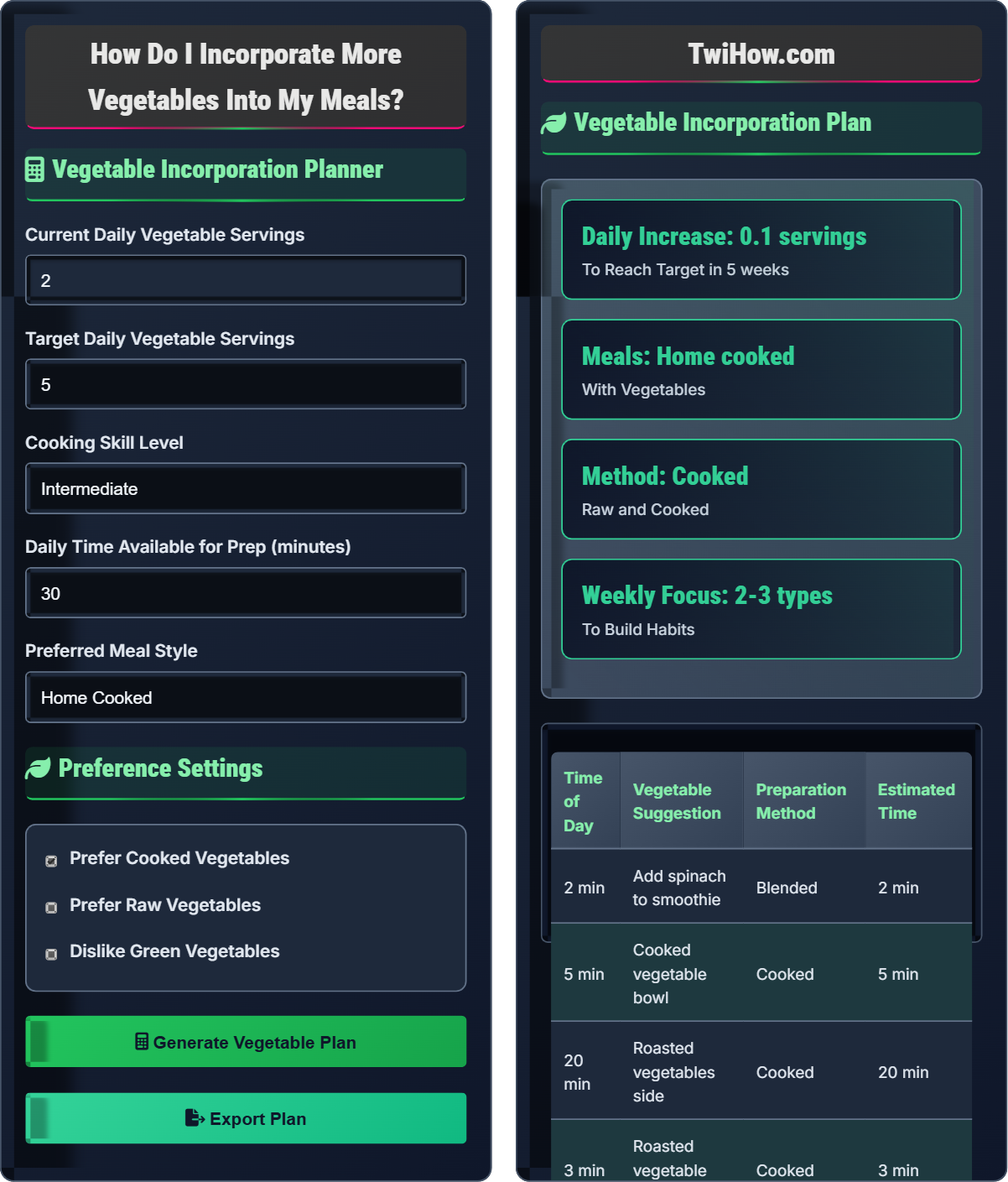
Vegetable Incorporation Planner
Preference Settings
Vegetable Incorporation Plan
| Time of Day | Vegetable Suggestion | Preparation Method | Estimated Time |
|---|---|---|---|
| Breakfast | Add spinach to smoothie | Blended | 2 min |
| Lunch | Salad with mixed greens | Raw | 5 min |
| Dinner | Roasted vegetables side | Cooked | 20 min |
| Snack | Veggie sticks with hummus | Raw | 3 min |
Strategies for Success
Based on your profile, here are the most effective ways to incorporate more vegetables:
- Gradual Increase: Add 1 serving every 3-4 days
- Batch Prep: Wash and cut vegetables weekly
- Hide in Favorites: Blend into sauces, soups, and casseroles
- Make Convenient: Keep frozen and pre-cut options available
Focus on vegetables you already enjoy and gradually expand your repertoire.
Quick Vegetable Recipes
- 5-Minute Veggie Stir Fry: Pre-cut vegetables, oil, soy sauce
- Blender Soups: Steam vegetables and blend with broth
- Sheet Pan Meals: Roast protein and vegetables together
- Smoothie Boosters: Spinach, cucumber, celery
All recipes under 15 minutes preparation time.
How to Incorporate More Vegetables Into Meals
Vegetables are nutritional powerhouses that provide essential vitamins, minerals, antioxidants, and fiber while being low in calories. The recommended daily intake is at least 5 servings (about 2.5 cups) of vegetables for optimal health benefits.
Each vegetable family offers unique nutrients: leafy greens provide folate and iron, orange vegetables offer beta-carotene, cruciferous vegetables contain sulforaphane, and colorful vegetables supply various antioxidants.
Understanding what constitutes a serving helps with meal planning:
Where:
- Raw Leafy: Lettuce, spinach, kale (1 cup = 1 serving)
- Cooked: Broccoli, carrots, peas (1/2 cup = 1 serving)
- Raw Crunchy: Carrots, peppers, tomatoes (1 medium = 1 serving)
- Juice: 100% vegetable juice (1 cup = 1 serving)
Different preparation methods affect both nutrition and palatability:
- Raw: Preserves water-soluble vitamins, adds crunch and texture
- Steaming: Retains most nutrients, preserves color and texture
- Roasting: Enhances flavors, creates appealing textures
- Sautéing: Quick method, allows for flavor additions
- Blending: Makes vegetables easier to consume in larger quantities
- Breakfast: Add vegetables to omelets, smoothies, or grain bowls
- Lunch: Upgrade sandwiches with extra veggies, make veggie-packed salads
- Dinner: Replace half grains with vegetables, try veggie-based pastas
- Snacks: Replace processed snacks with vegetable options
- Hidden: Blend vegetables into sauces, soups, and baked goods
Vegetable Fundamentals
Vegetable servings, nutritional density, preparation methods, seasonal availability.
Vegetable Serving = Volume × Nutritional Density Factor
Where 1 serving = 1 cup raw leafy OR 1/2 cup cooked vegetables.
- Variety is essential for nutrition
- Gradual increases are sustainable
- Prep ahead saves time
Practical Strategies
Meal planning, batch cooking, convenience foods, recipe modification.
- Shop for 2-3 new vegetables weekly
- Prep vegetables Sunday evening
- Try one new preparation method
- Track daily vegetable intake
- Adjust based on enjoyment and feasibility
- Start with familiar favorites
- Make vegetables convenient
- Don't force disliked vegetables
- Focus on positive additions
Vegetable Incorporation Quiz
According to nutrition guidelines, which of the following represents one serving of vegetables?
All of the listed portions represent one serving of vegetables according to standard nutrition guidelines. A serving of vegetables is defined as 1 cup of raw leafy vegetables, 1/2 cup of cooked or canned vegetables, or 1 medium-sized vegetable like a carrot, bell pepper, or tomato. Understanding serving sizes is crucial for meeting daily vegetable intake recommendations.
The answer is D) All of the above.
Vegetable serving sizes vary based on density and water content. Leafy vegetables are voluminous but low in calories, so a full cup counts as one serving. Dense vegetables like broccoli or carrots are more calorically concentrated, so 1/2 cup equals one serving. Medium-sized vegetables like carrots or peppers are naturally portioned to equal one serving. This standardization helps people track their intake accurately.
Serving Size: Standard measurement for comparing food portions
Nutrition Density: Nutrients per calorie content
Daily Value: Recommended amount for optimal health
• 1 serving = 1 cup raw leafy vegetables
• 1 serving = 1/2 cup cooked vegetables
• 1 serving = 1 medium vegetable
• Use measuring cups to learn serving sizes
• Mix raw and cooked vegetables for variety
• Combine different vegetables to reach goals
• Confusing portion sizes
• Not counting leafy greens as vegetables
• Underestimating serving amounts
Explain why gradually increasing vegetable intake is more effective than trying to dramatically increase consumption all at once. Include the psychological and physiological factors that support this approach.
Psychological Factors: Taste preferences are learned behaviors, and sudden dramatic changes in diet can trigger resistance and negative associations. Gradual increases allow taste buds and preferences to adapt without creating aversion. The brain requires time to form new habits, and incremental changes are more likely to become permanent.
Physiological Factors: The digestive system needs time to adjust to increased fiber intake. Rapid increases in vegetable consumption can cause bloating, gas, and digestive discomfort. The gut microbiome also adapts slowly to increased fiber intake.
Behavioral Factors: Sustainable habit formation follows a predictable pattern. Research shows that adding 1-2 servings every few days allows for better integration into routines without overwhelming the individual. This approach reduces the likelihood of reverting to previous habits.
Practical Considerations: Gradual changes are easier to implement and maintain given time constraints and cooking skill levels. It allows for experimentation with preparation methods and identification of preferred vegetables.
This question addresses the fundamental principle of behavior change: gradual, consistent changes are more sustainable than dramatic shifts. The human brain and body adapt better to incremental changes, and this principle applies broadly to nutrition and health behaviors. Understanding the science behind habit formation helps people implement lasting changes.
Habit Formation: Process of turning behavior into automatic routine
Taste Adaptation: Change in taste preferences over time
Behavioral Momentum: Building small wins toward larger goals
• Increase by 1-2 servings every few days
• Allow 2-3 weeks for adaptation
• Focus on consistency over perfection
• Track progress with a simple journal
• Start with vegetables you already enjoy
• Pair new vegetables with familiar foods
• Trying to eat too many vegetables too quickly
• Not giving body time to adapt
• Forcing vegetables you dislike
Sarah currently eats 1.5 servings of vegetables per day and wants to reach the recommended 5 servings daily. She has 20 minutes each evening to prepare vegetables for the next day. Using the 5-day rule (adding 1 serving every 5 days), calculate how many weeks it will take Sarah to reach her goal. Then suggest a weekly preparation plan that fits within her 20-minute constraint and provides vegetables for all meals.
Step 1 - Calculate Total Increase Needed: 5.0 - 1.5 = 3.5 servings
Step 2 - Calculate Timeline: 3.5 servings × 5 days per serving = 17.5 days ≈ 18 days
Step 3 - Convert to Weeks: 18 days ÷ 7 days per week ≈ 2.6 weeks ≈ 3 weeks
Weekly Preparation Plan:
Monday: Wash and chop leafy greens for salads (8 min)
Tuesday: Cut vegetables for stir-fries (7 min)
Wednesday: Prepare vegetable snacks (5 min)
This rotation allows Sarah to gradually increase intake while maintaining manageable prep time. By week 3, she'll reach her goal of 5 servings daily.
Answer: It will take approximately 3 weeks to reach the goal. Weekly prep can be distributed across multiple evenings to stay within the 20-minute constraint.
This problem demonstrates the importance of planning and pacing when making dietary changes. The calculation shows that reaching nutritional goals is achievable with realistic timelines. The preparation plan shows how time management can support dietary goals without overwhelming schedules.
Gradual Increase: Slow, steady progression toward goals
Time Management: Efficient allocation of preparation time
Meal Planning: Organizing meals in advance
• Add 1 serving every 5 days
• Distribute prep time throughout the week
• Plan for variety in vegetables
• Use weekends for bulk preparation
• Invest in quality storage containers
• Pre-cut frozen vegetables save time
• Underestimating preparation time needed
• Not planning for the entire week
• Choosing vegetables that require excessive prep
Your partner dislikes vegetables and claims they "don't taste good." They are willing to try incorporating more vegetables if they don't notice them in their food. Design a strategy that incorporates vegetables into familiar dishes without compromising taste, and explain the nutritional impact of this approach.
Strategy for "Hiding" Vegetables:
1. Smoothies: Blend spinach, cucumber, or avocado into fruit smoothies
2. Sauces: Puree vegetables into pasta sauces, gravies, or dips
3. Ground Meat: Mix finely diced vegetables into meatballs, burgers, or tacos
4. Baked Goods: Add grated vegetables to muffins, breads, or pancakes
5. Soups: Blend vegetables into creamy soups
Nutritional Impact: This approach maintains most nutritional benefits of vegetables while making them palatable. Cooking and blending can make some nutrients more bioavailable. However, some water-soluble vitamins may be lost during processing. The fiber content remains largely intact and provides digestive benefits.
Long-term Considerations: This strategy serves as a bridge to develop acceptance of vegetables in their recognizable form. Over time, the palate adapts and begins to appreciate vegetable flavors.
This approach recognizes that taste preferences can be modified through repeated exposure in palatable forms. The "hiding" strategy reduces neophobia (fear of new foods) and allows for gradual acceptance. The nutritional value remains high even when vegetables are processed, making this an effective transitional approach.
Neophobia: Fear of trying new foods
Bioavailability: Amount of nutrient absorbed by the body
Palatability: Pleasantness of taste and acceptability
• Start with small amounts of hidden vegetables
• Gradually increase over time
• Maintain familiar flavors initially
• Strong-flavored vegetables work best (carrots, sweet potatoes)
• Mix vegetables with favorite ingredients
• Gradually reduce masking ingredients
• Adding too much vegetable content too quickly
• Using bitter vegetables initially
• Not maintaining consistent exposure
Which preparation method best preserves the nutritional value of vegetables while enhancing their flavor?
Steaming is generally the best method for preserving nutritional value while enhancing flavor. It uses minimal water, preventing the loss of water-soluble vitamins like vitamin C and B-complex vitamins. The gentle heat preserves the vegetable's structure and natural flavors while making some nutrients more bioavailable. Steaming also doesn't require added fats, keeping the calorie content low.
Boiling causes significant nutrient loss into the water. Roasting can enhance flavors but may destroy heat-sensitive vitamins. Blending preserves nutrients but changes the texture and satiety properties.
The answer is B) Steaming for 10-15 minutes.
This question highlights the relationship between preparation methods and nutritional outcomes. Different cooking methods affect nutrient retention differently. Water-soluble vitamins are particularly vulnerable to loss during cooking, while fat-soluble vitamins and minerals are more stable. The key is balancing nutrition preservation with palatability to encourage consumption.
Nutrient Retention: Amount of vitamins/minerals preserved during cooking
Bioavailability: Amount of nutrient absorbed by the body
Water-Soluble Vitamins: Vitamins that dissolve in water (C and B vitamins)
• Minimize water contact for water-soluble vitamins
• Use shorter cooking times when possible
• Choose methods that preserve texture and flavor
• Use minimal water when cooking
• Save cooking water for soups or sauces
• Cook vegetables until just tender
• Overcooking vegetables until mushy
• Boiling in excess water
• Not considering nutrient loss during cooking
FAQ
Q: How can I get my kids to eat more vegetables? They refuse to try anything green.
A: Getting children to eat vegetables requires patience and creativity:
Strategies:
1. Lead by example: Children mimic adult eating behaviors
2. Make it fun: Cut vegetables into fun shapes, create faces with vegetables
3. Involve them: Let children help with shopping and preparation
4. Start small: Offer tiny portions without pressure
5. Be persistent: It can take 10+ exposures to a new food before acceptance
Practical Tips:
• Hide vegetables in familiar foods (smoothies, pasta sauce)
• Serve vegetables when children are hungry (not right before dinner)
• Offer choice between two vegetable options
• Avoid battles over food - keep offering without pressure
Remember, it's a gradual process that requires consistency and patience.
Q: I have a very busy schedule. What are the fastest ways to incorporate vegetables into my meals?
A: Busy professionals can incorporate vegetables efficiently with these time-saving strategies:
Preparation:
• Buy pre-washed, pre-cut vegetables
• Keep frozen vegetables on hand (they're just as nutritious)
• Batch prep on Sundays (wash, chop, store in containers)
Quick Additions:
• Add spinach to morning smoothies (blends completely)
• Top toast with sliced tomatoes or avocado
• Pack raw vegetables with hummus as snacks
• Add frozen vegetables to soups, pasta, or rice dishes
Convenience Options:
• Pre-made salads with protein
• Vegetable-based soups and broths
• Vegetable chips or dried vegetables as snacks
Even small additions throughout the day can help you reach your vegetable goals efficiently.