How Do I Manage Food Allergies or Intolerances?
Complete allergy management guide • Step-by-step explanations
Food Allergy Management Overview:
Show Risk AssessmentManaging food allergies and intolerances requires a comprehensive approach that includes identification, avoidance strategies, emergency preparedness, and lifestyle adaptations. Food allergies involve the immune system and can cause severe reactions, while food intolerances affect digestion and typically cause milder symptoms.
Effective management requires understanding the difference between allergies and intolerances, identifying triggers, and implementing preventive measures to avoid accidental exposure.
Key management strategies:
- Identification: Proper diagnosis through testing and symptom tracking
- Label Reading: Careful examination of food ingredients
- Communication: Informing restaurants, schools, and others about allergies
- Emergency Preparedness: Having medication and action plans ready
Successful management requires vigilance, education, and support systems to ensure safety while maintaining quality of life.
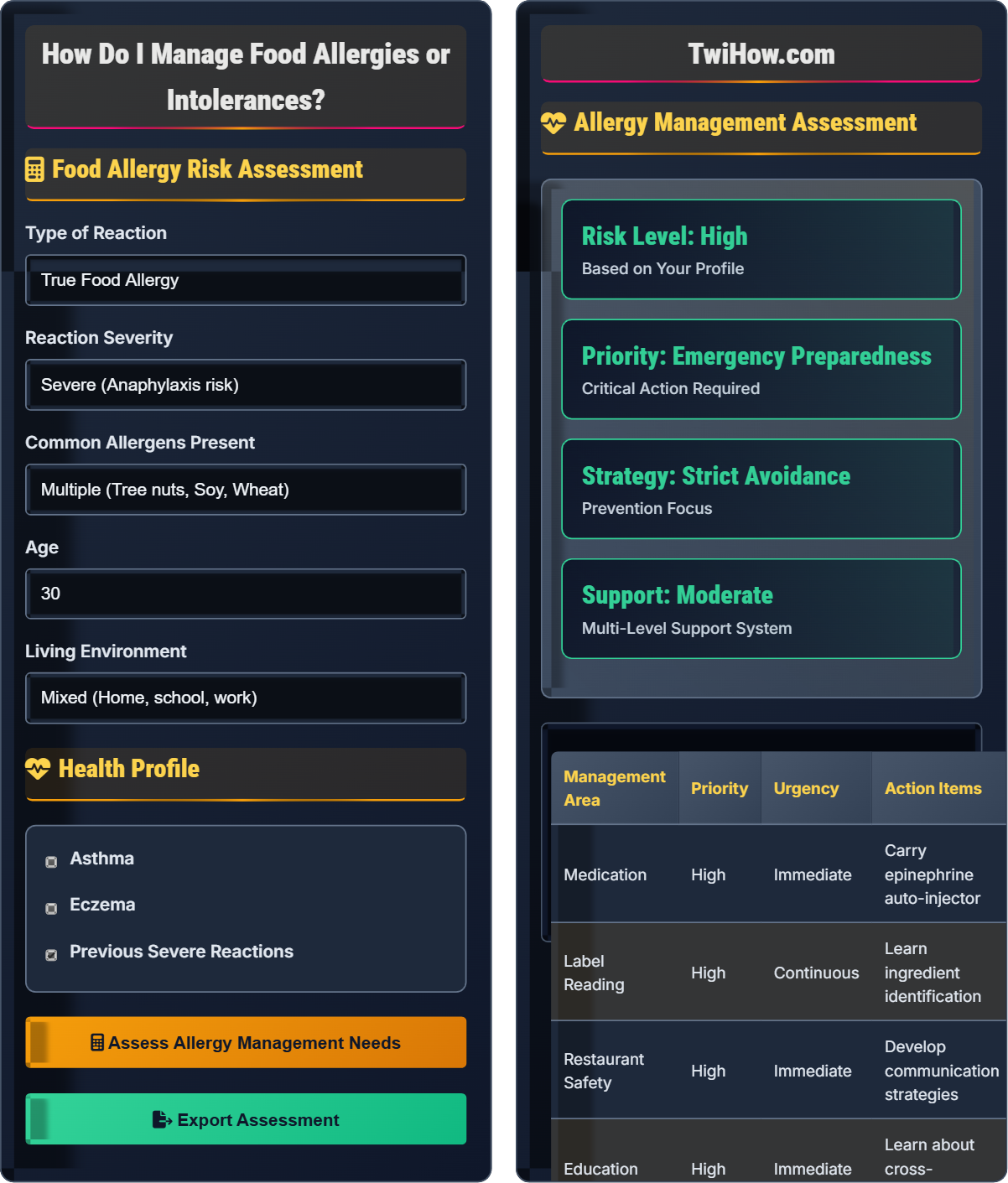
Food Allergy Risk Assessment
Health Profile
Allergy Management Assessment
| Management Area | Priority | Urgency | Action Items |
|---|---|---|---|
| Medication | High | Immediate | Carry epinephrine auto-injector |
| Label Reading | High | Continuous | Learn ingredient identification |
| Restaurant Safety | High | Immediate | Develop communication strategies |
| Education | Medium | Ongoing | Learn about cross-contamination |
Emergency Action Plan
Based on your profile, you need:
- Epinephrine Auto-Injector: Always carry and know how to use
- Emergency Contacts: Provide to schools/workplaces
- Medical Alert Bracelet: Wear at all times
- Symptom Recognition: Know early signs of reaction
Review your plan annually with your allergist.
Avoidance Strategies
- Reading Labels: Check for allergen warnings
- Communication: Tell servers/chefs about allergies
- Home Safety: Separate cooking utensils
- Travel: Pack safe snacks and medications
Always have backup safe options available.
Food Allergy and Intolerance Management
Food allergies and food intolerances are different conditions that are often confused. Food allergies involve the immune system and can be life-threatening, while food intolerances affect digestion and typically cause milder symptoms. Proper identification of your condition is crucial for effective management.
Food allergies trigger an immune response that can affect multiple organs and cause severe reactions. Food intolerances result from the inability to properly digest certain foods, leading to digestive symptoms.
The severity of risk depends on multiple factors:
Where:
- Severity Factor: Mild (1), Moderate (2), Severe (3)
- Exposure Probability: Low (1), Medium (2), High (3)
- Comorbidity Factor: None (1), Asthma/Eczema (1.5), Previous Reactions (2)
The "Big Eight" allergens account for 90% of food allergic reactions:
- Milk: Most common in children, often outgrown
- Eggs: Common childhood allergy, frequently outgrown
- Peanuts: Usually lifelong, can cause severe reactions
- Tree Nuts: Includes almonds, walnuts, cashews, etc.
- Wheat: Contains gluten, causes celiac disease in some
- Soy: Found in many processed foods
- Fish: Usually develops in adulthood
- Shellfish: Crustaceans and mollusks, often lifelong
- Strict Avoidance: Eliminate allergens completely
- Careful Label Reading: Check for allergen warnings
- Emergency Preparedness: Carry medications at all times
- Cross-Contamination Awareness: Prevent contact with allergens
- Communication: Inform others about your allergies
- Safe Alternatives: Identify and stock allergen-free foods
Allergy Management Fundamentals
Food allergies, food intolerances, cross-contamination, emergency protocols, allergen labeling.
Risk Level = Severity × Exposure Probability × Comorbidity Factor
Where values range from 1 (low) to 3 (high) for each factor.
- Never ignore food allergy symptoms
- Always carry emergency medication
- Read labels every time
Practical Implementation
Label reading, kitchen safety, restaurant communication, travel preparation.
- Check food labels before purchase
- Prepare safe meals at home
- Communicate allergies when dining out
- Carry emergency medications
- Have action plan readily available
- Accidental exposure is always possible
- Reactions can vary in severity
- Education is ongoing
Food Allergy Management Quiz
What is the key difference between a food allergy and a food intolerance?
Food allergies involve the immune system and can cause severe, potentially life-threatening reactions. The immune system produces antibodies (IgE) in response to specific proteins in food. Food intolerances affect the digestive system and typically cause uncomfortable symptoms like bloating, gas, or diarrhea, but are not life-threatening.
Food allergies can affect multiple organ systems simultaneously and cause anaphylaxis, while food intolerances primarily affect the digestive tract.
The answer is B) Allergies involve the immune system, intolerances affect digestion.
Understanding the distinction between food allergies and intolerances is crucial for proper management. The immune system involvement in allergies means that even tiny amounts of an allergen can trigger severe reactions. This is why strict avoidance is necessary for food allergies, while people with food intolerances may be able to consume small amounts of problematic foods.
IgE Antibodies: Immunoglobulin E antibodies that trigger allergic reactions
Anaphylaxis: Severe, potentially life-threatening allergic reaction
Cross-Contamination: Transfer of allergens from one food to another
• Food allergies require strict avoidance
• Allergies can cause systemic reactions
• Intolerances primarily affect digestion
• Get tested to confirm suspected allergies
• Learn to read food labels carefully
• Understand the difference in management
• Confusing allergies with intolerances
• Not taking allergies seriously
• Assuming reactions will always be mild
Explain the essential components of an emergency action plan for someone with severe food allergies and describe when and how to use epinephrine.
Essential Components of Emergency Action Plan:
Identify Symptoms: Recognize early signs of allergic reaction including hives, swelling, difficulty breathing, vomiting, or dizziness.
Epinephrine Administration: Use auto-injector immediately at first sign of serious reaction. Epinephrine is the first-line treatment for anaphylaxis.
Emergency Contact: Call 911 immediately after administering epinephrine.
Positioning: Have person lie down with legs elevated unless having trouble breathing.
Second Dose: A second dose may be needed if symptoms persist after 5-15 minutes.
When to Use Epinephrine: Any time there are symptoms affecting breathing, circulation, or multiple body systems. Also consider for gastrointestinal symptoms if the person has had previous severe reactions.
How to Administer: Inject into outer thigh muscle, hold for 3 seconds, massage area for 10 seconds. Do not inject into veins or buttocks.
Emergency preparedness is critical for those with severe food allergies. Epinephrine acts quickly to reverse the symptoms of anaphylaxis by opening airways, constricting blood vessels, and reducing swelling. It's essential to act quickly and not delay administration while waiting to see if symptoms worsen.
Anaphylaxis: Severe, systemic allergic reaction
Epinephrine: Medication that reverses allergic reactions
Auto-injector: Device that delivers epinephrine easily
• Always carry epinephrine
• Use immediately when needed
• Call 911 after administration
• Practice with trainer device
• Keep auto-injectors in accessible locations
• Educate family and friends about use
• Waiting to see if reaction gets worse
• Using antihistamines as first treatment
• Not carrying epinephrine consistently
You have a severe peanut allergy and want to dine at a restaurant. Calculate the risk factors and describe the safest approach to communicate your allergy to restaurant staff. Include what questions you should ask and what accommodations you should request.
Risk Factor Calculation:
Severity Factor: 3 (severe peanut allergy)
Exposure Probability: 2 (restaurants often use nuts in cooking)
Comorbidity Factor: 1 (assuming no other conditions)
Risk Level: 3 × 2 × 1 = 6 (High Risk)
Safest Communication Approach:
Initial Contact: Speak with manager or chef, not just server
Essential Questions:
• Do you use peanuts or peanut oil in any dishes?
• How do you prevent cross-contamination?
• What procedures do you have for handling allergies?
Requested Accommodations:
• Dedicated clean cooking surface and utensils
• Staff member who knows about your order
• Separate preparation area if possible
Answer: Always communicate your allergy clearly, ask specific questions about ingredients and preparation methods, and request dedicated equipment to prevent cross-contamination.
This problem demonstrates the importance of risk assessment and proactive communication in food allergy management. Restaurants pose higher risks due to potential cross-contamination, but with proper communication and precautions, dining out can be done safely. The risk calculation formula helps quantify the danger level and informs decision-making.
Cross-Contamination: Transfer of allergens during food preparation
Risk Assessment: Evaluating potential dangers systematically
Communication Strategy: Planned approach to conveying allergy needs
• Communicate with kitchen staff directly
• Ask specific questions about ingredients
• Request dedicated preparation equipment
• Choose restaurants with allergy policies
• Go during less busy times
• Bring your own safe snacks as backup
• Only telling the server about allergies
• Not asking about preparation methods
• Assuming all kitchens follow safe practices
You have a wheat allergy and live with roommates who frequently bake with wheat flour. Design a comprehensive plan to prevent cross-contamination in your shared kitchen space while maintaining good relationships with your roommates.
Designated Safe Space:
• Claim specific shelves, drawers, and refrigerator sections exclusively for safe foods
• Use colored tape or labels to mark your safe areas
Separate Equipment:
• Have your own toaster, cutting boards, utensils, and cookware
• Store safely away from common areas
Cleaning Protocols:
• Clean shared surfaces with soap and water before preparing safe foods
• Establish a cleaning routine after baking sessions
Roommate Communication:
• Explain the severity of your allergy and the importance of prevention
• Provide resources about cross-contamination for education
Shared Responsibility:
• Ask roommates to wash hands after handling wheat products
• Request notification before baking with wheat flour
Emergency Preparedness:
• Ensure your medications are always accessible
• Inform roommates about your emergency plan
This approach balances safety with respect for shared living arrangements.
This scenario demonstrates how to implement practical cross-contamination prevention strategies in real-life situations. The key is creating physical barriers while maintaining positive relationships through education and communication. Successful cohabitation requires mutual understanding and cooperation.
Cross-Contamination: Transfer of allergens between surfaces or foods
Physical Barriers: Separating safe and unsafe items
Shared Responsibility: Everyone participating in safety measures
• Have dedicated safe equipment
• Clean surfaces thoroughly
• Educate others about risks
• Use sealed containers for safe foods
• Keep a safe food list visible
• Create a buddy system with roommates
• Sharing kitchen equipment
• Not communicating the severity
• Assuming visual cleanliness is sufficient
When reading food labels for allergens, which statement is TRUE?
Under the Food Allergen Labeling and Consumer Protection Act (FALCPA), manufacturers must list all eight major food allergens in plain English on food labels. This includes milk, eggs, fish, shellfish, tree nuts, peanuts, wheat, and soybeans. The allergen must be listed either in the ingredient list or in a "Contains" statement after the ingredients.
"May contain" statements are voluntary warnings about possible cross-contamination and indicate potential risk. Products without proper labeling should not be assumed safe for those with allergies.
The answer is B) Manufacturers must list all eight major allergens in plain language.
Label reading is a critical skill for food allergy management. Understanding regulatory requirements helps consumers make informed decisions. However, regulations don't cover all potential allergens, so vigilance is always necessary. The law specifically requires clear labeling of the Big Eight allergens, but other ingredients may still pose risks.
FALCPA: Food Allergen Labeling and Consumer Protection Act
Major Allergens: Eight foods that cause most allergic reactions
Plain Language: Clear, understandable labeling requirements
• Read labels every time, even for familiar products
• Look for "Contains" statements
• Treat "may contain" as potential risk
• Take photos of labels when shopping
• Contact manufacturers with questions
• Keep a list of safe brands
• Assuming products are safe if allergens aren't listed
• Not checking for "may contain" statements
• Relying on ingredient names alone
FAQ
Q: How can I teach my child with food allergies to advocate for themselves?
A: Teaching children to advocate for themselves is crucial for their safety and independence:
Early Education:
• Teach them to recognize their allergens and symptoms
• Practice saying "I have a food allergy" clearly
• Role-play scenarios at restaurants and parties
Confidence Building:
• Encourage them to ask questions about food preparation
• Teach them to say "no thank you" to offered food
• Practice using their auto-injector with a trainer device
Age-Appropriate Steps:
• Ages 4-6: Identify safe vs. unsafe foods
• Ages 7-10: Communicate with adults about allergies
• Ages 11+: Carry and potentially use medications
Start with simple concepts and gradually increase responsibility as they mature.
Q: How do I manage food allergies in a college dining hall?
A: College dining halls present unique challenges for students with food allergies:
Initial Meeting:
• Meet with dining services director and chef
• Discuss your specific allergies and severity
• Review food preparation processes and cross-contamination protocols
Daily Strategies:
• Identify safe stations and menu items
• Ask staff to check ingredients before serving
• Bring your own safe snacks as backup
Communication:
• Establish a relationship with key dining staff
• Provide written documentation from your allergist
• Consider a 504 plan for academic accommodations
Safety Measures:
• Always carry emergency medications
• Have a roommate aware of your allergies
• Know the location of nearest hospital
Most colleges are accommodating when properly informed about food allergies.