Efficient Meal Prep Mastery
Complete nutrition guide • Step-by-step explanations
Meal Prep Essentials:
Show Meal Prep PlannerEfficient meal prep is the practice of planning, preparing, and organizing meals in advance to save time, reduce stress, and improve nutrition. It involves batch cooking, strategic planning, and smart storage to ensure you have healthy meals ready throughout the week without daily cooking.
Successful meal prep requires understanding your schedule, preferences, and nutritional needs while implementing time-saving techniques and organizational strategies. The key is creating a sustainable system that fits your lifestyle and doesn't feel overwhelming.
Core principles:
- Planning: Organizing meals and shopping lists in advance
- Batch Cooking: Preparing large quantities of basic components
- Assembly: Combining prepared elements into complete meals
- Storage: Proper preservation to maintain quality and safety
Effective meal prep can save 10+ hours per week while ensuring consistent nutrition and reducing food waste.
Meal Prep Calculator
Prep Options
Prep Analysis
| Recipe | Prep Time | Protein (g) | Calories |
|---|---|---|---|
| Quinoa Protein Bowl | 20 min | 25g | 450 |
| Chicken Stir Fry | 25 min | 30g | 500 |
| Salmon with Rice | 30 min | 35g | 550 |
| Egg Muffins | 35 min | 20g | 300 |
Understanding Meal Preparation
Meal prep is the practice of preparing meals or meal components in advance to streamline daily eating. It involves planning, shopping, cooking, and storing food to ensure consistent nutrition while saving time and reducing decision fatigue throughout the week.
- Planning: Deciding what to eat and when
- Shopping: Buying ingredients efficiently
- Cooking: Batch preparation of proteins, grains, and vegetables
- Storing: Proper preservation to maintain quality
- Assembling: Combining components into complete meals
Effective meal prep creates a sustainable system that supports your health goals while fitting into your lifestyle.
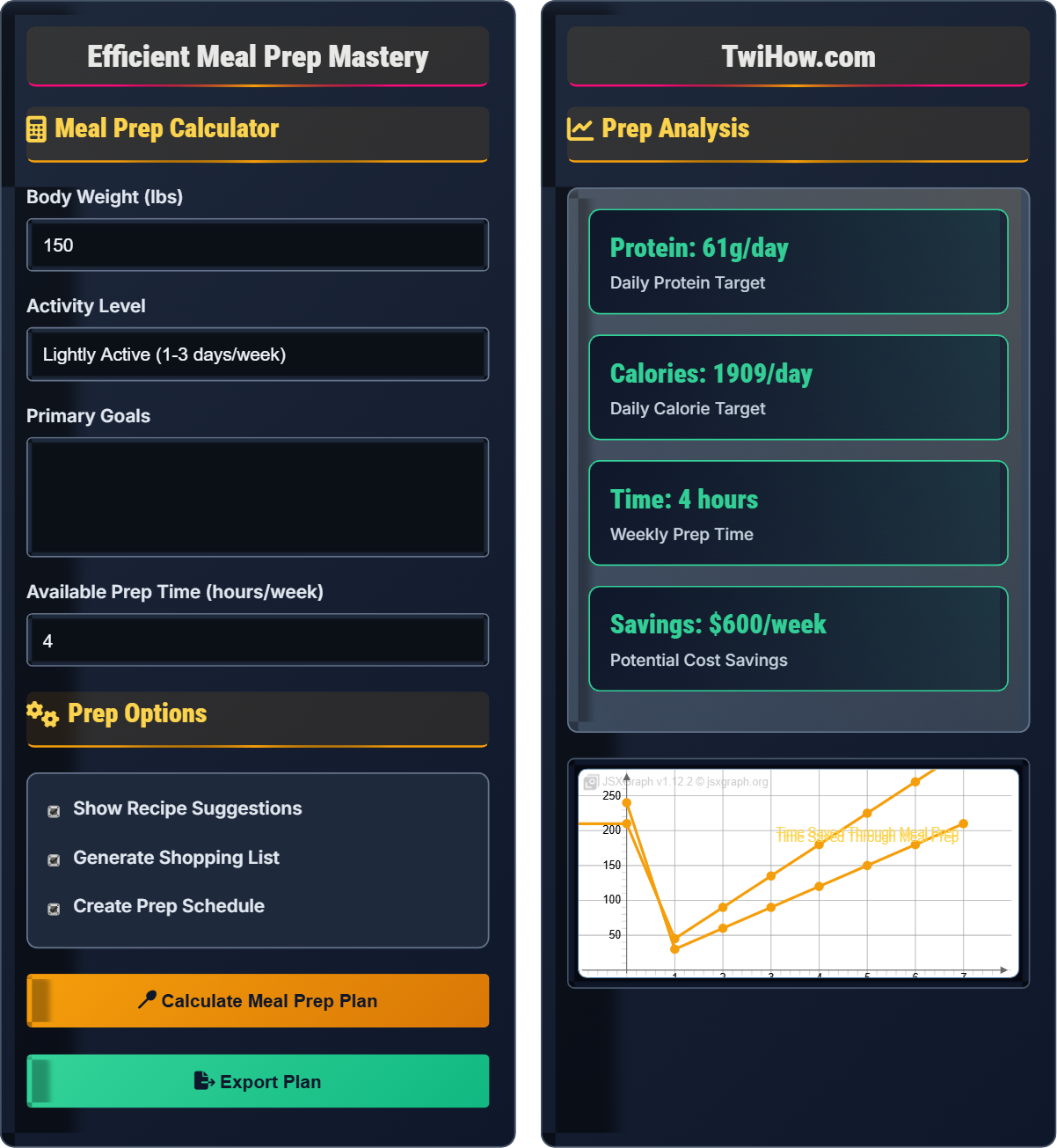
The efficiency of meal prep follows this equation:
Where:
- Daily Cooking Time: Average time spent cooking per day without prep
- Days: Number of days in the planning period
- Prep Time: Time spent on batch preparation
- Assembly Time: Time to combine components
- Time Saved: Net time saved through meal prep
Meal prep applies across multiple lifestyle contexts:
- Busy Professionals: Saving time during work weeks
- Students: Managing limited kitchen access and budget
- Families: Coordinating multiple schedules and preferences
- Athletes: Meeting high protein and calorie needs
- Health Goals: Maintaining consistent nutrition
- Budget Conscious: Reducing food waste and costs
- Batch Cooking: Preparing large quantities of basic components
- Component Method: Cooking proteins, grains, and vegetables separately
- Assembly Method: Preparing complete meals in containers
- Freezer Prep: Preparing meals for freezing and reheating
- One-Pot Meals: Simplifying preparation and cleanup
- Leftover Integration: Planning for repurposing leftovers
Prep Planning Framework
Menu, recipes, shopping
Ingredients, supplies
Cooking, portioning
Containers, organization
Nutritional Guidelines
0.8-2.2g per kg body weight depending on activity level and goals.
Protein Target (g) = Body Weight (kg) × Activity Factor × Goal Multiplier
Where Activity Factor ranges from 0.8 for sedentary to 2.2 for athletes.
- Spread protein across 3-4 meals
- Include complete proteins when possible
- Combine with resistance training
Time Management Strategies
Batch cooking, one-pot meals, slow cooker, instant pot, freezer meals.
- Planning: 15-30 minutes
- Shopping: 45-60 minutes
- Prep Day: 2-4 hours
- Daily Assembly: 5-10 minutes
- Refrigerate within 2 hours
- Use airtight containers
- Label with dates
- Follow FIFO (first in, first out)
Meal Prep Approaches Overview
Focus on recipes that can be prepared quickly while maximizing nutritional value. Emphasize one-pot meals, sheet pan cooking, and slow cooker recipes.
Systematic approach to menu planning that considers nutrition, variety, and time constraints. Focus on recipes that share common ingredients.
Proper food storage techniques to maintain quality, safety, and nutritional value. Includes container selection and organization systems.
Meal Prep Learning Quiz
What is the most effective approach to distributing protein throughout the day?
Research shows that spreading protein intake across multiple meals (3-4 meals with 25-30g each) maximizes muscle protein synthesis throughout the day. This approach allows for better absorption and utilization compared to consuming all protein in one large meal.
The answer is B) Spread protein evenly across 3-4 meals.
The body can only utilize a limited amount of protein at once for muscle synthesis (approximately 25-30g per meal). Excess protein beyond this threshold is either oxidized or converted to fat. By distributing protein intake throughout the day, you maintain a consistent supply of amino acids for muscle maintenance and repair, which is especially important for active individuals.
Muscle protein synthesis: Process of building muscle proteins
Amino acids: Building blocks of protein
Maximal response: Point of diminishing returns
• Aim for 25-30g protein per meal
• Include protein at each meal
• Consider activity timing
• Plan protein-rich breakfast
• Include snacks with protein
• Combine plant proteins for completeness
• Front-loading protein at dinner
• Skipping protein at breakfast
• Not accounting for absorption limits
Explain the "component method" of meal prep and describe why it's considered more efficient than preparing complete meals.
Component method: Preparing proteins, grains, and vegetables separately in large batches, then combining them in different ways throughout the week.
Efficiency advantages: 1) One batch of grilled chicken can be used in salads, wraps, stir-fries, and soups, 2) Cooked quinoa can be mixed with different vegetables and proteins, 3) Reduces overall cooking time by maximizing simultaneous preparation.
Flexibility: Allows for variety while maintaining efficiency. Instead of preparing 7 different complete meals, you prepare 3-4 components that can be combined in multiple ways.
The component method leverages the principle of modular design applied to cooking. By creating versatile base components, you multiply your meal possibilities without increasing prep time proportionally. This approach reduces monotony while maintaining the efficiency benefits of batch cooking. It's particularly effective for families with different preferences.
Batch cooking: Preparing large quantities at once
Modular design: Creating flexible, combinable parts
Repurposing: Using components in multiple contexts
• Prepare neutral-flavored bases
• Store components separately
• Plan for variety in combinations
• Season components minimally
• Use different sauces for variety
• Prepare a variety of textures
• Over-seasoning components
• Not storing properly
• Forgetting about variety
You're a working parent with 30 minutes available for daily meal prep during the week. You need to feed a family of four (including two teenagers) with varying schedules. Design a meal prep strategy that maximizes efficiency while meeting everyone's needs.
Sunday prep: Dedicate 3-4 hours to batch cook proteins (roasted chicken, ground turkey), grains (quinoa, rice), and vegetables (roasted vegetables, steamed broccoli).
Storage: Portion proteins and grains into containers. Keep vegetables separate to maintain texture.
Daily assembly: Spend 10 minutes each morning assembling lunches and 20 minutes in evening combining components into complete meals.
Flexibility: Prepare versatile components that can be assembled differently (e.g., chicken for salads, wraps, or stir-fries).
This strategy exemplifies the principle of "time shifting" - investing concentrated time on weekends to save distributed time during the week. The key is creating a system that accommodates different schedules and preferences while maintaining consistency in nutrition. The component method allows for customization while maintaining efficiency.
Time shifting: Concentrating work in one period
System design: Creating sustainable processes
Customization: Adapting to individual preferences
• Invest time upfront
• Plan for individual preferences
• Maintain flexibility
• Involve family in prep day
• Prepare grab-and-go options
• Keep simple backup options
• Not accounting for family preferences
• Overcomplicating the system
• Not having backup plans
You're on a tight budget but want to meal prep to save money. Analyze the cost-effectiveness of different protein sources and create a strategy that maximizes nutrition while minimizing expenses.
Most economical proteins: Beans/lentils ($0.50/serving), eggs ($0.75/serving), chicken thighs ($1.00/serving), canned fish ($1.25/serving).
Cost-saving strategies: Buy in bulk, choose seasonal produce, purchase generic brands, cook from scratch rather than buying prepared foods.
Weekly strategy: Center meals around economical proteins, add vegetables and grains for bulk and nutrition, prepare large batches to maximize efficiency.
Expected savings: 30-50% compared to restaurant or takeout meals.
Meal prep is particularly cost-effective because it eliminates impulse purchases and reduces food waste. Economical proteins like legumes offer excellent nutritional value while being significantly cheaper than meat. The key is balancing cost with nutritional density and palatability to ensure the plan is sustainable.
Nutritional density: Nutrients per dollar
Food waste: Unused food that's discarded
Impulse purchases: Unplanned buying decisions
• Plan before shopping
• Choose economical proteins
• Buy in bulk when possible
• Shop sales and stock up
• Freeze for later use
• Use discount stores
• Not considering storage limitations
• Buying expensive items
• Not accounting for spoilage
What is the maximum safe storage time for cooked meals in the refrigerator?
Cooked meals are generally safe for 3-4 days in the refrigerator. After this time, bacterial growth increases the risk of foodborne illness. For longer storage, freezing is recommended. This timeframe ensures both safety and optimal quality.
The answer is A) 3-4 days.
Food safety is critical in meal prep. The "danger zone" for bacterial growth is between 40°F and 140°F, and refrigeration only slows growth rather than stopping it. The 3-4 day rule provides a safety buffer while maintaining food quality. For longer-term storage, freezing extends the safe period to 2-6 months depending on the food.
Danger zone: Temperature range for bacterial growth
Foodborne illness: Illness from contaminated food
Shelf life: Safe consumption period
• Follow the 3-4 day rule
• Cool food quickly
• Label with dates
• Use shallow containers for faster cooling
• Place hot food in ice bath
• Follow FIFO method
• Not following storage guidelines
• Not cooling food properly
• Not labeling containers
FAQ
Q: How can I meal prep effectively with a very busy schedule and no time on weekends?
A: Try micro-prep strategies:
1. One-pot meals: Cook entire meals in single pots/pans for easy cleanup
2. Slow cooker: Set ingredients in the morning, dinner ready by evening
3. Freezer meals: Prepare and freeze individual portions in advance
4. Batch cooking: Cook large quantities on the few days you have time
5. Simple recipes: Focus on 15-20 minute meals that require minimal prep
6. Pre-cut vegetables: Buy pre-cut produce to save time on prep
Even 30 minutes of daily cooking can be more manageable than one long prep session.
Q: What are the best budget-friendly meal prep options for students?
A: Budget-friendly meal prep focuses on economical staples:
Proteins: Beans, lentils, eggs, canned fish, chicken thighs (cheaper than breasts)
Grains: Rice, oats, pasta, quinoa (buy in bulk)
Vegetables: Frozen vegetables, seasonal fresh produce, root vegetables
Recipes: One-pot meals, casseroles, stir-fries with rice
Shopping tips: Buy generic brands, shop sales, buy in bulk when possible
Example meal: Rice and beans with vegetables costs less than $1 per serving while providing complete nutrition.