Benefits of Cooking at Home vs Eating Out
Complete guide • Step-by-step explanations
Home vs Restaurant Cooking:
Show Cost & Nutrition CalculatorCooking at home offers numerous advantages over eating out, including greater control over ingredients, nutritional content, and food safety. Home cooking allows for customization based on dietary needs, significant cost savings, and the opportunity to develop culinary skills. However, eating out provides convenience, variety, and social experiences that can be valuable for busy lifestyles.
Research consistently shows that home-cooked meals are healthier, containing fewer calories, less sodium, and more nutrients than restaurant meals. The average restaurant meal contains 1,327 calories compared to 650 calories for home-prepared meals.
Key advantages of home cooking include:
- Healthier Ingredients: Full control over what goes into your food
- Cost Savings: Up to 80% less expensive than restaurant meals
- Nutritional Control: Ability to adjust portions and ingredients
- Food Safety: Direct oversight of preparation practices
- Family Bonding: Opportunity for shared cooking experiences
Successful home cooking balances these benefits with the convenience of occasional dining out.
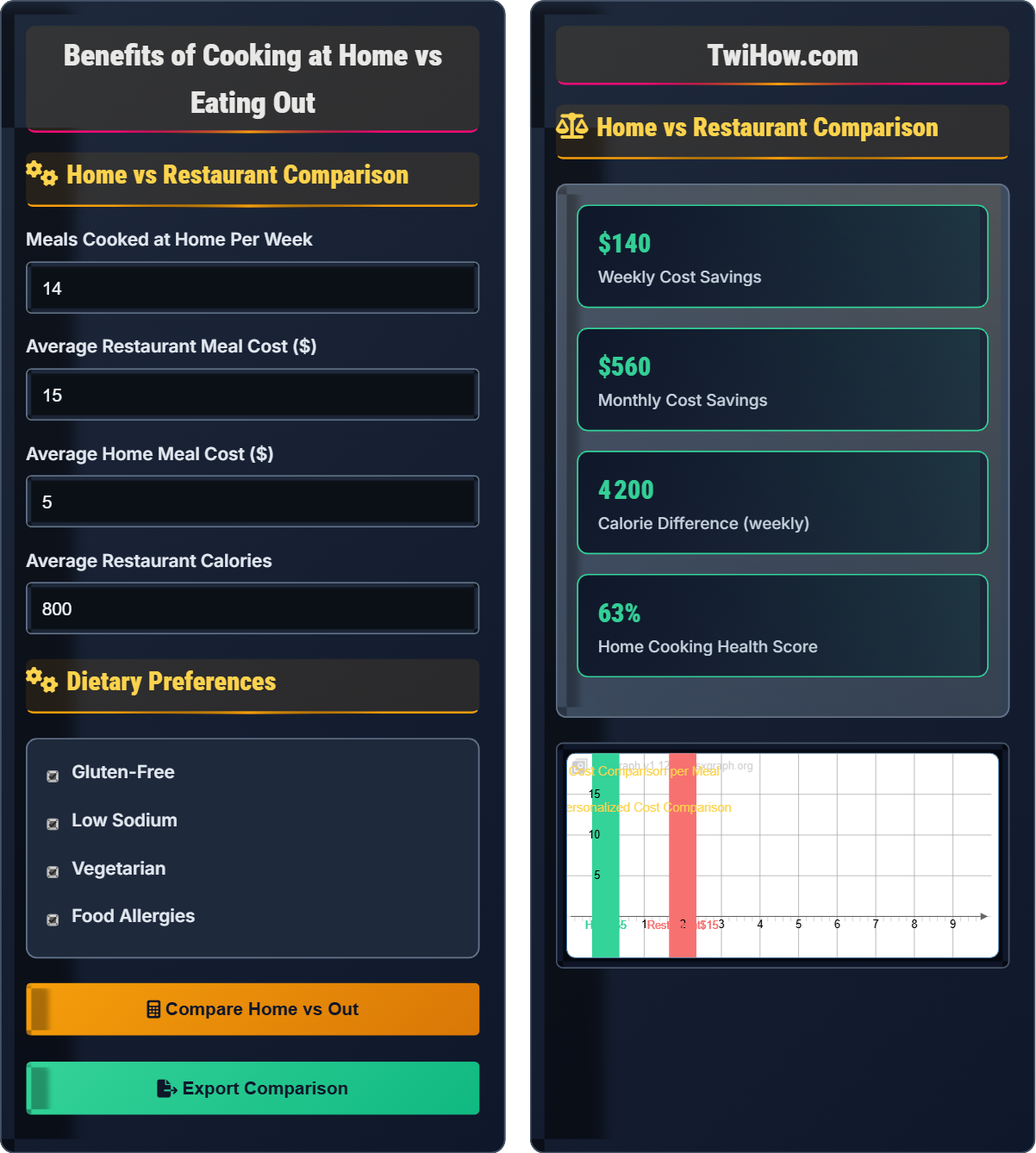
Home vs Restaurant Comparison
Dietary Preferences
Home vs Restaurant Comparison
| Aspect | Home Cooking | Eating Out | Advantage |
|---|---|---|---|
| Cost | $5 | $15 | Home |
| Calories | 500 | 800 | Home |
| Sodium | 600mg | 1500mg | Home |
| Ingredients Control | Full | Limited | Home |
| Convenience | Moderate | High | Out |
Home vs Restaurant Cooking Explained
Research consistently shows that home-cooked meals are significantly healthier than restaurant meals. Home cooks consume fewer calories, less sodium, and more vegetables. The average restaurant meal contains 1,327 calories, while home-prepared meals average 650 calories. Home cooking allows for precise control over ingredients, enabling healthier substitutions and portion sizes.
The financial benefits of home cooking are substantial:
- Home Cooking: $4-8 per meal
- Fast Food: $8-15 per meal
- Restaurant: $15-30 per meal
- Monthly Savings: Up to $1,200 by cooking 14 meals weekly
Home-cooked meals typically contain:
- 30% fewer calories than restaurant meals
- 40% less sodium than restaurant meals
- More vegetables and fiber than restaurant meals
- Higher micronutrient density due to fresh ingredients
- Better portion control to match caloric needs
- Customizable nutrition based on dietary needs
- Strategic Eating Out: Reserve restaurant meals for special occasions
- Quick Home Options: Develop 15-minute meal recipes
- Meal Prep: Dedicate 1-2 hours weekly to food preparation
- Delivery Services: Consider healthy meal kit delivery
- Hybrid Approach: Cook proteins at home, buy prepared sides
- Seasonal Adjustments: Adapt frequency based on schedule demands
Health Benefits
Lower calories, reduced sodium, increased fiber, better nutrient density, improved portion control, customizable ingredients.
Home cooking allows substitution of healthier ingredients, adjustment of portion sizes, and avoidance of allergens.
- Home meals average 30% fewer calories
- Restaurant meals contain 40% more sodium
- Home cooking enables dietary customization
Cost Analysis
Significant savings through ingredient purchasing, reduced markups, and bulk preparation.
- Buy ingredients in bulk
- Plan meals around sales
- Use seasonal produce
- Prepare meals in batches
- Grow herbs and vegetables
- Initial investment in equipment
- Time investment for preparation
- Food waste reduction important
- Quality ingredients cost more
Home vs Restaurant Comparison
- Full ingredient control
- Lower cost per meal
- Better nutritional value
- Food safety oversight
- Dietary customization
- Convenience and time-saving
- Professional preparation
- Variety and specialty dishes
- Social dining experience
- No cleanup required
Home vs Restaurant Learning Quiz
According to research, how many more calories does the average restaurant meal contain compared to a home-prepared meal?
Studies show that the average restaurant meal contains approximately 1,327 calories, while home-prepared meals average about 650 calories. This means restaurant meals contain about 677 more calories on average. The difference is primarily due to larger portions and cooking methods that use more oil, butter, and other high-calorie ingredients.
The answer is C) 600-700 calories.
This question highlights the significant caloric difference between home and restaurant meals. Understanding portion sizes and caloric density is crucial for making informed dietary decisions. The comparison demonstrates how cooking at home naturally leads to lower caloric intake.
Caloric Density: Calories per gram of food
Portion Distortion: Larger-than-normal serving sizes
Restaurant Calorie Counts: Average calories per meal
• Restaurant meals average 1,327 calories
• Home meals average 650 calories
• Portion sizes in restaurants are typically larger
• Check nutrition information when dining out
• Share large portions with companions
• Request dressings and sauces on the side
• Underestimating restaurant portion sizes
• Not accounting for hidden calories in sauces
• Assuming "healthy" menu items are low calorie
Calculate the annual cost difference between eating out and cooking at home, assuming someone eats 21 meals per week. Assume restaurant meals average $15 each and home meals cost $5 each. Explain the financial implications.
Weekly Cost Calculation:
Restaurant: 21 meals × $15 = $315
Home: 21 meals × $5 = $105
Weekly difference: $315 - $105 = $210
Annual Cost Difference: $210 × 52 weeks = $10,920
Financial Implications: Cooking at home instead of eating out could save over $10,000 annually. This represents a significant amount that could be invested, saved, or used for other purposes. The savings are even more pronounced for families or those who eat out more frequently.
Additional considerations include reduced fuel costs for dining out and potential health benefits that could reduce medical expenses.
This question demonstrates the substantial financial benefits of home cooking through concrete calculations. The exercise shows how seemingly small differences in meal costs can accumulate to significant annual savings, emphasizing the importance of financial literacy in food choices.
Markup: Price increase from cost to selling price
Opportunity Cost: Value of alternative uses of money spent
Compound Savings: Accumulated savings over time
• Restaurant meals cost 2-3x more than home equivalents
• Annual savings can be substantial
• Additional costs include transportation
• Track actual meal costs to see real savings
• Factor in time value when calculating benefits
• Consider bulk buying for additional savings
• Not accounting for all restaurant costs (tax, tip, parking)
• Overlooking food waste in home cooking
• Ignoring time investment in calculations
Sarah has celiac disease and follows a strict gluten-free diet. She often struggles to find safe options when eating out. How does cooking at home benefit her dietary needs, and what challenges might she face compared to someone without dietary restrictions?
Benefits of Home Cooking for Sarah:
1. Complete Ingredient Control: Sarah can ensure no cross-contamination with gluten-containing ingredients. She knows exactly what goes into every meal.
2. Reliable Food Safety: At home, she controls all utensils, surfaces, and cooking methods, eliminating risk of cross-contamination.
3. Cost-Effective: Gluten-free specialty foods are expensive, but Sarah can buy ingredients in bulk and prepare meals economically.
4. Greater Variety: She can prepare any recipe using gluten-free substitutes without relying on limited restaurant options.
Challenges Compared to Others:
1. Ingredient Costs: Gluten-free products are 2-3x more expensive than regular ingredients.
2. Extra Precautions: Must maintain dedicated gluten-free cooking areas and utensils.
3. Recipe Adaptation: Requires more effort to modify traditional recipes.
4. Shopping Complexity: Must carefully read labels and shop for specialty ingredients.
This scenario demonstrates how home cooking is especially beneficial for those with dietary restrictions. It shows how the control and customization possible at home can address specific health needs that restaurants may not accommodate effectively.
Cross-Contamination: Transfer of allergens from one food to another
Dietary Restrictions: Specific food limitations due to health reasons
Specialty Foods: Products for specific dietary needs
• Home cooking offers complete dietary control
Mark works long hours and feels he doesn't have time to cook at home. He eats out 20+ times per week. What strategies could help him incorporate home cooking while respecting his time constraints?
Time-Efficient Strategies:
1. Meal Prep: Spend 2-3 hours Sunday preparing 4-5 quick meals for the week. Cook proteins in bulk and prepare simple components.
2. One-Pot Meals: Focus on recipes that require minimal cleanup and combine protein, carbs, and vegetables in one dish.
3. Slow Cooker/Instant Pot: Use appliances that require minimal hands-on time while cooking nutritious meals.
4. Batch Cooking: Prepare large quantities of basic components (rice, beans, roasted vegetables) to mix and match throughout the week.
5. Quick Meal Templates: Develop 3-5 simple meal formulas that can be rotated with different ingredients.
6. Strategic Shopping: Order groceries online or shop once weekly with a detailed list to minimize time spent shopping.
7. Partial Home Cooking: Cook proteins at home but purchase prepared sides or salads to reduce overall preparation time.
This question addresses one of the most common barriers to home cooking: time constraints. It demonstrates that with proper planning and efficient strategies, home cooking can be integrated into busy lifestyles while providing significant benefits.
Meal Prep: Preparing meals in advance for later consumption
Batch Cooking: Preparing large quantities at once
Time Efficiency: Maximizing results while minimizing time spent
• Preparation time can be consolidated
• Efficient cooking methods save time
• Planning reduces decision fatigue
• Invest in quality knives to speed up prep
• Keep a repertoire of 15-minute meals
• Use frozen vegetables when fresh isn't convenient
• Assuming all home cooking takes a lot of time
• Not investing in time-saving tools
• Trying to cook elaborate meals daily
Which environmental benefit is most significant when comparing home cooking to eating out?
While all options have merit, reduced food packaging is the most significant environmental benefit of home cooking. Restaurant meals typically involve single-use containers, bags, napkins, and utensils for takeout. Home cooking uses reusable containers and significantly reduces packaging waste. The average restaurant meal generates 2-3 times more packaging waste than home-prepared meals.
The answer is A) Reduced food packaging.
This question expands the discussion beyond personal benefits to environmental impact. It highlights how individual food choices contribute to broader environmental sustainability, demonstrating the far-reaching implications of cooking at home versus eating out.
Food Packaging Waste: Containers, bags, and materials used in food service
Environmental Footprint: Total environmental impact of food choices
Sustainability: Meeting needs without compromising future generations
• Home cooking reduces packaging waste significantly
• Transportation emissions are also reduced
• Food waste can be managed in both settings
• Use reusable containers for food storage
• Buy ingredients with minimal packaging
• Compost food scraps when possible
• Not considering environmental impact of food choices
• Overlooking packaging waste
• Assuming all food options have similar impact
FAQ
Q: I have young children and barely have time to eat, let alone cook. Is it worth trying to cook at home with such a busy schedule?
A: Absolutely! Cooking at home is especially important for children's developing eating habits:
1. Quick Methods: Use slow cookers, instant pots, or sheet pan meals that require minimal hands-on time.
2. Involve Kids: Let children help with age-appropriate tasks like washing vegetables or stirring.
3. Batch Cooking: Prepare large portions on weekends and freeze individual servings.
4. Simple Recipes: Focus on 15-minute meals with few ingredients.
5. Family Benefits: Home-cooked meals provide better nutrition for growing children and model healthy eating behaviors.
The time invested in home cooking pays dividends in family health and can be a bonding activity.
Q: I'm on a tight budget as a student. How can I cook at home affordably with limited kitchen access?
A: Budget-friendly home cooking strategies for students:
1. Basic Equipment: Start with a rice cooker, microwave, and one good pot.
2. Staple Foods: Rice, pasta, lentils, eggs, and frozen vegetables are inexpensive and versatile.
3. Buying Strategy: Shop at discount stores, buy generic brands, and look for sales.
4. Simple Recipes: Master 5-10 basic recipes using overlapping ingredients.
5. Leftovers: Cook large portions and eat leftovers for multiple meals.
Even simple home-cooked meals cost significantly less than campus dining or takeout, saving $5-10 per meal.