How Do I Advocate for Myself in Healthcare Settings?
Complete healthcare advocacy guide • Step-by-step explanations
Healthcare Advocacy:
Show Advocacy PlannerHealthcare advocacy involves actively participating in your own healthcare decisions, communicating effectively with providers, and ensuring your needs and preferences are respected. Self-advocacy empowers patients to navigate complex healthcare systems, ask the right questions, and receive appropriate care aligned with their values and goals.
Effective healthcare advocacy requires preparation, communication skills, and knowledge of your rights as a patient. It encompasses everything from routine checkups to complex medical decisions, ensuring you receive safe, respectful, and effective care. Self-advocacy can lead to better health outcomes, increased satisfaction with care, and reduced medical errors.
Key advocacy strategies:
- Preparation: Research, prepare questions, bring advocates
- Communication: Ask questions, express concerns, clarify information
- Documentation: Keep records, track symptoms, note treatments
- Decision-Making: Participate in treatment choices, understand alternatives
- Follow-Up: Monitor outcomes, report concerns, maintain continuity
Modern healthcare advocacy emphasizes shared decision-making between patients and providers, recognizing that patients are experts on their own experiences and preferences.
Advocacy Preparation Tool
Advocacy Tools
Advocacy Strategy
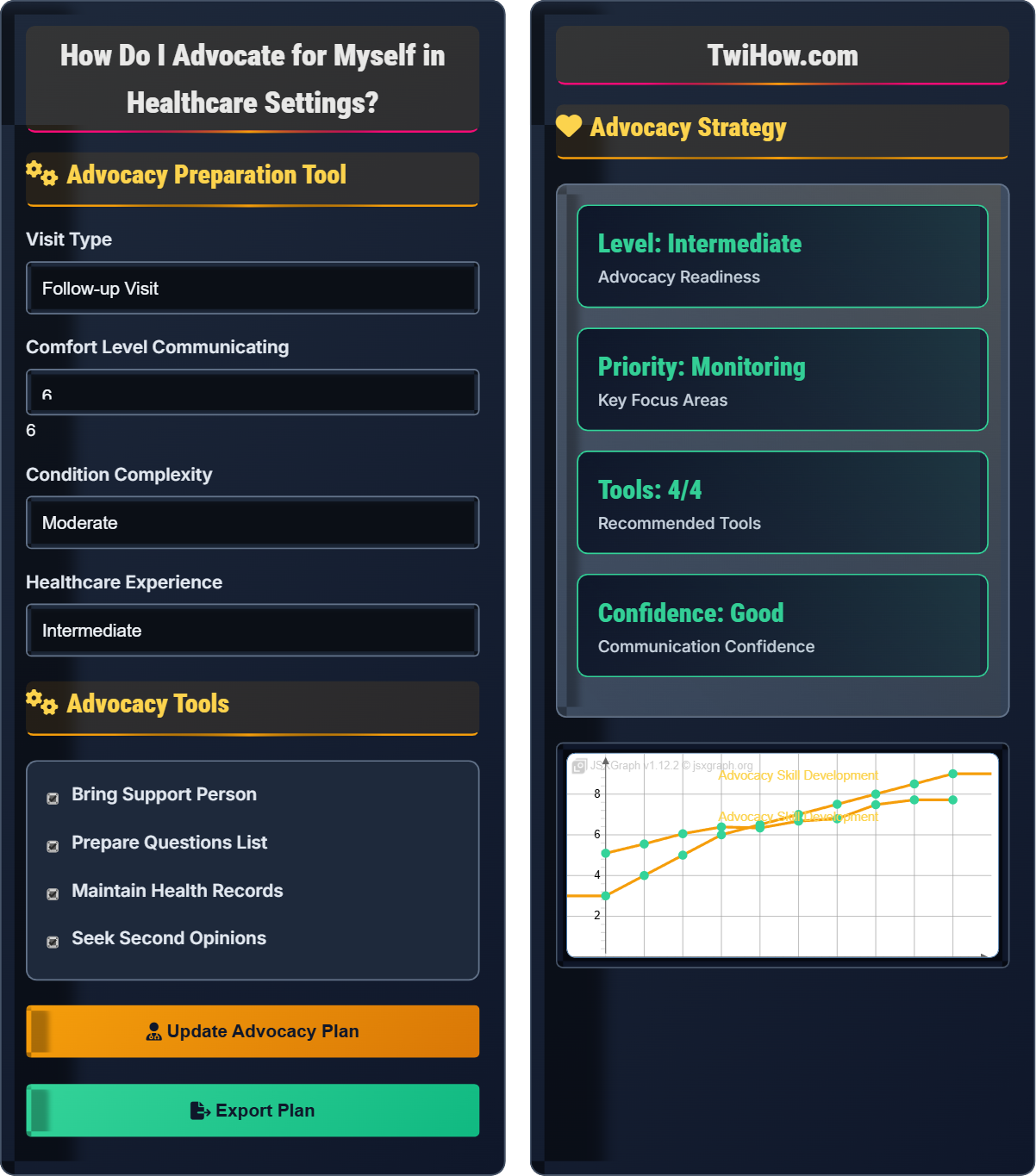
| Area | Current Level | Recommendation | Next Steps |
|---|---|---|---|
| Communication | 6/10 | Good | Prepare questions in advance |
| Knowledge | Medium | Continue learning | Research condition |
| Documentation | Adequate | Maintain consistently | Update records |
| Decision Making | Good | Continue participation | Ask for alternatives |
| Follow-up | Good | Stay engaged | Track outcomes |
Healthcare Advocacy Explained
Healthcare advocacy is the active participation in one's own healthcare decisions and the ability to effectively communicate with healthcare providers to ensure optimal care. It involves understanding your rights as a patient, asking relevant questions, expressing concerns, and making informed decisions about your treatment options.
Effective healthcare advocacy follows a structured approach:
Where:
- Preparation: Knowledge gathering, question formulation, goal setting
- Communication: Active listening, clear expression, collaborative dialogue
- Documentation: Record keeping, symptom tracking, treatment history
- Barriers: Language differences, cultural factors, system inefficiencies
Key areas where healthcare advocacy provides significant benefits:
- Preventive Care: Ensuring appropriate screenings and vaccinations
- Chronic Disease Management: Collaborating on treatment plans
- Emergency Situations: Communicating preferences and medical history
- Specialist Care: Coordinating between multiple providers
- End-of-Life Planning: Expressing wishes and values
- Quality Improvement: Providing feedback to enhance care
- Direct Communication: Speaking up during appointments
- Written Documentation: Maintaining health journals
- Family Involvement: Bringing advocates to appointments
- Technology Use: Using patient portals and apps
- Second Opinions: Seeking alternative perspectives
Advocacy Fundamentals
Patient advocacy, informed consent, shared decision-making, patient rights, communication skills.
Advocacy Effectiveness = (Preparation + Communication + Documentation) / Barriers
Where Preparation = research and planning, Communication = active engagement.
- Ask questions until you understand
- Express concerns without hesitation
- Request clarification when needed
Advocacy Applications
Appointment preparation, question lists, health journals, second opinions, patient portals.
- Research your condition
- Prepare questions in advance
- Bring a support person
- Take notes during appointments
- Respectful communication is essential
- Balance assertiveness with cooperation
- Documentation supports continuity
- Advocacy is ongoing, not episodic
Healthcare Advocacy Learning Quiz
Which of the following is NOT a recognized patient right in healthcare settings?
While patients have many important rights, they do not have the right to demand treatments that are medically inappropriate, experimental without proper protocols, or that go against established medical standards. Healthcare providers have the professional responsibility to recommend treatments based on evidence and clinical guidelines. Patients can refuse recommended treatments, but they cannot demand treatments that are not medically indicated or appropriate for their condition.
The answer is C) Right to demand any treatment regardless of medical appropriateness.
Understanding patient rights is crucial for effective advocacy, but it's equally important to understand the limits and responsibilities that come with those rights. Patient rights are designed to protect autonomy and dignity while ensuring safe, appropriate care. The right to refuse treatment is fundamental, but the right to demand specific treatments is limited by medical appropriateness and safety standards.
Patient Rights: Legal and ethical protections for healthcare recipients
Informed Consent: Permission given with full understanding of risks/benefits
Medical Appropriateness: Treatment aligned with clinical standards
• Patients can refuse appropriate treatment
• Providers must follow medical standards
• Rights come with responsibilities
• Know your basic patient rights
• Understand the limits of those rights
• Balance advocacy with respect for providers
• Confusing patient rights with unlimited demands
• Not understanding medical appropriateness
• Aggressive behavior instead of advocacy
Explain the most effective communication strategies for advocating for yourself in healthcare settings, including specific techniques for asking questions, expressing concerns, and ensuring understanding.
Preparation Strategies: Before appointments, research your condition, prepare a list of questions prioritized by importance, bring a summary of symptoms and medications, and consider bringing a support person to help listen and remember information.
Asking Questions: Use open-ended questions like "What are my treatment options?" rather than yes/no questions. Ask for explanations in plain language, request written materials when available, and don't hesitate to ask "Can you explain that again?" or "What does that mean?"
Expressing Concerns: Be specific about your concerns rather than general complaints. Use "I" statements like "I'm concerned about..." rather than accusatory language. Share how symptoms are affecting your daily life.
Ensuring Understanding: Use the "teach-back" method by repeating what you understood in your own words. Ask "What would happen if I don't treat this now?" and "What are the next steps?" to clarify the plan.
Follow-up Communication: Take notes during appointments, request copies of test results, and know how to reach your provider with questions after the visit.
Effective healthcare communication requires both preparation and active engagement during appointments. The goal is collaborative communication that respects both the patient's expertise about their own experience and the provider's medical expertise. Good communication builds trust and leads to better health outcomes.
Shared Decision-Making: Collaborative approach between patient and provider
Teach-Back Method: Patient repeats information to confirm understanding
Health Literacy: Ability to understand and use health information
• Prepare questions in advance
• Ask for explanations when unclear
• Take notes during appointments
• Bring a notebook to appointments
• Use the "Ask Me 3" approach (risks, benefits, alternatives)
• Request written summaries when possible
• Not preparing questions beforehand
• Failing to ask for clarification
• Not bringing a support person when needed
A patient receives a diagnosis of a chronic condition and is prescribed a new medication with significant side effects. The provider recommends starting with a standard dose but doesn't discuss alternatives or the possibility of starting with a lower dose. The patient is concerned about the side effects based on their age and other medications. Design an advocacy approach that balances expressing concerns while maintaining a collaborative relationship with the provider.
Opening Statement: "Thank you for explaining my condition and treatment options. I have some concerns about the medication and would like to discuss them."
Expressing Concerns: "Based on my age and the other medications I'm taking, I'm concerned about the potential side effects. Could we discuss whether starting with a lower dose might be appropriate for me?"
Asking Questions: "What are the risks and benefits of starting with a lower dose versus the standard dose? Are there alternative medications with fewer side effects? What would we monitor if I start with a lower dose?"
Collaborative Approach: "I want to make sure we find the right approach for my specific situation. What do you think would be the best way to start and monitor how I respond?"
Follow-up: "What signs should I watch for, and when should I contact you if I have concerns? When would we evaluate how the treatment is working?"
Effective advocacy in this scenario involves expressing concerns respectfully while acknowledging the provider's expertise. The approach demonstrates engagement in the decision-making process while showing appreciation for the provider's recommendations. This collaborative approach is more likely to result in a modified plan that addresses the patient's concerns while ensuring appropriate treatment.
Collaborative Communication: Respectful exchange between patient and provider
Shared Decision-Making: Joint decision process considering patient preferences
Respectful Advocacy: Asserting needs while respecting provider expertise
• Express concerns respectfully
• Ask for alternatives and rationale
• Maintain collaborative tone
• Acknowledge provider expertise
• Frame concerns as questions
• Suggest collaborative solutions
• Confrontational communication
• Not acknowledging provider expertise
• Demanding specific changes without discussion
You're helping someone develop a system for documenting their healthcare experiences and tracking symptoms to support their advocacy efforts. Explain how documentation can enhance self-advocacy and provide specific examples of what to record and how to organize this information effectively.
Benefits of Documentation: Written records provide objective information about symptoms, treatments, and responses. They help identify patterns, support communication with providers, and ensure continuity of care across different appointments and providers.
What to Document:
1. Symptoms: Date, time, severity, triggers, what relieves symptoms
2. Medications: Name, dose, timing, side effects experienced
3. Appointments: Date, provider, main topics discussed, decisions made
4. Test Results: Dates, values, normal ranges, provider interpretations
5. Questions Asked: Provider responses and follow-up needed
Organization Methods:
• Physical notebook with sections for symptoms, medications, appointments
• Digital health apps that sync across devices
• Calendar entries with health-related notes
• Shared documents accessible to support persons
Having organized documentation ready for appointments allows patients to provide detailed, accurate information and ask informed questions.
Documentation serves as an objective record of the patient's experience that can be referenced during healthcare encounters. It helps overcome memory limitations and provides concrete examples to support concerns or demonstrate patterns. Good documentation systems make advocacy more effective by providing specific, measurable information rather than general impressions.
Health Records: Documentation of medical information and experiences
Objective Information: Measurable, factual data
Subjective Information: Personal experiences and perceptions
• Document consistently and accurately
• Keep records organized and accessible
• Share relevant information with providers
• Use simple, consistent format
• Note time and date for all entries
• Include both positive and negative experiences
• Inconsistent documentation
• Not sharing records with providers
• Over-documenting irrelevant details
Which of the following represents the most significant barrier to effective healthcare advocacy?
While all these factors can create barriers to effective advocacy, the fear of provider disapproval is often the most significant because it prevents patients from speaking up at all. When patients are afraid to ask questions or express concerns, they cannot effectively advocate for themselves regardless of other factors. This fear often stems from perceived power imbalances in the healthcare relationship and can result in patients not receiving the information they need to make informed decisions.
The answer is B) Fear of provider disapproval.
Addressing the fear of provider disapproval requires understanding that good healthcare providers welcome questions and value patient input. Most providers appreciate engaged patients who take an active role in their care. Building confidence in advocacy skills and recognizing that asking questions is part of good healthcare can help overcome this barrier.
Power Imbalance: Perceived difference in authority between patient and provider
Healthcare Partnership: Collaborative relationship between patient and provider
Advocacy Barriers: Factors that impede effective self-advocacy
• Good providers welcome questions
• Advocacy improves care quality
• Fear should not prevent communication
• Remember providers are partners in care
• Prepare questions in advance
• Bring support persons to reduce anxiety
• Letting fear prevent questions
• Assuming providers are infallible
• Not preparing for appointments
FAQ
Q: How do I ask my doctor questions without seeming like I'm questioning their expertise?
A: Asking questions is not only acceptable but encouraged in healthcare! Good doctors appreciate engaged patients who want to understand their care. Here's how to frame your questions positively:
Effective Question Framing:
• "Help me understand..." rather than "Why are you...?"
• "What are my options?" rather than "I don't want that."
• "Can you explain the risks and benefits?" rather than "That sounds scary."
Examples of Good Questions:
• "Could you explain what this test will show us?"
• "What are the side effects I should watch for?"
• "Are there alternatives we should consider?"
• "What would happen if we waited to see if symptoms improve?"
Remember, your doctor wants you to be informed and comfortable with your care. Most providers welcome questions because it shows you're engaged in your treatment plan.
Q: What should I do if I feel my concerns aren't being heard by healthcare providers?
A: Feeling unheard is frustrating, but there are constructive steps you can take:
Immediate Steps:
1. Be Specific: Instead of "You're not listening," say "I'm concerned about [specific symptom] that hasn't been addressed."
2. Ask for Clarification: "I want to make sure I understand. You said [repeat what you heard]. Is that correct?"
3. Request More Time: "I have several concerns I'd like to discuss. Could we extend our appointment or schedule a follow-up?"
If Concerns Persist:
• Document the conversation and your concerns
• Request a patient advocate or ombudsman
• Seek a second opinion from another provider
• Contact the hospital's patient relations department
• Consider changing providers if the relationship isn't working
Remember that you have the right to be heard and to receive care that addresses your concerns. Don't give up advocating for yourself or your loved one.