How Do I Balance Work Demands with Health Priorities?
Complete work-life balance guide • Step-by-step explanations
Work-Health Balance:
Show Balance PlannerBalancing work demands with health priorities is a critical skill in today's fast-paced world. This involves strategically managing time, energy, and resources to maintain physical and mental well-being while meeting professional obligations. The goal is to create sustainable practices that support both career success and personal health.
Effective work-health balance requires intentional planning, boundary-setting, and the integration of healthy habits into daily routines. It's not about achieving perfect equilibrium every day, but rather creating a sustainable rhythm that prioritizes health while maintaining professional effectiveness.
Key balancing strategies:
- Time Management: Scheduling health activities, setting boundaries
- Energy Optimization: Strategic rest, proper nutrition, adequate sleep
- Stress Management: Mindfulness, relaxation techniques, workload management
- Workplace Wellness: Ergonomic setup, movement breaks, healthy habits
- Flexible Integration: Remote work options, flexible schedules
Modern approaches emphasize work-life integration rather than rigid separation, recognizing that health and work are interconnected aspects of a fulfilling life.
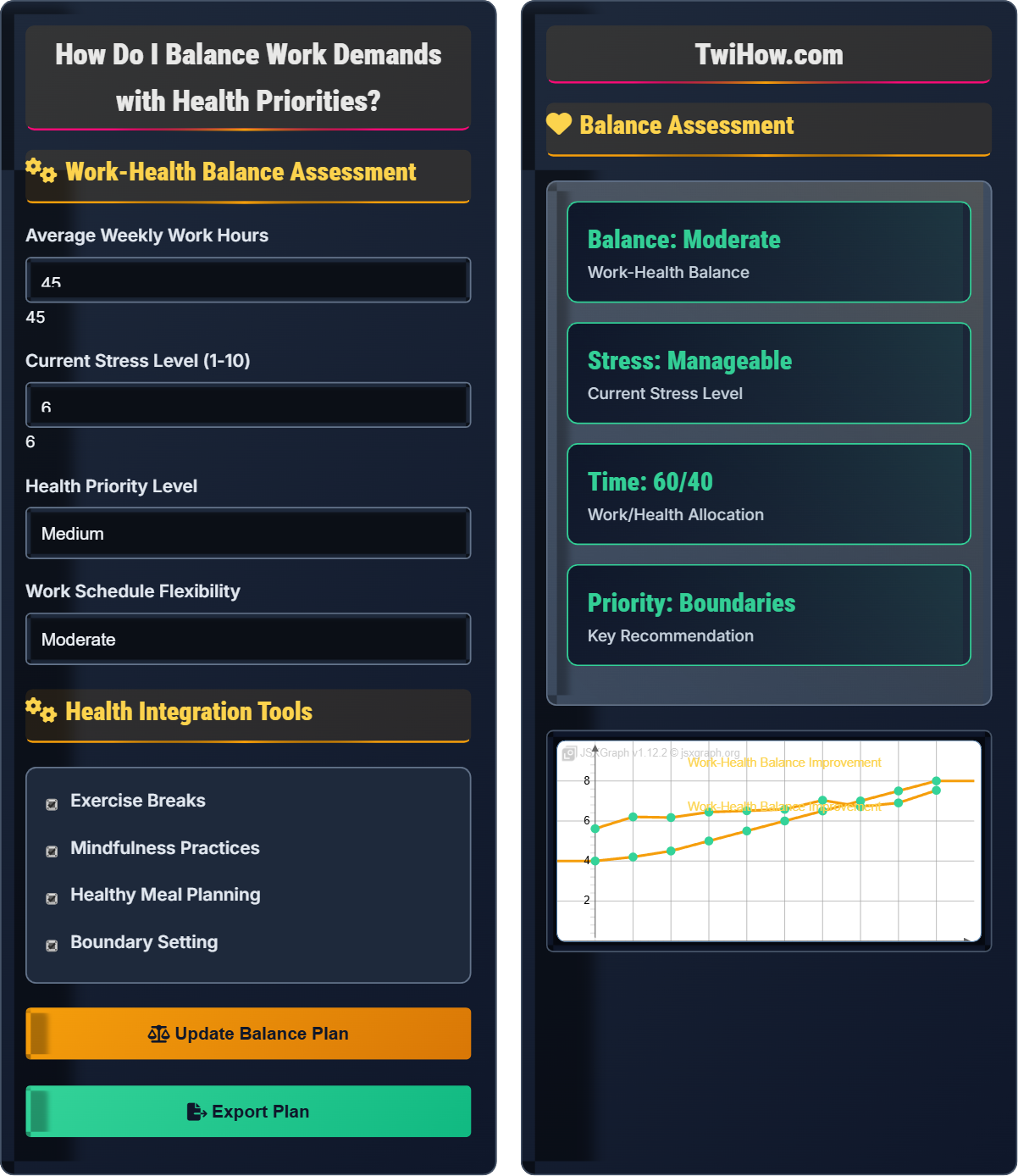
Work-Health Balance Assessment
Health Integration Tools
Balance Assessment
| Category | Current State | Recommendation | Next Steps |
|---|---|---|---|
| Work Hours | 45 hours/week | Moderate | Consider reducing to 40 |
| Stress Level | 6/10 | Manageable | Implement stress reduction |
| Health Priority | Medium | Good | Increase to high |
| Flexibility | Moderate | Acceptable | Negotiate more flexibility |
| Integration | Good | Positive | Continue practices |
Work-Health Balance Explained
Work-health balance refers to the strategic management of professional responsibilities alongside personal health and well-being. It involves creating sustainable practices that allow individuals to excel in their careers while maintaining physical, mental, and emotional health. This balance is dynamic and requires ongoing adjustment based on changing circumstances and priorities.
Effective work-health balance follows a comprehensive framework:
Where:
- Health Investments: Time, energy, and resources devoted to health
- Work Performance: Professional effectiveness and achievement
- Life Satisfaction: Overall well-being and happiness
- Stress Load: Cumulative pressure from all sources
Key areas where work-health balance provides significant benefits:
- Productivity: Better focus and efficiency when rested
- Job Satisfaction: Reduced burnout and increased engagement
- Physical Health: Lower risk of work-related health issues
- Mental Health: Reduced stress and anxiety
- Relationships: Better quality time with family/friends
- Career Sustainability: Long-term professional success
- Time Blocking: Dedicated periods for work and health activities
- Micro-Breaks: Short health-focused activities during work
- Boundary Setting: Clear limits between work and personal time
- Energy Management: Matching tasks to energy levels
- Flexible Scheduling: Adapting to health needs
Work-Health Balance Fundamentals
Work-life balance, stress management, time management, boundary setting, self-care, energy optimization.
Balance Score = (Health Investments + Work Performance + Life Satisfaction) / Stress Load
Where Health Investments = time/energy devoted to health, Work Performance = effectiveness.
- Health is foundational to work success
- Boundaries protect both work and health
- Balance is dynamic, not static
Application Strategies
Time blocking, micro-breaks, boundary setting, stress management, ergonomic optimization.
- Assess current balance state
- Set realistic goals
- Implement gradual changes
- Monitor and adjust regularly
- Balance looks different for everyone
- Seasonal adjustments may be needed
- Communication with stakeholders is key
- Sustainability is more important than perfection
Work-Health Balance Learning Quiz
What is the most accurate definition of work-health balance?
Work-health balance is about strategic management of time, energy, and resources to support both professional success and personal health. It's not about equal time allocation, as different life seasons and career stages may require different emphases. The goal is to create sustainable practices that support both areas without compromising long-term success or well-being.
The answer is B) Strategically managing time and energy to support both work and health.
True work-health balance is dynamic and individualized. It recognizes that sometimes work demands may be higher (during critical projects) and sometimes health needs may take precedence (during illness or recovery). The key is maintaining awareness and making conscious choices that support long-term sustainability in both areas.
Work-Health Balance: Strategic management of professional and health priorities
Sustainability: Long-term viability of practices
Dynamic Balance: Flexible adjustment based on changing needs
• Balance is individualized
• It's dynamic, not static
• Adjust expectations based on life season
• Focus on integration rather than separation
• Prioritize consistency over perfection
• Striving for equal time allocation
• Ignoring seasonal variations
• Sacrificing long-term health for short-term gains
Explain the importance of setting boundaries in work-health balance, including specific examples of effective boundaries and strategies for maintaining them.
Importance of Boundaries: Boundaries protect both work productivity and personal health by creating clear expectations and preventing role confusion. Without boundaries, work can intrude into personal time and health needs can disrupt work focus.
Effective Boundary Examples:
Time Boundaries: No emails after 7 PM, lunch breaks for exercise, specific work hours on weekends.
Physical Boundaries: Dedicated workspace at home, gym bag kept at office for lunch workouts, healthy snacks at desk.
Communication Boundaries: Auto-responder settings, "do not disturb" during exercise, clear availability hours.
Mental Boundaries: Transition rituals between work and home, mindfulness practices during breaks, separating work stress from family time.
Maintenance Strategies: Communicate boundaries clearly to colleagues, use technology tools to enforce limits, regularly reassess and adjust boundaries as needed, practice saying no to non-essential requests.
Boundaries are essential for work-health balance because they create structure and predictability. They help prevent the common trap of "always being on" which leads to burnout and reduced effectiveness in both work and health. Boundaries should be viewed as professional tools that enhance performance rather than restrictions that limit success.
Boundaries: Limits that define acceptable behavior
Work-Life Integration: Blending rather than separating work and personal life
Transition Rituals: Activities that mark transitions between roles
• Communicate boundaries clearly
• Be consistent in enforcement
• Adjust boundaries as needed
• Start with small, achievable boundaries
• Use technology to support boundaries
• Explain the business value of boundaries
• Not communicating boundaries clearly
• Being inconsistent in enforcement
• Apologizing for setting boundaries
A marketing executive works 50+ hours per week, frequently takes calls during dinner, and skips workouts due to work demands. They're experiencing chronic stress and early signs of burnout. Design a work-health balance plan that addresses their specific challenges while maintaining professional effectiveness.
Immediate Actions:
1. Boundary Setting: Establish "no work calls after 7 PM" and "no weekend work" unless absolutely critical. Communicate these boundaries to team and clients.
2. Micro-Health Habits: Schedule 10-minute morning stretches, 5-minute breathing exercises between meetings, and 15-minute lunch walks.
Weekly Structure:
3. Time Blocking: Dedicate 6-7 AM for exercise on 3 weekdays, schedule 30-minute "health breaks" mid-morning and mid-afternoon.
4. Meal Planning: Prepare healthy lunches on Sunday, keep nutritious snacks at desk to avoid vending machine reliance.
Long-term Strategies:
5. Efficiency Improvements: Delegate non-critical tasks, use productivity tools to streamline work, batch similar activities together.
6. Weekend Recovery: Designate one weekend day as "work-free" for complete recovery and health focus.
This approach maintains professional effectiveness while building in essential health practices.
This example demonstrates how to create sustainable changes that don't compromise professional responsibilities. The key is integrating health practices into existing work patterns rather than trying to add entirely new blocks of time. Small, consistent changes are more sustainable than dramatic shifts that might disrupt work performance.
Micro-Habits: Small, easily implemented health practices
Time Blocking: Scheduling specific activities in advance
Work-Life Integration: Blending health practices into work routines
• Integrate rather than add
• Start small and build gradually
• Maintain professional commitments
• Use transition rituals between work and health
• Batch similar activities to save time
• Communicate the business value of health
• Trying to add too much too quickly
• Not considering work culture
• Sacrificing health for work performance
You're helping someone develop a stress management plan that integrates with their demanding work schedule. Explain how stress management can be incorporated into busy work days and provide specific techniques that can be used during work hours.
Stress Management During Work:
Micro-Techniques (1-3 minutes):
1. Box Breathing: 4 counts in, hold 4, out 4, hold 4 - can be done at desk
2. Progressive Muscle Relaxation: Tense and release shoulders, neck, jaw during breaks
3. Grounding Techniques: 5-4-3-2-1 method (notice 5 things you see, 4 you hear, etc.)
Mini-Breaks (5-10 minutes):
4. Walking Meetings: Take meetings outside when possible
5. Desk Stretching: Neck rolls, shoulder shrugs, seated spinal twists
6. Mindfulness Moments: Brief meditation or mindful breathing
Structured Breaks (15-30 minutes):
7. Lunch Exercise: Quick walk, yoga poses, or stretching routine
8. Nature Connection: Step outside, look at greenery, get fresh air
9. Journaling: Quick stress dump or gratitude practice
These techniques can be seamlessly integrated into work schedules without disrupting productivity.
Effective stress management in demanding work environments relies on micro-interventions that can be implemented quickly and discreetly. These techniques work by interrupting the stress response and activating the parasympathetic nervous system. The key is consistency rather than duration - regular brief interventions are more effective than occasional long sessions.
Micro-Interventions: Brief stress management techniques
Parasympathetic Activation: Relaxation response of the nervous system
Stress Response Interruption: Breaking the cycle of stress reactions
• Consistency is more important than duration
• Techniques should be discrete and quick
• Practice during calm moments to prepare for stress
• Set regular reminders for breaks
• Practice techniques during calm periods
• Use bathroom breaks for quick stress relief
• Waiting until stressed to try techniques
• Only using long-form techniques
• Not practicing regularly enough
Which strategy is most effective for managing energy levels throughout demanding work days?
Matching task difficulty to energy levels is the most effective strategy for energy management. This approach involves scheduling high-demand tasks during peak energy times and lower-demand tasks during energy dips. It works with natural energy rhythms rather than against them, leading to more sustainable productivity. Other strategies like pushing through fatigue or skipping breaks actually deplete energy reserves and reduce overall effectiveness.
The answer is B) Matching task difficulty to energy levels.
Energy management is about working with natural rhythms rather than fighting against them. Our energy naturally fluctuates throughout the day, and recognizing these patterns allows for strategic task scheduling. This approach preserves energy for important tasks and prevents the exhaustion that comes from forcing high-level performance during low-energy periods.
Energy Management: Strategic allocation of energy throughout the day
Peak Performance Times: When energy and focus are highest
Energy Rhythms: Natural fluctuations in energy levels
• Work with natural energy rhythms
• Match tasks to energy levels
• Rest when energy is low
• Track your energy patterns for a week
• Schedule important tasks during peak times
• Use low-energy periods for routine tasks
• Ignoring natural energy rhythms
• Scheduling demanding tasks during low energy
• Pushing through natural energy lows
FAQ
Q: How do I prioritize health when my job is very demanding and time-consuming?
A: Prioritizing health in demanding jobs requires strategic thinking and integration rather than separate time allocation:
Integration Strategies:
• Micro-workouts: 5-minute stretches between meetings, desk exercises, stair climbing
• Walking meetings: Conduct phone calls while walking
• Healthy meal prep: Prepare nutritious meals in advance to avoid poor choices during busy periods
• Boundary setting: Establish clear limits on work hours when possible
Efficiency Improvements:
• Streamline work processes to create time for health activities
• Use productivity tools to work smarter, not longer
• Delegate tasks that don't require your specific expertise
Remember: Health is not separate from work performance - it directly impacts your ability to handle demanding responsibilities effectively. Investing in health actually increases your capacity to handle work demands.
Q: What if my company culture doesn't support work-life balance?
A: Navigating unsupportive company cultures requires strategic approaches:
Within Your Control:
• Set personal boundaries: Turn off notifications after work hours, don't respond to emails immediately
• Lead by example: Take lunch breaks, use vacation time, model healthy behaviors
• Focus on results: Demonstrate that you can maintain high performance while prioritizing health
• Find allies: Connect with colleagues who share similar values
Long-term Strategies:
• Look for opportunities: Transfer to departments with healthier cultures
• Consider alternatives: Explore remote work options or different companies
• Advocate for change: Propose wellness initiatives or flexible policies
Remember: You cannot control company culture entirely, but you can control your response to it. Sometimes, changing jobs may be the best option for long-term health and career satisfaction.