How Do I Deal With Health Anxiety?
Complete anxiety management guide • Step-by-step explanations
Health Anxiety Management:
Show Anxiety TrackerHealth anxiety, also known as illness anxiety disorder or hypochondriasis, is characterized by excessive worry about having or developing a serious illness despite having few or no symptoms. This condition can significantly impact daily life, relationships, and overall wellbeing.
Effective management of health anxiety involves understanding the psychological mechanisms behind the condition, implementing evidence-based coping strategies, and developing a balanced approach to health awareness without excessive worry. The goal is to maintain healthy health behaviors while reducing catastrophic thinking patterns.
Key management approaches:
- Cognitive Restructuring: Challenging anxious thoughts and beliefs
- Behavioral Techniques: Reducing safety behaviors and reassurance seeking
- Mindfulness Practices: Staying present and accepting uncertainty
- Lifestyle Modifications: Exercise, sleep, nutrition, and stress management
- Professional Support: Therapy, counseling, and medical guidance
Modern anxiety management combines therapeutic techniques with self-help tools, creating a comprehensive approach to managing health-related worries while maintaining appropriate health vigilance.
Anxiety Management Tools
Coping Strategies
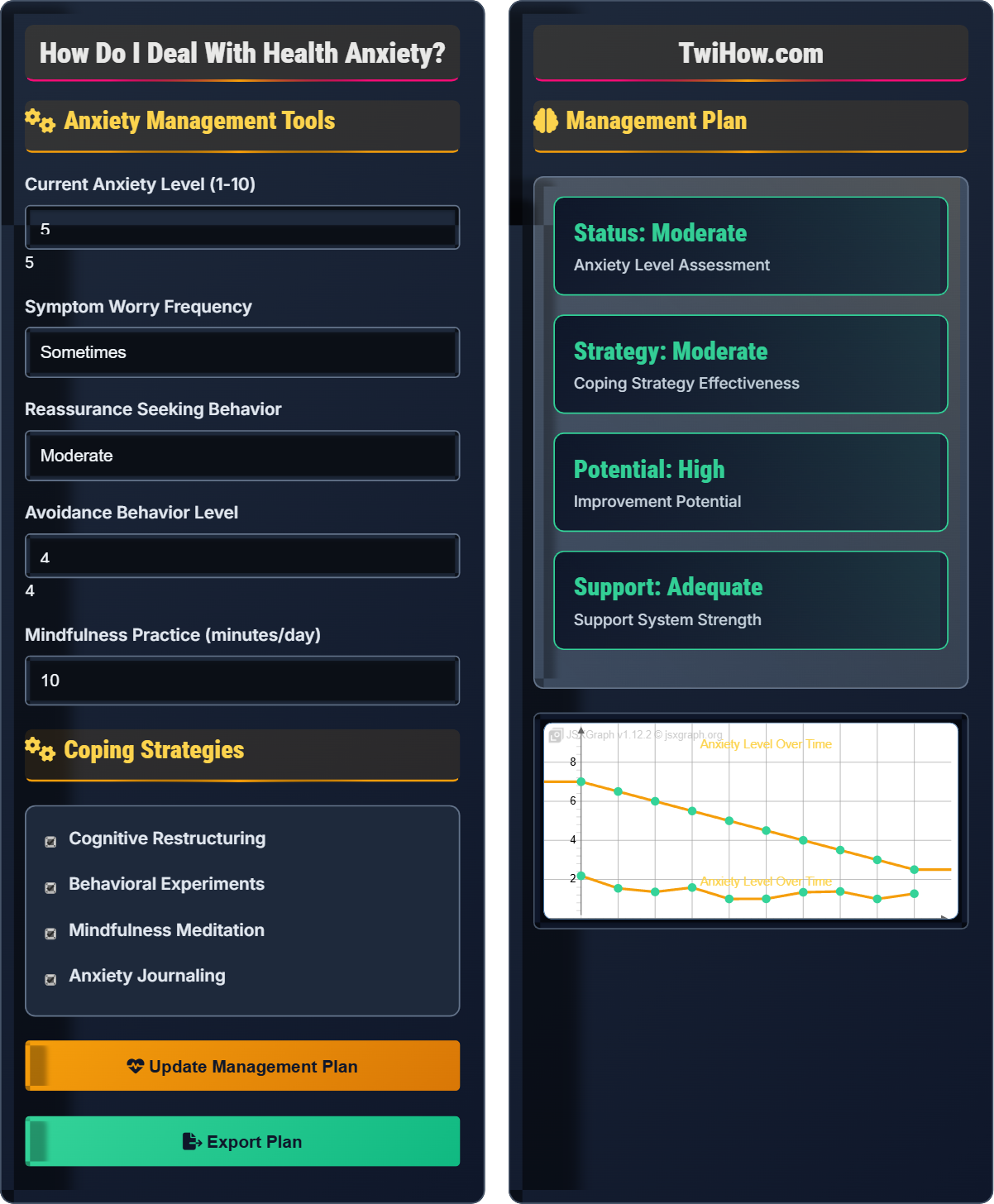
Management Plan
| Area | Current Level | Recommendation | Next Steps |
|---|---|---|---|
| Anxiety Level | 5/10 | Moderate | Implement daily coping techniques |
| Reassurance Seeking | Moderate | Reduce frequency | Set limits on checking |
| Avoidance Behavior | 4/10 | Manageable | Gradual exposure exercises |
| Mindfulness Practice | 10 min | Good start | Increase to 20 minutes |
| Support System | Adequate | Positive | Strengthen connections |
Health Anxiety Management Explained
Health anxiety, also known as illness anxiety disorder or hypochondriasis, is characterized by persistent and excessive worry about having or developing a serious medical condition. People with health anxiety often misinterpret normal bodily sensations as signs of serious illness, leading to distress and impairment in daily functioning.
Effective management of health anxiety follows a multi-component approach:
Where:
- Cognitive Strategies: Thought challenging, reality testing, perspective taking
- Behavioral Techniques: Exposure therapy, response prevention, behavioral experiments
- Mindfulness Practices: Present-moment awareness, acceptance, non-judgmental observation
- Anxiety Triggers: Catastrophic thinking, reassurance seeking, avoidance behaviors
Key areas where anxiety management techniques provide significant benefits:
- Daily Functioning: Improved concentration, productivity, and social interactions
- Medical Compliance: Better relationship with healthcare providers
- Relationships: Reduced worry about transmitting illness, improved communication
- Self-Care: Balanced health behaviors without excessive worry
- Stress Management: Better overall emotional regulation
- Quality of Life: Increased enjoyment of activities and experiences
- Cognitive Behavioral Therapy (CBT): Evidence-based approach targeting thought patterns
- Acceptance and Commitment Therapy (ACT): Mindfulness-based approach
- Exposure Therapy: Gradual confrontation of anxiety triggers
- Mindfulness-Based Stress Reduction (MBSR): Present-moment awareness
- Pharmacological Treatment: Medication support when appropriate
Anxiety Management Fundamentals
Health anxiety, catastrophic thinking, reassurance seeking, mindfulness, cognitive restructuring.
Anxiety Reduction = (Cognitive Strategies + Behavioral Techniques + Mindfulness) / Anxiety Triggers
Where Cognitive Strategies = thought challenging, Behavioral = exposure work.
- Challenge catastrophic interpretations of symptoms
- Reduce reassurance seeking behaviors
- Practice acceptance of uncertainty
Management Applications
CBT techniques, mindfulness meditation, exposure therapy, journaling, breathing exercises.
- Identify specific triggers
- Learn cognitive techniques
- Practice behavioral changes
- Develop mindfulness skills
- Progress takes time and patience
- Relapses are part of the process
- Professional support is beneficial
- Balance health awareness with anxiety
Health Anxiety Learning Quiz
Which of the following is the most distinguishing characteristic of health anxiety compared to normal health concerns?
Health anxiety is characterized by disproportionate and persistent worry about having or developing a serious illness, often in the absence of significant symptoms or when symptoms are minimal. The key distinction is the severity of the worry relative to the actual symptoms. Normal health concerns involve proportionate responses to actual symptoms, while health anxiety involves catastrophic interpretations of minor or normal bodily sensations.
The answer is B) Disproportionate worry about minor symptoms.
Understanding the difference between normal health concerns and health anxiety is crucial for proper management. Normal health awareness involves appropriate concern for genuine symptoms and reasonable health precautions. Health anxiety, however, involves persistent fear despite reassurance from medical professionals and minimal or no actual symptoms. The disproportionate nature of the worry is what distinguishes it from normal health consciousness.
Health Anxiety: Excessive worry about having serious illness despite minimal symptoms
Catastrophic Thinking: Assuming worst-case scenarios without evidence
Normal Health Concerns: Proportionate response to actual symptoms
• Disproportionate worry indicates anxiety
• Reassurance doesn't alleviate anxiety
• Normal concerns are situation-specific
• Notice if worry persists after medical clearance
• Track the relationship between symptoms and worry
• Seek professional evaluation if concerned
• Dismissing all health concerns as anxiety
• Equating symptom awareness with illness
• Ignoring genuine medical symptoms
Explain how cognitive behavioral therapy (CBT) techniques can be applied to manage health anxiety. Include specific cognitive and behavioral interventions, and describe the expected outcomes.
Cognitive Interventions: CBT for health anxiety focuses on identifying and challenging catastrophic thoughts about health. Patients learn to examine the evidence for their fears, consider alternative explanations for symptoms, and develop more balanced perspectives. Techniques include thought records, probability estimation, and decatastrophizing exercises.
Behavioral Interventions: These target safety behaviors that maintain anxiety, such as excessive checking, reassurance seeking, and avoidance. Behavioral experiments test feared outcomes, exposure exercises confront avoided situations, and response prevention reduces compulsive checking behaviors.
Expected Outcomes: Significant reduction in anxiety levels, decreased reassurance seeking, improved quality of life, better relationship with healthcare providers, and increased tolerance for uncertainty regarding health.
CBT for health anxiety addresses the vicious cycle where catastrophic thoughts lead to safety behaviors, which provide temporary relief but ultimately reinforce the anxiety. By breaking this cycle through cognitive restructuring and behavioral experiments, patients learn to tolerate uncertainty and reduce the impact of health-related worries on their lives. The approach is evidence-based and highly effective for managing health anxiety.
Cognitive Behavioral Therapy (CBT): Evidence-based treatment targeting thoughts and behaviors
Safety Behaviors: Actions taken to prevent or reduce anxiety
Behavioral Experiments: Tests to evaluate the validity of anxious predictions
• Challenge catastrophic thoughts systematically
• Gradually reduce safety behaviors
• Accept uncertainty about health
• Keep a thought record to identify patterns
• Practice "worry time" to limit rumination
• Use behavioral experiments to test fears
• Seeking constant reassurance
• Avoiding medical care entirely
• Trying to eliminate all health worries
A 35-year-old person has been experiencing health anxiety for 6 months, constantly checking their pulse, researching symptoms online, and visiting urgent care frequently. They want to implement a management plan that addresses their specific behaviors while maintaining appropriate health vigilance. Design a comprehensive plan that includes cognitive, behavioral, and mindfulness components.
Cognitive Component: Implement thought challenging for catastrophic interpretations. When checking pulse, ask: "Is this number really dangerous?" and "What evidence supports my fear?" Use probability estimation to put fears in perspective.
Behavioral Component: Gradually reduce checking behaviors by setting limits (check pulse once daily at designated time). Implement response prevention for online research. Schedule regular doctor visits to reduce urgent care visits.
Mindfulness Component: Practice body scanning to observe sensations without judgment. Use grounding techniques when anxiety peaks. Develop acceptance of normal bodily sensations.
Implementation Strategy: Start with one technique at a time, track progress daily, and gradually increase challenges. Celebrate small victories and expect setbacks as part of the process.
Effective anxiety management plans address the specific maintenance factors of each individual's anxiety. For this person, the key maintenance factors are safety behaviors (checking, researching) and catastrophic thinking patterns. The plan targets these behaviors while maintaining appropriate health awareness. Success depends on gradual implementation and consistent practice rather than elimination of all health behaviors.
Maintenance Factors: Behaviors or thoughts that keep anxiety going
Safety Behaviors: Actions that temporarily reduce anxiety but maintain it long-term
Response Prevention: Deliberately not engaging in anxiety-reducing behaviors
• Target specific maintenance factors
• Gradual reduction of safety behaviors
• Maintain appropriate health awareness
• Set specific limits on checking behaviors
• Use delay tactics before researching
• Practice acceptance of bodily sensations
• Trying to eliminate all health behaviors
• Not addressing specific maintenance factors
• Expecting immediate results
You're helping someone integrate mindfulness techniques into their health anxiety management plan. They express skepticism about "meditation" and prefer practical, immediate solutions. Explain how mindfulness can be applied specifically to health anxiety, including practical exercises that don't require formal meditation practice.
Mindfulness for Health Anxiety: Mindfulness in this context means observing bodily sensations without immediately interpreting them catastrophically. It's about noticing symptoms as they are, rather than jumping to conclusions about their meaning.
Practical Exercises:
1. 5-4-3-2-1 Technique: When anxiety peaks, notice 5 things you see, 4 you hear, 3 you touch, 2 you smell, 1 you taste - to ground in present moment
2. Body Scanning: Systematically notice sensations without labeling them as "dangerous"
3. Urge Surfing: When feeling compelled to check symptoms, sit with the urge until it passes naturally
4. Thought Labeling: When worried thoughts arise, mentally label them as "just a thought" rather than truth
These techniques can be practiced during daily activities and don't require sitting meditation.
Mindfulness for health anxiety is fundamentally about changing the relationship with thoughts and sensations rather than trying to eliminate them. It's about observing without immediately reacting or interpreting. This approach helps break the cycle of catastrophic thinking that fuels health anxiety. The key is practicing non-judgmental awareness of present-moment experience.
Mindfulness: Present-moment awareness without judgment
Non-Judgmental Awareness: Observing without evaluating as good/bad
Urge Surfing: Allowing urges to rise and pass without acting
• Observe sensations without immediate interpretation
• Notice thoughts without believing them
• Allow discomfort to pass naturally
• Start with brief 1-minute exercises
• Practice during routine activities
• Use grounding techniques when anxious
• Expecting meditation to eliminate anxiety
• Judging mindfulness practice as "failed"
• Trying to suppress anxious thoughts
Which scenario most strongly indicates the need for professional mental health support for health anxiety?
Functional impairment is the key indicator for professional intervention. When health anxiety begins to interfere significantly with work, relationships, or daily activities, it suggests the anxiety has reached a level that requires professional support. Missing work or social events due to health worries indicates that the anxiety is substantially impacting the person's life and may require specialized treatment approaches like CBT.
The answer is B) Missing work or social events due to health worries.
Professional help becomes important when anxiety reaches a level that significantly impairs daily functioning. While some health awareness is normal, when it begins to interfere with important life areas, specialized support can provide effective tools and strategies. Professional treatment for health anxiety is highly effective and can significantly improve quality of life.
Functional Impairment: Significant interference with daily life activities
Professional Intervention: Mental health treatment from qualified providers
Specialized Treatment: Evidence-based therapies for specific conditions
• Seek help when anxiety impacts daily life
• Professional treatment is highly effective
• Early intervention prevents worsening
• Look for functional impairment as a sign
• Find therapists specializing in anxiety
• Consider CBT as first-line treatment
• Waiting until anxiety is severe
• Dismissing need for professional help
• Assuming anxiety will resolve without intervention
FAQ
Q: How do I know if my health concerns are normal worry or health anxiety?
A: The key differences lie in the intensity, persistence, and impact of the concerns:
Normal Health Concerns: Focused on actual symptoms that are concerning or persistent, proportionate to the symptoms, improves with medical reassurance, doesn't significantly interfere with daily life.
Health Anxiety: Persistent worry despite medical reassurance, catastrophic interpretation of minor symptoms, significant time spent worrying or checking, interferes with work, relationships, or activities, often shifts focus to different symptoms over time.
Red Flags for Health Anxiety: Frequent reassurance seeking that doesn't provide lasting relief, avoiding activities due to health fears, spending excessive time researching symptoms, difficulty functioning due to health worries.
If your health concerns persist despite appropriate medical evaluation and begin to significantly impact your daily life, it may be health anxiety requiring specialized treatment.
Q: Is it safe to reduce health monitoring if I have health anxiety? Won't I miss important symptoms?
A: Managing health anxiety doesn't mean ignoring your health - it means finding a balanced approach between appropriate health awareness and excessive worry. Here's the distinction:
Appropriate Health Awareness: Regular check-ups with healthcare providers, paying attention to genuinely concerning symptoms, following recommended screening guidelines, maintaining healthy lifestyle habits.
Excessive Health Monitoring: Constant checking of vital signs without medical indication, frequent emergency room visits for minor symptoms, obsessive research of every sensation, avoiding activities due to health fears.
Safe Approach: Establish a reasonable schedule for health monitoring with your doctor, limit checking behaviors to specific times, trust medical professionals' assessments, maintain a healthy lifestyle without becoming obsessed with health metrics.
The goal is to maintain good health habits while reducing the excessive worry that characterizes health anxiety. Working with healthcare providers ensures you maintain appropriate vigilance without the anxiety component.