How Do I Evaluate Health Trends and Avoid Misinformation?
Complete health information evaluation guide • Step-by-step explanations
Health Information Evaluation:
Show Evaluation ToolEvaluating health trends and avoiding misinformation requires critical thinking skills, source verification, and an understanding of scientific methodology. In an era of abundant health information, the ability to distinguish credible sources from misleading content is essential for making informed health decisions.
Health misinformation can spread rapidly through social media, influencer marketing, and anecdotal evidence, often presenting itself as legitimate science. Developing information literacy skills helps individuals make evidence-based decisions about their health and avoid potentially harmful practices.
Key evaluation strategies:
- Source Verification: Check credentials and institutional backing
- Scientific Rigor: Look for peer-reviewed research and study design
- Peer Review: See if findings are replicated by other researchers
- Logical Consistency: Identify red flags and implausible claims
- Expert Consensus: Check if the broader scientific community agrees
Effective evaluation combines skepticism with openness to evidence, requiring individuals to question sources while remaining receptive to legitimate scientific discoveries.
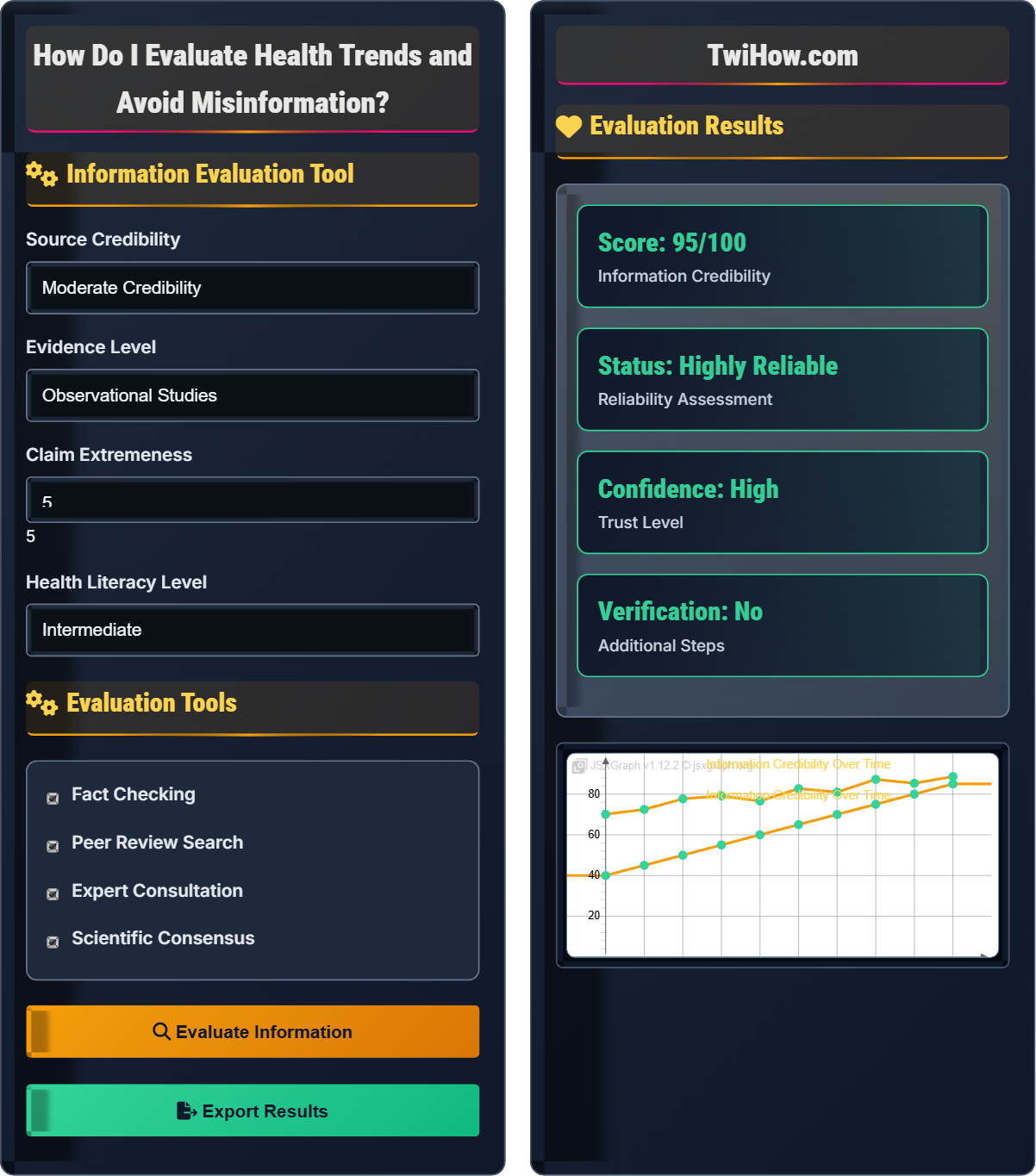
Information Evaluation Tool
Evaluation Tools
Evaluation Results
| Criteria | Assessment | Score | Recommendation |
|---|---|---|---|
| Source Credibility | Moderate | 70/100 | Verify credentials |
| Study Quality | Observational | 60/100 | Look for RCTs |
| Claim Reasonableness | Moderate | 65/100 | Research further |
| Peer Review | Present | 75/100 | Check consensus |
| Expert Opinion | Varied | 55/100 | Consult specialists |
Health Information Evaluation Explained
Evaluating health trends and avoiding misinformation involves systematically assessing the credibility, accuracy, and relevance of health-related information. This process requires critical thinking skills, understanding of scientific methodology, and the ability to distinguish between evidence-based information and unfounded claims.
Effective health information evaluation follows a comprehensive framework:
Where:
- Source Quality: Credibility and expertise of the source
- Evidence Strength: Scientific rigor and quality of supporting studies
- Expert Consensus: Agreement among qualified professionals
- Red Flags Count: Warning signs indicating potential misinformation
Key areas where health information evaluation provides significant benefits:
- Diet and Nutrition: Evaluating supplement claims and dietary trends
- Exercise and Fitness: Assessing workout claims and fitness advice
- Medical Treatments: Verifying alternative therapy claims
- Preventive Care: Distinguishing evidence-based prevention from myths
- Health Products: Evaluating marketing claims for health devices
- Vaccines and Immunization: Separating scientific facts from misinformation
- Source Verification: Checking institutional backing and credentials
- Study Quality Assessment: Evaluating research methodology and sample size
- Peer Review Verification: Confirming independent scientific review
- Logical Consistency: Identifying contradictions and implausible claims
- Expert Consultation: Seeking professional healthcare opinions
Evaluation Fundamentals
Health misinformation, fact checking, critical thinking, health literacy, peer review, scientific consensus.
Credibility Score = (Source Quality + Evidence Strength + Expert Consensus) / Red Flags Count
Where Source Quality = credibility of origin, Evidence = scientific support.
- Question extraordinary claims
- Verify through multiple sources
- Consult healthcare professionals
Application Strategies
Source verification, fact checking, peer review search, expert consultation, scientific consensus verification.
- Identify the health claim
- Verify the source credibility
- Check for scientific evidence
- Consult healthcare providers
- Science evolves over time
- Correlation doesn't equal causation
- Individual responses vary
- Marketing differs from science
Health Information Evaluation Learning Quiz
Which of the following is the most reliable indicator of a health information source's credibility?
Peer-reviewed publication in a scientific journal is the gold standard for health information credibility. This process involves independent experts evaluating the methodology, evidence, and conclusions before publication. Social media popularity, bold claims, and media coverage do not indicate scientific validity. The peer review process helps ensure that research meets scientific standards and methodologies.
The answer is B) Peer-reviewed publication in a scientific journal.
This question highlights the difference between popularity and credibility. Social media metrics and media coverage can be manipulated, but peer review is a rigorous scientific process that evaluates research quality. Understanding this distinction is fundamental to health information evaluation.
Peer Review: Independent evaluation by experts in the field
Scientific Journal: Publication venue for research
Methodology: Research methods and procedures
• Popularity doesn't indicate validity
• Peer review ensures quality
• Independent verification is essential
• Check if research was peer-reviewed
• Look for journal reputation
• Verify author credentials
• Confusing popularity with credibility
• Not verifying peer review status
• Trusting media coverage over science
Explain the key red flags that indicate health information might be misleading or false, and provide specific examples of each.
Extraordinary Claims: Statements like "cure-all" solutions or "breakthrough" discoveries that seem too good to be true. Example: "This supplement can cure cancer and diabetes simultaneously."
Emotional Manipulation: Appeals to fear, anger, or desperation rather than evidence. Example: "Big Pharma is hiding the real cure to make money!"
Lack of Transparency: Missing information about funding sources, conflicts of interest, or study methodology. Example: "Clinical trials prove this works" without citing specific studies.
Anecdotal Evidence: Relying on personal testimonials rather than controlled studies. Example: "Thousands of people have been cured by this treatment" without verification.
Secret Ingredients: Claims about proprietary or secret formulations. Example: "Our special formula contains ancient herbs that scientists don't understand."
Unrealistic Timelines: Promises of immediate results. Example: "Lose 30 pounds in 7 days without dieting or exercise."
Attacking Science: Discrediting established scientific institutions. Example: "Scientists don't know what they're talking about."
Recognizing these red flags helps distinguish credible information from potential misinformation.
Red flags are warning signs that indicate information may not be trustworthy. These indicators often appear together in misinformation campaigns. Learning to recognize these patterns helps develop critical thinking skills for health information evaluation.
Red Flags: Warning signs indicating potential issues
Extraordinary Claims: Unusually bold or unrealistic statements
Anecdotal Evidence: Personal stories without scientific validation
• Extraordinary claims need extraordinary evidence
• Emotion shouldn't override evidence
• Transparency indicates trustworthiness
• Look for multiple red flags together
• Verify extraordinary claims
• Question emotional appeals
• Getting swayed by emotional appeals
• Not questioning extraordinary claims
• Trusting testimonials over studies
You come across a viral social media post claiming that a specific supplement can prevent COVID-19 infection. The post includes testimonials from "thousands" of users and claims that "mainstream medicine doesn't want you to know." The product is sold by a company with a website that looks professional. Design an evaluation plan to determine the credibility of this claim.
Immediate Red Flags:
1. Extraordinary Claim: No supplement can prevent COVID-19 infection
2. Emotional Manipulation: Claims "mainstream medicine" is hiding information
3. Unverified Testimonials: "Thousands" of users without verification
Evaluation Plan:
4. Source Verification: Check the company's credentials and regulatory status
5. Scientific Evidence Search: Look for peer-reviewed studies supporting the claim
6. Expert Consultation: Consult healthcare professionals about the claim
7. Official Sources: Check CDC, WHO, and FDA positions on the supplement
8. Peer Review: Look for independent scientific reviews
Expected Conclusion: This claim is almost certainly misinformation. No supplement has been proven to prevent COVID-19 infection. Legitimate prevention measures include vaccination, masking, and social distancing as recommended by health authorities.
This example demonstrates how to apply evaluation skills to a real-world scenario. The key is recognizing multiple red flags and systematically verifying claims through credible sources. Professional medical guidance is essential for health-related decisions.
Health Authority: Official health organization like CDC or WHO
Peer Review: Independent scientific evaluationTestimonial: Personal account without verification
• Trust official health authorities
• Question extraordinary claims
• Verify through multiple sources
• Look for multiple red flags
• Check official health websites
• Consult healthcare providers
• Believing extraordinary claims
• Not checking official sources
• Trusting unverified testimonials
You read a study that found people who drink green tea regularly have lower rates of heart disease. However, you know that correlation doesn't necessarily prove causation. Explain how to evaluate whether this association is causal or simply correlational, and what additional evidence would be needed.
Correlation vs. Causation Distinction:
Just because green tea drinkers have lower heart disease rates doesn't mean green tea prevents heart disease. Other factors could explain this association.
Potential Confounding Variables:
1. Healthy Lifestyle: Green tea drinkers might have other healthy habits
2. Socioeconomic Status: Higher income might enable both green tea and better healthcare
3. Education Level: Higher education might correlate with both green tea consumption and health awareness
Additional Evidence Needed:
4. Randomized Controlled Trial: Participants randomly assigned to green tea or placebo groups
5. Dose-Response Relationship: More green tea consumption should show stronger effects
6. Biological Plausibility: Understanding how green tea compounds affect heart health
7. Temporal Sequence: Green tea consumption must precede heart disease prevention
8. Replication: Multiple studies showing similar results
Only with this additional evidence can causation be established beyond correlation.
This example illustrates a fundamental concept in health research: the difference between correlation and causation. Many health claims are based on observational studies that show associations but don't prove causation. Understanding this distinction is crucial for evaluating health information.
Correlation: Statistical relationship between variables
Causation: One variable directly causes changes in another
Confounding Variable: Factor that influences both variables being studied
• Correlation doesn't imply causation
• Look for confounding variables
• Randomized trials provide strongest evidence
• Question assumed cause-and-effect
• Look for alternative explanations
• Seek randomized trial evidence
• Assuming correlation equals causation
• Not considering confounding variables
• Accepting observational studies as proof
What is the best way to determine if there is scientific consensus on a health topic?
The best way to determine scientific consensus is to look for position statements from major medical organizations. These organizations, such as the American Medical Association, American Heart Association, or World Health Organization, represent the collective expertise of thousands of qualified professionals. They base their positions on comprehensive reviews of scientific evidence and represent the consensus of the medical community.
The answer is B) Look for position statements from major medical organizations.
Scientific consensus emerges from the collective evaluation of evidence by qualified professionals. Medical organizations aggregate this expertise and provide authoritative positions on health topics. Social media, book sales, and celebrity endorsements are not indicators of scientific consensus.
Scientific Consensus: Agreement among qualified professionals
Medical Organization: Professional group of healthcare experts
Position Statement: Official stance based on evidence review
• Consensus comes from experts
• Popularity doesn't indicate consensus
• Professional organizations aggregate expertise
• Check major medical organizations
• Look for evidence-based positions
• Verify through multiple professional sources
• Confusing popularity with consensus
• Trusting non-expert opinions
• Not verifying professional positions
FAQ
Q: How can I tell if a health article is credible if I don't have a medical background?
A: You don't need medical expertise to evaluate health information credibility:
Source Checks:
• Is it from a reputable medical institution, journal, or government health agency?
• Are the authors' credentials listed and verifiable?
• Does it cite peer-reviewed research?
Content Red Flags:
• Does it promise miracle cures or quick fixes?
• Does it attack conventional medicine?
• Does it rely heavily on testimonials?
Corroboration:
• Do multiple credible sources say the same thing?
• Does it align with information from major health organizations?
• Has it been fact-checked by reputable organizations?
When in Doubt: Always consult your healthcare provider about health information, especially before making treatment decisions.
Q: What if scientific studies seem to contradict each other on a health topic?
A: Conflicting studies are common in science, but you can evaluate them:
Study Quality:
• Look for larger sample sizes and longer study durations
• Randomized controlled trials are more reliable than observational studies
• Studies with control groups are more reliable than those without
Systematic Reviews:
• Meta-analyses combine multiple studies for stronger evidence
• Cochrane Reviews are considered gold standard for evidence synthesis
Timing and Replication:
• Recent studies may incorporate newer methods
• Findings replicated across multiple studies are more reliable
Conflict of Interest:
• Studies funded by industry may have bias
• Look for independent funding sources
Scientific Consensus: Major medical organizations consider all evidence and provide guidance that represents the current scientific consensus.