How to Find Reliable Health Information Online
Complete health information guide • Step-by-step explanations
Health Information Overview:
Show Information CheckerFinding reliable health information online is crucial for making informed decisions about your health. With the abundance of information available, it's important to know how to evaluate sources, distinguish credible information from misinformation, and identify trustworthy health websites. Reliable health information should come from authoritative sources and be based on scientific evidence.
Health misinformation can have serious consequences, leading to inappropriate self-treatment, delayed care, or dangerous health decisions. Developing skills to critically evaluate online health information is essential for maintaining your health and safety.
Core concepts:
- Authoritative Sources: Government agencies, medical institutions, peer-reviewed journals
- Evidence-Based: Information backed by scientific research
- Transparency: Clear authorship, funding, and methodology
- Current: Recently updated with current medical knowledge
- Peer Review: Information reviewed by experts in the field
Always consult with healthcare professionals for personalized medical advice and before making significant health decisions.
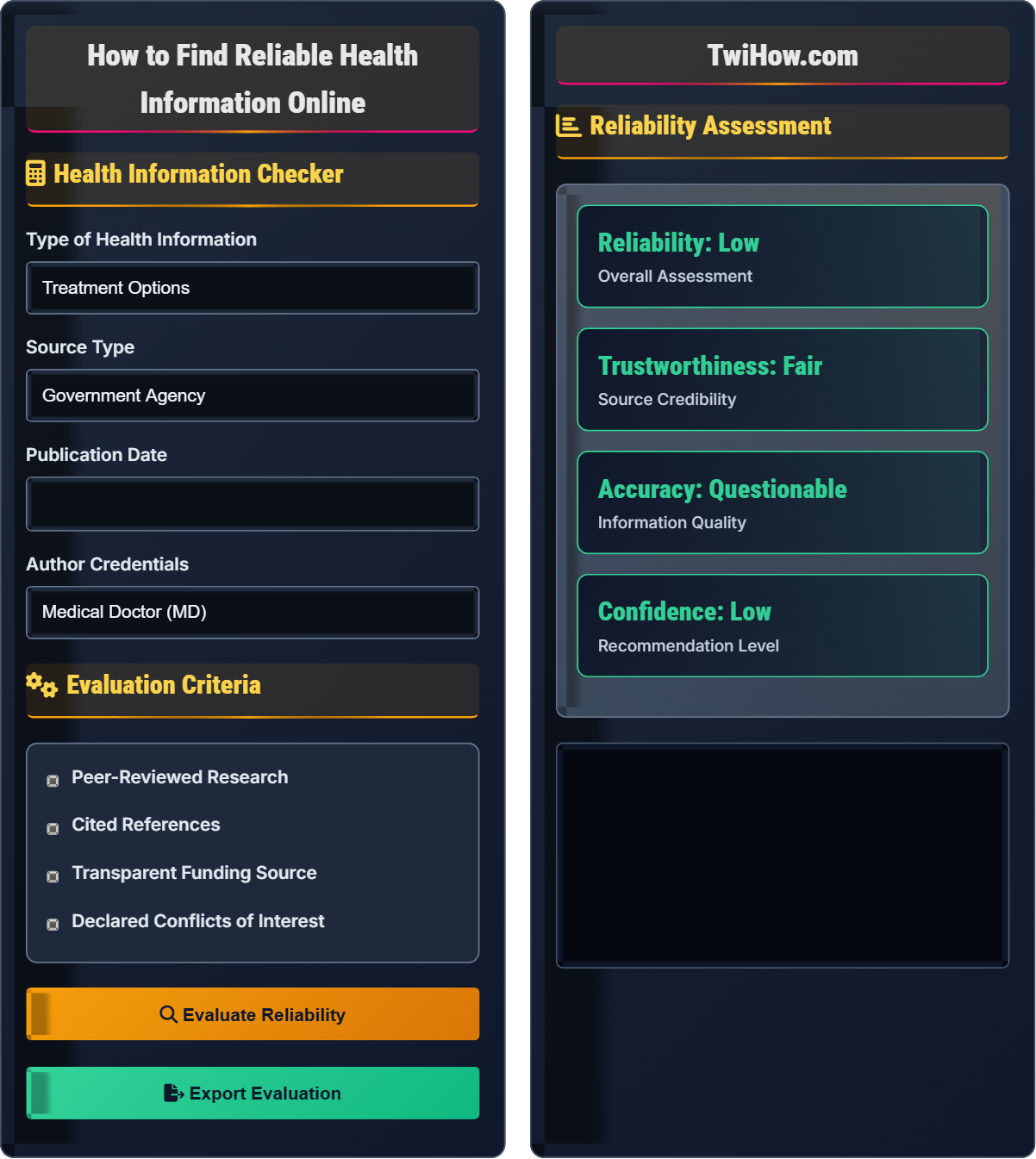
Health Information Checker
Evaluation Criteria
Reliability Assessment
| Source | Reliability | Notes |
|---|---|---|
| Centers for Disease Control (CDC) | High | Government health agency |
| Mayo Clinic | High | Medical institution |
| WebMD | Medium | Good for basics, limited detail |
| Healthline | Medium | Well-researched, medical review |
| PubMed | High | Medical literature database |
Health Information Evaluation Explained
Reliable health information comes from authoritative sources with established credibility:
- Government Agencies: CDC, NIH, WHO, FDA
- Medical Institutions: Mayo Clinic, Cleveland Clinic, Johns Hopkins
- Professional Organizations: American Medical Association, American Heart Association
- Peer-Reviewed Journals: New England Journal of Medicine, Lancet, JAMA
- Medical Schools: Harvard Medical School, Stanford Medicine
Use these criteria to evaluate health information sources:
- Author Credentials: Medical professionals, researchers, or qualified journalists
- Publication Date: Recent information reflecting current knowledge
- Peer Review: Reviewed by experts in the field
- References: Cites scientific studies and sources
- Transparency: Discloses funding sources and conflicts of interest
- Editorial Standards: Established editorial process and quality control
Be cautious of sources with these characteristics:
- Anonymous Authors: No credentials or contact information provided
- Sensational Claims: "Miracle cures" or "breakthrough discoveries"
- Commercial Bias: Selling products or services
- Outdated Information: Old publication dates without updates
- No Citations: No references to scientific studies
- Emotional Appeals: Fear tactics or emotional manipulation
- Unsupported Claims: No evidence to back up statements
Health information should be based on evidence with these levels of strength:
- Systematic Reviews/Meta-Analyses: Highest level of evidence
- Randomized Controlled Trials: Gold standard for clinical studies
- Controlled Clinical Trials: Strong evidence for treatment efficacy
- Observational Studies: Cohort, case-control, cross-sectional
- Case Reports/Expert Opinion: Lowest level of evidence
Use these resources to verify health information:
- Snopes: Verifies viral health claims and myths
- Health News Review: Evaluates health journalism
- Science-Based Medicine: Analyzes medical claims
- PubMed: Database of peer-reviewed medical literature
- Cochrane Library: Systematic reviews of medical research
Always discuss online health information with healthcare providers:
- Personalized Advice: Information tailored to your specific health
- Context: Understanding how information applies to you
- Verification: Confirming accuracy of online information
- Integration: Incorporating information into your care plan
- Warning Signs: Identifying potentially dangerous advice
Health Information Reliability = (Author Credibility × Source Authority × Evidence Quality × Transparency) ÷ (Bias × Sensationalism)
Higher scores indicate more reliable information sources.
Evaluation Checklist
Author credentials, source authority, publication date, peer review, references, transparency, editorial standards.
Score each criterion from 1-5 (5 = highest reliability), then calculate average score.
Scores 4-5: Highly reliable; Scores 3: Moderately reliable; Scores 1-2: Unreliable.
- Always verify with healthcare professional
- Look for multiple credible sources
- Be skeptical of sensational claims
- Check publication date for currency
Red Flags to Avoid
Anonymous authors, commercial bias, sensational claims, outdated information, no citations, emotional appeals, unsupported claims.
- Question the source and credentials
- Look for peer review and citations
- Check for bias and commercial interests
- Verify with established health organizations
- Discuss with healthcare provider
- Health information can change over time
- Individual health needs vary
- Personal stories are not scientific evidence
- Correlation does not equal causation
Health Information Evaluation Quiz
Which of the following is considered the most authoritative source for health information?
The answer is B) A peer-reviewed article in a medical journal.
Peer-reviewed articles in medical journals are considered the gold standard for health information because they undergo rigorous evaluation by experts in the field before publication. The peer review process ensures that the research methodology is sound, the data is valid, and the conclusions are supported by evidence.
Other sources, while potentially informative, lack the same level of scrutiny and scientific rigor that peer-reviewed journals provide.
The peer review process is a cornerstone of scientific integrity. Experts in the same field evaluate research before publication, checking for methodological flaws, ensuring appropriate statistical analysis, and verifying that conclusions are supported by the data. This process helps maintain high standards of scientific accuracy.
Peer Review: Evaluation of scholarly work by experts in the same field
Gold Standard: Most reliable method or procedure available
Scientific Rigor: Strict application of scientific methods and standards
• Peer-reviewed research is most reliable
• Author credentials matter significantly
• Check if articles are peer-reviewed
• Look for institutional affiliations
• Verify author credentials
• Accepting information from unqualified sources
• Not checking for peer review
• Confusing popularity with reliability
Identify and explain the warning signs that indicate unreliable health information, and describe how to verify the credibility of a health source.
Warning Signs of Unreliable Health Information:
1. Sensational Claims: Phrases like "miracle cure," "breakthrough discovery," or "shocking secret" that promise extraordinary results
2. Anonymous Authors: No clear author identity or credentials provided
3. Commercial Bias: The source is selling products or services related to the health claim
4. No References: Claims made without citing scientific studies or reputable sources
5. Emotional Manipulation: Using fear tactics or emotional appeals rather than facts
6. Outdated Information: Old publication dates without updates or revision notices
7. Unsupported Claims: Statements that contradict established medical consensus without proper evidence
Verifying Credibility:
1. Check Author Credentials: Look for MD, PhD, RN, or other recognized health professional credentials
2. Review Publication: Determine if it's a reputable medical journal or established health organization
3. Examine References: Verify that claims are supported by peer-reviewed research
4. Look for Peer Review: Check if the information has been evaluated by other experts
5. Check Date: Ensure the information reflects current medical knowledge
6. Search for Consensus: See if other reputable sources support the same information
Health misinformation often exploits emotions and uses marketing techniques rather than scientific evidence. Critical evaluation skills help distinguish between legitimate health information and misleading claims. Developing these skills is essential for making informed health decisions.
Health Misinformation: False or misleading health information
Critical Evaluation: Careful analysis of information quality and reliabilityMedical Consensus: Agreement among experts based on evidence
• Always verify with multiple sources
• Look for scientific evidence
• Be wary of emotional appeals
• Use fact-checking websites
• Consult healthcare professionals
• Look for institutional affiliations
• Accepting first search result as truth
• Not questioning popular content
• Assuming all websites are equally reliable
You find an article titled "The Amazing Cure for Diabetes That Big Pharma Doesn't Want You to Know About!" published on a website called "NaturalHealthSecrets.com." The article claims that a specific supplement can cure Type 2 diabetes within 30 days. The author has no listed credentials, and the article was published 3 years ago with no updates. The article contains testimonials but no scientific references. Evaluate this source using the criteria we've discussed.
Analysis of Warning Signs:
• Sensational Title: Uses "amazing cure" and conspiracy language ("Big Pharma doesn't want you to know")
• Commercial Bias: Likely selling supplements or promoting alternative treatments
• Anonymous Author: No credentials provided for the author
• Outdated Information: Published 3 years ago with no updates
• No Scientific References: Lacks citations to peer-reviewed research
• Testimonials Instead of Evidence: Uses personal stories rather than scientific data
• Extraordinary Claim: Claims to cure diabetes (contradicts medical consensus)
Reliability Assessment:
This source fails all major reliability criteria. It exhibits multiple red flags indicating unreliable health information. The claim of curing diabetes contradicts established medical understanding, which recognizes diabetes as a chronic condition requiring ongoing management.
Recommendation:
Do not rely on this information for health decisions. Consult with a healthcare professional and refer to established medical sources for accurate information about diabetes management.
Proper Action:
Look for information from reputable sources like the American Diabetes Association, CDC, or peer-reviewed medical journals.
This example demonstrates multiple warning signs of unreliable health information. The combination of sensational language, anonymous authorship, lack of scientific evidence, and extraordinary claims indicates this source should be avoided for health decisions. Critical evaluation helps identify such problematic sources.
Testimonial: Personal anecdotal evidence without scientific validation
Medical Consensus: Agreement among experts based on evidence
Extraordinary Claims: Assertions that contradict established knowledge
• Extraordinary claims require extraordinary evidence
• Personal anecdotes are not scientific evidence
• Conspiracy theories often indicate unreliable information
• Look for multiple credible sources
• Check for institutional affiliations
• Verify with healthcare professional
• Believing sensational health claims
• Not checking author credentials
• Accepting testimonials as evidence
You're researching treatment options for high blood pressure. You find four different sources: A) A systematic review of 15 randomized controlled trials, B) A case study of one patient, C) A news article summarizing recent research, D) A blog post by a health coach. Rank these sources in order of reliability based on evidence levels, and explain why.
Ranking by Reliability (Most to Least):
1. A) Systematic Review of 15 Randomized Controlled Trials
Reason: This represents the highest level of evidence in the hierarchy of scientific evidence. Systematic reviews synthesize multiple high-quality studies, providing the most robust evidence for treatment effectiveness.
2. C) News Article Summarizing Recent Research
Reason: While not primary research, a well-written news article that summarizes peer-reviewed research can be informative. However, it depends on the quality of the journalism and the original research being reported.
3. B) Case Study of One Patient
Reason: Case studies provide the lowest level of evidence in clinical research. While they can suggest hypotheses for further investigation, they cannot establish causation or effectiveness for treatment.
4. D) Blog Post by a Health Coach
Reason: Unless the health coach has relevant medical credentials and cites peer-reviewed research, this source provides the lowest reliability. Personal opinions and experiences are not equivalent to scientific evidence.
Evidence Hierarchy:
The pyramid of evidence shows that systematic reviews and meta-analyses provide the strongest evidence, followed by randomized controlled trials, observational studies, and finally case reports and expert opinion.
Understanding the hierarchy of evidence is crucial for evaluating health information. The strength of evidence determines how much weight to give to research findings. Higher levels of evidence provide more confidence in the validity of conclusions.
Systematic Review: Comprehensive review of all relevant research on a topic
Randomized Controlled Trial: Study design with random assignment to treatment/control groups
Evidence Hierarchy: Ranking of evidence types by reliability
• Systematic reviews provide strongest evidence
• Individual cases provide weak evidence
• Expert opinion is less reliable than research
• Look for systematic reviews first
• Check study design and sample size
• Consider the evidence hierarchy
• Treating all evidence as equal
• Not understanding research methodology
• Confusing correlation with causation
Which of the following is the best approach when you encounter a health claim that seems too good to be true?
The answer is B) Look for multiple reputable sources that confirm the claim.
When encountering health claims that seem too good to be true, the most responsible approach is to verify the information through multiple credible sources. This involves:
1. Checking established medical institutions (CDC, NIH, WHO)
2. Looking for peer-reviewed research on PubMed
3. Consulting healthcare professionals
4. Using fact-checking resources
Why other options are problematic:
• A) Sharing unverified information spreads potential misinformation
• C) Trying unproven treatments can be dangerous
• D) Ignoring could mean missing legitimate health information
Verification through multiple authoritative sources helps distinguish between legitimate breakthroughs and health scams.
Verification is the cornerstone of health literacy. Rather than accepting or rejecting claims outright, critical evaluation involves seeking corroboration from authoritative sources. This approach protects against both health misinformation and missed opportunities for beneficial information.
Verification: Confirming accuracy through multiple sources
Corroboration: Supporting evidence from independent sources
Health Literacy: Ability to access, understand, and use health information
• Verify before sharing
• Use multiple authoritative sources
• Consult healthcare professionals
• Keep a list of trusted sources
• Use fact-checking websites
• Discuss findings with healthcare providers
• Accepting first source as truth
• Not verifying extraordinary claims
• Sharing unverified information
FAQ
Q: How can I tell if health information on social media is reliable?
A: Social media is particularly challenging for health information because:
Red Flags on Social Media:
• Posts with sensational headlines or "shocking" claims
• Accounts with no verification or credentials shown
• Posts selling products or services
• Information that contradicts established medical consensus
• Lack of sources or citations
What to Look For:
• Verified accounts from healthcare organizations
• Posts that link to reputable health websites
• Information that encourages consulting healthcare providers
• Professional-looking content with clear authorship
Best Practices:
1. Don't make health decisions based on social media alone
2. Always verify social media health claims with authoritative sources
3. Look for posts from verified healthcare professionals
4. Be wary of personal testimonials presented as medical advice
Remember: Social media should complement, not replace, information from healthcare professionals and authoritative health organizations.
Q: What should I do if I find conflicting health information from seemingly reliable sources?
A: Conflicting health information can occur for several reasons:
Common Causes:
• Different populations studied in research
• Evolving medical understanding
• Different methodologies in studies
• Outdated information in some sources
• Context-specific recommendations
How to Resolve Conflicts:
1. Look for Meta-Analyses: These synthesize multiple studies and provide stronger evidence
2. Check Publication Dates: Prioritize the most recent research
3. Consider the Source: Give more weight to systematic reviews from major medical organizations
4. Look for Consensus: What do the majority of high-quality studies say?
5. Consult Your Provider: They can interpret conflicting information in the context of your specific health
Red Flags:
• Sources that ignore contradictory evidence
• Claims that completely contradict mainstream medicine
• Information that seems to cherry-pick studies
When in doubt, always consult with your healthcare provider who knows your medical history and can provide personalized guidance.