How Do I Improve My Sleep Quality Naturally?
Science-backed sleep guide • Step-by-step approach
Natural Sleep Improvement:
Assess Your SleepNatural sleep improvement involves optimizing your sleep environment, establishing consistent routines, managing stress, and making lifestyle changes that support your body's natural circadian rhythms. The most effective approach combines good sleep hygiene, relaxation techniques, and environmental adjustments.
Key principles of natural sleep improvement:
- Sleep Hygiene: Consistent bedtime and wake times
- Environment Optimization: Cool, dark, quiet bedroom
- Stress Management: Relaxation techniques before bed
- Lifestyle Integration: Regular exercise and healthy eating
Successful natural sleep improvement requires patience and consistency. Small, gradual changes in sleep habits compound over time to create significant improvements in sleep quality and duration.
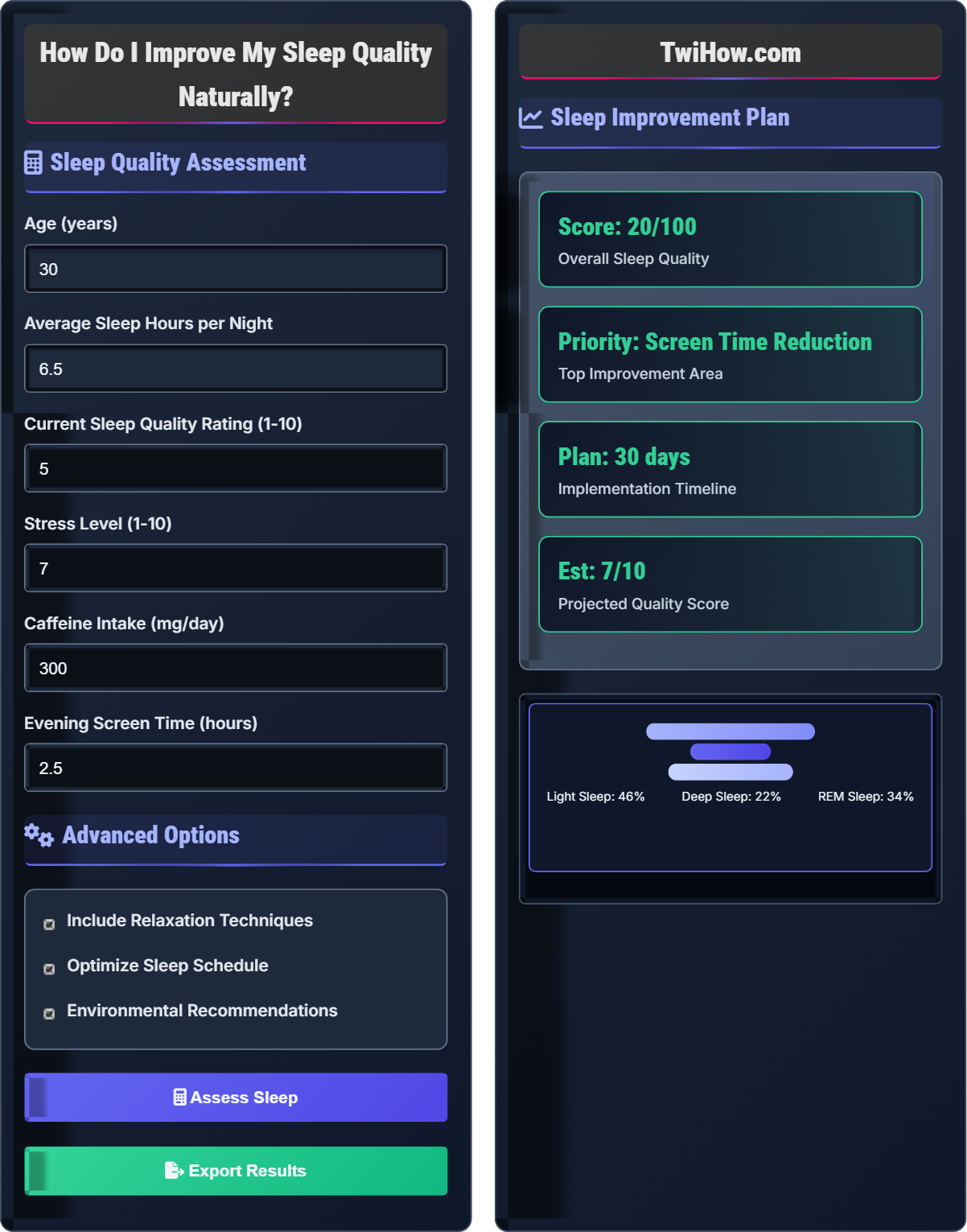
Sleep Quality Assessment
Advanced Options
Sleep Improvement Plan
| Area | Current Status | Recommendation |
|---|---|---|
| Bedtime Routine | Inconsistent | Establish 30-min wind-down |
| Screen Time | 2.5 hours | Reduce to 1 hour before bed |
| Caffeine Intake | 300mg | Limit to 200mg, avoid after 2pm |
| Stress Management | High | Practice meditation/relaxation |
Environmental Improvements
Temperature: Keep bedroom between 60-67°F (15-19°C)
Lighting: Use blackout curtains, dim lights 1 hour before bed
Noise: Use earplugs or white noise machine
Bedding: Invest in comfortable, breathable materials
Optimal Sleep Schedule
Bedtime: 10:30 PM (based on 8-hour sleep need)
Wake Time: 6:30 AM (consistent daily)
Power Naps: 20 minutes before 3 PM if needed
Consistency: Same times on weekends
Science of Natural Sleep Improvement
Sleep consists of different stages that cycle throughout the night. Understanding these stages helps optimize sleep quality:
Healthy sleep includes approximately 50% light sleep, 20% deep sleep, and 25% REM sleep. Deep sleep is crucial for physical restoration, while REM sleep supports cognitive function and emotional regulation.
Your circadian rhythm is your body's internal clock that regulates sleep-wake cycles. Optimizing it involves:
Key factors affecting circadian rhythm:
- Light Exposure: Bright light in morning, dim light at night
- Temperature: Cooler temperatures promote sleepiness
- Timing: Consistent sleep/wake times
- Meals: Regular eating schedule
Research supports several evidence-based approaches for natural sleep improvement:
- Progressive Muscle Relaxation: Systematically tense and relax muscles
- Mindfulness Meditation: Focus on breathing and present moment awareness
- Light Therapy: Morning bright light exposure to regulate circadian rhythm
- Herbal Remedies: Chamomile, valerian root, lavender aromatherapy
- Cognitive Restructuring: Challenge anxious thoughts about sleep
- Patience: Sleep improvements take 2-4 weeks to establish
- Consistency: Same times daily, including weekends
- Gradual Changes: Implement one change at a time
- Tracking: Monitor sleep patterns and triggers
- Realistic Expectations: Focus on quality, not just quantity
Sleep Fundamentals
Circadian rhythm, sleep hygiene, sleep stages, melatonin, sleep pressure, relaxation techniques.
Optimal Bedtime = Wake Time - Sleep Need (typically 7-9 hours)
Where Sleep Need varies by individual, with most adults requiring 7-9 hours for optimal health.
- Consistency is more important than perfect timing
- Avoid screens 1-2 hours before bed
- Keep bedroom cool, dark, and quiet
Environmental Optimization
Temperature: 60-67°F, Lighting: Dim/none, Noise: Minimal, Bedding: Comfortable.
- Install blackout curtains or eye mask
- Set room temperature to 60-67°F
- Use white noise machine or earplugs
- Invest in comfortable mattress and pillows
- Individual preferences vary significantly
- Changes may take weeks to show effects
- Combine multiple environmental factors
- Monitor for allergies or sensitivities
Sleep Improvement Knowledge Quiz
According to sleep experts, how many hours before bedtime should you stop using electronic devices?
Sleep experts recommend avoiding electronic devices 1-2 hours before bedtime. The blue light emitted by screens suppresses melatonin production, making it harder to fall asleep. This light can shift your circadian rhythm and delay sleep onset. Even dimmed screens can have this effect, so it's best to avoid them entirely before bed.
The answer is B) 1-2 hours.
Understanding the impact of screen time on sleep is crucial for natural sleep improvement. Blue light from screens mimics daylight, signaling to your brain that it's still daytime. This disrupts your natural circadian rhythm and can make it difficult to fall asleep. The 1-2 hour window allows your body to begin producing melatonin naturally.
Blue Light: High-energy visible light that suppresses melatonin
Circadian Rhythm: Body's internal clock regulating sleep-wake cycles
Melatonin: Hormone that promotes sleepiness
• Avoid screens 1-2 hours before bed
• Use blue light filters if screens are unavoidable
• Replace screen time with relaxing activities
• Set device timers to remind you
• Read physical books instead of e-readers
• Charge devices outside the bedroom
• Using devices right up until bedtime
• Not realizing blue light affects sleep
• Thinking dimming screens eliminates blue light
Explain the ideal sleep environment conditions and why each factor is important for natural sleep improvement.
Temperature: 60-67°F (15-19°C) is optimal because your core body temperature naturally drops as you prepare for sleep. A cooler room supports this natural process and promotes deeper sleep.
Lighting: Complete darkness or very dim lighting signals to your brain that it's time to sleep. Light exposure suppresses melatonin production and can delay sleep onset.
Noise: Quiet environments prevent sleep disruption. If complete silence isn't possible, consistent white noise can mask disruptive sounds.
Comfort: A supportive mattress and comfortable bedding prevent physical discomfort that can interrupt sleep. Room ventilation is also important for air quality.
The sleep environment plays a crucial role in natural sleep quality because our bodies are sensitive to external stimuli. Creating optimal conditions supports your body's natural sleep processes rather than fighting against them. Small environmental changes can have significant impacts on sleep quality.
Core Body Temperature: Internal temperature that drops during sleep preparation
White Noise: Consistent sound that masks disruptive noises
Environmental Sleep Cues: External factors that signal sleep time
• Keep bedroom temperature between 60-67°F
• Achieve complete darkness
• Minimize disruptive sounds
• Use blackout curtains or eye mask
• Try cooling mattress pads
• Use earplugs or white noise machine
• Keeping bedroom too warm
• Not addressing light pollution
• Ignoring noise disruptions
John works evening shifts and struggles with sleep during the day. He typically goes to bed at 11 AM after work and wakes up at 7 PM for his next shift. His bedroom gets bright sunlight in the morning. What natural sleep strategies would you recommend for John to improve his daytime sleep quality?
Environmental Modifications: Install heavy blackout curtains or blinds to block out all sunlight. Consider light-blocking window film for maximum darkness. Use a sleep mask as backup.
Noise Control: Use earplugs or a white noise machine to block out daytime sounds like traffic, neighbors, etc. Consider a fan for consistent background noise.
Pre-Sleep Routine: Establish a wind-down routine immediately after getting home from work. Take a warm shower, read, or practice relaxation techniques.
Temperature Control: Keep the bedroom cool (60-67°F) using air conditioning or fans. Consider cooling mattress accessories.
Posture: Use an eye mask to block any remaining light, even with blackout curtains.
Consistency: Maintain the same sleep schedule even on days off to stabilize his circadian rhythm.
This example demonstrates how to adapt sleep recommendations for shift workers. The key is to recreate nighttime conditions during the day. This requires more aggressive environmental modifications since John is fighting against his natural circadian rhythm. Consistency becomes even more important for shift workers to establish a stable sleep pattern.
Shift Work Sleep Disorder: Disruption of circadian rhythm due to work schedule
Light Blocking: Methods to eliminate light exposure during sleep
Chronotherapy: Gradually adjusting sleep schedule
• Block out all light for daytime sleep
• Maintain consistent schedule
• Create artificial night environment
• Use multiple layers of light blocking
• Inform family/housemates of sleep schedule
• Consider melatonin supplements (consult doctor first)
• Accepting light exposure as inevitable
• Not maintaining consistent schedule
• Skipping pre-sleep routine
Sarah experiences high anxiety and racing thoughts that prevent her from falling asleep. She often lies awake for 1-2 hours thinking about work and personal concerns. What natural relaxation techniques can she use to calm her mind before sleep?
Progressive Muscle Relaxation: Starting with toes and working upward, tense each muscle group for 5 seconds, then release. This creates physical relaxation that promotes mental calm.
4-7-8 Breathing: Inhale for 4 counts, hold for 7, exhale for 8. This activates the parasympathetic nervous system and reduces anxiety.
Mindfulness Meditation: Focus on breath or body sensations. When thoughts arise, acknowledge them without judgment and return focus to breath.
Journaling: Write down worries or tomorrow's tasks before bed to clear the mind. This prevents rumination during sleep attempts.
Visualization: Imagine a peaceful scene or place, engaging all senses. This redirects attention away from stressful thoughts.
Thought Stopping: When racing thoughts begin, mentally say "stop" and redirect to a calming phrase like "I am relaxed and safe."
Stress and anxiety are common barriers to natural sleep. The techniques mentioned work by activating the parasympathetic nervous system, which counteracts the fight-or-flight response that keeps us alert. Physical relaxation often leads to mental relaxation, creating a positive feedback loop toward sleepiness.
Parasympathetic Nervous System: Controls rest and relaxation functions
Progressive Muscle Relaxation: Systematic tensing and releasing of muscles
Mindfulness: Present-moment awareness without judgment
• Practice techniques consistently
• Start with 10-15 minutes
• Be patient with results
• Use guided meditation apps
• Try different techniques to find what works
• Practice during the day to build skill
• Expecting immediate results
• Giving up after one session
• Trying too many techniques at once
What is the most important aspect of maintaining a healthy sleep schedule?
Consistency of both bedtime and wake time is the most important aspect of a healthy sleep schedule. Your body's internal clock (circadian rhythm) responds best to predictable patterns. While going to bed and waking up at the same time daily, even on weekends, helps regulate your natural sleep-wake cycle. This consistency is more important than getting exactly 8 hours or sleeping at a specific time of night.
The answer is B) Consistency of both bedtime and wake time.
This question highlights that sleep schedule consistency is more important than perfect timing or exact hours. Our circadian rhythms thrive on predictability. Irregular sleep schedules (like sleeping in on weekends) can disrupt our internal clock and make it harder to fall asleep and wake up consistently. The timing of sleep matters less than the consistency of the schedule.
Circadian Rhythm: Body's internal 24-hour clock
Sleep Schedule Consistency: Regular timing of sleep periods
Chronodisruption: Disturbance of circadian rhythms
• Same sleep/wake times daily
• Even on weekends
• Consistency over perfect hours
• Use alarm to signal bedtime
• Prepare for bed before feeling tired
• Gradually adjust schedule if needed
• Having different weekend schedules
• Focusing only on bedtime
• Ignoring wake time consistency
FAQ
Q: I've tried all the natural sleep tips but still can't fall asleep. When should I consider seeing a doctor?
A: You should consider seeing a doctor if you've consistently practiced good sleep hygiene for 2-3 weeks without improvement. Other signs that warrant medical evaluation include:
• Difficulty falling asleep for more than 30 minutes regularly
• Waking up frequently during the night and struggling to return to sleep
• Daytime fatigue that interferes with daily activities
• Snoring loudly or gasping for air during sleep
• Restless legs or uncomfortable sensations that keep you awake
• Persistent insomnia despite natural interventions
Sleep problems can sometimes indicate underlying medical conditions like sleep apnea, restless leg syndrome, or other sleep disorders that require professional diagnosis and treatment. A sleep specialist can perform studies to identify specific issues and recommend appropriate therapies.
Q: How long does it typically take to see improvements in sleep quality after implementing natural strategies?
A: Most people begin to notice initial improvements in sleep quality within 3-7 days of implementing consistent sleep hygiene practices. However, significant and lasting improvements typically take 2-4 weeks of consistent implementation.
The timeline varies based on several factors:
• Severity of previous sleep problems
• Consistency in implementing changes
• Individual responsiveness to interventions
• Presence of underlying sleep disorders
It's important to be patient and persistent. Some changes, like adjusting to a cooler bedroom temperature, may show immediate effects, while others, like establishing a consistent circadian rhythm, take longer to develop. Keep a sleep diary to track your progress and identify which strategies are most effective for you.
Remember that small, consistent improvements compound over time. Focus on building sustainable habits rather than expecting overnight transformations.