How to Protect Your Skin from Sun Damage
Complete sun protection guide • Step-by-step explanations
Sun Protection Overview:
Show Sun Protection CalculatorProtecting your skin from sun damage is crucial for preventing skin cancer, premature aging, and other harmful effects. The sun emits ultraviolet (UV) radiation that damages skin cells, leading to DNA mutations and photoaging. Effective sun protection involves multiple strategies including sunscreen, protective clothing, seeking shade, and avoiding peak sun hours.
UV radiation consists of UVA (aging) and UVB (burning) rays. Both cause skin damage and contribute to skin cancer. SPF (Sun Protection Factor) measures protection against UVB rays, while broad-spectrum coverage protects against both UVA and UVB.
Core concepts:
- SPF Rating: Protection factor against UVB rays
- Broad Spectrum: Protection against both UVA and UVB
- UPF Rating: Protection factor for clothing
- UV Index: Measurement of UV radiation intensity
- Sun Exposure Timing: Peak hours when UV rays are strongest
Proper sun protection requires consistent application and multiple protective measures for optimal effectiveness.
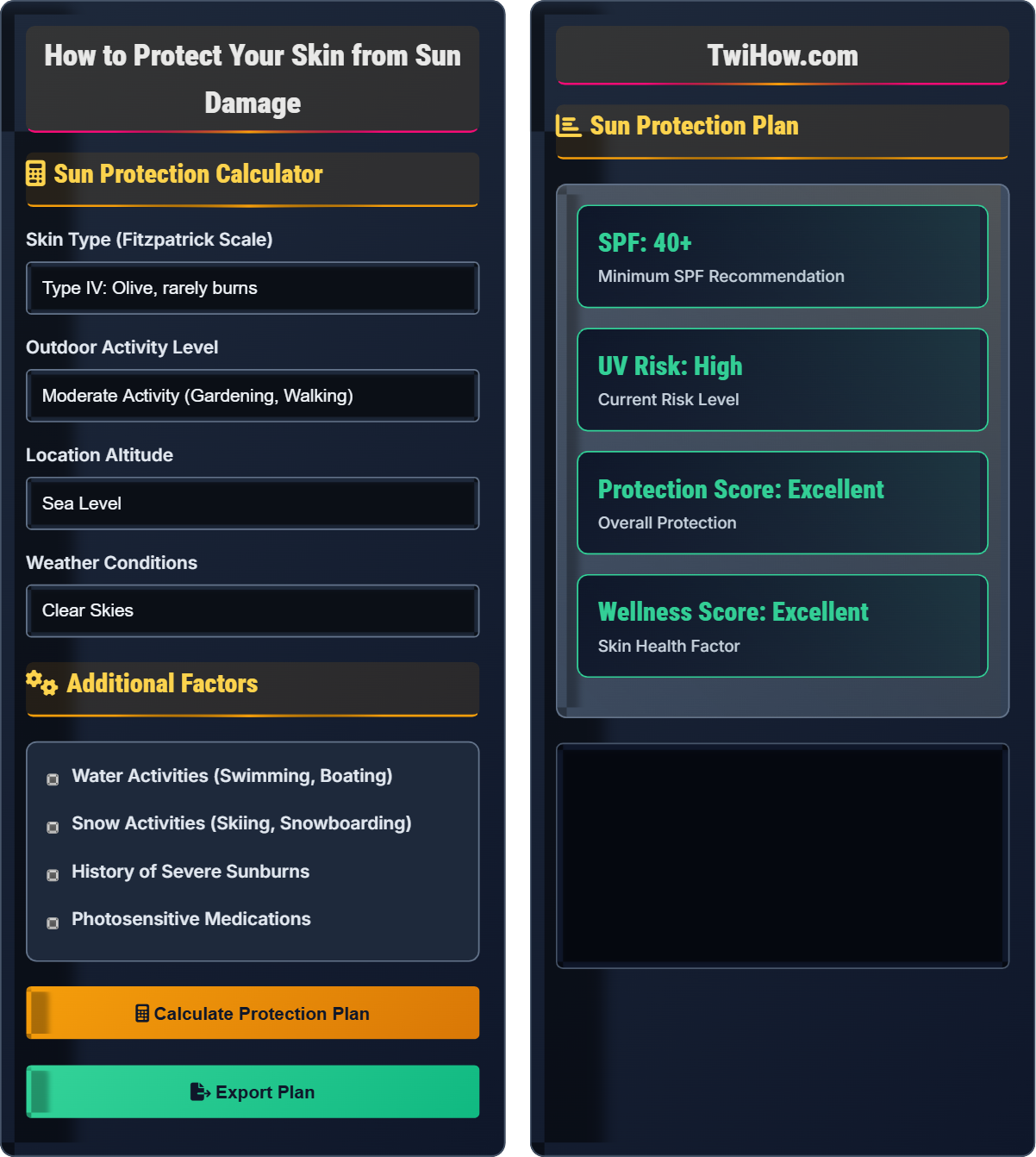
Sun Protection Calculator
Additional Factors
Sun Protection Plan
| Time | Action | Details |
|---|---|---|
| Before going out | Apply sunscreen | Use SPF 30+ on all exposed skin |
| Every 2 hours | Reapply sunscreen | More frequently if swimming/sweating |
| Peak hours | Seek shade | 10am-4pm when UV is strongest |
| After sun exposure | Apply after-sun care | Moisturizer with aloe vera |
Sun Protection Science Explained
Ultraviolet radiation consists of two main types that affect skin health:
- UVA Rays: Longer wavelength, penetrate deeper into skin, cause aging and wrinkling
- UVB Rays: Shorter wavelength, primarily affect outer skin layer, cause sunburn
Both UVA and UVB rays can cause DNA damage leading to skin cancer and premature aging.
SPF (Sun Protection Factor) measures protection against UVB rays:
- SPF 15: Blocks about 93% of UVB rays
- SPF 30: Blocks about 97% of UVB rays
- SPF 50: Blocks about 98% of UVB rays
SPF indicates how long you can stay in the sun without burning compared to unprotected skin.
Clothing provides additional protection through UPF (Ultraviolet Protection Factor):
- UPF 15-24: Good protection
- UPF 25-39: Very good protection
- UPF 40-50+: Excellent protection
Dark colors, tightly woven fabrics, and specially treated textiles offer better protection.
UV radiation is strongest between 10am and 4pm when the sun is highest in the sky. During these peak hours:
- UV index is typically 6-11+ (high to extreme)
- Shadow is shorter than your height
- Extra precautions are necessary
Planning outdoor activities for early morning or late afternoon significantly reduces UV exposure.
Sun exposure causes various types of skin damage:
- Sunburn: Acute inflammation from UVB exposure
- Photoaging: Premature aging from chronic UVA exposure
- Hyperpigmentation: Dark spots and uneven tone
- Skin Cancer: DNA damage leading to malignant growths
Protection prevents all these forms of damage.
Effective sun protection combines multiple strategies:
Protection Level = (Sunscreen Factor × Clothing Coverage × Shade Seeking × Timing) - (Environmental Factors × Skin Sensitivity)
Maximizing each component provides optimal protection.
Sun Protection Methods
Sunscreen application, protective clothing, seeking shade, wearing sunglasses, avoiding peak hours, using broad-spectrum products.
Amount Needed = 1 oz (2 tbsp) per full body coverage
Reapplication Frequency = Every 2 hours, or immediately after swimming/sweating.
- Apply sunscreen 15 minutes before sun exposure
- Use enough product (1 oz for full body)
- Reapply every 2 hours minimum
- Don't forget often-missed areas (ears, feet, neck)
Risk Assessment
Skin type, family history, previous sunburns, medications, geographic location, altitude, reflection surfaces.
- Assess baseline risk (skin type, history)
- Consider environmental factors
- Calculate cumulative exposure
- Select appropriate protection level
- Monitor for changes
- Higher risk requires more protection
- Consistency is crucial
- Multiple methods are most effective
- Vigilance is required year-round
Sun Protection Quiz
If you normally burn after 10 minutes of sun exposure without protection, how long would you theoretically be protected with SPF 30 sunscreen?
SPF stands for Sun Protection Factor and indicates how much longer you can stay in the sun without burning compared to unprotected skin.
Formula: Protected time = SPF × Unprotected burn time
Calculation: 30 × 10 minutes = 300 minutes (5 hours)
However, this is theoretical. In reality, sunscreen effectiveness decreases due to sweating, swimming, rubbing, and degradation, so reapplication every 2 hours is recommended regardless of SPF.
The answer is B) 300 minutes (5 hours).
The SPF number represents a multiplication factor for your natural protection time. Understanding this helps in calculating how long you can safely stay in the sun. However, it's important to remember that this is a theoretical calculation and real-world factors reduce effectiveness.
SPF: Sun Protection Factor measuring UVB protection
Theoretical Protection: Calculated time based on SPF factor
Real-World Protection: Actual protection considering practical factors
• SPF is a multiplication factor
• Reapplication is necessary regardless of SPF
• Environmental factors affect effectiveness
• Use the "2-hour rule" for reapplication
• Apply before sun exposure (not during)
• Use more than you think you need
• Thinking high SPF means you don't need to reapply
• Applying too little sunscreen
• Not accounting for environmental factors
Explain the difference between UVA and UVB rays, their effects on skin, and how to protect against each type.
UVA Rays (Ultraviolet A):
• Wavelength: 320-400 nanometers
• Penetration: Deeper into skin (dermis layer)
• Effects: Premature aging, wrinkles, loss of elasticity, hyperpigmentation
• Intensity: Consistent throughout the day and year
• Protection: Look for "broad spectrum" and "UVA protection" on labels
UVB Rays (Ultraviolet B):
• Wavelength: 290-320 nanometers
• Penetration: Primarily affects outer skin layer (epidermis)
• Effects: Sunburn, direct DNA damage, skin cancer
• Intensity: Strongest between 10am-4pm, varies by season/location
• Protection: Measured by SPF rating
Protection Strategy: Use broad-spectrum sunscreen that protects against both UVA and UVB rays. Look for ingredients like zinc oxide, titanium dioxide, avobenzone, or mexoryl SX.
Understanding the different types of UV radiation is crucial for selecting appropriate protection. Many people focus only on UVB protection (which causes visible sunburn) while neglecting UVA protection (which causes invisible but equally damaging effects).
UVA: Aging rays that penetrate deeply into skin
UVB: Burning rays that affect surface skin layers
Broad Spectrum: Protection against both UVA and UVB rays
• Protect against both UVA and UVB
• Look for broad-spectrum protection
• UVA damage is cumulative and irreversible
• Always choose broad-spectrum products
• UVA protection doesn't depend on SPF number
• Check ingredient list for UVA filters
• Assuming high SPF protects against UVA
• Not checking for broad-spectrum label
• Thinking cloudy days eliminate UV exposure
You're planning a beach day and need to apply sunscreen to cover your entire body. If the recommended amount is 1 ounce (2 tablespoons) for full body coverage, and you plan to stay at the beach for 8 hours, how much sunscreen will you need to bring if you reapply every 2 hours?
Initial Application: 1 ounce (2 tablespoons)
Reapplication Schedule:
Starting at 10am, reapplying every 2 hours for 8 hours means applications at:
• 10am (initial)
• 12pm (reapplication 1)
• 2pm (reapplication 2)
• 4pm (reapplication 3)
Total Applications: 4 applications
Total Sunscreen Needed: 4 × 1 ounce = 4 ounces
Therefore, you should bring at least 4 ounces (120ml) of sunscreen for an 8-hour beach day with 2-hour reapplication intervals.
Additional Considerations: If swimming or sweating heavily, you may need to reapply more frequently, requiring additional sunscreen.
Proper sunscreen application requires not just the right amount for each application, but also sufficient quantity for the entire duration of sun exposure. Many people underestimate how much sunscreen they need for extended outdoor activities.
Application Amount: Quantity needed for adequate coverage
Reapplication Interval: Time between subsequent applications
Duration Coverage: Total quantity needed for planned exposure
• Use 1 oz per full body application
• Reapply every 2 hours minimum
• Calculate total needed for duration
• Bring more than you think you'll need
• Pack sunscreen in clear containers
• Consider travel-size bottles for portability
• Not bringing enough sunscreen for duration
• Applying too little per application
• Forgetting to account for reapplications
The UV index forecast for today is 8 (Very High). You need to spend 3 hours outdoors for work. What protection measures should you take based on this UV index level, and what is the estimated time to sunburn without protection?
UV Index 8 (Very High) Characteristics:
• UV Index Scale: 8-10
• Risk Level: Very High
• Estimated Time to Burn: 15-25 minutes for fair skin
• Intensity: Approximately 8 times stronger than UV Index 1
Required Protection Measures:
1. Sunscreen: Apply SPF 30+ broad-spectrum sunscreen 15 minutes before exposure
2. Clothing: Wear long-sleeved shirt, long pants, wide-brimmed hat (3 inches+)
3. Sunglasses: UV-blocking sunglasses
4. Shade: Seek shade during peak hours (10am-4pm)
5. Reapplication: Every 2 hours, more frequently if sweating
Special Considerations:
• UV radiation is strong even on cloudy days
• Reflection from surfaces (water, sand, snow) increases exposure
• Altitude increases UV intensity by 10% per 1000 meters
For 3 hours of outdoor work at UV Index 8, you'll need maximum protection measures to prevent sun damage.
The UV Index is a valuable tool for determining appropriate protection levels. It standardizes UV radiation measurement, allowing people to make informed decisions about sun exposure regardless of weather conditions.
UV Index: Measurement of UV radiation intensity
Peak Hours: Time of day with strongest UV radiation
Reflection: UV rays bouncing off surfaces, increasing exposure
• UV Index 6+ requires extra precautions
• Index 8+ requires maximum protection
• Protection needed even on cloudy days
• Check UV index daily in weather reports
• Download UV index apps for real-time updates
• Plan outdoor activities for low UV index times
• Not checking UV index before outdoor activities
• Assuming clouds block UV radiation
• Underestimating reflection effects
Which of the following is a common myth about sun protection?
The answer is A) Dark-skinned people don't need sunscreen.
This is a dangerous myth. While people with darker skin have more melanin which provides some natural protection against UV rays, they can still get sunburned and develop skin cancer. Darker-skinned individuals often receive diagnoses at later stages because of this misconception.
Options B, C, and D are all facts:
• Sunscreen should be reapplied every 2 hours (B) - TRUE
• UV rays can penetrate clouds (C) - TRUE (up to 80% of UV radiation reaches ground on cloudy days)
• Sunscreen should be applied 15 minutes before sun exposure (D) - TRUE (allows absorption and formation of protective barrier)
Everyone, regardless of skin tone, needs sun protection to prevent skin damage and cancer.
Dispelling sun protection myths is crucial for public health. Misinformation can lead to inadequate protection and increased health risks. It's important to understand that sun protection is universal and not dependent on skin color.
Melanin: Natural pigment that provides some UV protection
Skin Cancer: Malignant growths caused by UV-induced DNA damage
Universal Protection: Sun safety for all skin types
• Sun protection is universal
• Everyone can get skin cancer
• Myths can be dangerous
• Share sun safety facts with others
• Educate about universal sun protection
• Dispel common myths respectfully
• Believing sun protection myths
• Assuming darker skin is immune to UV damage
• Not educating others about risks
FAQ
Q: I'm going on vacation to Hawaii. What SPF should I use, and how often should I reapply sunscreen?
A: For Hawaii's intense tropical sun, I recommend:
SPF Recommendation: Use at least SPF 30, but SPF 50+ is better for tropical conditions with intense UV radiation. Hawaii has a high UV index year-round due to its proximity to the equator.
Application Guidelines:
1. Amount: Apply 1 ounce (2 tablespoons) for full body coverage
2. Timing: Apply 15-30 minutes before sun exposure
3. Frequency: Reapply every 2 hours, or immediately after swimming/sweating
Additional Considerations:
• Use water-resistant sunscreen (good for 40-80 minutes of swimming/sweating)
• Seek shade during peak hours (10am-4pm)
• Wear UPF clothing and wide-brimmed hats
• Don't forget often-missed areas like ears, feet, and behind the neck
Given Hawaii's strong sun, it's better to over-protect than under-protect.
Q: What sunscreen is safe and effective for children under 6 months?
A: For infants under 6 months, sun protection is primarily through physical barriers:
Primary Recommendations:
1. Keep Out of Direct Sun: Especially for babies under 6 months
2. Protective Clothing: Lightweight, long-sleeved shirts and pants
3. Wide-Brimmed Hats: That shade the face, ears, and neck
4. Umbrellas/Shade: Use stroller covers or pop-up tents
Sunscreen Use:
• The American Academy of Pediatrics says sunscreen may be used sparingly on small areas of exposed skin if adequate clothing and shade are not available
• Use mineral-based sunscreens with zinc oxide or titanium dioxide
• Avoid chemical sunscreens in infants
• Always prioritize physical protection over sunscreen for infants
Remember: babies' skin is more sensitive and prone to irritation, so physical barriers are always preferred.