How Do I Start a Fitness Routine and Stick With It?
Complete fitness routine guide • Step-by-step explanations
Fitness Routine Fundamentals:
Show Fitness PlannerStarting and maintaining a fitness routine requires a strategic approach that includes goal setting, realistic planning, consistent habits, and sustainable motivation. Success comes from finding activities you enjoy, setting achievable milestones, and creating systems that support long-term adherence.
Fitness routines work by establishing consistent patterns that become automatic over time. The key is to start small, focus on consistency over intensity, and gradually build complexity. Behavioral science shows that habits form through repetition and reinforcement, making it crucial to create positive associations with exercise.
Key fitness routine components:
- Goal Setting: Specific, measurable, achievable, relevant, time-bound objectives
- Workout Planning: Balanced program including cardio, strength, and flexibility
- Habit Formation: Consistent scheduling and routine establishment
- Motivation Strategies: Tracking progress, celebrating wins, finding accountability
Modern fitness routines combine evidence-based exercise principles with personalized motivation techniques tailored to individual preferences and lifestyle factors.
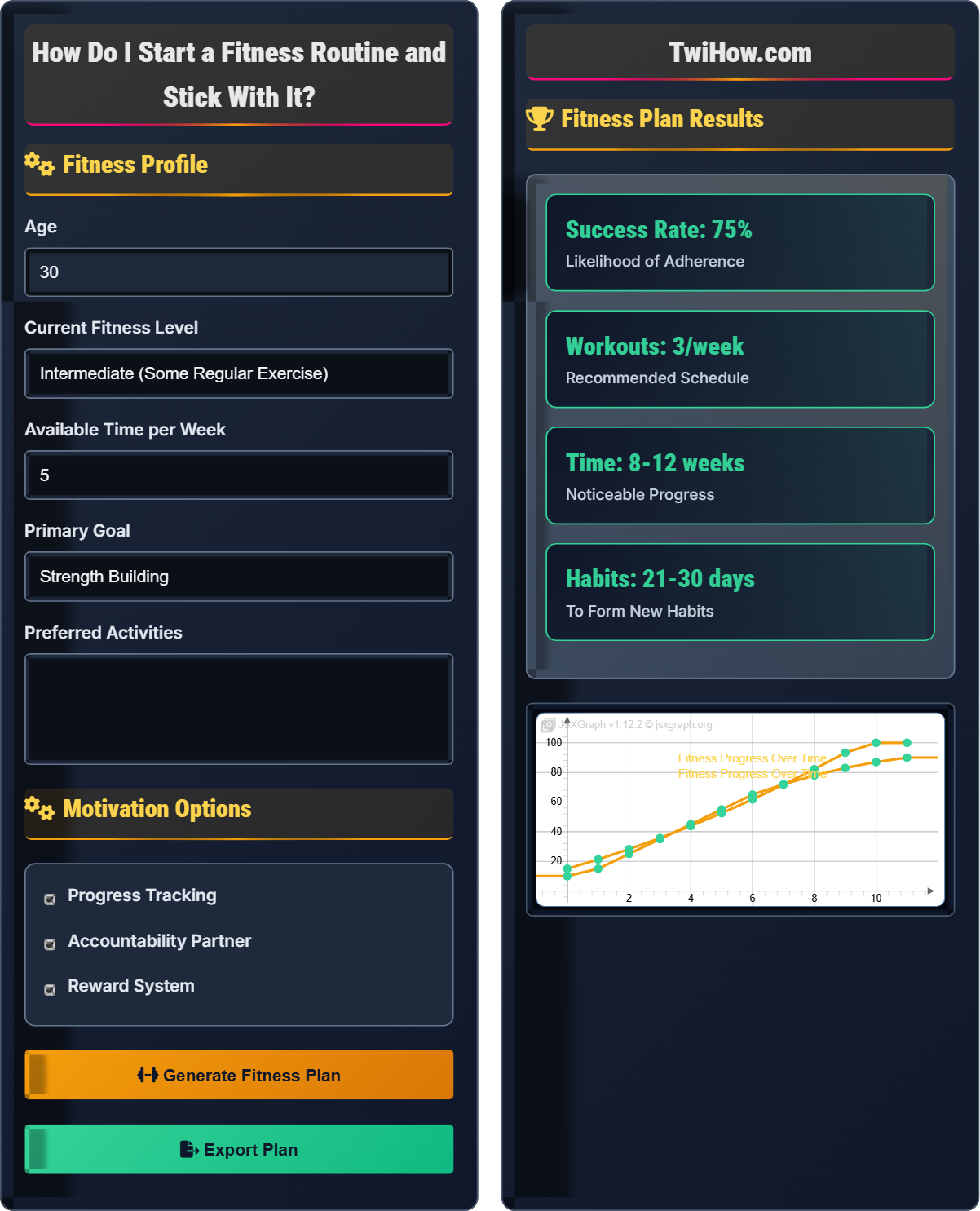
Fitness Profile
Motivation Options
Fitness Plan Results
| Day | Activity | Duration | Intensity |
|---|---|---|---|
| Monday | Cardio + Strength | 45 min | Moderate |
| Tuesday | Rest or Light Yoga | 20 min | Low |
| Wednesday | Strength Training | 50 min | Moderate |
| Thursday | Cardio | 30 min | High |
Fitness Routine Creation Explained
A successful fitness routine combines several key elements: appropriate exercise selection based on goals and fitness level, realistic scheduling that fits into daily life, progressive overload to ensure continuous improvement, and sustainable practices that can be maintained long-term. The routine should address all major fitness components: cardiovascular health, muscular strength, flexibility, and body composition.
Success in maintaining a fitness routine depends heavily on psychological factors including motivation, habit formation, and the ability to overcome obstacles. The routine must be enjoyable enough to sustain and flexible enough to adapt to life circumstances.
Adherence = (Enjoyment × Consistency × Realistic Goals × Support System) ÷ (Barriers × Complexity)
Where:
- Enjoyment: How much you like the activities
- Consistency: Regularity of workout schedule
- Realistic Goals: Appropriate challenge level
- Support System: Accountability and encouragement
- Barriers: Obstacles to exercising
- Complexity: Difficulty of routine
A comprehensive fitness routine should include:
- Cardiovascular Exercise: 150 minutes moderate or 75 minutes vigorous weekly
- Strength Training: 2-3 sessions targeting all major muscle groups
- Flexibility: Stretching or mobility work 2-3 times weekly
- Balance & Coordination: Especially important as we age
- Recovery: Rest days and proper sleep for adaptation
- Start Small: Begin with minimal viable workout to establish routine
- Stack Habits: Attach new habit to existing routine
- Focus on Consistency: Same time/day increases adherence
- Track Progress: Visible results maintain motivation
- Plan for Obstacles: Prepare responses to common barriers
Fitness Routine Fundamentals
Habit formation, progressive overload, specificity principle, recovery, consistency, periodization.
Success Rate = (Consistency × Enjoyment × Goal Alignment) / (Barriers × Complexity)
Where Success Rate indicates likelihood of adherence, components are weighted by research evidence.
- Start with 50% of your goal intensity
- Focus on consistency over perfection
- Make it convenient and accessible
Applications
Home workouts, gym routines, outdoor activities, group fitness, virtual training.
- Assess current fitness level
- Set SMART goals
- Create personalized plan
- Establish routine and track progress
- Individual preferences matter
- Progressive overload is essential
- Recovery is part of the plan
- Flexibility maintains long-term adherence
Fitness Routine Learning Quiz
According to research on habit formation, how many days does it typically take to form a new exercise habit?
Research published in the European Journal of Social Psychology found that it takes an average of 66 days to form a new habit, though this can vary widely from 18 to 254 days depending on the person and the behavior. The popular 21-day rule is a myth that originated from a misinterpretation of plastic surgery patient observations.
The answer is C) 66 days (on average).
Understanding the realistic timeline for habit formation helps set appropriate expectations. Many people abandon fitness routines after 2-3 weeks expecting immediate habit formation. Knowing the actual timeline helps maintain motivation during the initial difficult period when the behavior still feels effortful.
Habit Formation: Process of turning behavior into automatic routine
Automaticity: Degree to which behavior becomes unconscious
Consistency: Regular performance of behavior
• Habits take longer than expected
• Consistency is more important than perfection
• Individual variation is significant
• Expect the process to take time
• Focus on daily consistency
• Track progress to stay motivated
• Expecting instant habit formation
• Giving up too early
• Being too rigid about timing
Explain the "start small" principle in fitness routine creation and why it's more effective than beginning with an ambitious program.
The "Start Small" Principle: This approach involves beginning with a workout that's significantly easier than your goal level, then gradually progressing over time.
Why It Works:
Psychological Benefits: Small wins build confidence and motivation. Success early in the process encourages continuation.
Physical Benefits: Allows body to adapt gradually, reducing injury risk and excessive soreness that can discourage beginners.
Habit Formation: Easier to maintain consistency when the routine is manageable. Consistency is more important than intensity for habit formation.
Expectation Management: Prevents disappointment from overambitious goals that aren't met, which often leads to abandonment.
Research Support: Studies show that people who start with smaller, achievable goals have higher long-term adherence rates than those who start with challenging programs.
Practical Example: Instead of aiming for 5 days per week of intense exercise, start with 2-3 days of moderate activity and gradually increase.
The "start small" principle leverages the psychological concept of "implementation intentions" and the importance of early success experiences. When people achieve their initial goals, they develop self-efficacy (belief in their ability to succeed), which is crucial for long-term adherence. This approach also allows the body to adapt physiologically before increasing demands.
Self-Efficacy: Belief in one's ability to succeed
Implementation Intentions: Specific plans for goal-directed behavior
Progressive Overload: Gradually increasing exercise demands
• Begin at 50% of your goal capacity
• Focus on consistency over intensity
• Gradual progression prevents injury
• Make it easier than you think you need
• Celebrate small victories
• Plan for gradual increases
• Starting too ambitiously
• Ignoring early warning signs
• Not planning for progression
Sarah wants to start a fitness routine but faces several barriers: she works long hours, has young children, limited equipment at home, and no gym membership. How should she approach creating a realistic fitness plan that addresses these challenges?
Addressing Time Constraints: Focus on shorter, more frequent workouts (15-20 minutes) that can be done in chunks throughout the day. Use high-intensity interval training (HIIT) for efficient workouts.
Family Considerations: Include children in workouts when possible (babywearing exercises, playground workouts). Schedule workouts during naps or early morning before kids wake up.
Equipment Limitations: Design bodyweight-only routines that can be done anywhere. Focus on compound movements that work multiple muscle groups.
Gym-Free Options: Utilize free online resources, apps, and YouTube workouts. Outdoor activities like walking, running, or playground exercises.
Realistic Plan: Start with 2-3 days per week of 15-20 minute sessions. Focus on consistency rather than intensity. Choose activities that can be adapted to different circumstances.
Specific Recommendations: Morning workouts before kids wake up, bodyweight circuits during lunch breaks, evening walks with family. Stack exercise with existing habits (post-nap routine).
This example demonstrates the importance of environmental design and barrier anticipation in fitness planning. Successful routines are designed around real-life constraints rather than ideal circumstances. The key is to make the routine fit the person's life, not force the person to fit an unrealistic routine.
Environmental Design: Arranging surroundings to support desired behavior
Barrier Anticipation: Planning responses to obstacles
Compound Movements: Exercises working multiple muscle groups
• Design routine around real constraints
• Have backup plans for different scenarios
• Use minimal equipment options
• Involve family when possible
• Planning ideal-world routines
• Not accounting for life disruptions
• Being too inflexible
Tom successfully started his fitness routine 6 weeks ago but is now experiencing decreased motivation. He's seeing some progress but finds it harder to maintain consistency. What strategies should he implement to reignite his motivation and ensure long-term adherence?
Address Motivation Plateau: Acknowledge that motivation naturally fluctuates and rely on systems/habits rather than motivation alone.
Progress Recognition: Document and celebrate small wins. Use photos, measurements, or fitness apps to visualize progress beyond the scale.
Goal Adjustment: Set new short-term goals to maintain challenge and direction. Consider different types of goals (strength, endurance, skill-based).
Accountability Increase: Find a workout partner, join a community, or hire a coach for external accountability.
Enjoyment Enhancement: Add variety to prevent boredom. Try new activities, classes, or workout formats.
Identity Reinforcement: Focus on becoming the type of person who exercises rather than just someone who works out. Use affirming language and identity-based goals.
System Optimization: Review and refine systems that support the routine. Optimize workout times, locations, and preparation.
Remember that motivation follows behavior, so continuing to show up despite low motivation often restores motivation.
This scenario represents the common "motivation dip" that occurs around weeks 4-8 when initial enthusiasm wanes. The key is transitioning from motivation-based to habit-based exercise. This requires focusing on systems and identity rather than relying solely on feelings. Research shows that people who exercise despite not feeling like it are more successful long-term.
Identity-Based Goals: Goals focused on becoming a type of person
Systems Thinking: Focusing on processes rather than outcomesMotivation Plateau: Natural decrease in initial enthusiasm
• Habits > motivation for long-term success
• Motivation follows action, not vice versa
• Identity reinforces behavior
• Prepare for motivation fluctuations
• Focus on showing up regardless of feelings
• Celebrate consistency, not just results
• Stopping when motivation decreases
• Not planning for plateaus
• Relying solely on motivation
According to American College of Sports Medicine guidelines, how many days per week should adults engage in moderate-intensity aerobic activity for health benefits?
The American College of Sports Medicine recommends 150 minutes of moderate-intensity aerobic activity per week, which equates to 5 days of 30-minute sessions or 3 days of 50-minute sessions. This can be distributed flexibly, but the minimum recommendation is 3 days per week for health benefits.
The answer is C) 5 days per week (for 30 minutes daily).
These guidelines represent the minimum amount of exercise needed for health benefits. However, for fitness routine adherence, it's often better to start with fewer days and gradually increase. The key is consistency rather than meeting maximum recommendations immediately. Individual factors like current fitness level, goals, and schedule should influence the actual frequency chosen.
Moderate-Intensity: Exercise that raises heart rate and breathing
Aerobic Activity: Endurance-focused exercise
ACSM Guidelines: Evidence-based exercise recommendations
• Minimum 150 minutes weekly for health benefits
• Start with fewer days and progress
• Consistency beats intensity
• Break activity into smaller chunks
• Find activities you enjoy
• Use active transportation when possible
• Starting with too much volume
• Not accounting for rest days
• Ignoring individual capacity
FAQ
Q: I've failed at fitness routines before. How do I know this time will be different?
A: Previous failures provide valuable learning opportunities. Here's what makes this attempt different:
Learn from Past Mistakes: Analyze why previous attempts didn't work. Was it too ambitious? Poor timing? Lack of support? Address these specific issues.
Start Smaller: This time, begin with activities that feel almost too easy. Success builds momentum.
Focus on Systems, Not Goals: Create routines and habits rather than relying on motivation alone.
Prepare for Challenges: Plan responses to common obstacles before they occur.
Choose Enjoyable Activities: Select exercises you genuinely like, not just what you think you should do.
Build Gradually: Increase intensity only after consistency is established.
Most importantly, view setbacks as part of the process, not failures. Every successful exerciser has experienced ups and downs.
Q: Should I focus on cardio or strength training first when starting a routine?
A: Both are important, but for beginners, the order depends on your current fitness level and goals:
If Very Deconditioned: Start with light cardio to build basic endurance and prepare your body for more complex movements. This also helps with motivation through quick cardiovascular improvements.
If Overweight/Inactive: Begin with low-impact cardio combined with basic bodyweight strength exercises. This addresses multiple health concerns simultaneously.
If Generally Healthy: Include both from the start with emphasis on your primary goal. A balanced approach often works best.
Key Principles:
Foundational Strength: Basic strength is important for injury prevention and functional movement.
Cardiovascular Base: Heart and lung health are crucial for overall fitness.
Progressive Integration: Start with simple movements, then add complexity and intensity gradually.
Research shows that combining both types of exercise yields the best long-term results and adherence.