How Do I Support a Loved One with a Chronic Condition?
Complete chronic condition support guide • Step-by-step explanations
Chronic Condition Support:
Show Support PlannerSupporting a loved one with a chronic condition requires understanding, patience, and a balanced approach that maintains both their dignity and your own well-being. Chronic conditions, which include diabetes, heart disease, arthritis, multiple sclerosis, and many others, present ongoing challenges that affect not only the person diagnosed but also their entire support network.
Effective support involves emotional empathy, practical assistance, advocacy, and self-care. The goal is to empower the person with the condition while providing the help they need without creating dependency or undermining their independence. Support should adapt to the changing nature of chronic conditions.
Key support strategies:
- Emotional Support: Active listening, empathy, encouragement
- Practical Assistance: Transportation, household tasks, medical appointments
- Health Advocacy: Accompanying to appointments, medication management
- Education: Learning about the condition, treatment options
- Self-Care: Maintaining your own well-being as a supporter
Successful support requires a delicate balance between offering help and respecting autonomy, while adapting to the evolving needs that come with chronic conditions.
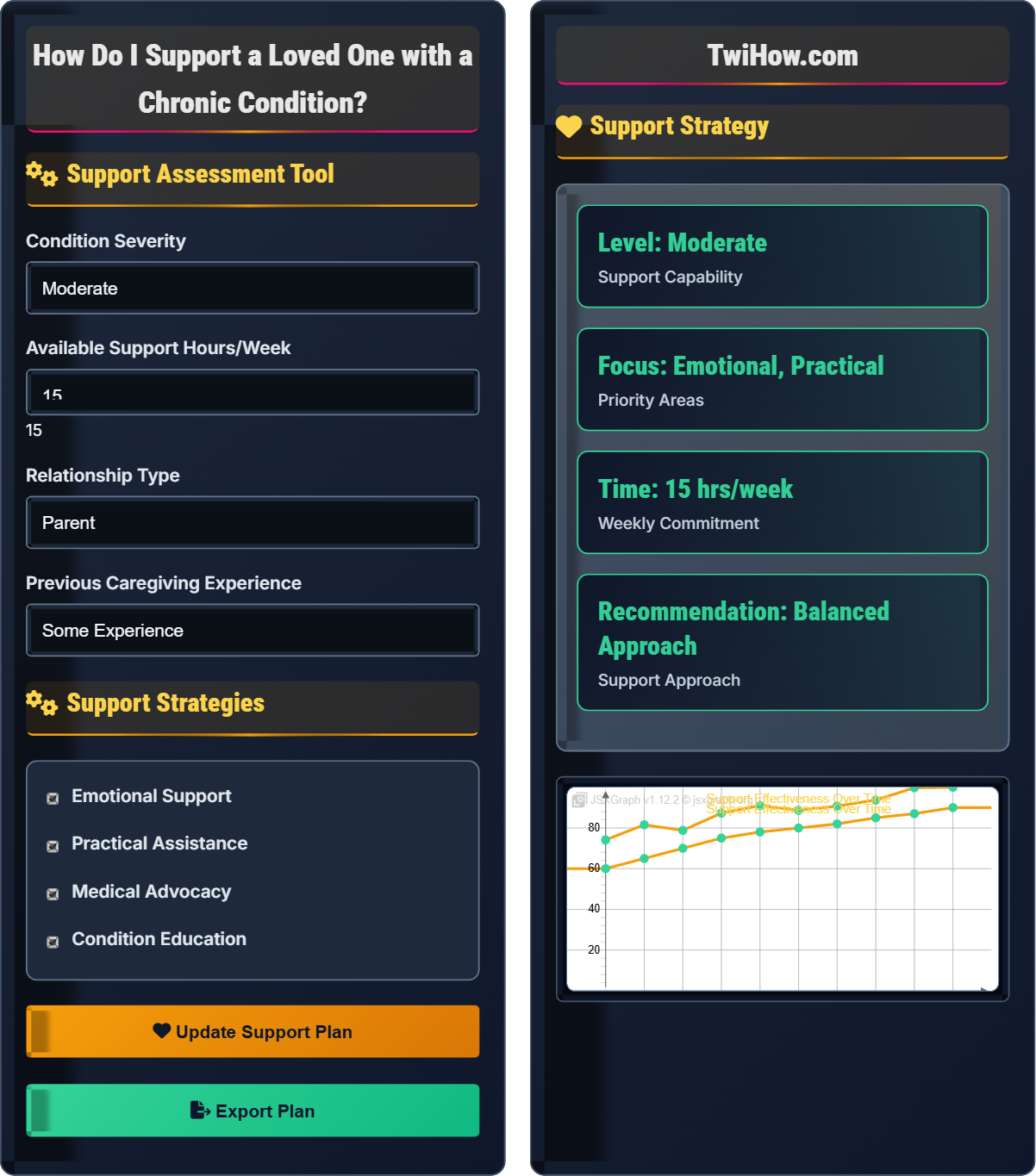
Support Assessment Tool
Support Strategies
Support Strategy
| Support Area | Current Level | Recommendation | Next Steps |
|---|---|---|---|
| Emotional Support | High | Continue | Check in regularly |
| Practical Help | Moderate | Increase | Transportation, meals |
| Medical Advocacy | Medium | Develop | Accompany to appointments |
| Condition Education | Medium | Continue | Research new developments |
| Self-Care | Low | Improve | Set boundaries, rest |
Chronic Condition Support Explained
Supporting a loved one with a chronic condition involves providing assistance, understanding, and advocacy while maintaining the dignity and independence of the person affected. Chronic conditions are long-lasting health problems that typically require ongoing management rather than cure, such as diabetes, heart disease, arthritis, multiple sclerosis, and many others.
Effective chronic condition support follows a comprehensive framework:
Where:
- Emotional Support: Empathy, listening, encouragement
- Practical Help: Daily tasks, transportation, household duties
- Medical Advocacy: Appointment attendance, medication management
- Personal Burnout: Risk of caregiver exhaustion
Key areas where chronic condition support provides significant benefits:
- Emotional Well-being: Reduced isolation and depression
- Medical Management: Better adherence to treatment plans
- Daily Living: Assistance with challenging tasks
- Health Outcomes: Improved condition management
- Relationship Quality: Maintained connections and intimacy
- Independence: Preserved autonomy and dignity
- Active Listening: Providing emotional validation and understanding
- Practical Assistance: Helping with daily tasks when needed
- Medical Advocacy: Supporting healthcare decisions and appointments
- Condition Education: Learning about the condition together
- Boundary Setting: Maintaining healthy limits
Support Fundamentals
Chronic condition, caregiver support, emotional support, medical advocacy, condition management, self-care.
Support Effectiveness = (Emotional Support + Practical Help + Medical Advocacy) / Personal Burnout
Where Emotional Support = empathy and validation, Practical Help = daily assistance.
- Respect autonomy and independence
- Maintain your own well-being
- Listen without trying to fix everything
Application Strategies
Emotional support, practical assistance, medical advocacy, condition education, self-care planning.
- Learn about the specific condition
- Assess needs and capabilities
- Set realistic expectations
- Establish sustainable routines
- Conditions evolve over time
- Needs change with condition progression
- Self-care is essential for supporters
- Professional help may be needed
Chronic Condition Support Learning Quiz
What is the most important principle when supporting a loved one with a chronic condition?
The most important principle is respecting the person's autonomy while providing appropriate support. This approach maintains their dignity, independence, and sense of control while ensuring they receive the help they need. Taking complete control or minimizing their involvement in decision-making undermines their agency and can lead to resentment. Chronic conditions require long-term management, and preserving the person's autonomy is crucial for their psychological well-being and motivation to manage their condition.
The answer is B) Respecting their autonomy while providing appropriate support.
This principle reflects the understanding that people with chronic conditions are still whole individuals deserving of respect and autonomy. While they may need assistance, they should remain active participants in their care decisions. This approach promotes better outcomes because individuals are more likely to adhere to plans they've helped create and feel ownership over.
Autonomy: Self-determination and decision-making power
Dignity: Respect for inherent worth and individuality
Person-Centered Care: Approach focusing on individual needs and preferences
• Respect autonomy while offering support
• Maintain dignity in all interactions
• Include person in decision-making
• Ask "What can I help with?" not "I'll do everything"
• Offer choices whenever possible
• Respect their decisions even if you disagree
• Taking over completely
• Making decisions without consultation
• Not respecting their preferences
Explain effective strategies for providing emotional support to a loved one with a chronic condition, including how to balance empathy with avoiding enabling.
Effective Emotional Support Strategies:
Active Listening: Give full attention without trying to immediately solve problems. Reflect back what you've heard to show understanding: "It sounds like you're feeling frustrated with the pain today."
Validation: Acknowledge their feelings without judgment: "It makes sense that you're tired of dealing with this every day."
Presence: Simply being available without trying to "fix" everything. Sometimes physical presence is more comforting than words.
Encouragement: Focus on strengths and acknowledge their efforts: "I'm proud of how you handled that difficult appointment."
Setting Healthy Boundaries: To avoid enabling, distinguish between supporting their efforts and taking over. Offer help but respect their decision to decline. Encourage them to do what they can manage while being available for what's truly difficult.
Avoiding Enabling: Don't do things they can reasonably do themselves. Encourage independence while being ready to assist when genuinely needed. Help them problem-solve rather than solving problems for them.
Balance comes from understanding the difference between being supportive and being protective.
Emotional support is often the most needed yet least understood aspect of chronic condition care. It requires a delicate balance between showing care and maintaining the person's sense of capability. The goal is to provide emotional safety while encouraging resilience and self-efficacy.
Active Listening: Fully concentrating on and reflecting what someone says
Validation: Acknowledging the legitimacy of someone's feelings
Enabling: Helping in ways that prevent growth or independence
• Listen without trying to fix immediately
• Validate feelings without judgment
• Support efforts, not dependency
• Use "I" statements when sharing concerns
• Focus on their efforts and progress
• Ask permission before offering advice
• Trying to solve every problem
• Minimizing their struggles
• Taking over when they want to try
Your spouse has recently been diagnosed with Type 2 diabetes and is struggling with dietary changes and medication management. They feel overwhelmed and frustrated. Design a support plan that addresses their immediate needs while encouraging long-term self-management and maintaining your relationship.
Immediate Support Actions:
1. Education Together: Research diabetes management together, attend educational classes, and learn about the condition as a team. This shows support while empowering them with knowledge.
2. Practical Assistance: Help with grocery shopping for healthy foods, meal planning, and creating a medication organization system. But encourage them to take the lead on cooking and taking medications themselves.
3. Emotional Validation: Acknowledge that the diagnosis is overwhelming and that their frustration is understandable. Avoid trying to "cheer them up" immediately.
Long-term Self-Management:
4. Gradual Independence: Start with more hands-on support and gradually step back as they become confident with management tasks.
5. Goal Setting: Help them set small, achievable goals for blood sugar management, medication adherence, and lifestyle changes.
6. Relationship Maintenance: Continue to engage in activities unrelated to diabetes to maintain the broader relationship. Don't let the condition become the sole focus of your interactions.
Monitoring and Adjustment: Regularly check in about their comfort level with support and adjust accordingly.
This example demonstrates how to provide practical support while encouraging self-management. The key is to be a partner in learning and management rather than taking over. This approach builds confidence and maintains the relationship by addressing both medical needs and emotional well-being.
Self-Management: Personal responsibility for managing a chronic condition
Gradual Independence: Stepping back support as competence increases
Partnership Approach: Collaborative support rather than caretaking
• Partner in learning, don't lecture
• Maintain relationship beyond condition
• Learn together to show investment
• Focus on small wins and progress
• Keep the relationship balanced
• Taking over all management tasks
• Not learning about the condition
• Letting condition dominate relationship
You're helping a friend with a chronic condition prepare for medical appointments. Explain how to effectively advocate for them while ensuring they remain the primary participant in their healthcare decisions.
Pre-Appointment Preparation:
1. Together Planning: Help them prepare questions and concerns to discuss with their healthcare provider. Review their symptoms, medication changes, and goals.
2. Documentation: Assist in organizing medical records, medication lists, and symptom tracking logs that they will present to the provider.
During Appointments:
3. Supportive Presence: Attend as a silent support person, taking notes if helpful, but allowing them to speak for themselves.
4. Clarification Support: Wait for them to finish speaking, then ask if they'd like you to ask clarifying questions if they seem confused about information.
5. Memory Aid: Help them remember important points discussed, especially if they were overwhelmed during the appointment.
Post-Appointment:
6. Review Together: Go over what was discussed, treatment plans, and next steps together to ensure understanding.
7. Follow-up Support: Help them remember instructions and encourage adherence to treatment plans.
Always defer to them as the primary decision-maker while providing support for understanding and communication.
Medical advocacy is about supporting communication and understanding, not making decisions for the person. The goal is to enhance their ability to advocate for themselves while providing backup support when needed. This approach maintains their autonomy while ensuring they receive the best possible care.
Medical Advocacy: Supporting healthcare communication and decision-making
Shared Decision-Making: Collaborative approach between patient and provider
Communication Facilitation: Helping convey information clearly
• Person speaks for themselves first
• Support their communication
• Don't make decisions for them
• Take notes to help with recall
• Ask permission before speaking
• Focus on their concerns
• Speaking for the person
• Making decisions without consultation
• Not preparing adequately
Why is self-care important for people supporting loved ones with chronic conditions?
Self-care is crucial for maintaining your ability to provide effective support long-term. Caregivers who neglect their own needs often experience burnout, which ultimately reduces their capacity to help their loved one. Taking care of yourself isn't selfish—it's necessary for sustainable support. When caregivers are well-rested, emotionally balanced, and physically healthy, they can provide better support and maintain their own well-being.
The answer is B) To maintain your ability to provide effective support long-term.
This is often the most overlooked aspect of chronic condition support. Many supporters believe that caring for themselves is secondary to caring for their loved one, but this view is counterproductive. Like airplane safety instructions, you must secure your own oxygen mask first before helping others. Self-care enables sustained, effective support.
Self-Care: Activities that maintain personal well-being
Burnout: Exhaustion from prolonged stress
Sustainable Support: Long-term support capability
• Self-care enables better support
• Sustainable support requires personal well-being
• Boundaries protect both parties
• Schedule regular breaks
• Maintain your own interests
• Seek support from others
• Neglecting personal needs
• Feeling guilty about self-care
• Not setting boundaries
FAQ
Q: How do I know when I'm being too helpful versus when I'm not helping enough?
A: The key is asking and observing:
Signs You Might Be Too Helpful:
• Your loved one seems to have given up trying to do things themselves
• They appear to expect you to do things for them rather than trying
• You find yourself constantly anticipating their needs before they ask
• They seem to have lost confidence in their own abilities
Signs You Might Not Be Helping Enough:
• They're struggling visibly with tasks they find difficult
• They seem overwhelmed and are asking for help
• They're becoming isolated because they can't manage certain activities
• They express frustration with their limitations
Best Practice: Ask directly: "What would be most helpful right now?" or "Would you prefer to try this yourself or would help be welcome?" Respect their answer, and check in periodically about the level of support.
Q: What if my friend with a chronic condition doesn't want my help?
A: Respect their autonomy while maintaining your support:
Respect Their Decision: If they decline help, accept it gracefully. They may need to maintain their independence or feel capable of managing.
Offer Specific Options: Instead of general "let me know if you need anything," offer specific help: "Would it help if I picked up groceries this week?" or "I could drive you to your next appointment if that would be useful."
Stay Connected: Continue to include them socially and check in on their well-being in other ways.
Be Available: Let them know you're available if they change their mind: "I understand you want to handle this yourself. I'm here if you decide you'd like help."
Don't Take It Personally: Their reluctance may stem from pride, independence, or not wanting to burden you, not from rejecting your friendship.
Remember, sometimes the greatest support is respecting their wishes while remaining available.