How Many Calories Should I Eat?
Complete calorie calculator • Step-by-step nutrition guide
Calorie Fundamentals:
Calculate My CaloriesYour daily calorie needs depend on your Basal Metabolic Rate (BMR) and Total Daily Energy Expenditure (TDEE). BMR is the number of calories your body burns at rest to maintain basic functions like breathing and circulation. TDEE factors in your activity level to determine total daily calorie burn.
Your calorie goal depends on your objective: weight loss (deficit), weight gain (surplus), or maintenance (balance).
Key factors affecting calorie needs:
- Age: Metabolism slows with age
- Gender: Men typically have higher caloric needs
- Weight & Height: Larger bodies require more energy
- Activity Level: Exercise increases calorie burn
- Goals: Weight management targets
Understanding your caloric needs is foundational to successful weight management and nutrition planning.
Personal Information
Activity Level
Goals
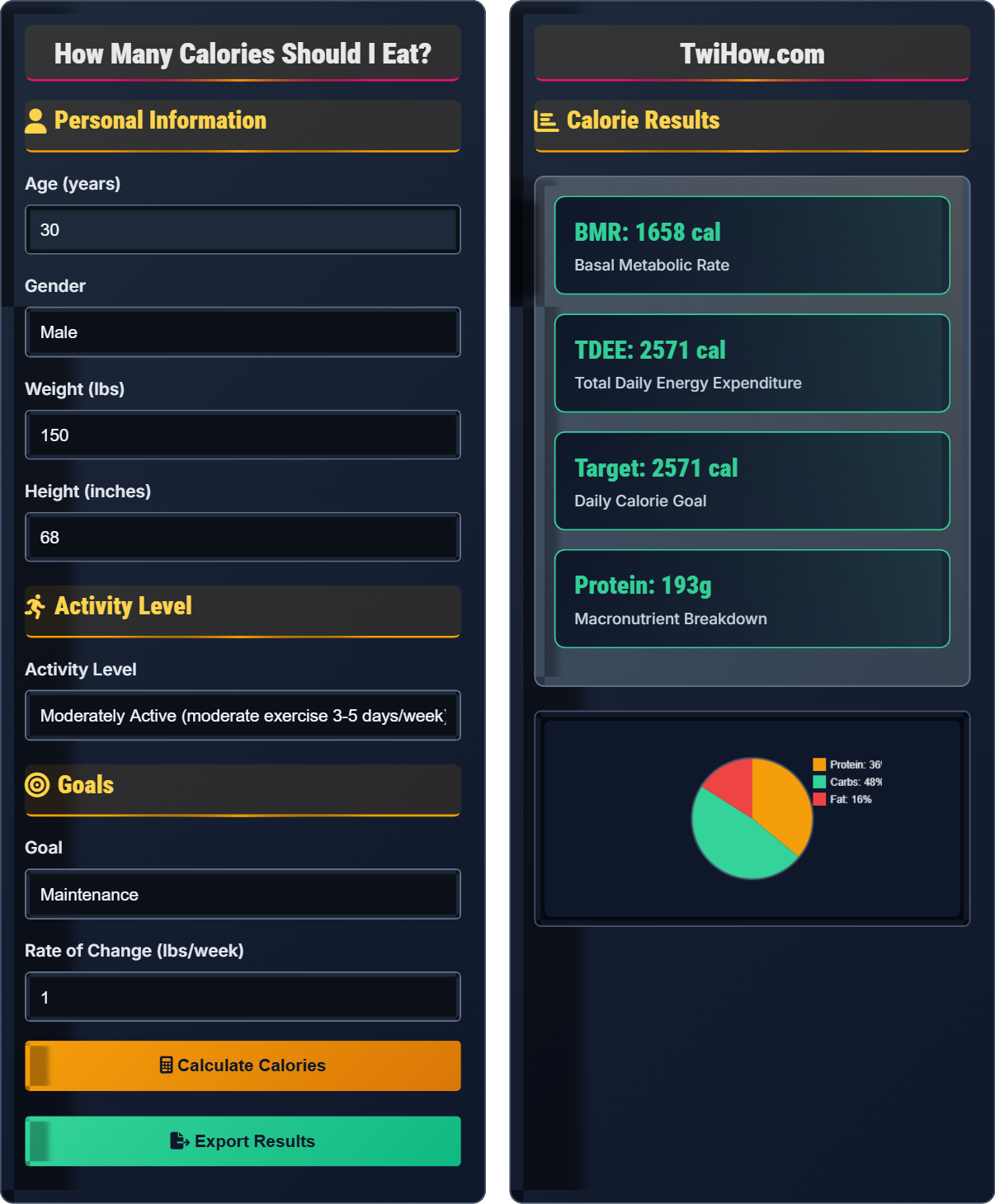
Calorie Results
| Macronutrient | Amount | Calories | % of Total |
|---|---|---|---|
| Protein | 150g | 600 cal | 36% |
| Carbohydrates | 200g | 800 cal | 48% |
| Fat | 60g | 540 cal | 32% |
Understanding Calorie Calculations
Basal Metabolic Rate (BMR) is the number of calories your body burns at complete rest to maintain vital functions like breathing, circulation, and cell production. It represents your body's minimum energy needs.
For men: BMR = 88.362 + (13.397 × weight in kg) + (4.799 × height in cm) - (5.677 × age in years)
For women: BMR = 447.593 + (9.247 × weight in kg) + (3.098 × height in cm) - (4.330 × age in years)
Total Daily Energy Expenditure (TDEE) is your BMR multiplied by an activity factor that accounts for your daily movement and exercise. This gives you the total number of calories you burn per day.
Activity Factors:
- Sedentary: 1.2 (little or no exercise)
- Lightly Active: 1.375 (light exercise 1-3 days/week)
- Moderately Active: 1.55 (moderate exercise 3-5 days/week)
- Very Active: 1.725 (hard exercise 6-7 days/week)
- Extremely Active: 1.9 (very hard exercise & physical job)
Once you know your TDEE, you can set calorie goals based on your objectives:
Recommended macronutrient distribution for optimal health:
- Protein: 10-35% of total calories (0.8-1.2g per lb bodyweight)
- Carbohydrates: 45-65% of total calories
- Fat: 20-35% of total calories
Protein requirements vary based on activity level and goals. Athletes and those trying to build muscle often need more protein.
- Plateau Breaking: If weight loss stalls, reduce calories by 100-200 or increase activity
- Sustainable Deficits: Gradual changes are more maintainable than extreme restrictions
- Cycle Calories: Some people benefit from alternating higher and lower calorie days
- Refeed Days: Occasional higher calorie days can help reset metabolism
Calorie Fundamentals
BMR, TDEE, calorie deficit/surplus, macronutrients, activity factors.
TDEE = BMR × Activity Factor
Target Calories = TDEE ± Deficit/Surplus
- 1 lb of fat ≈ 3,500 calories
- Safe weight loss: 1-2 lbs per week
- Protein needs increase with activity
Nutrition Planning
Protein builds muscle, carbohydrates fuel activity, fats support hormones.
- Calculate daily calorie target
- Determine macronutrient needs
- Select nutrient-dense foods
- Track intake consistently
- Eat whole foods primarily
- Stay hydrated
- Maintain consistent meal timing
- Plan for flexibility
Calorie Knowledge Quiz
Which factor has the greatest impact on Basal Metabolic Rate (BMR)?
While age, gender, and activity level all affect BMR, body composition (muscle mass vs. fat mass) has the greatest impact. Muscle tissue is metabolically active and burns significantly more calories at rest than fat tissue. Therefore, individuals with higher muscle mass have higher BMRs regardless of age or gender.
The answer is B) Body Composition.
Understanding that muscle mass significantly impacts metabolism helps explain why strength training is beneficial for weight management. Even at rest, individuals with more muscle burn more calories. This is why body composition is more important than total body weight when considering metabolic health.
BMR: Calories burned at complete rest for basic bodily functions
Body Composition: Proportion of muscle, fat, bone, and water in the body
Muscle Metabolism: Muscle burns ~6-10 calories per pound per day vs. ~2 calories per pound of fat
• Muscle burns more calories than fat at rest
• BMR decreases with age
• Men generally have higher BMR than women
• Strength training increases muscle mass and BMR
• Preserve muscle during weight loss with adequate protein
• Focus on body composition, not just scale weight
• Confusing weight with body composition
• Neglecting strength training for metabolism
• Underestimating impact of muscle mass
Explain the relationship between calorie deficit and weight loss. How many calories should theoretically be reduced to lose one pound of body fat, and why might actual weight loss differ from theoretical calculations?
Theoretical Relationship: One pound of body fat contains approximately 3,500 calories. To lose one pound per week, you would need a daily calorie deficit of 500 calories (500 × 7 = 3,500).
Why Actual Differs: As you lose weight, your BMR decreases because you're carrying less body mass. Additionally, your body adapts to the deficit by becoming more efficient, potentially reducing calorie expenditure. Hormonal changes also affect appetite and metabolism.
Practical Application: Start with a 500-750 calorie daily deficit for 1-2 lbs/week loss, but adjust as needed when progress plateaus.
The 3,500-calorie rule is a useful starting point, but it doesn't account for metabolic adaptation. As you lose weight, your body becomes more efficient, requiring fewer calories to maintain the smaller body size. This is why weight loss often slows over time even with consistent effort.
Calorie Deficit: Consuming fewer calories than you burn
Metabolic Adaptation: Body's response to reduced calorie intake
Hormonal Changes: Shifts in leptin, ghrelin, and other hormones
• 3,500 calories ≈ 1 lb of fat (approximate)
• Adjust calories as weight changes
• Monitor body composition, not just weight
• Recalculate needs every 10-15 lbs lost
• Track non-scale victories
• Expect slower progress over time
• Expecting linear weight loss
• Not adjusting as weight decreases
• Focusing only on scale weight
Jennifer is a 28-year-old woman who weighs 165 lbs and is 65 inches tall. She works a desk job but goes to the gym 3 times per week. She wants to lose 1.5 lbs per week. Calculate her daily calorie needs and recommend a meal plan structure that meets her goals.
Step 1 - Calculate BMR: 447.593 + (9.247 × 74.8) + (3.098 × 165) - (4.330 × 28) = 447.593 + 691.676 + 511.17 - 121.24 = 1,529 calories
Step 2 - Calculate TDEE: 1,529 × 1.55 (moderately active) = 2,370 calories
Step 3 - Set Target: 2,370 - (1,500 × 1.5) = 2,370 - 2,250 = 1,120 calories
Recommendation: A safer approach would be 1,620 calories (500 calorie deficit) for 1 lb/week loss. Meal structure: 150g protein, 180g carbs, 60g fat. Focus on lean proteins, vegetables, fruits, and whole grains.
This example shows why extremely low calorie diets aren't recommended. At 1,120 calories, Jennifer would be below her BMR, potentially harming her metabolism. A moderate deficit allows sustainable weight loss while preserving muscle mass and metabolic health.
Safe Deficit: Generally 500-750 calories per day maximum
Minimum Calories: Women should not go below 1,200 calories per dayProtein Priority: Preserve muscle during weight loss
• Women should eat at least 1,200 calories
• Men should eat at least 1,500 calories
• Protein should be prioritized during deficits
• Increase fiber for satiety on low calories
• Plan meals in advance
• Stay hydrated to manage hunger
• Creating deficits that are too large
• Not accounting for metabolic adaptation
• Neglecting protein intake
A client has a daily calorie target of 2,200 calories and wants to follow a diet that's 30% protein, 40% carbohydrates, and 30% fat. Calculate the grams of each macronutrient they should consume daily.
Protein: 2,200 × 0.30 = 660 calories ÷ 4 cal/g = 165g
Carbohydrates: 2,200 × 0.40 = 880 calories ÷ 4 cal/g = 220g
Fat: 2,200 × 0.30 = 660 calories ÷ 9 cal/g = 73g
Verification: (165×4) + (220×4) + (73×9) = 660 + 880 + 657 = 2,197 calories (accounting for rounding)
This distribution provides adequate protein for muscle preservation, sufficient carbs for energy, and healthy fats for hormone production.
Understanding macronutrient calculations is crucial for creating balanced diets. Remember that protein and carbs each provide 4 calories per gram, while fat provides 9 calories per gram. This knowledge allows precise control over dietary composition.
Protein: 4 calories per gram (builds and repairs tissues)
Carbohydrates: 4 calories per gram (primary energy source)
Fat: 9 calories per gram (hormone production, vitamin absorption)
• Protein: 4 cal/g
• Carbs: 4 cal/g
• Fat: 9 cal/g
• Use the percentage method for easy calculations
• Round to nearest whole numbers
• Verify calculations by converting back to calories
• Forgetting fat has 9 cal/g (not 4)
• Miscalculating percentages
• Not verifying calculations
How much can activity level impact your daily calorie needs compared to your BMR?
Activity level can dramatically increase daily calorie needs. A sedentary person multiplies their BMR by 1.2, while an extremely active person multiplies by 1.9, representing a 58% increase. For someone with a 1,500 BMR, this means going from 1,800 calories (sedentary) to 2,850 calories (extremely active) - nearly double their resting needs.
The answer is C) 50-90% increase.
This demonstrates why activity level is so crucial for accurate calorie calculations. Two people with identical BMRs but different activity levels will have vastly different caloric needs. This is why personalized calculations are essential for successful nutrition planning.
Sedentary: Multiplies BMR by 1.2
Extremely Active: Multiplies BMR by 1.9
Activity Factor: Accounts for non-exercise activity thermogenesis
• Activity level significantly impacts needs
• Non-exercise movement matters
• Adjust as activity changes
• Consider all daily activities, not just workouts
• Reassess if lifestyle changes
• Use the most accurate activity level
• Overestimating activity level
• Ignoring non-exercise movement
• Not adjusting for lifestyle changes
FAQ
Q: How do I calculate my calorie needs if I exercise twice a day?
A: If you exercise twice a day regularly, you would likely fall into the "Very Active" (1.725) or "Extremely Active" (1.9) category depending on the intensity. However, you might also consider calculating your needs using the "Very Active" multiplier and then adding extra calories for your additional exercise. A good approach is to track your weight for 2 weeks at that calorie level - if you're losing weight unintentionally, increase by 200-300 calories. If you're gaining weight, decrease by that amount.
Q: Is it safe to eat below 1,200 calories per day for faster weight loss?
A: Generally, consuming fewer than 1,200 calories per day is not recommended for women and 1,500 for men without medical supervision. Very low-calorie diets can slow your metabolism, lead to muscle loss, cause nutritional deficiencies, and result in gallstones. They're also difficult to maintain long-term. A moderate deficit of 500-750 calories per day is safer and more sustainable, leading to 1-2 pounds of weight loss per week, which is considered healthy and maintainable.
Q: How often should I recalculate my calorie needs as I lose weight?
A: It's recommended to recalculate your calorie needs every 10-15 pounds lost, or approximately every 4-6 weeks if you're losing weight consistently. As you lose weight, your BMR decreases because you're maintaining a smaller body mass, which means you need fewer calories. Continuing with the same calorie target will eventually cause a plateau. When recalculating, take your new current weight and recalculate your BMR and TDEE to find your updated maintenance and target calories.