How Much Water Should I Drink Daily?
Complete hydration calculator • Step-by-step hydration guide
Hydration Fundamentals:
Calculate My Water NeedsYour daily water needs depend on multiple factors including body weight, activity level, climate, and overall health. Water is essential for temperature regulation, joint lubrication, nutrient transport, and waste removal. Proper hydration supports cognitive function, physical performance, and overall health.
General recommendations suggest drinking 8-10 glasses of water daily, but individual needs vary significantly based on personal factors.
Key factors affecting water needs:
- Body Weight: Heavier individuals need more water
- Activity Level: Exercise increases water requirements
- Climate: Hot weather increases water loss
- Health Status: Illness may increase needs
- Age: Older adults may need more conscious hydration
Understanding your hydration needs is crucial for optimal health and performance.
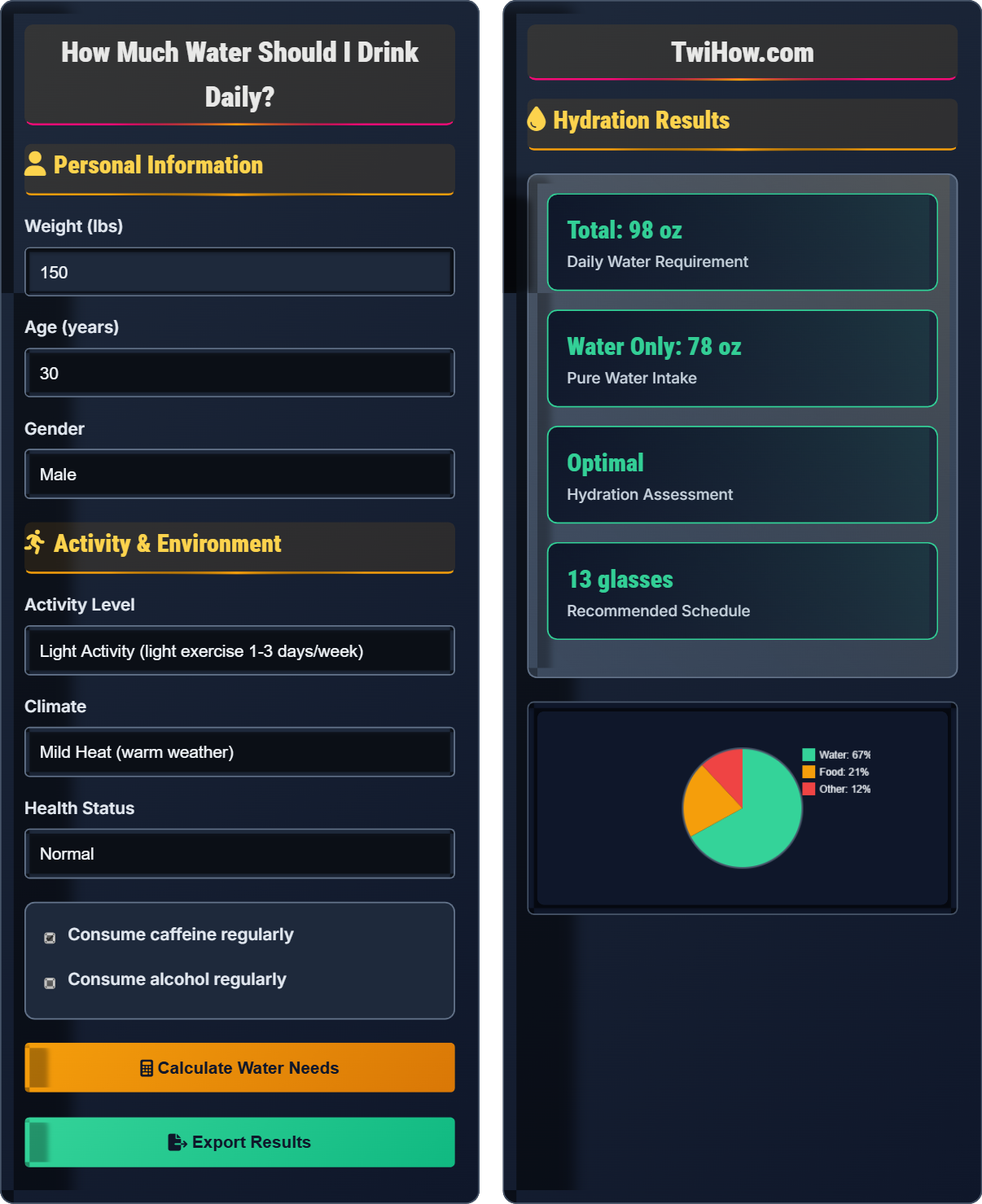
Personal Information
Activity & Environment
Hydration Results
| Source | Amount | Percentage | Notes |
|---|---|---|---|
| Plain Water | 64 oz | 67% | Main source |
| Food | 20 oz | 21% | Fruits/vegetables |
| Other Beverages | 12 oz | 12% | Tea, coffee, juice |
Understanding Hydration Science
Water is essential for life, comprising approximately 60% of the human body. It serves numerous critical functions including temperature regulation, joint lubrication, nutrient transport, and waste removal. Proper hydration supports cognitive function, physical performance, and overall health.
Water helps maintain blood volume, regulate body temperature, and facilitate chemical reactions. Dehydration can impair mental clarity, physical performance, and organ function.
There are several approaches to estimate daily water needs:
Activity, climate, and health status modify these base calculations. The most accurate method considers individual factors and adjusts accordingly.
Signs of proper hydration include:
Water comes from various sources beyond plain water:
- Plain Water: 60-70% of total intake (optimal source)
- Food: 20-30% from fruits, vegetables, soups
- Beverages: 10-20% from tea, coffee, juices
- Metabolic Water: Small amount from cellular processes
Foods like watermelon, cucumber, and soup contribute significantly to hydration.
- Pre-hydration: Drink water before feeling thirsty
- Consistent Sipping: Spread intake throughout the day
- Timing: More water before, during, and after exercise
- Electrolytes: Add sodium/potassium during intense activity
- Flavoring: Add lemon or cucumber if plain water is unappealing
Hydration Fundamentals
Water requirements, hydration assessment, fluid balance, electrolytes, water sources.
Daily Water (oz) = Base Requirement + Activity Factor + Climate Factor + Health Factor
Base Requirement = Weight (lbs) × 0.5-1 oz (depending on activity)
- Drink water before feeling thirsty
- Monitor urine color for hydration status
- Adjust for activity and climate
Hydration Planning
Urine color, skin elasticity, energy levels, cognitive function.
- Calculate daily water needs
- Plan intake schedule
- Choose preferred water sources
- Monitor hydration status
- Start with 8 glasses daily
- Increase with activity
- Monitor for signs of dehydration
- Spread intake throughout the day
Hydration Knowledge Quiz
What percentage of the human body is composed of water?
The human body is composed of approximately 60-70% water, though this percentage varies by age, sex, and body composition. Infants have higher water content (~75%), while older adults have slightly less. Muscle tissue contains more water than fat tissue, so individuals with higher muscle mass tend to have higher body water percentages.
The answer is C) 60-70%.
Understanding that the body is mostly water emphasizes why hydration is so critical. This high water content explains why even mild dehydration can affect physical and cognitive performance. The variation by body composition is why athletes and physically active individuals often have different hydration needs.
Body Water Percentage: Proportion of water in the body relative to total body weight
Dehydration: Loss of body water exceeding intake
Fluid Balance: Equilibrium between water intake and output
• Higher muscle mass = higher water percentage
• Water needs increase with activity
• Older adults may need more conscious hydration
• Monitor body water percentage if tracking health metrics
• Adjust water intake based on body composition
• Consider age-related changes in water needs
• Assuming everyone needs the same amount of water
• Ignoring body composition differences
• Not adjusting for age-related changes
Describe the progressive effects of dehydration on the human body, starting from mild dehydration and progressing to severe dehydration. Include both physiological and cognitive impacts.
Mild Dehydration (1-2% body weight loss): Thirst, dry mouth, decreased urine output, fatigue, slight headache.
Moderate Dehydration (3-5% body weight loss): Increased heart rate, dizziness, muscle cramps, reduced cognitive function, irritability, dark urine.
Severe Dehydration (6-10% body weight loss): Rapid pulse, low blood pressure, confusion, weakness, sunken eyes, minimal urine output.
Life-threatening Dehydration (>10% body weight loss): Shock, kidney failure, coma, death.
Cognitive effects include decreased concentration, memory impairment, mood changes, and reduced reaction time.
This progression shows why preventing even mild dehydration is important. The body's ability to maintain homeostasis is compromised as dehydration worsens. Cognitive effects appear relatively early, which is why staying hydrated is crucial for mental performance.
Dehydration: Loss of body water exceeding intake
Homeostasis: Body's ability to maintain stable internal conditions
Electrolyte Imbalance: Disruption of mineral balance due to fluid loss
• Cognitive effects begin at 1-2% dehydration
• Physical symptoms worsen progressively
• Prevention is easier than treatment
• Monitor urine color regularly
• Drink before feeling thirsty
• Increase intake during illness
• Waiting until thirsty to drink
• Underestimating cognitive effects
• Not adjusting for environmental factors
David is a 35-year-old man weighing 180 lbs. He works outdoors in hot weather and exercises moderately 4 times per week. He drinks 2 cups of coffee daily and occasionally has alcohol. Calculate his daily water needs and create a hydration plan for him.
Base Requirement: 180 lbs × 0.75 oz = 135 oz (adjusting for moderate activity)
Activity Factor: +15 oz (moderate exercise 4x/week)
Climate Factor: +15 oz (hot outdoor work)
Caffeine Adjustment: +8 oz (coffee has mild diuretic effect)
Total Daily Need: 135 + 15 + 15 + 8 = 173 oz
Hydration Plan: 12 glasses of water, 2 glasses from food, 1 glass from other beverages. Drink 2 glasses upon waking, 3-4 glasses midday, 4-5 glasses afternoon, and 2-3 glasses evening. Increase during exercise and outdoor work.
This example shows how multiple factors compound to increase water needs. David's outdoor work in hot weather combined with regular exercise creates significant water loss. The caffeine adjustment accounts for the mild diuretic effect of coffee, though it still contributes to overall fluid intake.
Diuretic Effect: Increased urine production from certain substances
Evaporative Cooling: Water loss through sweating and respiration
Fluid Compensation: Adjusting intake for losses
• Outdoor work increases water needs significantly
• Exercise and heat compound water loss
• Caffeine requires minor adjustments
• Carry water when working outdoors
• Pre-hydrate before exercise
• Monitor hydration during heat exposure
• Underestimating outdoor work impact
• Not adjusting for combined factors
• Ignoring environmental stressors
An endurance athlete is preparing for a marathon. Explain the optimal hydration strategy before, during, and after the race, including timing and amounts. Consider electrolyte replacement needs.
Before Race (24 hours prior): Begin hydrating with 16-20 oz of water 2-3 hours before. Continue sipping 8-10 oz every 10-15 minutes until start.
During Race: Drink 6-8 oz every 15-20 minutes. For races >1 hour, include electrolyte drinks to replace sodium and potassium.
After Race: Replace 150% of fluid lost (weigh before/after to calculate). Include electrolytes and consume within 6 hours post-race.
Electrolyte Strategy: 200-300mg sodium per hour during prolonged exercise to prevent hyponatremia.
Marathon hydration requires strategic planning because simple water isn't sufficient for long-duration events. Electrolyte replacement prevents dangerous imbalances. The 150% replacement rule accounts for ongoing fluid losses after exercise ends.
Hyponatremia: Low sodium levels from overhydration
Electrolytes: Minerals that conduct electrical impulses (Na+, K+, Cl-)
Fluid Replacement: Restoring lost body water
• Don't overhydrate during endurance events
• Include electrolytes for events >1 hour
• Replace 150% of fluid losses post-exercise
• Practice hydration strategy during training
• Monitor weight before/after exercise
• Taste preferences matter for compliance
• Only focusing on water, ignoring electrolytes
• Drinking too much too quickly
• Not practicing strategy before race day
Which combination of indicators most accurately reflects proper hydration status?
Pale yellow urine indicates proper hydration, as it suggests the kidneys are adequately filtering waste products while maintaining proper dilution. Rarely feeling thirsty confirms that fluid intake is meeting body needs. Clear urine can indicate overhydration, while dark yellow urine suggests dehydration. Thirst is a late indicator of dehydration.
The answer is B) Pale yellow urine and rarely feeling thirsty.
Urine color is one of the most reliable indicators of hydration status. The pale yellow color indicates optimal dilution - enough water to flush toxins but not so much as to dilute essential compounds. Thirst, while important, is a reactive mechanism and indicates that mild dehydration has already begun.
Urine Specific Gravity: Measure of urine concentration
Osmolality: Concentration of particles in solution
Antidiuretic Hormone: Regulates water retention by kidneys
• Urine color is the best hydration indicator
• Thirst is a late sign of dehydration
• Clear urine may indicate overhydration
• Check urine color first thing in morning
• Use it as a daily hydration gauge
• Combine with other indicators for accuracy
• Relying solely on thirst as an indicator
• Assuming clear urine always means optimal hydration
• Not considering other factors affecting urine color
FAQ
Q: How much water should I drink during a 10-mile run?
A: For a 10-mile run, aim to drink 6-8 oz of fluid every 15-20 minutes during the run. This typically equals about 24-32 oz for the entire distance. However, individual sweat rates vary significantly. Weigh yourself before and after runs to determine your specific fluid loss - for every pound lost, drink 16-24 oz to rehydrate. For runs longer than 60-90 minutes, include electrolyte drinks to replace sodium and potassium lost in sweat.
Q: Can I drink too much water? Is that dangerous?
A: Yes, drinking excessive amounts of water can be dangerous and lead to a condition called hyponatremia, or water intoxication. This occurs when blood sodium levels become dangerously diluted. Symptoms include nausea, headache, confusion, seizures, and in severe cases, coma or death. It's rare in healthy individuals with normal kidney function, but can occur during prolonged exercise when people drink far more fluid than they lose in sweat. Listen to your body's signals and don't force excessive fluid intake.
Q: Do coffee and tea count toward my daily water intake?
A: Yes, coffee and tea do count toward your daily fluid intake. While caffeine has a mild diuretic effect, research shows that caffeinated beverages contribute to hydration similarly to water, especially for regular consumers. The diuretic effect is offset by the fluid volume consumed. However, be aware that very high caffeine intake (more than 400mg/day) may have stronger diuretic effects. Plain water should still be your primary fluid source, but moderate amounts of coffee and tea can contribute to daily needs.