How to Boost Immunity?
Complete immune health guide • Step-by-step immunity boosters
Immune System Fundamentals:
Assess My ImmunityThe immune system is your body's defense network, protecting against pathogens, infections, and diseases. It consists of white blood cells, antibodies, the complement system, the lymphatic system, spleen, thymus, and bone marrow. A strong immune system can prevent illness, recover faster from infections, and maintain overall health.
Immune health depends on multiple factors including nutrition, sleep, stress management, physical activity, and genetics. Lifestyle choices significantly impact immune function.
Key immune-boosting strategies:
- Nutrition: Vitamins C, D, zinc, and antioxidants
- Sleep: 7-9 hours of quality rest nightly
- Exercise: Moderate regular physical activity
- Stress Management: Chronic stress weakens immunity
- Social Connections: Strong relationships support immune health
Understanding immune health is crucial for preventing illness and maintaining vitality.
Health Profile
Lifestyle Factors
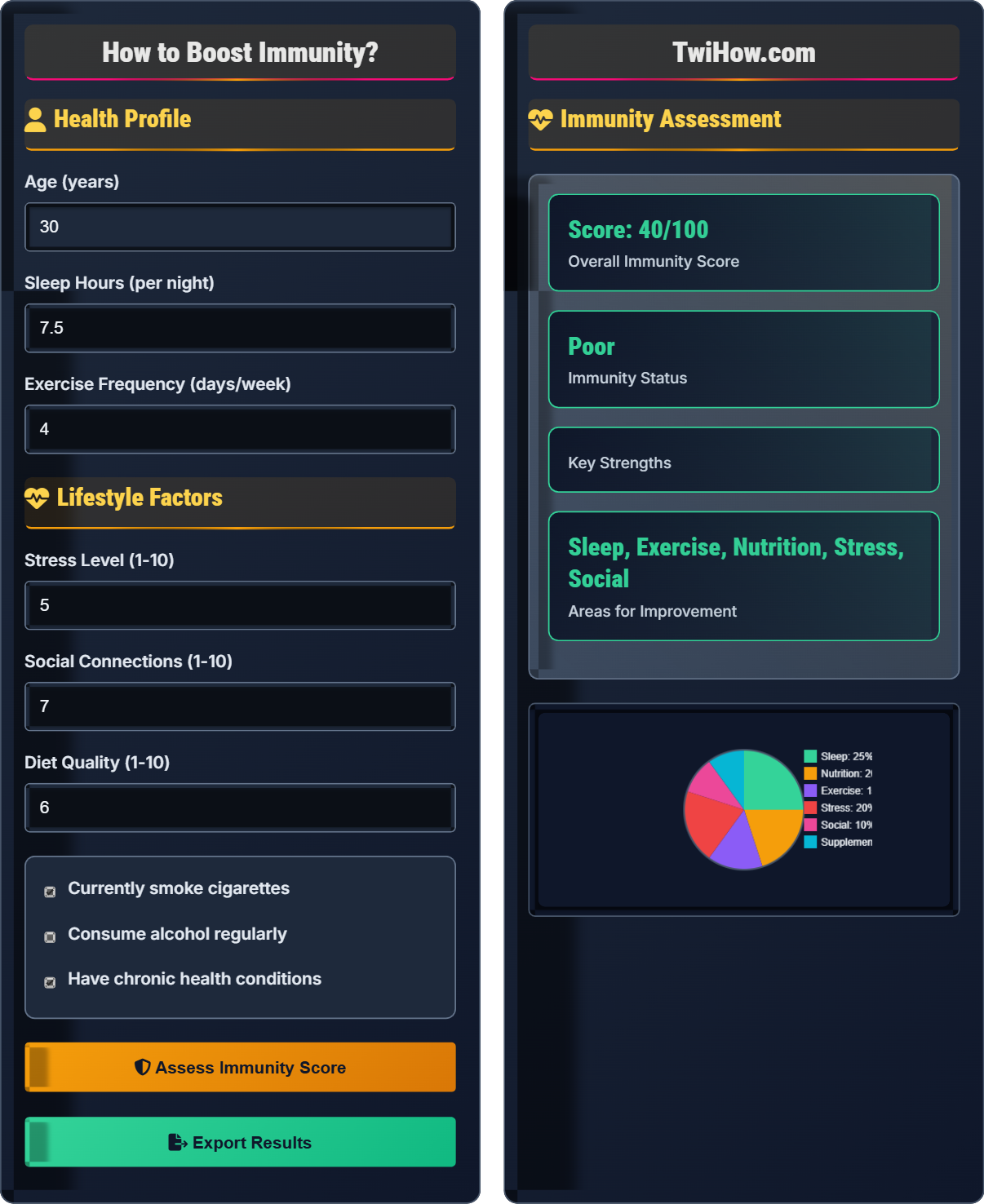
Immunity Assessment
| Action | Priority | Impact | Timeline |
|---|---|---|---|
| Improve sleep quality | High | 25% | Immediate |
| Reduce stress levels | High | 20% | 2-4 weeks |
| Add immune-boosting foods | Medium | 15% | 1-2 weeks |
| Take vitamin D supplement | Medium | 10% | 1-2 weeks |
Understanding Immune System Function
The immune system is a complex network of cells, tissues, and organs that work together to defend the body against harmful pathogens like bacteria, viruses, fungi, and toxins. It has two main components:
Innate Immunity: The first line of defense that responds immediately to threats. Includes physical barriers (skin, mucous membranes), white blood cells (neutrophils, macrophages), and inflammatory responses.
Adaptive Immunity: A targeted response that develops after exposure to specific pathogens. Creates antibodies and memory cells for long-term protection.
Immune Function Score = (Sleep Quality × 0.25) + (Nutrition × 0.20) + (Exercise × 0.15) + (Stress Management × 0.20) + (Social Connection × 0.10) + (Supplements × 0.10)
Each factor is rated on a scale of 1-10, with 10 being optimal. The weights reflect research on the relative impact of each factor on immune function.
Additional modifiers include age (immune function declines with age), smoking (-10 points), chronic conditions (-5 to -15 points), and sleep quality (+/- 5 points).
Key actions to strengthen immunity:
Key components of the immune system:
- White Blood Cells: Neutrophils, lymphocytes, monocytes, eosinophils, basophils
- Antibodies: Proteins that identify and neutralize pathogens
- Lymphatic System: Network of vessels and nodes that transport immune cells
- Spleen: Filters blood and removes old cells
- Bone Marrow: Produces immune cells
These components work synergistically to protect the body from infections and diseases.
- Vitamin D: Essential for immune cell function and pathogen defense
- Zinc: Critical for immune cell development and communication
- Vitamin C: Antioxidant that supports various immune functions
- Probiotics: Beneficial bacteria that support gut immunity
- Omega-3s: Anti-inflammatory fatty acids that modulate immune responses
Immunity Fundamentals
Immune system, innate immunity, adaptive immunity, immune cells, antibodies, inflammation.
Immune Score = (Sleep × 0.25) + (Nutrition × 0.20) + (Exercise × 0.15) + (Stress × 0.20) + (Social × 0.10) + (Supplements × 0.10)
- Sleep is foundational for immune function
- Chronic stress suppresses immunity
- Nutrition directly impacts immune cell function
Immune-Boosting Nutrition
Vitamins C, D, E, zinc, selenium, iron, omega-3 fatty acids, probiotics.
- Consume 5-9 servings of colorful fruits and vegetables daily
- Include lean proteins and healthy fats
- Add fermented foods for probiotics
- Limit processed foods and added sugars
- Colorful foods provide diverse antioxidants
- Gut health influences immune function
- Balance is more important than perfection
- Consistency over short-term fixes
Immune Health Quiz
Which of the following is NOT part of the innate immune system?
Antibodies are part of the adaptive immune system, not the innate immune system. The innate immune system provides immediate, non-specific defense through physical barriers (skin, mucus), phagocytic cells (neutrophils, macrophages), and natural killer cells. The adaptive immune system creates specific antibodies after exposure to particular antigens and provides long-term immunity.
The answer is B) Antibodies.
Understanding the difference between innate and adaptive immunity is fundamental to appreciating how the immune system works. Innate immunity acts immediately but non-specifically, while adaptive immunity takes time to develop but provides targeted, long-lasting protection. Both systems work together to protect the body.
Innate Immunity: Immediate, non-specific immune response
Adaptive Immunity: Specific, long-term immune response
Antibodies: Proteins that identify and neutralize specific antigens
• Innate immunity responds within minutes
• Adaptive immunity creates memory cells
• Both systems work synergistically
• Innate = "Inborn" immediate response
• Adaptive = "Adapts" to specific threats
• Vaccines work through adaptive immunity
• Confusing innate with adaptive immunity
• Thinking antibodies are immediate response
• Underestimating role of innate immunity
Explain the relationship between sleep and immune function. How does poor sleep affect the immune system, and what are the mechanisms behind this relationship?
Relationship: Sleep is critical for immune function. During sleep, the body produces and releases cytokines, proteins that help fight infection and inflammation. Poor sleep reduces the production of these protective cytokines.
Effects of Poor Sleep: Reduces T-cell function, decreases antibody production, impairs vaccine effectiveness, and increases inflammation markers.
Mechanisms: Sleep deprivation increases cortisol (which suppresses immune function), reduces growth hormone release (needed for immune cell repair), and disrupts circadian rhythms that regulate immune genes.
Research: Studies show that people who sleep less than 7 hours are 3 times more likely to catch a cold than those sleeping 8+ hours.
Sleep is when the immune system regenerates and strengthens. The body uses this time to produce essential immune cells and proteins. This is why adequate sleep is considered foundational for immune health. The relationship is bidirectional - illness often causes increased sleepiness as the body tries to heal.
Cytokines: Signaling proteins that regulate immune responses
T-cells: White blood cells that identify and destroy infected cells
Circadian Rhythms: Biological processes that follow a 24-hour cycle
• Sleep 7-9 hours for optimal immune function
• Sleep quality matters as much as quantity
• Consistent sleep schedule supports immunity
• Maintain consistent sleep schedule
• Create optimal sleep environment
• Prioritize sleep during illness
• Sacrificing sleep for productivity
• Not recognizing sleep as health priority
• Ignoring sleep debt accumulation
Sarah is a 35-year-old teacher who gets sick frequently during winter months. She sleeps 5 hours nightly, exercises twice weekly, eats a poor diet, and experiences high stress. She wants to reduce her sick days by 50%. Create a comprehensive immunity improvement plan for Sarah focusing on her biggest weaknesses.
Priority Areas: Sleep (most impactful), stress management, nutrition, exercise frequency
Week 1-2: Establish consistent bedtime routine, aim for 7 hours sleep, reduce caffeine after 2 PM
Week 3-4: Add 15-minute daily meditation, increase exercise to 4 days weekly
Week 5-8: Improve diet by adding 2 servings of fruit/vegetables daily, take vitamin D supplement
Month 2+: Maintain improvements, add probiotics, continue stress management
Expected Outcome: 40-60% reduction in sick days within 3 months as immune function strengthens.
This example demonstrates how multiple factors compound to weaken immunity. Sarah's low sleep, high stress, and poor nutrition create a perfect storm for frequent illness. Addressing the most impactful factor first (sleep) creates a foundation for other improvements. The gradual approach ensures sustainability.
Immune Priming: Gradual strengthening of immune responses
Adaptive Response: Immune system improvement over time
Comprehensive Approach: Addressing multiple factors simultaneously
• Address biggest weaknesses first
• Make gradual, sustainable changes
• Focus on foundations (sleep, nutrition)
• Track changes and symptoms
• Celebrate small improvements
• Be patient with results
• Trying to change everything at once
• Expecting immediate results
• Not addressing root causes
A study found that medical students had 40% lower antibody response to flu vaccination during exam periods compared to vacation periods. Explain the physiological mechanisms connecting stress to immune suppression and suggest practical stress management techniques for immune health.
Physiological Mechanisms: Chronic stress elevates cortisol, which suppresses immune cell production and function. Stress also increases inflammatory cytokines that can interfere with immune responses. The sympathetic nervous system activation diverts resources away from immune function.
Stress Management Techniques: 1) Mindfulness meditation (10-15 minutes daily), 2) Progressive muscle relaxation, 3) Regular moderate exercise, 4) Adequate sleep (7-9 hours), 5) Social support and connection.
Practical Application: Even brief stress management practices (like 5-minute breathing exercises) can help maintain immune function during high-stress periods.
This demonstrates how psychological stress directly impacts physical immunity. The stress-immunity connection is well-established through research showing that chronic stress literally weakens the immune system's ability to respond to threats. This is why stress management is considered as important as nutrition and sleep for immune health.
Psychoneuroimmunology: Study of mind-body-immune connections
Cortisol: Stress hormone that suppresses immune function
HPA Axis: Hypothalamus-pituitary-adrenal stress response system
• Chronic stress suppresses immunity
• Short-term stress can enhance immunity
• Stress management is preventive medicine
• Build stress management into daily routine
• Practice techniques before stress peaks
• Recognize stress early and respond
• Waiting until stressed to manage stress
• Underestimating stress impact on immunity
• Not prioritizing stress management
Which combination of nutrients is most effective for supporting immune function?
Vitamin C supports various immune cell functions and acts as an antioxidant. Vitamin D regulates immune responses and helps activate immune cells. Zinc is essential for immune cell development and communication. These three nutrients work synergistically to support multiple aspects of immune function. Research consistently shows their importance for immune health.
The answer is A) Vitamin C, Vitamin D, Zinc.
These three nutrients are the most extensively studied for immune support. Vitamin C enhances white blood cell function, vitamin D modulates immune responses, and zinc is critical for immune cell signaling. While other nutrients are important, these three form the foundation of nutritional immune support.
Antioxidants: Compounds that protect cells from oxidative damage
Immune Cell Signaling: Communication between immune cells
Synergistic Effects: Combined effects greater than individual effects
• Balance is more important than single nutrients
• Food sources preferred over supplements
• Consistency in intake matters
• Consume variety of colorful foods
• Include vitamin D rich foods/supplement
• Choose zinc-rich plant foods
• Relying on single "superfoods"
• Taking excessive doses of supplements
• Ignoring food quality for supplements
FAQ
Q: Does intense exercise weaken the immune system?
A: The relationship between exercise and immunity follows a J-curve. Moderate exercise enhances immune function, but extreme exercise can temporarily suppress it. Intense training without adequate recovery can increase susceptibility to upper respiratory tract infections. The key is balancing training intensity with recovery, sleep, nutrition, and stress management. Athletes should focus on consistent moderate exercise with planned recovery periods rather than constantly pushing limits.
Q: Are immune-boosting supplements safe for children?
A: Most children get adequate immune-supporting nutrients from a balanced diet. Before considering supplements, focus on whole foods rich in vitamins C and D, zinc, and probiotics. If supplementation is considered, consult your pediatrician first. Children under 4 should generally avoid supplements unless specifically recommended by a doctor. Priority should be on sleep, nutrition, physical activity, and hygiene rather than supplements for immune support.
Q: Can you boost immunity in just a few days before travel?
A: Immune system changes occur over weeks to months, not days. However, you can optimize current immune function before travel by getting adequate sleep (7-9 hours), eating nutrient-rich foods, managing stress, and staying hydrated. Taking vitamin C, zinc, and probiotics a few days before travel may provide some benefit. But remember, immunity is built through consistent healthy habits over time, not quick fixes.