Healthy Alternatives to Sugar
Complete sugar substitute guide • Step-by-step explanations
Sugar Alternatives Overview:
Show Sweetener CalculatorHealthy sugar alternatives offer ways to enjoy sweetness without the negative health effects of refined sugar. These substitutes include natural sweeteners like stevia and monk fruit, sugar alcohols like xylitol and erythritol, and artificial sweeteners like sucralose. Each alternative has unique properties regarding taste, glycemic impact, and safety considerations.
Key categories of sugar alternatives include natural sweeteners, sugar alcohols, and artificial sweeteners. The choice depends on individual health goals, taste preferences, and specific dietary needs such as diabetes management or weight control.
Core concepts:
- Caloric Impact: Zero-calorie vs. low-calorie options
- Glycemic Index: Effect on blood sugar levels
- Sweetness Intensity: Relative sweetness compared to sugar
- Digestive Effects: Potential for GI upset with some sugar alcohols
- Culinary Properties: Baking, cooking, and preservation qualities
Choosing the right sugar alternative requires understanding your health priorities, taste preferences, and intended use for the sweetener.
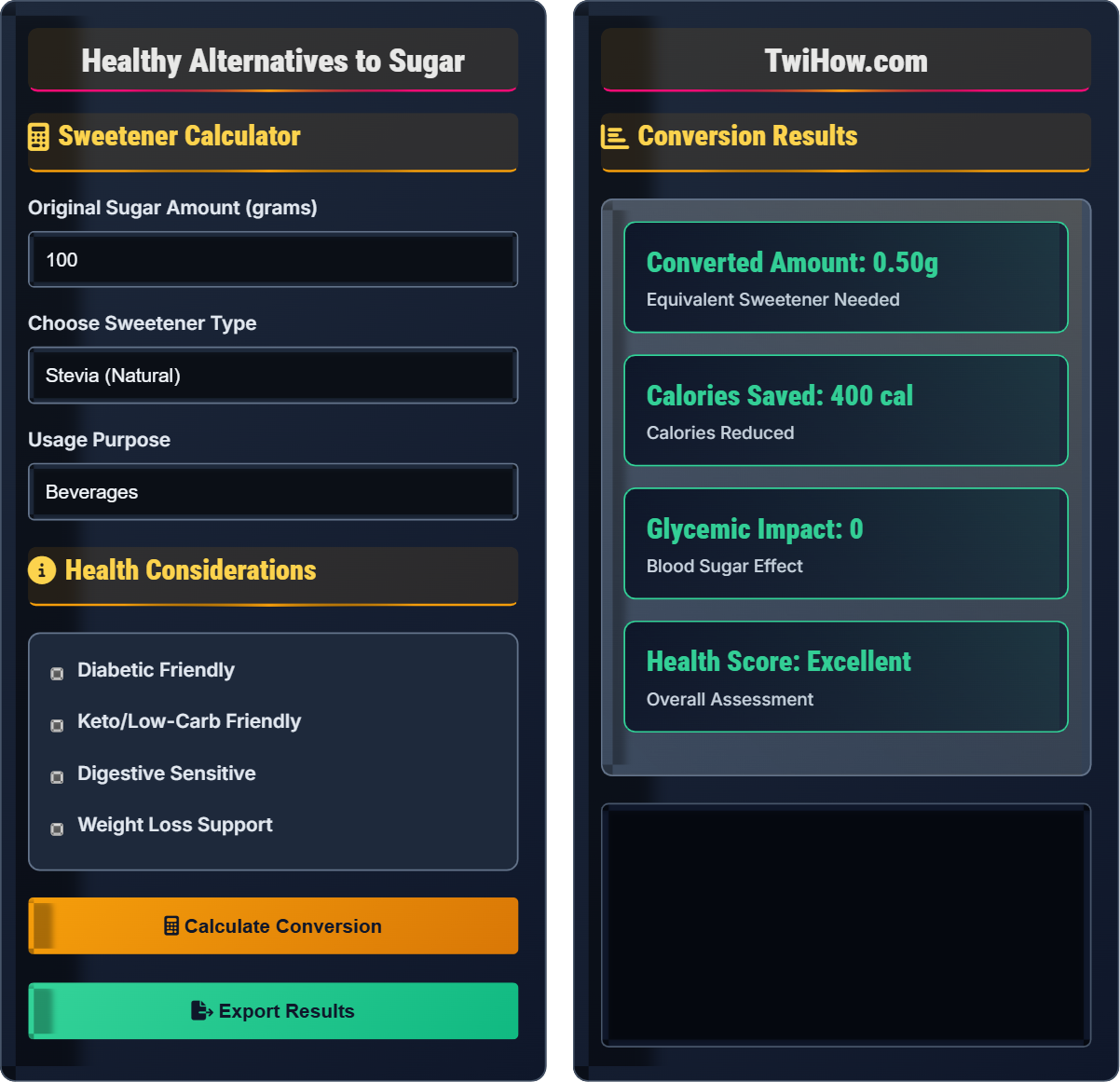
Sweetener Calculator
Health Considerations
Conversion Results
| Sweetener | Calories | Sweetness | Glycemic | Diabetic Safe |
|---|---|---|---|---|
| Stevia | 0 | 200x | 0 | ✓ |
| Monk Fruit | 0 | 150x | 0 | ✓ |
| Erythritol | 0.2 | 0.6x | 1 | ✓ |
| Xylitol | 2.4 | 1x | 7 | Limited |
Healthy Sugar Alternatives Explained
Refined sugar consumption has been linked to numerous health issues including obesity, type 2 diabetes, heart disease, and dental problems. The average American consumes about 17 teaspoons of added sugar daily, far exceeding the recommended limit of 6-9 teaspoons. Healthy sugar alternatives provide sweetness with fewer calories and minimal impact on blood sugar levels.
Natural sweeteners are derived from plants or fruits and offer sweetness with minimal processing:
- Stevia: Extracted from Stevia rebaudiana leaves, 200-300 times sweeter than sugar, zero calories, no glycemic impact
- Monk Fruit: From Luo Han Guo fruit, 150-200 times sweeter than sugar, zero calories, no glycemic impact
- Maple Syrup: Less processed than refined sugar, contains minerals, but still high in calories
- Raw Honey: Contains antioxidants and antimicrobial properties, but still impacts blood sugar
Sugar alcohols are carbohydrates with a chemical structure similar to sugar but with reduced calories and slower absorption:
- Erythritol: 0.2 calories per gram, minimal digestive effects, glycemic index of 1
- Xylitol: 2.4 calories per gram, beneficial for dental health, glycemic index of 7
- Stevia: 2.4 calories per gram, may cause digestive upset in large quantities
- Allulose: 0.4 calories per gram, minimal glycemic impact, tastes and behaves like sugar
Artificial sweeteners are synthetic compounds that provide intense sweetness without calories:
- Sucralose: 600 times sweeter than sugar, heat-stable for baking, no calories
- Aspartame: 200 times sweeter than sugar, breaks down with heat, no calories
- Saccharin: 300-400 times sweeter than sugar, may have metallic aftertaste
- Acesulfame K: 200 times sweeter than sugar, often combined with other sweeteners
When substituting sugar alternatives, conversion ratios are important for maintaining sweetness levels:
- Stevia: Use 1/200th the amount of sugar (1 tsp sugar = 1/8 tsp stevia powder)
- Monk Fruit: Use 1/150th the amount of sugar
- Erythritol: Use 1:1 ratio with sugar
- Xylitol: Use 1:1 ratio with sugar
Note: When baking, sugar alternatives may require adjustments to recipes since sugar provides bulk, browning, and texture.
Benefits of healthy sugar alternatives:
- Reduced calorie intake
- Minimal impact on blood sugar
- Lower risk of dental cavities
- Support for weight management
- Diabetes-friendly options
Considerations:
- Some may cause digestive discomfort in large amounts
- Aftertastes may be noticeable with some alternatives
- Baking properties may differ from sugar
- Quality and purity can vary between brands
Sugar Alternative Categories
Natural sweeteners, sugar alcohols, artificial sweeteners, and minimally processed alternatives.
Converted Amount = Original Sugar Amount / Sweetness Ratio
Example: For stevia (200x sweeter than sugar), 100g sugar = 100g / 200 = 0.5g stevia needed.
- Match sweetness intensity appropriately
- Consider glycemic impact for diabetics
- Account for digestive tolerance
- Adjust for culinary properties
Selection Guidelines
Diabetes: Stevia, monk fruit, erythritol. Weight loss: Stevia, monk fruit, allulose. Dental health: Xylitol, erythritol. Baking: Erythritol, xylitol, blends.
- Identify health priorities (diabetes, weight, etc.)
- Consider taste preferences
- Assess digestive tolerance
- Evaluate intended use (baking, beverages, etc.)
- Test small amounts initially
- Start with small amounts
- Rotate different types occasionally
- Read ingredient labels carefully
- Consult healthcare provider if diabetic
Sugar Alternatives Quiz
Which sugar alternative is approximately 200 times sweeter than regular sugar?
Stevia is a natural sweetener extracted from the Stevia rebaudiana plant that is approximately 200-300 times sweeter than regular sugar. This means only a tiny amount of stevia is needed to achieve the same level of sweetness as sugar.
Other sweeteners have different intensities: - Erythritol: About 0.6-0.7 times as sweet as sugar - Xylitol: About 1 times as sweet as sugar (equivalent) - Maple Syrup: About 0.66 times as sweet as sugar
The answer is B) Stevia.
Understanding the sweetness intensity of sugar alternatives is crucial for proper substitution. Because stevia is so much sweeter than sugar, using too much can result in an overly sweet or bitter taste. This is why conversion ratios are important when replacing sugar with high-intensity sweeteners.
Sweetness Intensity: How sweet a substance is compared to sugar (which is set as 1x)
Stevia: Natural sweetener derived from Stevia rebaudiana plant leaves
Conversion Ratio: Amount needed relative to sugar to achieve same sweetness
• Higher intensity means less needed for same sweetness
• Adjust amounts based on intensity differences
• Taste testing is important for new sweeteners
• Start with less than recommended amount
• Mix with other ingredients to dilute intensity
• Gradually increase until desired sweetness
• Using same amount as sugar for high-intensity sweeteners
• Not accounting for aftertaste variations
• Assuming all natural sweeteners have same intensity
Explain why stevia and monk fruit are considered safe for people with diabetes, and how this differs from sugar alcohols like xylitol.
Stevia and Monk Fruit: Both stevia and monk fruit are non-nutritive sweeteners that do not raise blood glucose levels because they are not metabolized by the body in the same way as sugar. They pass through the digestive system without being absorbed, providing sweetness without affecting blood sugar.
Sugar Alcohols (like xylitol): Sugar alcohols are partially absorbed by the body and can have a small impact on blood sugar, though much less than regular sugar. Xylitol has a glycemic index of about 7-13 (compared to 100 for sugar), meaning it causes a modest rise in blood glucose.
Practical Difference: People with diabetes can use stevia and monk fruit freely without concern for blood sugar impact. With sugar alcohols, they need to count half the grams of sugar alcohol as carbohydrates for insulin dosing purposes.
The glycemic impact of sweeteners is determined by how they are metabolized in the body. Non-nutritive sweeteners like stevia and monk fruit are not digested or absorbed, so they don't affect blood glucose. Sugar alcohols are partially absorbed and can cause a small glucose response, which is why they're not completely free of glycemic impact.
Glycemic Index: Measure of how quickly a food raises blood glucose levels
Non-nutritive Sweeteners: Sweeteners that provide no calories and minimal metabolic impact
Sugar Alcohols: Carbohydrates with reduced caloric impact and slower absorption
• Non-nutritive sweeteners: 0 glycemic impact
• Sugar alcohols: Small glycemic impact
• Count half sugar alcohol grams as carbs for diabetes
• Check labels for sugar alcohol content
• Start with non-nutritive sweeteners for best glucose control
• Monitor blood sugar when introducing new sweeteners
• Treating all sugar-free products as having 0 glycemic impact
• Not accounting for sugar alcohols in carb counting
• Assuming natural means no blood sugar effect
You're baking cookies and need to replace 1 cup of sugar (200g) with erythritol. Erythritol has the same sweetness intensity as sugar but different baking properties. Calculate the amount of erythritol needed and explain what adjustments you might need to make to the recipe for successful baking.
Amount Calculation: Since erythritol has the same sweetness intensity as sugar (1:1 ratio), you would use 200g of erythritol to replace 200g of sugar.
Recipe Adjustments: When baking with erythritol, consider these changes:
1. Texture: Erythritol doesn't caramelize like sugar, so cookies may not brown as much
2. Moisture: Add 1-2 tablespoons extra liquid since erythritol doesn't retain moisture like sugar
3. Leavening: Sugar helps with leavening, so you might need to slightly increase baking powder
4. Cooling: Erythritol can create a cooling sensation, which might affect perceived flavor
For best results, consider using a blend of erythritol with a small amount of stevia to maintain sweetness while achieving better baking properties.
While sugar alternatives may match sugar in sweetness, they don't always behave the same way in baking. Sugar serves multiple functions beyond sweetening: it contributes to browning, texture, moisture retention, and structure. Successful sugar-free baking often requires understanding these additional roles and making compensatory adjustments.
Caramelization: Chemical reaction that creates browning and flavor during baking
Hygroscopic: Property of attracting and retaining moisture
Leavening: Process of creating air bubbles to make baked goods rise
• Match sweetness but expect texture differences
• Use sugar-free baking recipes specifically designed
• Blend different sweeteners for better results
• Expect longer baking times for proper browning
• Treating sugar alternatives exactly like sugar
• Not adjusting for moisture content differences
• Expecting identical texture and appearance
A friend with IBS wants to try sugar alternatives but is concerned about digestive effects. Compare the digestive tolerance of erythritol, xylitol, and stevia, and recommend which would be best for someone with sensitive digestion.
Erythritol: Generally the most digestive-friendly sugar alcohol. It's absorbed in the small intestine and excreted unchanged in urine, so it doesn't reach the large intestine to ferment. Most people can tolerate 1-1.5g per kg of body weight without issues.
Xylitol: Causes digestive upset in larger quantities (more than 10-15g for some people) because it reaches the large intestine and draws water into the gut, potentially causing gas, bloating, and diarrhea.
Stevia: Generally well-tolerated in normal amounts. Some people may experience mild digestive effects, but it's primarily related to taste preferences rather than physical effects.
Recommendation: For someone with IBS, erythritol would likely be the best starting option due to its superior digestive tolerance. Stevia is also an excellent choice. Xylitol should be introduced gradually and in smaller amounts.
The digestive effects of sugar alcohols are due to their osmotic properties and fermentation by gut bacteria. Erythritol is unique because it's absorbed before reaching the colon, avoiding the fermentation process that causes digestive symptoms. This makes it ideal for people with sensitive digestive systems.
Osmotic Effect: Drawing water into the intestines, causing loose stools
Fermentation: Breakdown of substances by gut bacteria, producing gas
Digestive Tolerance: Maximum amount that can be consumed without GI symptoms
• Start with small amounts to test tolerance
• Erythritol is most digestive-friendly
• Stevia generally well-tolerated
• Keep a food diary when trying new sweeteners
• Spread consumption throughout the day
• Combine with food to reduce digestive effects
• Consuming too much too quickly
• Not realizing sugar alcohols have different effects
• Ignoring individual tolerance levels
Which combination of sugar alternatives is most suitable for high-temperature baking?
Option C (Sucralose + Erythritol) is the best choice for high-temperature baking because:
Sucralose (Splenda) is extremely heat-stable and maintains its sweetness even at high temperatures, making it ideal for baking and cooking.
Erythritol is also heat-stable and provides bulk similar to sugar, helping with texture and browning in baked goods.
Why other options aren't ideal: - Option A: Stevia can become bitter when heated - Option B: Aspartame breaks down at high temperatures - Option D: Aspartame is not heat-stable
The answer is C) Sucralose + Erythritol.
Heat stability is a crucial factor when selecting sugar alternatives for baking. Some sweeteners break down or change taste when exposed to high temperatures. Understanding the thermal properties of different sweeteners helps ensure successful sugar-free baking.
Heat Stability: Ability to maintain chemical structure and taste at high temperatures
Thermal Degradation: Breakdown of compounds due to heat exposure
Baking Temperature: Typically ranges from 325°F to 425°F (163°C to 218°C)
• Aspartame: Not heat-stable
• Sucralose: Highly heat-stable
• Sugar alcohols: Generally heat-stable
• Use heat-stable sweeteners for baking
• Research thermal properties before baking
• Blend sweeteners for best results
• Using heat-sensitive sweeteners for baking
• Not checking temperature stability
• Assuming all sweeteners are heat-safe
FAQ
Q: Is stevia safe for people with diabetes, and how does it compare to other artificial sweeteners?
A: Yes, stevia is completely safe for people with diabetes and is actually one of the best options available. Here's how it compares to other sweeteners:
Stevia: Zero calories, zero glycemic impact, no effect on blood glucose or insulin levels. Extracted from a plant, so it's natural.
Comparison with other sweeteners:
1. Sucralose: Also zero calories and zero glycemic impact, heat-stable for baking
2. Aspartame: Zero calories, zero glycemic impact, but breaks down with heat
3. Sugar alcohols: Have minimal glycemic impact but still affect blood sugar slightly
Stevia is particularly beneficial for diabetics because it doesn't trigger insulin release and has been shown in studies to potentially help improve glucose tolerance and insulin sensitivity.
Q: Which sugar alternatives are best for a ketogenic diet, and why?
A: For a ketogenic diet, the best sugar alternatives are those with zero or minimal net carbs:
Top Keto-Friendly Options:
1. Erythritol: 0.2 calories per gram, 0 net carbs, minimal digestive effects. Excellent for baking.
2. Stevia: Zero calories, zero carbs, no impact on ketosis. Great for beverages.
3. Monk Fruit: Zero calories, zero carbs, no impact on ketosis. Natural alternative to stevia.
4. Allulose: 0.4 calories per gram, minimal impact on blood sugar, technically a carb but not metabolized.
Avoid: Xylitol (4g carbs per tbsp), regular sugar, honey, maple syrup, and high-carb sweeteners.
Remember to calculate net carbs: Total carbs minus fiber and sugar alcohols (except erythritol and allulose which can be fully subtracted).