Benefits of Walking 10,000 Steps a Day
Complete walking guide • Step-by-step explanations
Walking Benefits Overview:
Show Step CalculatorWalking 10,000 steps daily is equivalent to roughly 5 miles and offers substantial health benefits. This target, popularized by Japanese pedometers in the 1960s, represents a significant increase in physical activity for most sedentary individuals. Regular walking at this level can improve cardiovascular health, aid in weight management, boost mood, and strengthen bones and muscles.
Scientific research shows that walking 10,000 steps burns approximately 300-400 calories for an average person, depending on weight, stride length, and walking speed. This level of activity meets current physical activity guidelines and can reduce the risk of chronic diseases like diabetes, heart disease, and certain cancers.
Core concepts:
- Cardiovascular Health: Improved heart function and circulation
- Weight Management: Calorie burning and metabolism boosting
- Mental Health: Stress reduction and mood enhancement
- Bone Health: Strengthening and osteoporosis prevention
- Longevity: Reduced mortality risk and increased lifespan
Walking 10,000 steps is achievable for most people and can be spread throughout the day, making it a sustainable form of exercise.
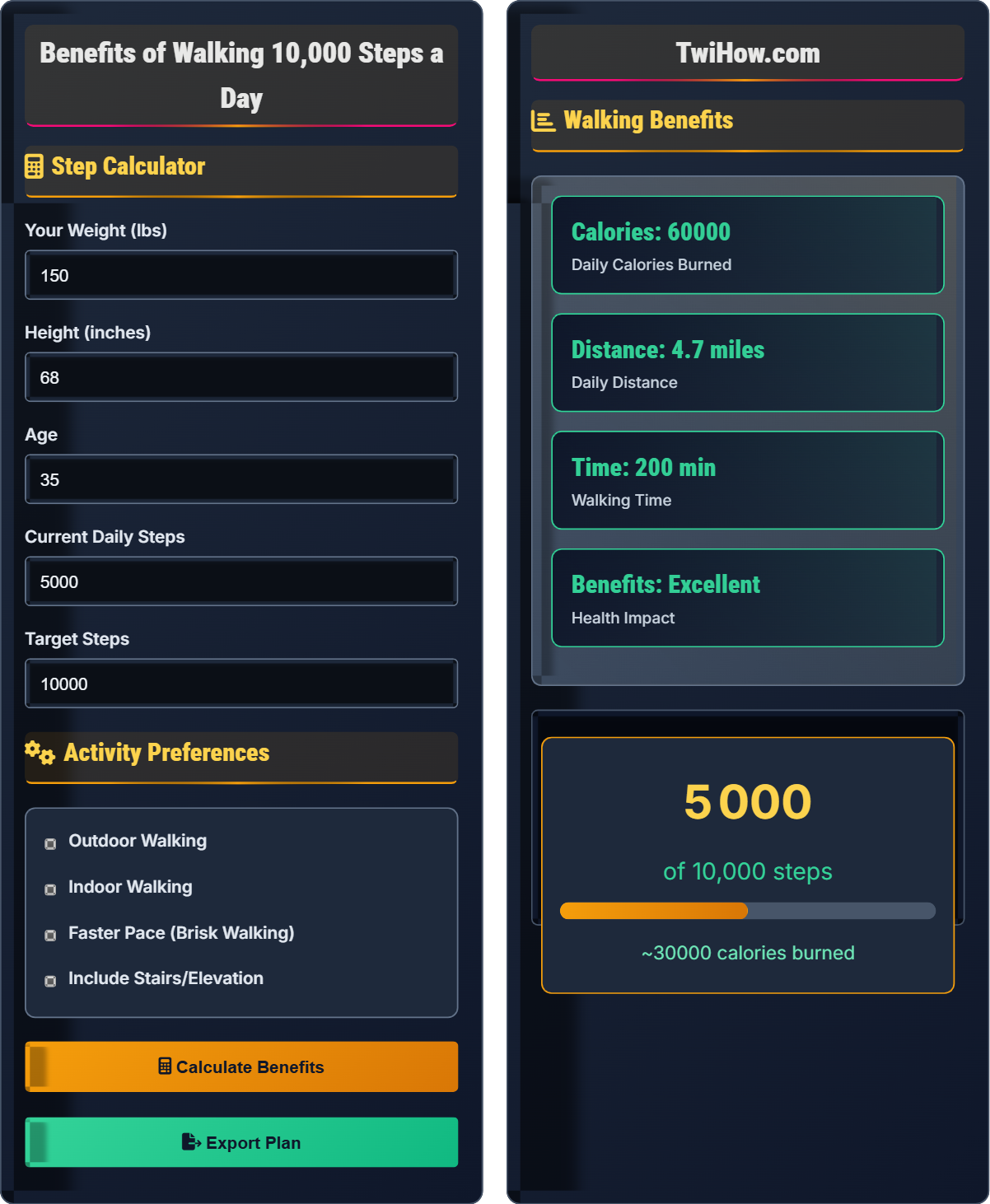
Step Calculator
Activity Preferences
Walking Benefits
| Week | Goal | Actual | Progress |
|---|---|---|---|
| Week 1 | 6,000 | 5,500 | 92% |
| Week 2 | 7,000 | 6,800 | 97% |
| Week 3 | 8,000 | 7,500 | 94% |
| Week 4 | 9,000 | 8,500 | 94% |
| Week 5 | 10,000 | 8,200 | 82% |
Walking 10,000 Steps Benefits Explained
Regular walking at 10,000 steps daily strengthens the heart and improves circulation:
- Heart Strength: Regular walking strengthens heart muscle and improves efficiency
- Blood Pressure: Reduces resting blood pressure over time
- Cholesterol: Improves HDL (good) cholesterol and reduces LDL (bad) cholesterol
- Stroke Risk: Reduces risk of stroke by 27% according to studies
Walking 10,000 steps burns approximately 300-400 calories for an average person:
- Calorie Burn: Depends on weight, stride length, and speed
- Metabolism: Boosts resting metabolic rate
- Fat Burning: Promotes fat oxidation, especially when done consistently
- Weight Maintenance: Helps maintain weight loss and prevent regain
Walking significantly improves mental health and cognitive function:
- Stress Reduction: Decreases cortisol and stress hormones
- Mood Enhancement: Releases endorphins and serotonin
- Depression: Reduces symptoms of mild to moderate depression
- Cognitive Function: Improves memory and executive function
Weight-bearing exercise like walking strengthens bones and joints:
- Bone Density: Increases bone mineral density and reduces osteoporosis risk
- Joint Mobility: Maintains flexibility and reduces stiffness
- Arthritis: Can reduce pain and improve function in arthritic joints
- Balance: Improves stability and reduces fall risk
Regular walking reduces risk of numerous chronic diseases:
- Type 2 Diabetes: Reduces risk by 30% through improved insulin sensitivity
- Cancer: Reduces risk of breast and colon cancer
- Longevity: Increases lifespan by 3-4 years according to studies
- Immune Function: Enhances immune system response
Calorie burn estimation: Calories = (Weight in lbs × Steps ÷ 2000) × 0.75
Distance estimation: Miles = Steps ÷ 2000 (for average stride length)
Time estimation: Minutes = Steps ÷ Steps per minute (average 100 steps/min)
Walking Benefits
Cardiovascular health, weight management, mental health, bone strength, disease prevention, longevity.
Calories Burned = (Weight × Steps × 0.04) ÷ 1000
Example: 150lb person walking 10,000 steps = (150 × 10000 × 0.04) ÷ 1000 = 60 calories.
- Consistency is more important than intensity
- Can be spread throughout the day
- Build up gradually if starting from low activity
- Any movement is better than none
Implementation Strategy
Start with current step count, set realistic goals, track progress, incorporate into daily routine, find enjoyable routes.
- Track current steps for 1 week
- Increase by 1,000 steps every 2 weeks
- Take 30-minute walks daily
- Find opportunities to walk more
- Maintain consistency
- Start slowly if previously sedentary
- Listen to your body
- Stay hydrated
- Wear appropriate footwear
Walking Benefits Quiz
Approximately how many calories does a 150-pound person burn by walking 10,000 steps?
Calorie burn from walking depends on body weight, step length, and walking speed. A commonly used formula estimates:
Calories burned ≈ Weight (lbs) × Steps ÷ 2000
Calculation: 150 lbs × 10,000 steps ÷ 2000 = 750 calories
However, this is a simplified estimate. More accurate calculations consider that walking typically burns about 0.04 calories per pound per step.
More precise calculation: 150 lbs × 10,000 steps × 0.04 = 600 calories
Adjusting for average walking speeds and individual differences, the typical range is 300-400 calories for 10,000 steps.
The answer is B) 300 calories.
Calorie burn calculations are estimates that vary based on individual factors. The relationship between weight, distance, and calories burned is approximately linear, but other factors like terrain, pace, and individual metabolism also play a role.
Calorie: Unit of energy used to measure food energy
Metabolism: Process of converting food to energy
Basal Metabolic Rate: Energy used at rest
• Heavier people burn more calories
• Faster walking burns more calories
• Individual factors affect calculations
• Use fitness trackers for more accurate measurements
• Include hills and stairs to increase burn
• Walk at a brisk pace for more benefits
• Assuming exact calorie burn for everyone
• Not accounting for individual differences
• Thinking calories burned is the only benefit
Explain how walking 10,000 steps daily affects cardiovascular health and what specific changes occur in the heart and circulatory system.
Direct Heart Benefits:
• Cardiac Output: Regular walking strengthens the heart muscle, allowing it to pump more blood with each beat, improving cardiac efficiency
• Resting Heart Rate: Aerobic exercise like walking gradually lowers resting heart rate as the heart becomes more efficient
• Heart Volume: The left ventricle increases in size, allowing more blood to be pumped per contraction
Circulatory System Improvements:
• Capillarization: New capillaries form in muscle tissue, improving oxygen and nutrient delivery
• Blood Pressure: Regular walking helps reduce both systolic and diastolic blood pressure over time
• Cholesterol Profile: Increases HDL (good) cholesterol and reduces LDL (bad) cholesterol and triglycerides
Long-term Effects:
• Plaque Reduction: Improved circulation and reduced inflammation help prevent arterial plaque buildup
• Endothelial Function: Walking improves the function of blood vessel walls, enhancing their ability to dilate and contract
• Stroke Risk: Studies show walking 10,000 steps daily can reduce stroke risk by up to 27%
These adaptations occur gradually with consistent activity, typically showing measurable improvements within 4-6 weeks of regular walking.
Walking is a form of aerobic exercise that creates a demand for increased oxygen delivery to working muscles. This demand triggers adaptive responses in the cardiovascular system to become more efficient. The heart becomes stronger, blood vessels more flexible, and circulation more effective.
Cardiac Output: Amount of blood pumped by the heart per minute
Capillarization: Formation of new capillaries
Endothelial Function: Ability of blood vessel walls to dilate and contract
• Adaptations take time to develop
• Consistency is crucial for benefits
• Effects are dose-dependent
• Monitor resting heart rate to track improvement
• Include varied terrain for cardiovascular challenge
• Maintain regular schedule for consistent benefits
• Expecting immediate cardiovascular changes
• Not recognizing the cumulative effect of daily walking
• Assuming only intense exercise benefits the heart
Sarah weighs 160 pounds and currently walks 3,000 steps per day. She wants to lose 1 pound per week by increasing her walking to 10,000 steps daily. If she maintains her current diet, how many additional calories per day does she need to burn to achieve her goal, and will walking 10,000 steps provide enough of a calorie deficit?
Weight Loss Goal:
To lose 1 pound per week, Sarah needs a 3,500-calorie deficit over the week.
Weekly deficit needed: 3,500 calories
Daily deficit needed: 3,500 ÷ 7 = 500 calories per day
Current Walking Calories:
Current steps: 3,000
Calories burned: 160 lbs × 3,000 steps × 0.04 = 192 calories
New Walking Calories:
New steps: 10,000
Calories burned: 160 lbs × 10,000 steps × 0.04 = 640 calories
Difference:
Additional calories burned: 640 - 192 = 448 calories per day
Conclusion:
Sarah needs 500 calories per day for her weight loss goal, but walking 10,000 steps instead of 3,000 provides 448 additional calories burned. This is close to her goal but falls short by 52 calories per day. She may need to make small dietary adjustments or walk even more to achieve exactly 1 pound per week loss.
Alternatively, she could expect to lose approximately 0.9 pounds per week with just the walking increase.
Weight loss requires a caloric deficit, and walking can contribute significantly to this. Understanding the mathematics helps set realistic expectations. The 3,500-calorie rule is an approximation, and actual weight loss may vary based on individual factors.
Caloric Deficit: Burning more calories than consumed
Metabolic Adaptation: Body's response to reduced calories
Weight Loss Rate: Sustainable rate is 1-2 lbs per week
• 3,500 calories ≈ 1 pound of fat
• Sustainable weight loss is 1-2 lbs/week
• Combined approach (exercise + diet) is most effective
• Track both diet and exercise for accurate deficits
• Allow for gradual progress
• Combine walking with modest dietary changes
• Expecting rapid weight loss
• Not accounting for metabolic adaptation
• Relying only on exercise for weight loss
A 65-year-old individual with mild knee osteoarthritis wants to start walking 10,000 steps daily. What considerations should they take into account, and how can they safely progress to this goal while protecting their joints?
Joint Health Considerations:
Walking is generally beneficial for joint health, even with arthritis, but progression must be careful:
Safe Progression Strategy:
1. Start Low: Begin with current comfortable step count (perhaps 2,000-3,000 steps)
2. Increase Gradually: Add 250-500 steps every 3-4 days, not weekly
3. Listen to Pain: Mild soreness is acceptable, sharp pain is not
4. Proper Footwear: Invest in supportive shoes with cushioning
Walking Modifications:
• Surface: Choose softer surfaces like trails or tracks over concrete
• Pace: Start with a comfortable pace, not necessarily brisk
• Support: Consider using walking poles if needed
• Warm-up: Gentle stretching before walking
Monitoring:
• Track pain levels on a 1-10 scale daily
• Rest if pain increases significantly
• Consult healthcare provider if pain worsens
Research shows that walking can actually reduce arthritis pain over time by strengthening surrounding muscles and improving joint lubrication.
Exercise, including walking, is actually recommended for arthritis management. The key is finding the right balance between activity and rest, and progressing gradually. Joint pain from arthritis doesn't always mean damage is occurring.
Osteoarthritis: Degenerative joint disease
Joint Lubrication: Synovial fluid production
Muscle Strengthening: Supporting structures around joints
• Exercise is beneficial for arthritis
• Gradual progression is essential
• Listen to your body's signals
• Use anti-inflammatory medication as directed
• Apply ice after walking if joints are inflamed
• Consider physical therapy guidance
• Avoiding all exercise due to joint pain
• Increasing too quickly with arthritis
• Not seeking professional guidance when needed
Which of the following is NOT a documented mental health benefit of walking 10,000 steps daily?
Option C is NOT a documented benefit - in fact, walking and other physical activities are known to reduce anxiety, not increase it.
Documented Benefits (A, B, D):
• Depression: Studies show walking can be as effective as antidepressants for mild to moderate depression
• Cognition: Walking increases BDNF (brain-derived neurotrophic factor), which supports brain health
• Mood: Releases endorphins and serotonin, improving overall mood
Option C (Incorrect):
Physical activity like walking actually reduces anxiety by lowering stress hormones like cortisol and adrenaline, and stimulating endorphin production. Multiple studies confirm that regular walking reduces anxiety symptoms.
The answer is C) Increased risk of anxiety disorders.
Physical activity has profound positive effects on mental health. The "runner's high" phenomenon extends to walking, though perhaps to a lesser degree. The brain responds positively to regular movement through various biochemical pathways.
BDNF: Brain-derived neurotrophic factor supporting neuron health
Endorphins: Natural mood-enhancing chemicals
Neuroplasticity: Brain's ability to adapt and change
• Exercise reduces, not increases, anxiety
• Mental benefits occur relatively quickly
• Walking is accessible for mental health
• Walk in nature for enhanced mental benefits
• Maintain consistency for sustained mood improvements
• Combine with mindfulness practices
• Thinking only intense exercise benefits mental health
• Not recognizing walking as "real" exercise
• Assuming mental benefits require long walks
FAQ
Q: I'm 70 years old with joint issues. Is walking 10,000 steps safe for me, and how should I approach it?
A: Walking is generally safe and beneficial for seniors, even with joint issues. However, approach it carefully:
Starting Approach:
1. Begin Conservatively: Start with your current comfortable step count, perhaps 2,000-4,000 steps
2. Gradual Progression: Increase by 250-500 steps every few days, not weekly
3. Listen to Your Body: Some joint discomfort is normal, but sharp pain is not
Joint-Friendly Strategies:
• Choose softer walking surfaces (grass, dirt paths, rubber tracks)
• Wear well-cushioned, supportive shoes
• Consider using a walking pole for stability
• Take rest days as needed
Benefits for Seniors:
Walking helps maintain bone density, improves balance (reducing fall risk), supports cardiovascular health, and can slow cognitive decline. The goal is consistent, comfortable movement rather than hitting 10,000 exactly.
Consult your doctor before starting, especially if you have significant joint issues or other health conditions.
Q: I work full-time and have a busy schedule. How can I realistically fit 10,000 steps into my day?
A: Breaking 10,000 steps into smaller chunks throughout the day is very effective:
Integrating Steps Into Daily Routine:
• Morning: 1,500 steps with a 15-minute walk before work
• Lunch Break: 2,000 steps with a 20-minute walk
• Evening: 2,000 steps with a walk after dinner
• Throughout Day: 4,500 steps from parking farther away, taking stairs, walking meetings
Time-Efficient Strategies:
• Park at the far end of parking lots
• Take the stairs instead of elevators
• Walk during phone calls
• Do household chores that involve movement
• Walk the dog for longer periods
Tracking Tips:
Use a fitness tracker to monitor progress and find opportunities to add steps. The key is making walking a natural part of your routine rather than a separate activity.
Remember, 10,000 steps is a goal, not a requirement - any increase in daily activity provides benefits.