What Are the Health Benefits of Spending Time in Nature?
Complete nature therapy guide • Step-by-step explanations
Nature Health Benefits:
Show Nature Benefits CalculatorSpending time in nature offers profound health benefits that span physical, mental, and emotional well-being. Scientific research consistently demonstrates that exposure to natural environments can reduce stress, boost immune function, improve mood, and enhance overall health outcomes. This practice, known as "forest bathing" or "shinrin-yoku" in Japanese culture, harnesses the healing power of natural environments.
The health benefits of nature exposure occur through multiple pathways, including reduced stress hormones, improved immune function through phytoncides released by trees, enhanced cognitive function, and increased physical activity. These benefits can be achieved through various forms of nature engagement, from forest walks to urban green spaces.
Key health benefits include:
- Mental Health: Reduced anxiety, depression, and stress
- Physical Health: Improved immune function, lower blood pressure, better sleep
- Cognitive Function: Enhanced focus, creativity, and mental clarity
- Social Benefits: Improved mood, reduced isolation, community connection
- Immune System: Increased natural killer cell activity, anti-inflammatory effects
Modern research validates what many cultures have long known - that nature serves as a powerful medicine for both body and mind.
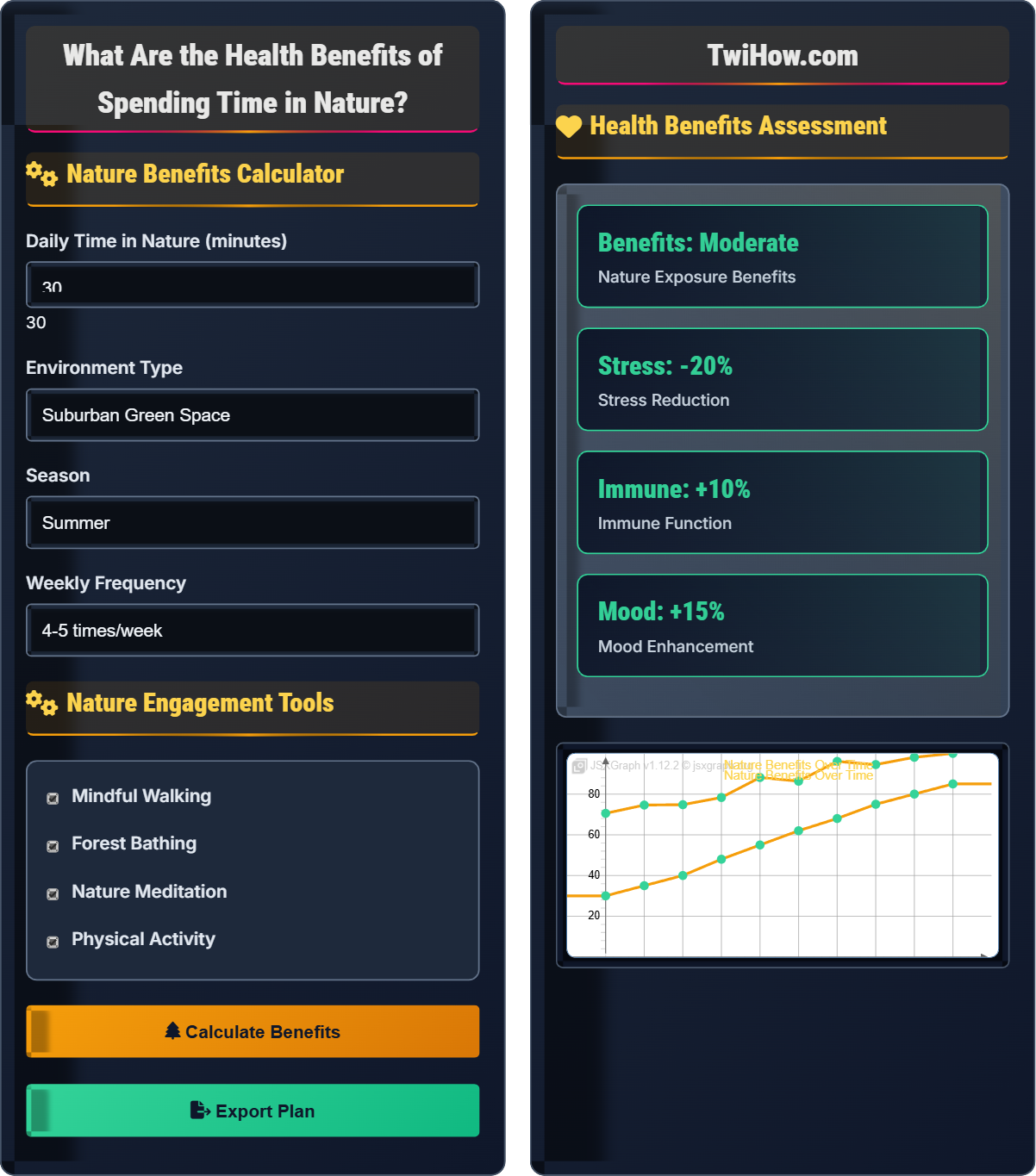
Nature Benefits Calculator
Nature Engagement Tools
Health Benefits Assessment
| Health Area | Current Benefit | Potential Improvement | Recommendation |
|---|---|---|---|
| Mental Health | +25% | Up to +40% | Increase to 45 min daily |
| Physical Health | +15% | Up to +30% | Add more physical activity |
| Immune Function | +20% | Up to +35% | More forest exposure |
| Cognitive Function | +20% | Up to +35% | Daily nature walks |
| Sleep Quality | +10% | Up to +25% | Evening nature time |
Nature Health Benefits Explained
Spending time in nature provides numerous health benefits that affect multiple body systems. These benefits occur through various mechanisms, including reduced stress hormones, exposure to beneficial compounds released by plants, improved air quality, and increased physical activity. The Japanese practice of "shinrin-yoku" (forest bathing) has been scientifically studied and shown to provide measurable health improvements.
Nature's health benefits follow a comprehensive framework:
Where:
- Time: Duration of nature exposure
- Environment: Type of natural setting
- Activities: Nature-based activities engaged in
- Frequency: Regularity of nature exposure
Key areas where nature exposure provides significant health benefits:
- Stress Reduction: Lower cortisol levels and reduced anxiety
- Immune Function: Increased natural killer cell activity
- Cardiovascular Health: Lower blood pressure and heart rate
- Mental Health: Reduced depression and improved mood
- Cognitive Function: Enhanced focus and creativity
- Physical Activity: Encouraged movement and exercise
- Phytoncides: Essential oils released by trees with antimicrobial properties
- Improved Air Quality: Cleaner air with reduced pollutants
- Microbial Diversity: Exposure to beneficial soil and plant microbes
- Light Exposure: Natural light regulating circadian rhythms
- Physical Activity: Encouragement of movement and exercise
Nature Benefits Fundamentals
Shinrin-yoku, forest bathing, ecotherapy, biophilia, nature therapy, green exercise, environmental psychology.
Health Improvement = f(Time, Environment, Activities, Frequency)
Where Time = duration of exposure, Environment = natural setting quality.
- Even short nature exposure provides benefits
- Consistency is more important than duration
- Different environments offer different benefits
Application Strategies
Mindful walking, forest bathing, nature meditation, outdoor exercise, garden therapy, wilderness retreats.
- Start with small amounts of nature time
- Find accessible natural spaces
- Engage in mindful nature activities
- Maintain consistent routine
- Any amount of nature is beneficial
- Urban green spaces provide benefits
- Seasonal variations affect experience
- Safety and accessibility matter
Nature Health Benefits Learning Quiz
What are phytoncides and how do they contribute to nature's health benefits?
Phytoncides are antimicrobial organic compounds released by trees and plants as part of their defense mechanism. These volatile organic compounds have been shown to boost human immune function, particularly by increasing the activity of natural killer (NK) cells, which play a crucial role in fighting infections and cancer. Japanese researchers discovered that forest bathing (shinrin-yoku) increases NK cell activity through exposure to these beneficial compounds released by trees.
The answer is B) Essential oils released by trees with antimicrobial properties.
This demonstrates one of the scientific mechanisms behind nature's health benefits. Phytoncides represent a direct biological pathway through which natural environments improve human health. The discovery of this mechanism helped validate traditional practices of spending time in forests for health and provided a scientific basis for nature therapy.
Phytoncides: Antimicrobial compounds released by plants
Natural Killer Cells: White blood cells that fight infections and cancer
Shinrin-yoku: Japanese practice of forest bathing
• Trees release beneficial compounds
• These compounds boost immunity
• Forest exposure increases NK cell activity
• Spend time in forests for immune benefits
• Fresh air contains beneficial compounds
• Forests have natural antimicrobial properties
• Thinking all plant emissions are harmful
• Not understanding biological mechanisms
• Assuming benefits are only psychological
Explain the physiological mechanisms by which nature exposure reduces stress and improves mental health.
Cortisol Reduction: Studies show that spending time in forests significantly reduces cortisol levels, a primary stress hormone. Just 15-30 minutes in nature can lower cortisol production.
Sympathetic Nervous System: Nature exposure decreases sympathetic nervous system activity (responsible for "fight or flight"), leading to reduced heart rate and blood pressure.
Parasympathetic Activation: Natural environments activate the parasympathetic nervous system, promoting relaxation and recovery.
Attention Restoration Theory: Natural environments restore directed attention capacity that gets depleted by urban environments and technology use.
Mindfulness and Present-Moment Awareness: Nature naturally encourages mindfulness, reducing rumination and anxiety-focused thoughts.
Biophilia Effect: Humans have an innate affinity for nature, and this connection reduces psychological stress when activated.
These mechanisms work synergistically to provide comprehensive stress reduction and mental health benefits.
The stress reduction from nature operates through multiple interconnected physiological pathways. This multi-system approach explains why nature exposure can be so effective for stress management. Understanding these mechanisms helps people appreciate that the benefits are real and measurable, not just imagined.
Cortisol: Primary stress hormone
Sympathetic Nervous System: Fight-or-flight response system
Parasympathetic Nervous System: Rest-and-digest response system
• Nature reduces stress hormones
• Attention restoration occurs
• Even short nature exposure reduces cortisol
• Nature activates relaxation response
• Attention restoration is rapid
• Thinking benefits are only psychological
• Assuming long exposure is required
• Not recognizing physiological changes
A corporate employee spends most of their day indoors in a high-stress environment. They experience chronic stress, poor sleep, and frequent colds. Design a nature-based intervention plan that fits into their busy schedule and maximizes health benefits.
Micro-Nature Interventions:
1. Morning Routine: 10-minute nature walk before work or during coffee break
2. Lunch Break: Eat outdoors or walk in nearby park for 15-20 minutes
3. Stress Breaks: 5-minute "forest bathing" by looking at trees/plants through windows
4. Commute Enhancement: Take routes that pass by green spaces when possible
Weekend Intensification:
5. Extended Sessions: 1-2 hour nature walks on weekends
6. Activity Integration: Combine nature with exercise (hiking, cycling)
Indoor Nature:
7. Workspace Enhancement: Add plants to workspace, use nature sounds
8. Virtual Nature: Nature videos during breaks when outdoor access isn't possible
This approach maximizes benefits through consistency rather than duration, fitting nature exposure into existing routines.
This example demonstrates how to integrate nature benefits into busy lifestyles. The key is consistency and multiple small exposures rather than infrequent long sessions. Micro-interventions can provide significant benefits while working around demanding schedules. The plan addresses multiple health areas simultaneously.
Micro-Interventions: Small, brief nature exposure activities
Consistency Principle: Regular exposure more important than duration
Integrated Approach: Embedding nature into daily routines
• Consistency over duration
• Multiple small exposures work
• Integrate into existing routines
• Use lunch breaks for nature time
• Add plants to indoor spaces
• Choose green commute routes
• Waiting for ideal conditions
• Thinking only long sessions count
• Not utilizing micro-opportunities
You're helping someone living in a dense urban environment with limited access to forests or parks. Explain how they can still obtain nature benefits and provide specific strategies for urban nature engagement.
Urban Nature Opportunities:
City Parks: Even small pocket parks provide benefits; focus on quality time rather than size
Botanical Gardens: Concentrated plant diversity with therapeutic benefits
Green Roofs and Walls: Access to vertical gardens and rooftop spaces
Window Views: Looking at trees, plants, or green spaces from windows
Indoor Plants: Houseplants provide air purification and psychological benefits
Community Gardens: Participate in local gardening activities
Water Features: Fountains, rivers, or lakes in urban areas
Tree-lined Streets: Walk routes with abundant street trees
Urban Forest Preserves: Seek out larger green spaces within the city
Virtual Nature: Nature sounds, videos, or virtual reality for additional benefits
Research shows that even urban green spaces provide significant health benefits, though forest environments may offer greater immune system benefits.
This demonstrates that nature benefits are accessible to everyone, regardless of location. Urban environments, while different from forests, still provide meaningful health benefits. The key is maximizing available opportunities and understanding that any contact with nature is better than none. Urban nature can be enhanced through intentional design and planning.
Urban Nature: Natural elements in city environments
Accessibility: Availability of nature experiences
Compensatory Strategies: Alternative approaches when ideal options aren't available
• Any nature is better than none
• Urban green spaces provide benefits
• Intentional seeking maximizes benefits
• Find the greenest routes for walking
• Add plants to your living space
• Use nature apps for guided experiences
• Believing only forests count
• Not seeking available urban options
• Giving up on nature access
According to scientific research, what is the minimum amount of time needed in nature to achieve measurable health benefits?
Scientific research consistently shows that just 20-30 minutes in nature can produce measurable health benefits. Studies have demonstrated that this amount of time is sufficient to reduce cortisol levels, lower blood pressure, decrease sympathetic nervous system activity, and improve mood. The Japanese practice of forest bathing often involves sessions of 2-4 hours for maximum benefits, but significant improvements begin with much shorter exposures. This finding is important because it makes nature therapy accessible to busy individuals.
The answer is B) 20-30 minutes.
This finding debunks the myth that long nature sessions are required for benefits. The 20-30 minute threshold makes nature therapy highly accessible, as most people can find this amount of time in their daily schedules. This accessibility is crucial for widespread adoption of nature-based health interventions. The consistency principle suggests that multiple short sessions may be as effective as fewer long sessions.
Measurable Benefits: Physiological changes that can be detected and quantified
Accessibility: Ease of implementing an intervention
Threshold Effect: Minimum amount needed for benefits
• Short exposure provides benefits
• Accessibility increases compliance
• Consistency matters more than duration
• Start with just 20 minutes daily
• Consistency is more important than length
• Multiple short sessions work well
• Thinking long sessions are required
• Not starting due to time constraints
• Assuming only weekends count
FAQ
Q: Do I need to go to forests or mountains to get nature benefits, or can I get them in a city park?
A: You can definitely get significant nature benefits from city parks and urban green spaces! Research shows that:
Urban Green Spaces Provide Benefits:
• Reduced stress and improved mood
• Better cognitive function and focus
• Increased physical activity
• Social connection opportunities
However, Forest Environments May Offer Additional Benefits:
• Higher levels of phytoncides (beneficial plant compounds)
• Greater microbial diversity
• More pronounced immune system enhancement
• Reduced air pollution exposure
Key Finding: Any green space is better than no green space. If you have access to forests, spend extra time there for maximum benefits, but city parks are excellent for maintaining consistent nature exposure. The most important factor is regularity of exposure rather than the type of green space.
Q: How does nature exposure affect the immune system, and how long do the benefits last?
A: Nature exposure affects the immune system through several mechanisms:
Primary Immune Enhancements:
• Natural Killer (NK) Cell Activity: Forest bathing increases NK cell activity by 40-50%, which can last 7-30 days
• Anti-Cancer Proteins: Levels of anti-cancer proteins increase after forest visits
• Stress Reduction: Lower cortisol reduces immune suppression
• Phytoncide Exposure: Tree compounds boost immune function
Duration of Benefits:
• Immediate: Stress hormones drop within 15-30 minutes
• Short-term: NK cell activity increases for 7-30 days
• Long-term: Regular exposure maintains elevated immune function
Optimal Strategy: Consistent weekly exposure (even 2-4 hours) maintains elevated immune function. The benefits are cumulative with regular exposure, but they do diminish over time without continued nature contact.