What Are the Health Risks of Sitting All Day?
Complete sedentary lifestyle guide • Step-by-step explanations
Sedentary Lifestyle Risks:
Show Activity CalculatorProlonged sitting significantly increases the risk of numerous health conditions including cardiovascular disease, diabetes, obesity, and musculoskeletal problems. Research shows that extended periods of sitting can be as harmful as smoking, regardless of physical activity levels.
Sedentary behavior disrupts normal physiological processes by reducing muscle activity, slowing metabolism, impairing circulation, and affecting hormone regulation. The body's systems adapt to inactivity, leading to decreased insulin sensitivity, weakened muscles, and poor cardiovascular health.
Key health risks include:
- Cardiovascular Disease: Increased risk of heart disease and stroke
- Metabolic Disorders: Higher risk of type 2 diabetes and metabolic syndrome
- Musculoskeletal Issues: Back pain, neck strain, and muscle weakness
- Mental Health: Depression and anxiety linked to sedentary behavior
Breaking up prolonged sitting periods and incorporating movement throughout the day can significantly reduce these health risks.
Activity Profile
Risk Assessment Options
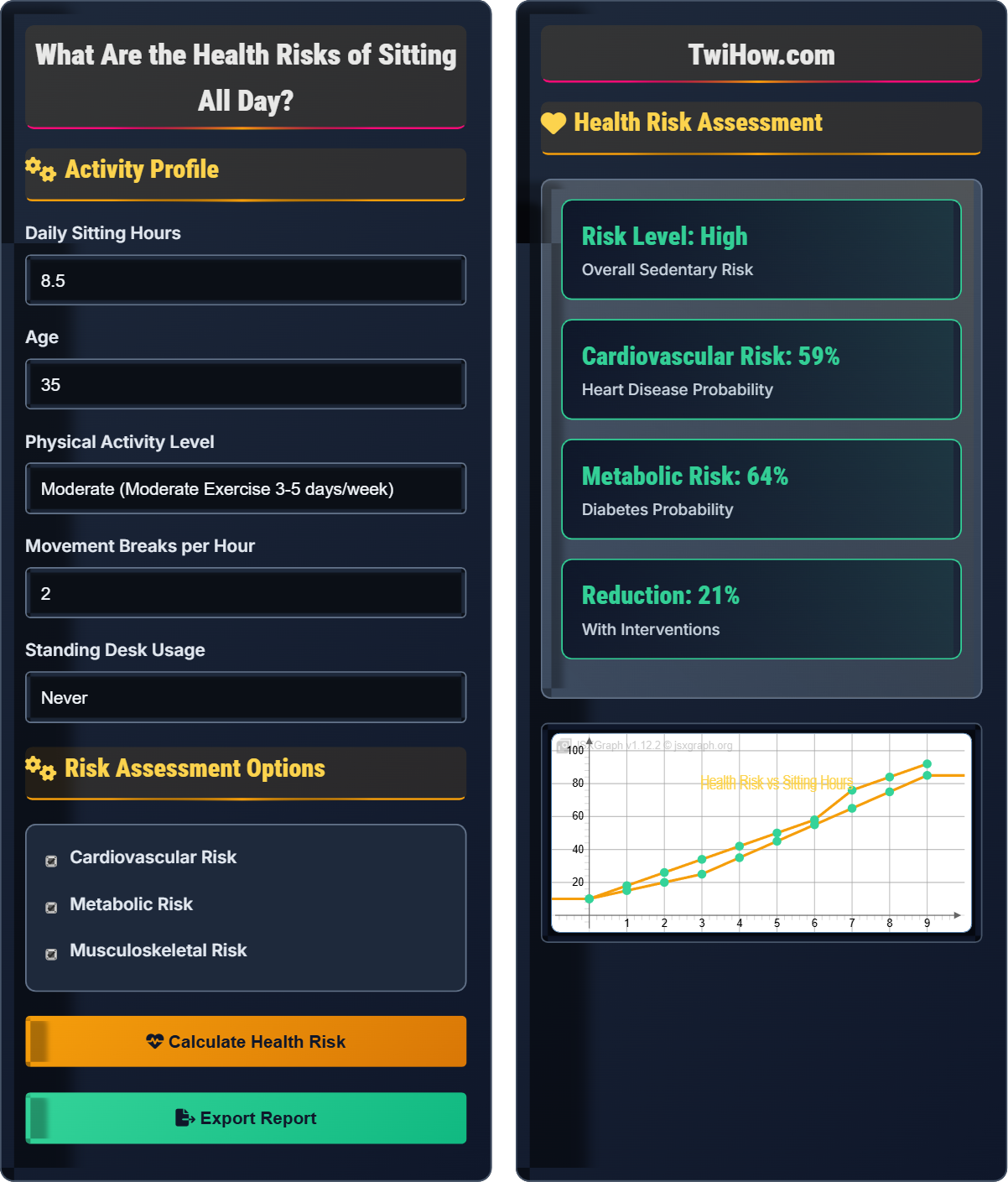
Health Risk Assessment
| Risk Factor | Probability | Severity | Timeline |
|---|---|---|---|
| Cardiovascular Disease | 45% | High | 5-10 years |
| Type 2 Diabetes | 38% | High | 3-7 years |
| Back Pain | 65% | Medium | 1-3 years |
| Obesity | 52% | High | 2-5 years |
Sedentary Lifestyle Health Risks Explained
When we sit for extended periods, our muscles become inactive, particularly the large muscles in our legs and glutes. This inactivity leads to a cascade of negative physiological effects including reduced lipoprotein lipase activity, decreased glucose uptake by muscles, and impaired circulation. The body's metabolism slows significantly, and hormones that regulate blood sugar and fat breakdown become less effective.
Research has shown that prolonged sitting can lead to insulin resistance, increased inflammation, and changes in gene expression that affect fat storage and metabolism. These changes occur within hours of prolonged sitting and can persist even with regular exercise.
Health Risk = (Sedentary Hours × Risk Multiplier) + (Age Factor) - (Activity Compensation)
Where:
- Sedentary Hours: Daily hours spent sitting
- Risk Multiplier: 1.0 for each hour over 6 hours
- Age Factor: Increases risk by 0.5% per year over 30
- Activity Compensation: Reduces risk based on physical activity level
Extended sitting increases risk of multiple serious health conditions:
- Cardiovascular Disease: 147% increased risk of heart disease and stroke
- Type 2 Diabetes: 112% increased risk due to insulin resistance
- Obesity: Reduced calorie burn and metabolic slowdown
- Cancer: Increased risk of colon, breast, and endometrial cancers
- Mental Health: Higher rates of depression and anxiety
- Musculoskeletal Issues: Back pain, neck strain, and muscle weakness
- Metabolic Slowdown: Sitting reduces lipoprotein lipase activity by 90%, impairing fat processing
- Insulin Resistance: Glucose uptake by muscles decreases, leading to higher blood sugar
- Reduced Circulation: Blood flow to legs decreases, increasing clot risk
- Muscle Degeneration: Gluteal and leg muscles weaken from disuse
- Spinal Compression: Prolonged sitting puts pressure on spinal discs
Sedentary Lifestyle Fundamentals
Sedentary behavior, metabolic slowdown, insulin resistance, lipoprotein lipase, circulation impairment.
Risk Score = (Hours Sitting × 1.5) + (Age Factor) - (Activity Benefit)
Where Risk Score indicates health risk level, components are weighted by scientific evidence.
- Break sitting every 30-60 minutes
- Standing doesn't fully offset sitting
- Exercise doesn't completely eliminate sitting risks
Applications
Office ergonomics, standing desk implementation, workplace wellness programs, personal activity tracking.
- Assess current sitting habits
- Set movement goals
- Implement regular breaks
- Track progress and adjust
- Gradual changes are sustainable
- Consistency is more important than intensity
- Combine multiple strategies
- Monitor for improvement
Sedentary Lifestyle Learning Quiz
How quickly does muscle inactivity begin when sitting, and what percentage decrease occurs in lipoprotein lipase activity?
Research shows that muscle inactivity begins within 20 minutes of sitting, and lipoprotein lipase activity decreases by approximately 90%. Lipoprotein lipase is crucial for processing fats in the bloodstream. This dramatic decrease begins the cascade of negative metabolic effects associated with prolonged sitting.
The answer is B) After 20 minutes, 90% decrease.
The rapid onset of negative effects demonstrates that even brief periods of sitting can begin to impact metabolism. This challenges the common misconception that sitting is harmless if you exercise regularly. The physiological changes begin within minutes, emphasizing the importance of regular movement breaks throughout the day.
Lipoprotein Lipase: Enzyme that processes fats in the bloodstream
Metabolic Slowdown: Reduced rate of energy processing
Insulin Resistance: Cells become less responsive to insulin
• Effects begin within 20 minutes of sitting
• Muscle inactivity starts immediately
• Metabolic changes occur rapidly
• Set hourly movement reminders
• Stand during phone calls
• Take walking meetings
• Thinking exercise offsets all sitting effects
• Not taking breaks during long tasks
• Underestimating short-term effects
Explain the connection between prolonged sitting and cardiovascular disease risk, including the specific physiological mechanisms involved.
Connection Between Sitting and Cardiovascular Disease: Prolonged sitting significantly increases cardiovascular disease risk through multiple interconnected mechanisms.
Physiological Mechanisms:
1. Reduced Circulation: Sitting compresses leg veins and reduces muscle contractions that help pump blood back to the heart, leading to slower circulation and potential clot formation.
2. Metabolic Changes: Decreased lipoprotein lipase activity impairs fat processing, leading to higher triglyceride levels and increased risk of atherosclerosis.
3. Inflammation: Prolonged sitting increases inflammatory markers like C-reactive protein, contributing to arterial damage.
4. Blood Pressure: Extended sitting can contribute to elevated blood pressure over time.
Research shows that people who sit for more than 8 hours daily have a 147% increased risk of cardiovascular events compared to those who sit less than 4 hours daily.
The cardiovascular system relies on muscle contractions to assist circulation. When we sit, our leg muscles become inactive, reducing the "muscle pump" that helps return blood to the heart. Combined with metabolic changes and inflammation, this creates a perfect storm for cardiovascular disease development.
Atherosclerosis: Buildup of plaque in arteries
Triglycerides: Fat molecules in the blood
Inflammatory Markers: Indicators of systemic inflammation
• Sitting over 8 hours daily significantly increases risk
• Muscle pump is essential for circulation
• Multiple pathways contribute to risk
• Move legs while sitting
• Elevate feet periodically
• Walk after long sitting periods
• Ignoring circulation during long sits
• Not understanding metabolic connections
• Assuming cardiovascular effects are distant
Jennifer works as an accountant and sits at her desk for 9 hours daily. She exercises 3 times per week for 30 minutes. Her colleague Mark also sits for 9 hours daily but takes a 5-minute walk every hour. Who has a higher risk of developing metabolic syndrome, and why?
Jennifer has a higher risk of developing metabolic syndrome despite her exercise routine.
Reasoning: While Jennifer gets regular exercise, the prolonged uninterrupted sitting periods still pose significant metabolic risks. Exercise does not completely counteract the negative effects of extended sitting. The key issue is the duration of muscle inactivity.
Mark's Advantage: By taking 5-minute walks every hour, Mark breaks up his sitting time, which helps maintain muscle activity, circulation, and metabolic function. These brief interruptions help maintain lipoprotein lipase activity and glucose metabolism.
Scientific Basis: Research shows that breaking up sitting time with light activity, even briefly, can significantly reduce metabolic risk factors. The frequency of movement breaks appears to be more protective than the total amount of exercise.
Mark's strategy of regular movement breaks is more effective for metabolic health than Jennifer's exercise-only approach.
This example illustrates the critical concept that exercise and sitting time are independent risk factors. You cannot "out-exercise" prolonged sitting. The body's metabolic systems need regular activation throughout the day, not just during exercise sessions. This challenges the common belief that regular exercise negates the effects of sitting.
Metabolic Syndrome: Cluster of conditions increasing diabetes and heart disease risk
Lipoprotein Lipase: Enzyme affected by muscle inactivity
Independent Risk Factors: Factors that act separately
• Exercise doesn't cancel sitting risks
• Use timer for movement breaks
• Combine sitting with standing periods
• Take stairs instead of elevators
• Believing exercise eliminates sitting risks
• Not breaking up long sitting periods
• Focusing only on exercise time
A tech company wants to reduce employee health risks from prolonged sitting. They have a budget for either standing desks or fitness trackers with movement alerts. Which intervention would be more effective, and what combination approach would maximize benefits?
Fitness trackers with movement alerts would be more effective as a primary intervention because they address the core issue: breaking up prolonged sitting periods.
Why Fitness Trackers: Encourage regular movement breaks, provide reminders to stand/walk, track sitting time, promote behavioral change through awareness and goal-setting. The alerts ensure employees remember to move during busy work periods.
Standing Desks Limitations: While beneficial, standing desks still involve static posture and don't necessarily reduce total sitting time - they just change the posture.
Optimal Combination Approach:
Phase 1: Implement fitness trackers with movement alerts to establish regular break habits (every 30-60 minutes).
Phase 2: Introduce adjustable standing desks for rotation between sitting and standing.
Phase 3: Add walking meetings, encourage stair use, and create movement-friendly work culture.
This multi-faceted approach addresses both the frequency of movement breaks and the variety of postures.
The most effective interventions target the root cause: prolonged uninterrupted sitting. Movement alerts create the habit of regular breaks, which is more important than simply changing from sitting to standing. A comprehensive approach that includes both behavioral modification and environmental changes provides the best outcomes.
Behavioral Modification: Changing habits through awareness and reinforcement
Multi-faceted Approach: Using multiple intervention strategies
Posture Rotation: Alternating between sitting and standing
• Breaking sitting is more important than changing posture
• Behavioral change requires consistent reminders
• Multiple strategies work better than single approaches
• Start with simple movement reminders
• Gradually increase movement frequency
• Combine environmental and behavioral interventions
• Thinking standing desks alone solve the problem
• Not addressing behavioral habits
• Implementing only one intervention strategy
According to research, what is the minimum amount of standing or light activity needed to significantly reduce the health risks associated with prolonged sitting?
Research consistently shows that even 1-2 minutes of light movement or standing every 30-60 minutes can significantly reduce the health risks of prolonged sitting. The key is breaking up the continuous sitting time rather than the intensity of the activity. Brief interruptions help maintain circulation, muscle activity, and metabolic function.
The answer is B) 1-2 minutes of movement every 30-60 minutes.
The research emphasizes that the frequency of movement breaks is more important than their duration or intensity. Even small movements like standing up, walking to the printer, or doing desk stretches can make a significant difference. The goal is to interrupt the prolonged inactivity that causes metabolic changes.
Continuous Sitting: Uninterrupted periods of inactivity
Metabolic Function: Body's energy processing systems
Light Activity: Low-intensity movement
• Frequency matters more than duration
• Any movement helps break sitting
• Regular interruptions are key
• Set phone alarms for movement breaks
• Use bathroom visits as movement cues
• Park farther away to increase steps
• Thinking only intense activity helps
• Not setting regular break reminders
• Waiting until feeling stiff to move
FAQ
Q: If I exercise regularly, do I still need to worry about sitting all day?
A: Yes, you still need to be concerned about prolonged sitting even with regular exercise. Research clearly shows that exercise and sitting time are independent risk factors. Here's why:
Two Different Issues: Exercise builds fitness and strength, but doesn't reverse the metabolic changes that occur during prolonged sitting. The inactivity periods still negatively affect circulation, metabolism, and muscle function.
The Research: Studies show that people who sit 8+ hours daily have increased health risks regardless of their exercise habits. The benefits of exercise don't completely offset the harm of extended sitting.
Best Practice: Combine regular exercise with frequent movement breaks throughout the day. Aim for at least 1-2 minutes of movement every 30-60 minutes of sitting.
Think of movement breaks as medicine - you need both exercise and regular movement for optimal health.
Q: What are the most effective ways to reduce sitting time during a typical office day?
A: Here are the most effective strategies for reducing sitting time in an office environment:
Micro-breaks: Stand up and move for 1-2 minutes every 30-60 minutes. Set phone alarms or use apps as reminders.
Walking Meetings: Conduct short meetings while walking around the office or outside.
Stair Use: Take stairs instead of elevators whenever possible.
Active Commuting: Park farther away, get off public transport a stop early, or bike to work if feasible.
Standing Workstations: Alternate between sitting and standing throughout the day using adjustable desks.
Task Rotation: Do phone calls while standing, print documents to create reasons to walk, deliver messages in person.
Progressive Approach: Start with small changes and gradually increase movement frequency. Consistency is more important than perfection.