What Is Personalized Medicine and Is It Accessible?
Complete personalized medicine guide • Step-by-step explanations
Personalized Medicine:
Show Personalized Medicine PlannerPersonalized medicine, also known as precision medicine, is an innovative approach to healthcare that tailors medical treatment to the individual characteristics of each patient. This revolutionary field uses genetic, environmental, and lifestyle information to guide decisions about prevention, diagnosis, and treatment of diseases.
Personalized medicine represents a shift from the traditional "one-size-fits-all" approach to a more targeted strategy that considers individual variability in genes, environment, and lifestyle. This approach aims to maximize treatment efficacy while minimizing adverse effects by customizing medical care to each person's unique profile.
Key components of personalized medicine:
- Genomic Profiling: DNA sequencing and genetic variant analysis
- Pharmacogenomics: How genetics affect drug metabolism and response
- Proteomics: Protein expression patterns and biomarkers
- Environmental Factors: Lifestyle, diet, and environmental exposures
- Therapeutic Targeting: Tailored treatments based on molecular profiles
While personalized medicine offers tremendous potential for improving healthcare outcomes, accessibility remains a significant challenge due to cost, infrastructure requirements, and health equity considerations.
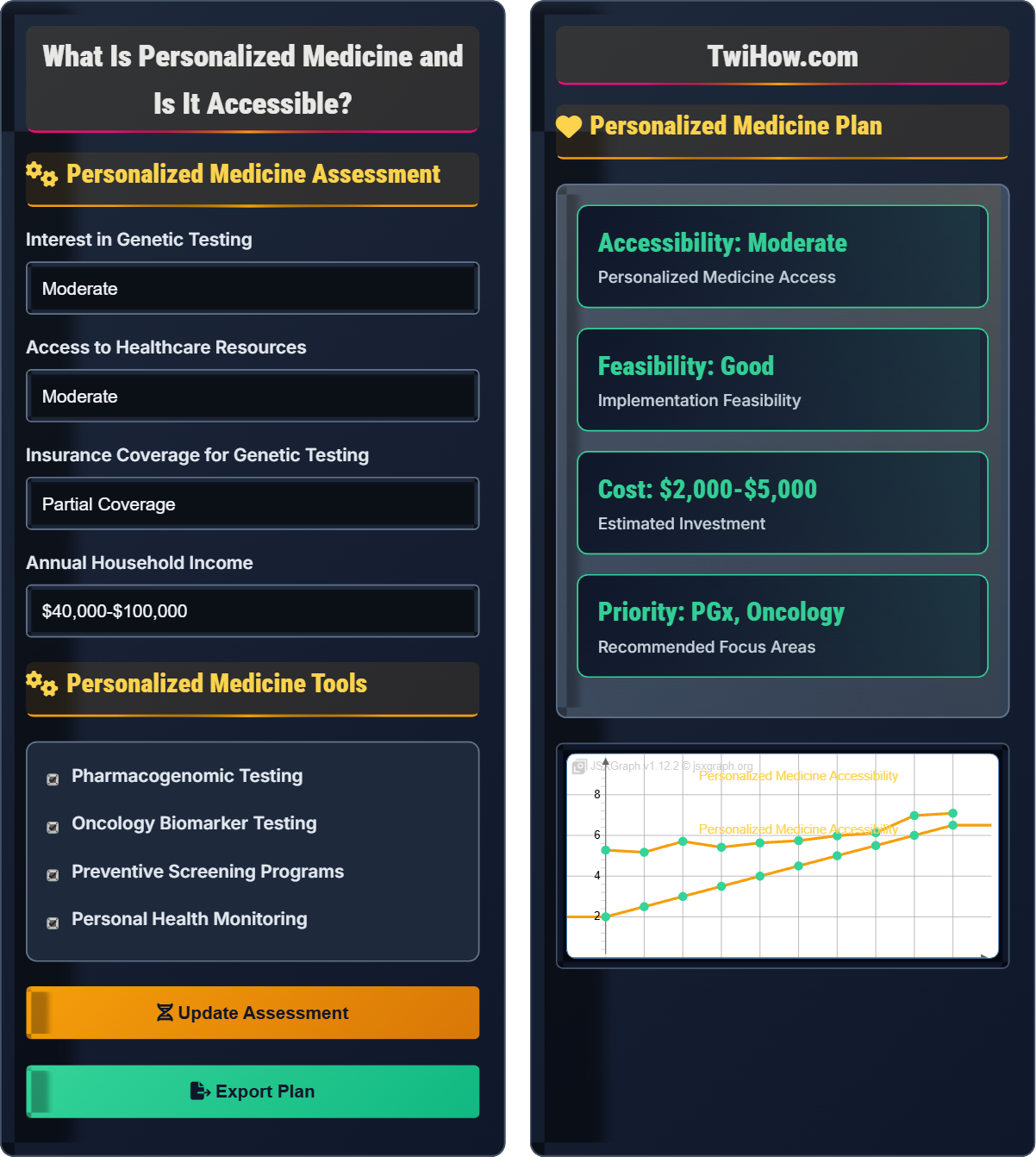
Personalized Medicine Assessment
Personalized Medicine Tools
Personalized Medicine Plan
| Component | Feasibility | Cost Range | Recommendation |
|---|---|---|---|
| Pharmacogenomics | High | $300-$800 | Recommended |
| Oncology Testing | Moderate | $2,000-$5,000 | Consider if needed |
| Preventive Screening | High | $500-$1,500 | Recommended |
| Health Monitoring | High | $100-$500 | Recommended |
| Genetic Counseling | Medium | $200-$400 | Recommended |
Personalized Medicine Explained
Personalized medicine, also known as precision medicine, is an innovative approach to healthcare that uses individual characteristics—such as genetic makeup, environment, and lifestyle—to tailor medical treatment. Rather than applying a one-size-fits-all approach, personalized medicine customizes healthcare decisions, treatments, practices, or products to the individual patient.
Personalized medicine follows a comprehensive framework:
Where:
- Genetic Factors: DNA variants, gene expression, inherited traits
- Environmental Factors: Diet, pollution, toxins, social determinants
- Lifestyle Factors: Exercise, stress, sleep, substance use
Key areas where personalized medicine provides significant benefits:
- Oncology: Targeted cancer therapies based on tumor genetics
- Pharmacogenomics: Personalized drug selection and dosing
- Cardiovascular Disease: Risk stratification and prevention
- Rare Diseases: Genetic diagnosis and treatment
- Autoimmune Disorders: Personalized immunosuppression
- Preventive Medicine: Risk assessment and screening
- Whole Genome Sequencing: Complete DNA analysis
- RNA Sequencing: Gene expression profiling
- Proteomics: Protein analysis and biomarkers
- Metabolomics: Metabolic pathway analysis
- Artificial Intelligence: Pattern recognition and prediction
Personalized Medicine Fundamentals
Personalized medicine, precision medicine, pharmacogenomics, genomics, biomarkers, targeted therapy.
Treatment Outcome = f(Genetic Factors, Environmental Factors, Lifestyle Factors)
Where Genetic Factors = DNA variants, Environmental = external influences.
- Individual genetic variation affects drug response
- Combining multiple data types improves accuracy
- Continuous monitoring enhances outcomes
Accessibility Challenges
Cost, insurance coverage, geographic access, health literacy, genetic counseling availability.
- Financial accessibility (cost and insurance)
- Geographic accessibility (location of services)
- Technological accessibility (infrastructure)
- Educational accessibility (health literacy)
- Cost remains a significant barrier
- Insurance coverage varies widely
- Healthcare disparities affect access
- Genetic counseling resources are limited
Personalized Medicine Learning Quiz
What is the primary difference between personalized medicine and traditional medicine?
Personalized medicine differs from traditional medicine primarily in its approach to treatment. Traditional medicine often uses a "one-size-fits-all" approach, where patients with the same condition receive similar treatments. Personalized medicine, on the other hand, tailors treatment based on individual characteristics such as genetic makeup, environment, and lifestyle. This approach aims to maximize treatment efficacy while minimizing adverse effects by customizing medical care to each person's unique profile.
The answer is B) Personalized medicine tailors treatment to individual characteristics.
The fundamental shift in personalized medicine is from population-based treatment to individualized care. This approach recognizes that individuals may respond differently to the same treatment due to genetic, environmental, and lifestyle factors. The goal is to move away from trial-and-error prescribing toward more targeted, effective treatments.
Personalized Medicine: Healthcare tailored to individual characteristics
Traditional Medicine: Population-based treatment approaches
Individual Variability: Differences in how people respond to treatments
• Individual characteristics affect treatment response
• Personalized approach aims for better outcomes
• Traditional medicine uses standard protocols
• Consider individual factors in treatment decisions
• Understand that everyone responds differently
• Personalized medicine builds on traditional medicine
• Confusing personalized with alternative medicine
• Thinking it only applies to genetic diseases
• Assuming it's always more expensive
Explain how pharmacogenomics contributes to personalized medicine, including specific examples of how genetic variations affect drug metabolism and treatment outcomes.
Pharmacogenomics Definition: Pharmacogenomics is the study of how genetic variations affect individual responses to medications. It examines how genes influence drug metabolism, efficacy, and toxicity.
Key Mechanisms:
Drug Metabolism Genes: The CYP2D6 gene affects metabolism of many psychiatric medications. Poor metabolizers may experience toxic effects at standard doses, while ultra-rapid metabolizers may require higher doses.
Warfarin Dosing: Variations in CYP2C9 and VKORC1 genes affect warfarin metabolism and sensitivity, allowing for more accurate initial dosing and reducing bleeding risk.
TPMT and Thiopurines: TPMT gene variants affect metabolism of thiopurine drugs used in leukemia and autoimmune diseases. Testing prevents life-threatening bone marrow suppression.
HLA-B*5701 and Abacavir: This genetic variant predicts severe hypersensitivity reactions to the HIV medication abacavir.
These examples demonstrate how genetic testing can optimize drug selection and dosing, reducing adverse effects and improving efficacy.
Pharmacogenomics represents one of the most successful applications of personalized medicine. By understanding how genetic variations affect drug metabolism, healthcare providers can predict which patients might experience adverse effects or suboptimal responses to medications. This knowledge allows for more precise dosing and drug selection, moving away from the traditional trial-and-error approach.
Pharmacogenomics: Study of genetic effects on drug response
Drug Metabolism: How the body processes medications
Genetic Polymorphisms: Variations in DNA sequences
• Genetic variations affect drug metabolism
• Testing can prevent adverse reactions
• Dosing should consider genetic factors
• Consider genetic testing for high-risk medications
• Understand that standard dosing may not work for everyone
• Genetic testing can improve drug safety
• Ignoring genetic factors in drug selection
• Assuming standard dosing works for all patients
• Not considering drug-gene interactions
A 55-year-old patient with breast cancer tests positive for HER2 amplification. Explain how this genetic information influences treatment decisions and what personalized treatment options are available based on this biomarker.
HER2 Status: HER2 (Human Epidermal Growth Factor Receptor 2) amplification occurs in approximately 20-25% of breast cancers and is associated with aggressive disease. HER2-positive tumors overexpress the HER2 protein, which promotes cell growth and division.
Personalized Treatment Options:
1. Trastuzumab (Herceptin): Monoclonal antibody that specifically targets HER2 protein, blocking its signaling pathways
2. Pertuzumab (Perjeta): Another HER2-targeted antibody that binds to a different site on HER2
3. Ado-trastuzumab emtansine (Kadcyla): Antibody-drug conjugate combining HER2 targeting with chemotherapy delivery
4. Lapatinib (Tykerb): Oral tyrosine kinase inhibitor targeting HER2
5. Tucatinib (Tukysa): Highly selective HER2 tyrosine kinase inhibitor
Treatment Impact: Without HER2-targeted therapy, HER2-positive breast cancers have poor prognosis. With targeted therapy, survival rates have dramatically improved. The presence of HER2 amplification specifically indicates which treatments will be most effective, avoiding less effective chemotherapy regimens.
This example illustrates the power of personalized medicine in oncology. Rather than using generic chemotherapy, genetic testing identifies specific molecular targets that drive cancer growth. This allows for targeted therapies that are more effective and often have fewer side effects than traditional chemotherapy. The HER2 example shows how genetic information can completely change treatment recommendations and outcomes.
Biomarker: Biological molecule indicating normal or pathological processes
Targeted Therapy: Treatment directed at specific molecular targets
HER2 Amplification: Increased copies of HER2 gene promoting cancer growth
• Genetic testing guides treatment selection
• Targeted therapies are more effective for specific biomarkers
• Personalized treatment improves outcomes
• Genetic testing should inform cancer treatment
• Match targeted therapies to specific biomarkers
• Consider comprehensive genomic profiling
• Not testing for predictive biomarkers
• Using targeted therapy without confirming target
• Overlooking personalized treatment options
You're helping a patient understand the accessibility challenges of personalized medicine. Explain the main barriers to accessing personalized medicine services and suggest practical solutions for overcoming these obstacles.
Main Accessibility Barriers:
Financial Barriers: Genetic testing and personalized treatments can be expensive. Insurance coverage varies widely, and out-of-pocket costs can be substantial. Many personalized medicine services are not yet covered by insurance.
Geographic Barriers: Advanced genetic testing and specialized personalized medicine services are often concentrated in urban academic centers, making them inaccessible to rural populations.
Health Literacy: Understanding genetic test results and personalized treatment recommendations requires significant health literacy, which may be lacking in some populations.
Provider Knowledge: Many healthcare providers lack training in interpreting genetic tests and implementing personalized medicine approaches.
Practical Solutions:
1. Financial: Research patient assistance programs, clinical trials offering free testing, and negotiate payment plans with providers
2. Geographic: Explore telemedicine consultations, mobile genetic testing services, and regional referral centers
3. Education: Seek genetic counseling services, educational resources from reputable organizations, and patient advocacy groups
4. Provider Collaboration: Request referrals to specialists with personalized medicine expertise and advocate for provider education
While personalized medicine offers tremendous potential, accessibility remains a significant challenge. The promise of personalized medicine must be balanced with the reality that not all patients have equal access to these services. Addressing accessibility requires systemic changes in healthcare financing, provider education, and health system infrastructure.
Health Equity: Fair and just opportunity to be healthy
Healthcare Disparities: Differences in health outcomes across populations
Health Literacy: Ability to understand health information
• Cost is a major barrier to access
• Geographic location affects availability
• Health literacy is essential for understanding
• Research financial assistance programs
• Consider clinical trials for access
• Seek genetic counseling for interpretation
• Assuming everyone has equal access
• Not considering financial constraints
• Overlooking geographic barriers
Which of the following represents the most significant ethical concern in personalized medicine?
Privacy and data security represent the most significant ethical concern in personalized medicine. Genetic information is uniquely identifying and permanent, containing information not only about the individual but also about their relatives. This data could potentially be used for discrimination by employers, insurers, or others. The sensitive nature of genetic information, combined with the potential for re-identification even from anonymized data, makes privacy protection paramount. While accuracy and quality are important, the ethical implications of genetic data misuse could have lifelong consequences for individuals and families.
The answer is B) Privacy and data security.
Genetic information raises unique ethical considerations because it's immutable, heritable, and contains information about not just the individual but also their biological relatives. Unlike other medical information that might change over time, genetic information remains constant and can reveal predispositions to diseases that haven't yet manifested. This creates potential for discrimination and stigmatization that extends beyond the individual to their family members.
Genetic Discrimination: Differential treatment based on genetic information
Genetic Privacy: Protection of genetic information
Hereditary Information: Genetic data affecting family members
• Genetic information is permanently identifying
• Privacy protection is essential
• Data security affects families too
• Understand data storage and sharing policies
• Review privacy protections before testing
• Consider family implications of genetic testing
• Not understanding data sharing policies
• Underestimating privacy risks
• Not considering family implications
FAQ
Q: How much does personalized medicine cost, and will insurance cover it?
A: The cost of personalized medicine varies significantly depending on the type of testing and treatment:
Genetic Testing Costs:
• Pharmacogenomic panels: $200-$800
• Cancer gene panels: $500-$3,000
• Whole exome/genome sequencing: $5,000-$10,000+
Insurance Coverage:
• Insurance coverage varies widely by plan and test type
• Many insurance companies cover pharmacogenomic testing when medically necessary
• Cancer genetic testing is often covered for patients meeting specific criteria
• Preventive genetic testing may not be covered
Factors Affecting Coverage:
• Medical necessity (based on personal/family history)
• FDA approval status of the test
• Insurance plan medical policy
• Prior authorization requirements
Many laboratories offer financial assistance programs for patients who cannot afford testing. It's important to check with your insurance company and laboratory before proceeding with testing.
Q: Is personalized medicine available for everyone, or only for certain conditions?
A: Personalized medicine is most advanced in certain areas but continues to expand:
Well-Established Applications:
• Oncology: Tumor genetic profiling guides targeted therapy selection
• Pharmacogenomics: Genetic testing for drug metabolism (warfarin, clopidogrel, psychiatric medications)
• Rare Genetic Diseases: Genetic diagnosis and targeted treatments
• Cystic Fibrosis: CFTR modulator therapy based on specific mutations
Emerging Applications:
• Cardiovascular Disease: Genetic risk scores and statin selection
• Autoimmune Diseases: Biologic therapy selection
• Psychiatry: Medication selection based on genetic markers
• Preventive Medicine: Polygenic risk scores for common diseases
Availability Factors:
• Clinical evidence supporting the test's utility
• Cost-effectiveness of the approach
• Insurance coverage decisions
• Healthcare provider expertise
While personalized medicine is not yet available for every condition, the scope continues to expand as research advances and costs decrease. The most mature applications tend to be in areas with clear genetic components and significant clinical impact.