What is the Best Diet?
Complete nutrition guide • Science-based approaches
Diet & Nutrition Fundamentals:
Find My Best DietThe "best diet" is highly individual and depends on numerous factors including personal health goals, medical conditions, cultural preferences, lifestyle, and genetic makeup. Rather than focusing on restrictive fad diets, the most sustainable and healthy approaches emphasize whole foods, proper nutrition balance, and long-term lifestyle changes.
Scientific evidence supports several dietary patterns that promote health and longevity. The key is finding an approach that you can maintain consistently while meeting your nutritional needs and health objectives.
Key considerations:
- Personalization: Diet should be tailored to individual needs
- Sustainability: Long-term adherence is crucial for success
- Balanced Nutrition: Adequate intake of all essential nutrients
- Whole Foods: Focus on minimally processed foods
Remember that nutrition is personal, and what works for one person may not work for another. Listen to your body and consider consulting with a healthcare professional for personalized advice.
Whole Foods
Emphasize minimally processed foods for optimal nutrition and health.
Balanced Nutrition
Proper balance of macronutrients and micronutrients.
Sustainability
Long-term adherence is more important than short-term results.
Personalization
Tailor diet to individual health goals and preferences.
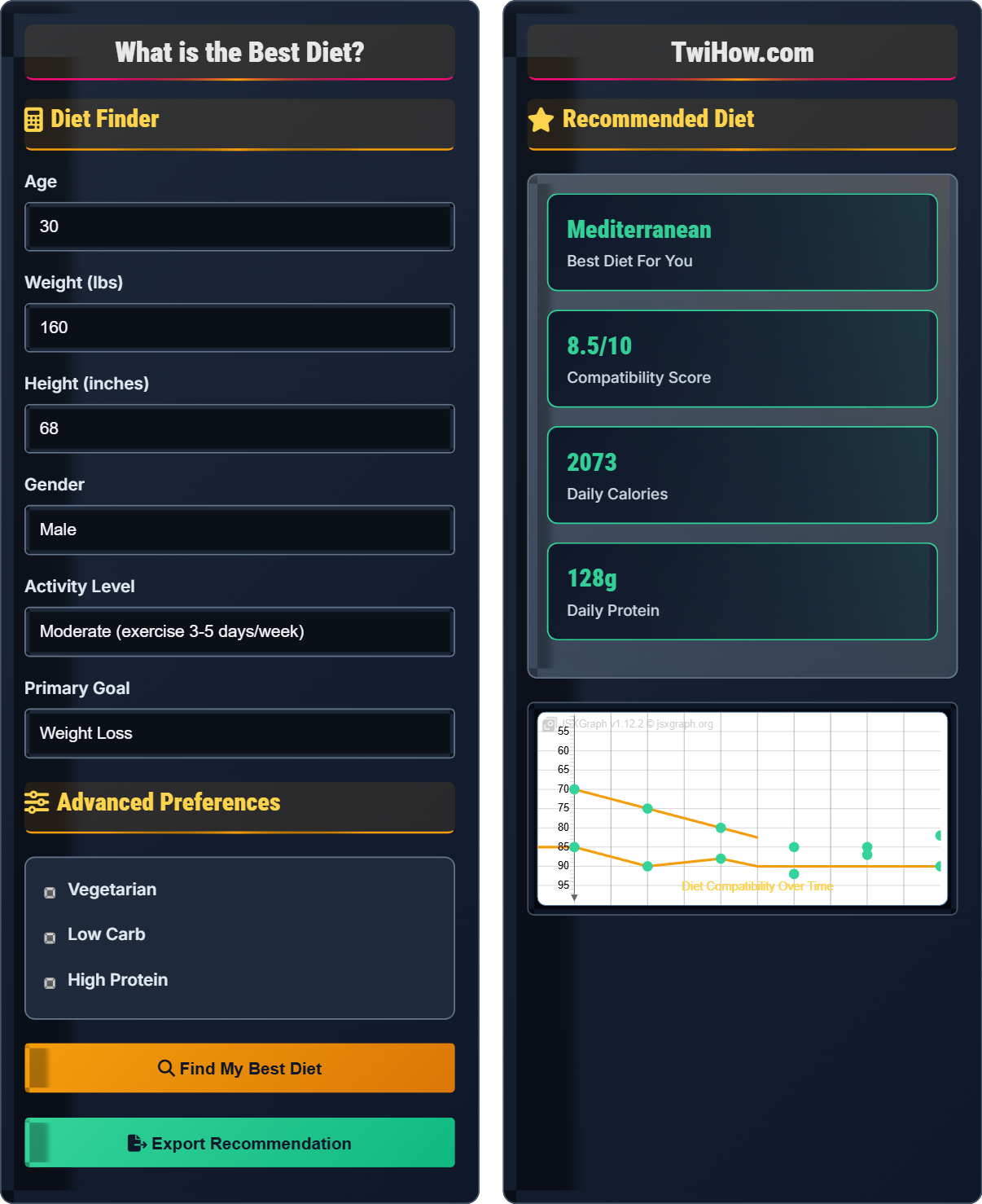
Diet Finder
Advanced Preferences
Recommended Diet
Overview: Emphasizes fruits, vegetables, whole grains, olive oil, fish, and moderate wine consumption.
Benefits: Heart health, longevity, cognitive function, weight management.
Macros: 45% carbs, 35% fat, 20% protein.
- High in antioxidants
- Anti-inflammatory
- Sustainable long-term
DASH Diet: Heart-healthy, sodium reduction.
Paleo Diet: Whole foods, ancestral eating.
Plant-Based: Vegetarian/vegan focus.
Flexible: Moderate approach to all foods.
| Diet | Effectiveness | Sustainability | Health Benefits | Restrictions |
|---|---|---|---|---|
| Mediterranean | ★★★★★ | ★★★★★ | ★★★★★ | Minimal |
| Keto | ★★★★☆ | ★★☆☆☆ | ★★★☆☆ | High |
| Paleo | ★★★☆☆ | ★★★☆☆ | ★★★★☆ | Medium |
| DASH | ★★★★☆ | ★★★★☆ | ★★★★★ | Low |
| Intermittent Fasting | ★★★★☆ | ★★★☆☆ | ★★★☆☆ | Timing |
Recommended Macronutrient Distribution
Dietary Philosophies
Major approaches to nutrition:
Focus on balance and portion control rather than restrictions. Allows for all foods in moderation.
Emphasizes minimally processed, nutrient-dense foods. Avoids ultra-processed items.
Focuses on specific ratios of carbs, proteins, and fats for optimal health.
Emphasizes awareness of hunger cues and eating behaviors.
Personalization Factors
Key factors that influence the best diet for you:
Sample Meal Plan
Example Mediterranean-style meal plan:
Common Diet Myths
Debunking popular misconceptions:
Reality: Carbs are essential for energy. It's excess calories, not carbs specifically, that cause weight gain.
Reality: Healthy fats are crucial for hormone production and nutrient absorption.
Reality: Your liver naturally detoxifies your body. Detox diets offer no proven benefits.
Reality: Can slow metabolism and lead to overeating later.
Diet & Nutrition Explained
The "best" diet is subjective and depends on individual factors including health goals, medical conditions, lifestyle, and personal preferences. Scientific evidence suggests that sustainable, balanced approaches focusing on whole foods tend to be most effective for long-term health and weight management.
Key criteria for evaluating diets:
- Sustainability: Can you maintain it long-term?
- Balanced Nutrition: Does it provide all essential nutrients?
- Scientific Support: Is there evidence backing the approach?
- Flexibility: Does it allow for personal preferences and social situations?
- Health Outcomes: Does it improve markers of health?
Recommended daily intake calculations:
General recommendations: 0.8-1.2g protein per kg body weight for sedentary, 1.2-2.0g for active individuals.
Well-researched dietary patterns:
- Mediterranean Diet: Emphasizes plants, fish, olive oil, moderate wine
- DASH Diet: Focuses on heart health with sodium reduction
- Plant-Based: Vegetarian or vegan approaches
- Low-Carb: Reduced carbohydrate intake (keto, Atkins)
- Intermittent Fasting: Time-restricted eating patterns
- Paleo: Whole foods, ancestral eating patterns
Individual factors that influence optimal dietary choices:
- Genetics: Genetic variations affect nutrient metabolism
- Health Conditions: Diabetes, heart disease, food allergies
- Lifestyle: Activity level, work schedule, cooking ability
- Preferences: Taste preferences, cultural background
- Goals: Weight loss, muscle gain, disease prevention
- Budget: Cost considerations and accessibility
Diet & Nutrition Fundamentals
Macronutrients, micronutrients, calories, glycemic index, satiety, metabolism, bioavailability.
Protein (g) = Body Weight (kg) × Activity Factor
Where Activity Factor = 0.8-1.2 for sedentary, 1.2-2.0 for active individuals.
- Focus on whole foods
- Maintain balanced macronutrients
- Consider sustainability over restriction
Dietary Approaches
Mediterranean, DASH, Keto, Paleo, Plant-based, Intermittent Fasting, Zone Diet.
- Assess health goals
- Consider medical conditions
- Match to lifestyle
- Ensure nutritional adequacy
- Individual responses vary
- Focus on long-term sustainability
- Consult healthcare professionals
Diet & Nutrition Learning Quiz
According to dietary guidelines, what percentage of daily calories should come from carbohydrates?
According to the Dietary Guidelines for Americans, carbohydrates should make up 45-65% of total daily calories. Carbohydrates are the body's preferred source of energy and should come primarily from complex carbohydrates like whole grains, fruits, and vegetables rather than simple sugars.
The answer is C) 45-65%.
Carbohydrates serve as the primary fuel source for the body, especially for the brain and muscles. The recommended range allows flexibility based on individual needs, activity level, and health conditions. While some diets advocate for very low carb intake, the general population benefits from including adequate carbohydrates from nutritious sources.
Macronutrients: Nutrients needed in large quantities (carbs, protein, fat)
Complex Carbohydrates: Fiber-rich carbs that digest slowly
Simple Sugars: Refined carbs that cause rapid blood sugar spikes
• Focus on complex carbs over simple sugars
• Include fiber-rich sources
• Adjust based on activity level
• Choose whole grains over refined
• Pair carbs with protein for stability
• Eliminating all carbohydrates
• Not distinguishing between types of carbs
• Focusing only on quantity, not quality
Explain the Mediterranean diet, its key components, and the scientific evidence supporting its health benefits. Why is it often considered one of the healthiest dietary approaches?
Mediterranean Diet: Based on traditional eating patterns of Mediterranean countries, emphasizing plant-based foods, healthy fats, and moderate animal products.
Key Components: High intake of fruits, vegetables, whole grains, legumes, nuts, seeds, and olive oil; moderate consumption of fish, poultry, dairy, and wine; limited red meat and processed foods.
Scientific Evidence: Large-scale studies like the PREDIMED trial show reduced risk of cardiovascular disease, type 2 diabetes, and certain cancers. The diet is rich in antioxidants, anti-inflammatory compounds, and healthy fats.
Why It's Considered Healthy: Promotes longevity, supports heart health, is sustainable long-term, and provides balanced nutrition.
The Mediterranean diet exemplifies a balanced, sustainable approach to nutrition. Its emphasis on whole foods, variety, and moderation makes it nutritionally complete while being enjoyable. The diet's success lies not in restricting entire food groups but in emphasizing nutrient-dense, minimally processed options. The scientific evidence supporting its benefits spans decades of research, making it one of the most well-documented dietary approaches.
Antioxidants: Compounds that protect cells from damage
Anti-inflammatory: Reducing inflammation in the body
Monounsaturated Fats: Healthy fats found in olive oil and nuts
• Emphasize plant-based foods
• Include healthy fats
• Moderate animal products
• Use olive oil as primary fat source
• Eat fish twice weekly
• Include nuts and seeds daily
• Thinking it's only about olive oil
• Not including enough vegetables
• Over-consuming animal products
Sarah is a 30-year-old woman weighing 140 lbs and standing 5'6" tall. She exercises moderately (3-5 days/week) and wants to lose weight. Calculate her daily caloric needs using the Mifflin-St Jeor equation, then determine her recommended caloric intake for weight loss. How much protein should she consume daily?
Mifflin-St Jeor Equation (women): BMR = 10 × weight(kg) + 6.25 × height(cm) - 5 × age(y) - 161
Weight: 140 lbs = 63.5 kg
Height: 5'6" = 66 inches = 167.6 cm
BMR: (10 × 63.5) + (6.25 × 167.6) - (5 × 30) - 161 = 635 + 1,047.5 - 150 - 161 = 1,371.5 calories
TDEE (moderate activity): 1,371.5 × 1.55 = 2,126 calories
Weight Loss Intake: 2,126 - 500 = 1,626 calories/day
Protein: 63.5 kg × 1.2 g/kg = 76g protein/day
Sarah needs 1,626 calories daily with 76g of protein for weight loss.
This example demonstrates how to calculate individual caloric needs using established equations. The Mifflin-St Jeor equation is considered the most accurate for estimating basal metabolic rate. The activity multiplier accounts for energy expenditure from exercise. A 500-calorie daily deficit is generally safe and sustainable for weight loss of about 1 lb per week.
BMR: Basal Metabolic Rate - calories at rest
TDEE: Total Daily Energy Expenditure
Activity Factor: Multiplier for physical activity level
• Calculate BMR first
• Apply appropriate activity factor
• Create sustainable caloric deficit
• Use online calculators for verification
• Adjust based on actual progress
• Monitor for signs of too large deficits
• Using generic activity factors
• Not accounting for metabolic adaptation
• Ignoring protein requirements
You're a 45-year-old man with type 2 diabetes and hypertension. You work a desk job and exercise twice a week. Your doctor recommends a diet to manage your conditions. Compare the suitability of the Mediterranean diet, DASH diet, and keto diet for your situation. Which would be most appropriate and why?
Mediterranean Diet: Excellent for diabetes and heart health, but may require carb monitoring.
DASH Diet: Specifically designed for hypertension, also good for diabetes management.
Keto Diet: May help with diabetes but could worsen cholesterol and isn't ideal for hypertension.
Most Appropriate: DASH diet is specifically designed for hypertension and is also beneficial for diabetes. It emphasizes foods that lower blood pressure (potassium, magnesium, calcium) while restricting sodium.
This example highlights the importance of matching dietary approaches to specific health conditions. The DASH diet was specifically developed for hypertension management, while the Mediterranean diet has broader health benefits. Personal medical conditions should be the primary consideration when choosing a dietary approach, with general health benefits being secondary.
DASH: Dietary Approaches to Stop Hypertension
Type 2 Diabetes: Insulin resistance condition
Hypertension: High blood pressure condition
• Prioritize health conditions
• Consult healthcare providers
• Monitor health markers
• Work with registered dietitian
• Monitor blood glucose regularly
• Track blood pressure changes
• Ignoring medical conditions
• Not consulting healthcare providers
• Focusing on weight over health
Which factor is most important for long-term dietary success?
Long-term dietary success depends most on enjoyment and sustainability. Research consistently shows that diets people can maintain long-term are more effective than restrictive approaches that lead to yo-yo dieting. The most successful dietary patterns are those that individuals can follow consistently while meeting their nutritional needs and fitting their lifestyle.
The answer is C) Enjoyment and sustainability.
This principle is fundamental to nutrition science. Short-term restrictive diets often fail because they're not sustainable. The "best" diet is the one you can follow consistently over time. This is why approaches like the Mediterranean diet, which emphasizes enjoyable whole foods rather than restrictions, tend to have better long-term outcomes than fad diets that eliminate entire food groups.
Sustainability: Ability to maintain dietary habits long-term
Yo-yo Dieting: Repeated cycles of weight loss and gain
Restrictiveness: Degree of food limitations
• Focus on long-term adherence
• Choose enjoyable foods
• Allow for flexibility
• Include favorite foods in moderation
• Allow for social situations
• Focus on addition rather than restriction
• Prioritizing quick results over sustainability
• Eliminating all enjoyable foods
• Not considering lifestyle fit
FAQ
Q: Is it better to count calories or macros?
A: Both approaches have merit, and the best choice depends on your goals:
Calorie Counting: Best for weight management. Ensures energy balance for weight loss, gain, or maintenance.
Macro Counting: Better for body composition goals and athletic performance. Ensures adequate protein and proper nutrient timing.
Combination: Most effective approach tracks both calories and macros for comprehensive nutrition.
Practical Considerations:
• Calorie counting is simpler for weight loss
• Macro counting is better for muscle building
• Both require consistency for success
• Consider your lifestyle and preferences
Focus on finding an approach you can maintain long-term.
Q: How important is meal timing?
A: Meal timing is less critical than total nutrition, but can provide benefits:
General Population: Consistent meal times can help regulate appetite and energy levels.
Athletes/Active Individuals: Pre- and post-workout nutrition timing can enhance performance and recovery.
Specific Conditions: Diabetics benefit from consistent meal timing for blood sugar management.
Intermittent Fasting: Time-restricted eating can aid weight loss and metabolic health.
Bottom Line: Total nutrition quality and quantity matter more than timing for most people. However, consistent meal patterns can support better appetite regulation and metabolic health.
Q: Are supplements necessary if I eat a balanced diet?
A: Supplements are generally unnecessary for healthy individuals eating a balanced diet:
Who May Need Supplements:
• Vegans/Vegetarians (B12, iron, omega-3s)
• Pregnant women (folic acid, iron)
• Elderly (B12, vitamin D)
• People with malabsorption conditions
Common Supplementation:
• Vitamin D (especially in northern climates)
• Omega-3 fatty acids (if fish intake is low)
• Magnesium (if dietary intake is insufficient)
General Rule: Food sources are preferred over supplements, as they provide additional nutrients and fiber. Supplements should fill gaps, not replace whole foods.