What is the Best Way to Track My Health Metrics?
Complete health guide • Step-by-step explanations
Health Metrics Tracking:
Show Health TrackerHealth metrics tracking involves systematically monitoring various physiological and lifestyle parameters to gain insights into your overall health status. These metrics can include vital signs like heart rate, blood pressure, and temperature, as well as fitness data, sleep patterns, and nutritional intake.
Effective health tracking combines multiple approaches - from traditional methods like manual logging to modern wearable devices and smartphone applications. The goal is to establish baseline measurements, identify trends, and make informed decisions about your health and wellness.
Key health metrics categories:
- Vital Signs: Heart rate, blood pressure, temperature, respiratory rate
- Fitness Data: Steps, calories burned, distance traveled
- Sleep Patterns: Duration, quality, sleep stages
- Nutritional Tracking: Calories, macros, hydration
- Mental Health: Mood, stress levels, mindfulness practices
Modern health tracking tools use sensors, algorithms, and data analytics to provide real-time feedback and long-term trend analysis, enabling proactive health management and early detection of potential issues.
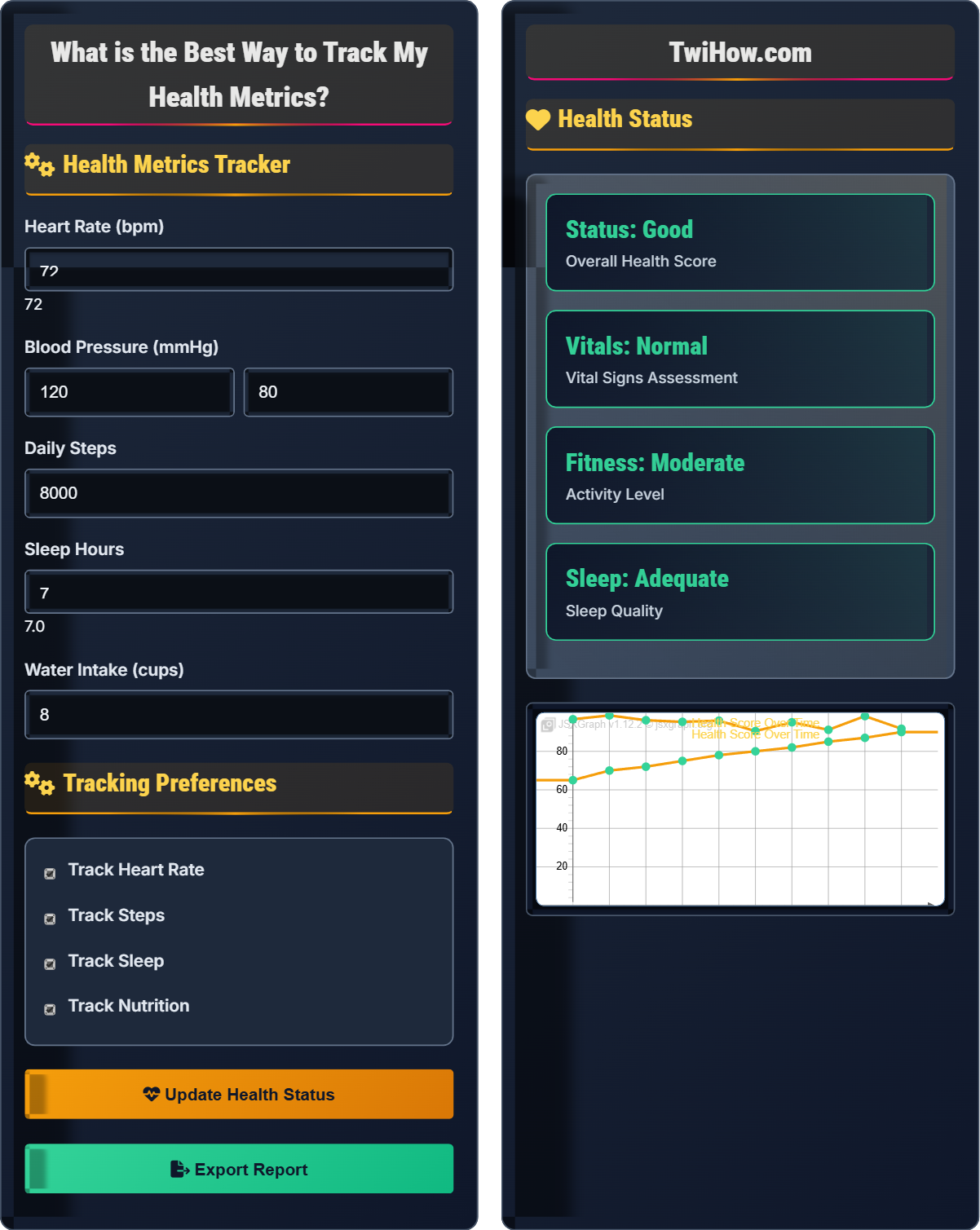
Health Metrics Tracker
Tracking Preferences
Health Status
| Metric | Value | Status | Recommendation |
|---|---|---|---|
| Heart Rate | 72 bpm | Normal | Maintain regular exercise |
| Blood Pressure | 120/80 mmHg | Normal | Continue healthy diet |
| Daily Steps | 8,000 steps | Average | Target 10,000 steps |
| Sleep | 7.0 hours | Adequate | Maintain sleep schedule |
| Hydration | 8 cups | Good | Keep current intake |
Health Metrics Tracking Explained
Health metrics are quantifiable measurements that provide insights into your physical and mental wellbeing. These measurements serve as indicators of your current health status and can help predict future health risks. Regular tracking of these metrics allows for early detection of potential health issues and enables proactive management of your health.
Health metrics fall into several important categories:
Where:
- Vital Signs: Heart rate, blood pressure, temperature, oxygen saturation
- Activity Metrics: Steps, calories burned, exercise duration
- Sleep Metrics: Duration, quality, sleep stages, consistency
- Nutrition Metrics: Calorie intake, macronutrient balance, hydration
Key areas where health metrics tracking provides significant benefits:
- Preventive Care: Early detection of health issues, risk assessment
- Chronic Disease Management: Diabetes, hypertension, heart disease monitoring
- Fitness Optimization: Workout planning, performance improvement
- Weight Management: Calorie tracking, progress monitoring
- Mental Health: Stress monitoring, mood tracking
- Medication Compliance: Reminders, effectiveness tracking
- Wearable Devices: Smartwatches, fitness trackers, chest straps
- Smartphone Apps: Manual entry, camera-based measurements
- Medical Devices: Blood pressure monitors, glucose meters
- Manual Logging: Paper journals, spreadsheets
- Integrated Platforms: Comprehensive health ecosystems
Health Metrics Fundamentals
Heart rate, blood pressure, steps, sleep duration, water intake, weight.
Health Index = (Vital Signs + Activity + Sleep + Nutrition) / Total Metrics Tracked
Where Vital Signs = heart rate, BP, temperature; Activity = steps, exercise.
- Consistency is crucial for accurate trend analysis
- Baseline measurements are essential for comparison
- Context matters - consider factors affecting metrics
Tracking Applications
Preventive care, chronic disease management, fitness optimization, weight control.
- Start with 2-3 key metrics
- Choose reliable tracking tools
- Establish consistent routines
- Review data weekly
- Privacy and data security
- Device accuracy verification
- Professional consultation for medical concerns
- Avoid obsessive tracking behavior
Health Metrics Learning Quiz
Which of the following is NOT typically considered a vital sign that should be tracked regularly?
While daily steps are an important health metric, they are not technically classified as a vital sign. The four traditional vital signs are heart rate, blood pressure, body temperature, and respiratory rate. These are called "vital" because they reflect essential bodily functions necessary for life. Steps, while important for fitness and overall health, are considered an activity metric rather than a vital sign.
The answer is C) Daily Steps.
Understanding the distinction between vital signs and other health metrics is important for proper health monitoring. Vital signs provide immediate insights into your body's basic functioning, while activity metrics like steps reflect your lifestyle and fitness level. Both are valuable, but they serve different purposes in health assessment. Vital signs can indicate acute health issues, while activity metrics help assess long-term health trends.
Vital Signs: Measurements of basic body functions (heart rate, BP, temp, respiration)
Activity Metrics: Measurements related to physical movement and exercise
Health Metrics: Quantifiable measurements of health status
• Vital signs indicate immediate health status
• Activity metrics show lifestyle patterns
• Both contribute to overall health picture
• Track vital signs consistently at same time
• Combine vital signs with activity data
• Look for correlations between metrics
• Confusing vital signs with activity metrics
• Inconsistent measurement timing
• Not considering context of measurements
Explain the benefits of tracking health metrics over time and describe how this contributes to preventive healthcare. Include specific examples of early detection opportunities.
Benefits of Long-Term Health Tracking: Continuous monitoring creates a comprehensive health profile that reveals patterns invisible during isolated medical visits. This approach enables the identification of gradual changes that may indicate developing health issues.
Preventive Healthcare Contribution: By establishing baseline measurements and monitoring trends, health tracking allows for early intervention before symptoms become severe. It transforms healthcare from reactive to proactive.
Early Detection Examples:
- Gradual increase in resting heart rate may indicate cardiovascular issues
- Rising blood pressure trends can signal hypertension development
- Decreasing sleep quality may precede stress-related health problems
- Reduced daily activity levels might indicate depression or illness
These early warning signals allow for timely medical consultation and lifestyle adjustments before serious complications develop.
Health metrics tracking represents a paradigm shift from episodic medical care to continuous health awareness. Rather than relying on occasional doctor visits, individuals can monitor their health trajectory and detect concerning patterns. This approach leverages the power of data to identify subtle changes that might indicate underlying health issues. The key is consistency in tracking and understanding what constitutes normal variation versus concerning trends.
Preventive Healthcare: Medical care focused on preventing illness rather than treating it
Baseline Measurement: Initial reference point for comparison
Trend Analysis: Identifying patterns over time
• Consistent tracking is essential for meaningful data
• Baseline measurements provide context for changes
• Trends matter more than individual readings
• Establish a daily tracking routine
• Note external factors affecting metrics
• Share data with healthcare providers
• Inconsistent tracking schedules
• Not considering contextual factors
• Overreacting to single abnormal readings
A 45-year-old office worker with a family history of heart disease wants to implement a comprehensive health tracking system. Design a tracking plan that includes metrics selection, tools recommendation, and data interpretation strategy. Consider their work environment and family health history.
Metrics Selection: Given the family history of heart disease, focus on cardiovascular metrics: resting heart rate, blood pressure, daily activity levels, and sleep quality. Also track stress indicators and sedentary time due to office work.
Tools Recommendation: Smartwatch for continuous heart rate and activity tracking, home blood pressure monitor for weekly readings, smartphone app for sleep tracking, and stress/mood logging app.
Data Interpretation Strategy: Establish baseline measurements over 2 weeks, set alerts for concerning thresholds (BP >140/90, resting HR >85), monitor sedentary time (aim for less than 8 hours), and review trends monthly with healthcare provider.
Work Environment Considerations: Set reminders to move every hour, track posture breaks, and correlate metrics with work stress levels.
Effective health tracking plans must be personalized based on individual risk factors, lifestyle, and goals. For someone with a family history of heart disease, cardiovascular-focused metrics are paramount. The plan should be practical for their environment while addressing specific health concerns. Success depends on selecting appropriate tools and establishing sustainable tracking habits.
Cardiovascular Risk: Likelihood of developing heart disease
Personalized Tracking: Health monitoring tailored to individual needs
Sustainable Habits: Tracking routines that can be maintained long-term
• Personalize tracking based on risk factors
• Select manageable number of metrics
• Choose tools that fit lifestyle
• Start with 2-3 key metrics
• Use integrated platforms when possible
• Schedule regular reviews with healthcare provider
• Tracking too many metrics initially
• Not considering environmental factors
• Failing to share data with healthcare providers
You're helping a 65-year-old retiree choose health tracking devices. They have mild arthritis, wear reading glasses, and want to monitor heart rate, sleep, and medication adherence. Explain the technical differences between various tracking options and recommend the most suitable solution, considering their age-related needs.
Tracking Options Comparison:
Basic Fitness Tracker: Simple interface, good battery life, limited features
Smartwatch: Advanced features, larger screen, potentially complex interface
Chest Strap Monitor: Most accurate heart rate, comfortable for extended wear
Mobile App: Manual entry, large text options, medication reminders
Recommended Solution: A basic fitness tracker with large, clear display and simple buttons. Pair with a smartphone app for medication reminders. The combination provides accurate sleep tracking, basic heart rate monitoring, and easy-to-use medication alerts without overwhelming complexity.
Selecting health tracking devices requires considering both technical capabilities and user accessibility. Age-related factors like dexterity, vision, and technological comfort significantly impact usability. The most sophisticated device isn't always the best choice if it's not user-friendly. Successful adoption depends on matching device capabilities with user needs and abilities.
User Accessibility: Ease of use considering physical and cognitive abilities
Device Compatibility: Ability to work with other technologies
Usability: How easy a device is to use effectively
• Prioritize usability over features
• Consider physical limitations
• Test devices before committing
• Look for devices with large displays
• Choose simple button interfaces
• Consider voice-enabled features
• Choosing devices based on features alone
• Not considering physical limitations
• Assuming all seniors dislike technology
Which of the following represents the most significant limitation of consumer-grade health tracking devices?
Consumer-grade health tracking devices, while useful for general wellness monitoring, are not medical devices and often lack the precision of clinical equipment. Studies have shown that smartwatch heart rate monitors can vary by 5-10 beats per minute from medical-grade equipment, and sleep tracking algorithms may misclassify sleep stages. This accuracy limitation means these devices are suitable for trend analysis and general awareness but not for medical diagnosis or critical health decisions.
The answer is B) Accuracy compared to medical devices.
Understanding the limitations of consumer health devices is crucial for proper interpretation of data. While these devices provide valuable insights for general wellness, they are not substitutes for medical-grade equipment. The accuracy trade-off is made to keep costs reasonable and devices accessible to consumers. Users should understand that consumer devices are designed for general trends rather than precise medical measurements.
Consumer-Grade Device: Designed for general use, not medical purposes
Medical-Grade Device: Clinical accuracy and FDA approval
Trend Analysis: Identifying patterns over time rather than exact measurements
• Consumer devices for wellness, not diagnosis
• Accuracy varies significantly
• Consult professionals for medical concerns
• Focus on trends rather than exact numbers
• Verify with medical professionals
• Use multiple data points for insights
• Treating consumer data as medical-grade
• Making medical decisions based on consumer data
• Ignoring accuracy limitations
FAQ
Q: How accurate are smartphone and smartwatch health tracking features compared to medical equipment?
A: Consumer health devices provide useful estimates but are not medical-grade equipment. Here's how they compare:
Heart Rate: Modern smartwatches are generally accurate for steady-state measurements (within 2-5 bpm of medical devices) but less reliable during intense exercise or irregular rhythms.
Blood Pressure: Smartwatches cannot measure blood pressure directly - this feature requires cuff-based measurement. Some apps claim to estimate BP but are not clinically validated.
Sleep Tracking: Consumer devices use movement and heart rate to estimate sleep stages, which is less accurate than clinical sleep studies using EEG.
Activity Tracking: Step counting is generally quite accurate for normal walking, though it may overcount during certain activities.
Use these devices for trend analysis and motivation, but consult medical professionals for diagnostic decisions.
Q: What's the difference between health tracking for fitness enthusiasts vs. medical monitoring?
A: These represent different applications of health monitoring technology:
Fitness Tracking: Focuses on performance optimization, goal setting, and motivation. Metrics include steps, calories, workout intensity, and recovery. Accuracy requirements are moderate, with emphasis on trend analysis and user engagement.
Medical Monitoring: Designed for clinical decision-making and patient care. Requires FDA approval, clinical validation, and much higher accuracy standards. Used for managing chronic conditions, post-surgical monitoring, and diagnostic purposes.
Key Differences:
1. Regulation: Medical devices face strict regulatory oversight; consumer devices do not
2. Accuracy: Medical devices require precision for clinical decisions
3. Validation: Medical devices undergo rigorous clinical trials
4. Intended Use: Fitness for wellness, medical for healthcare management
While both use similar sensor technologies, the validation, accuracy, and intended use differ significantly.