What Is the Future of Wearable Health Technology?
Complete wearable health tech guide • Step-by-step explanations
Wearable Health Tech Future:
Show Tech PredictorThe future of wearable health technology promises revolutionary advances in continuous health monitoring, personalized medicine, and preventive care. Next-generation wearables will integrate advanced sensors, artificial intelligence, and predictive analytics to provide unprecedented insights into our health and well-being.
Emerging technologies include non-invasive glucose monitoring, advanced biomarker detection, real-time disease prediction, and seamless integration with healthcare systems. These innovations will transform how we approach health management, shifting from reactive to proactive care models.
Key future developments include:
- Advanced Sensors: Non-invasive biomarker detection, continuous monitoring
- AI Integration: Predictive health analytics and personalized insights
- Medical-Grade Accuracy: Clinical-level precision in consumer devices
- Seamless Integration: Direct connection to electronic health records
- Preventive Focus: Early disease detection and prevention
The convergence of miniaturization, connectivity, and artificial intelligence will enable wearables to become powerful diagnostic tools that provide continuous health monitoring and personalized recommendations.
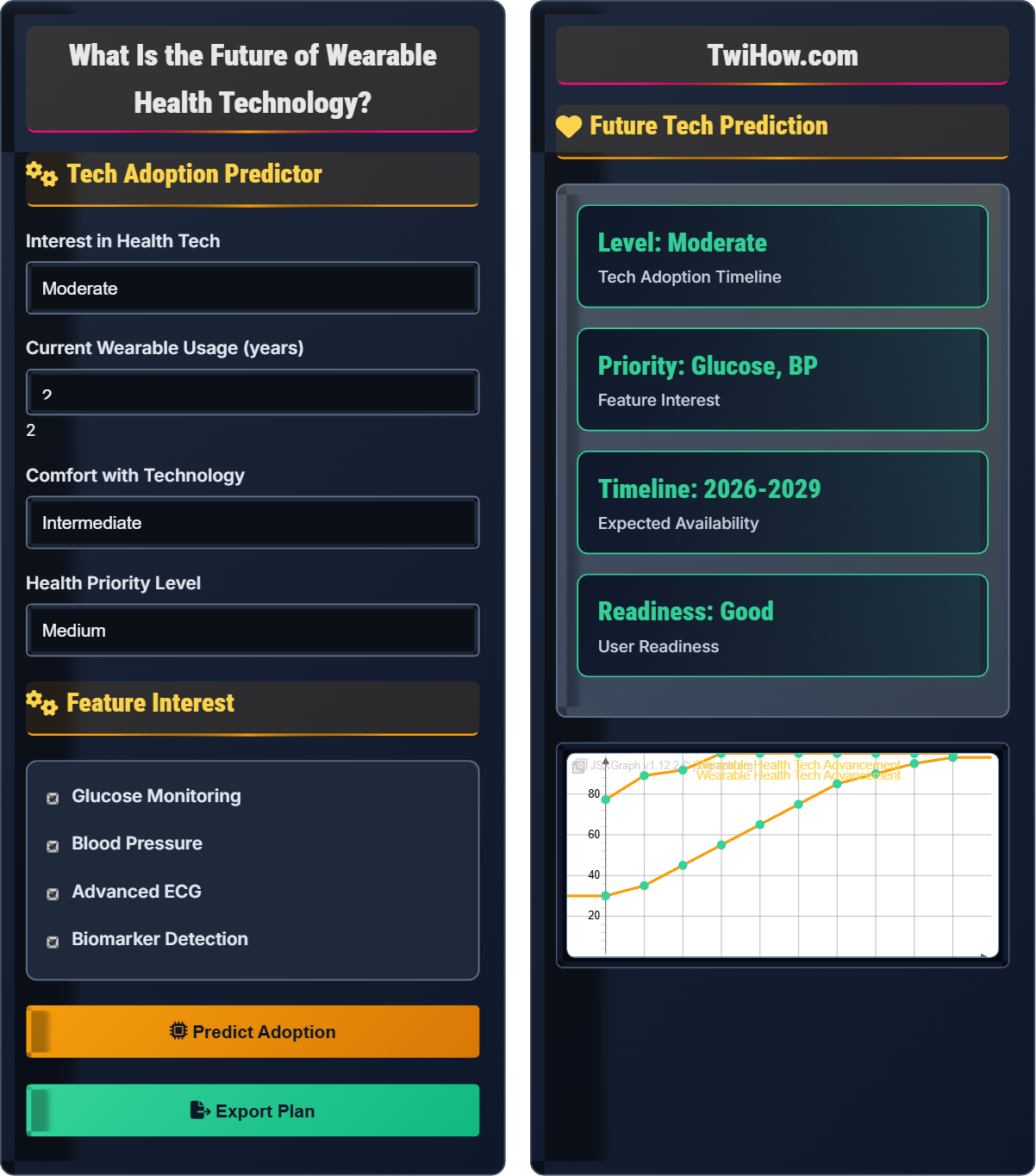
Tech Adoption Predictor
Feature Interest
Future Tech Prediction
| Technology | Development Stage | Availability | Impact Level |
|---|---|---|---|
| Non-invasive Glucose | Advanced Development | 2026-2027 | High |
| Continuous Blood Pressure | Clinical Trials | 2027-2028 | High |
| Advanced Biomarkers | Research | 2028-2030 | Very High |
| AI Health Prediction | Early Development | 2026-2029 | Very High |
| Seamless Integration | Conceptual | 2027-2030 | High |
Wearable Health Technology Future Explained
The future of wearable health technology represents a convergence of advanced sensors, artificial intelligence, and personalized medicine. Next-generation wearables will evolve from simple activity trackers to sophisticated medical devices capable of continuous health monitoring, early disease detection, and personalized health recommendations.
Future wearable health technology follows an advanced framework:
Where:
- Sensor Data: Advanced biomarker and physiological measurements
- AI Analytics: Predictive modeling and pattern recognition
- Personalization: Individual health profiles and recommendations
- Integration: Healthcare system connectivity
Key areas where future wearable health technology will provide significant benefits:
- Continuous Monitoring: 24/7 health parameter tracking
- Early Disease Detection: Identifying health issues before symptoms
- Personalized Medicine: Tailored treatments based on individual data
- Preventive Care: Proactive health management and recommendations
- Remote Patient Care: Healthcare delivery outside clinical settings
- Population Health: Large-scale health trend analysis
- Non-invasive Glucose Monitoring: Continuous blood sugar tracking
- Advanced ECG Capabilities: Heart rhythm analysis and AFib detection
- Blood Pressure Monitoring: Continuous, cuffless measurement
- Biomarker Detection: Cholesterol, lactate, and other markers
- AI-Powered Insights: Predictive health analytics
Wearable Tech Fundamentals
Wearable health technology, continuous monitoring, biometric sensors, health analytics, predictive medicine, digital health.
Health Insight = f(Sensor Data, AI Analytics, Personalization, Integration)
Where Sensor Data = physiological measurements, AI Analytics = predictive modeling.
- Accuracy is critical for medical applications
- Data privacy and security are paramount
- Integration with healthcare systems is essential
Application Strategies
Continuous glucose monitoring, heart rate tracking, sleep analysis, activity monitoring, stress detection, medication adherence.
- Identify specific health needs
- Select appropriate devices
- Integrate with healthcare providers
- Monitor and adjust as needed
- Medical-grade accuracy is evolving
- Regulatory approval processes are complex
- User adoption requires simplicity
- Data integration with healthcare systems is critical
Wearable Health Tech Learning Quiz
What is the primary challenge in developing non-invasive glucose monitoring for wearables?
The primary challenge in developing non-invasive glucose monitoring is achieving medical-grade accuracy. Current non-invasive methods struggle to match the precision of traditional finger-prick glucose meters. The challenge lies in measuring glucose levels through skin or other tissues without interference from other substances, temperature variations, and individual physiological differences. Several companies are exploring optical sensing, electromagnetic methods, and other technologies to achieve the accuracy required for medical applications.
The answer is B) Achieving medical-grade accuracy.
This challenge exemplifies the difference between consumer-grade and medical-grade devices. While fitness trackers can have some tolerance for inaccuracy, medical devices require precision that can directly impact treatment decisions. This is why non-invasive glucose monitoring remains one of the most sought-after breakthroughs in wearable health technology.
Non-invasive Monitoring: Measuring health parameters without penetrating skin
Medical-Grade Accuracy: Precision required for clinical decision-making
Consumer-Grade: Lower precision acceptable for wellness tracking
• Medical devices require high accuracy
• Non-invasive measurement is technically challenging
• Precision affects treatment decisions
• Accuracy is critical for medical applications
• Non-invasive methods are preferred by users
• Calibration improves accuracy
• Confusing consumer with medical accuracy
• Underestimating technical challenges
• Not considering individual variations
Explain how artificial intelligence will enhance wearable health technology and provide specific examples of AI-powered health insights.
Pattern Recognition: AI algorithms can identify subtle patterns in health data that humans might miss, such as early signs of atrial fibrillation from heart rate variability patterns or sleep apnea from respiratory patterns.
Predictive Analytics: Machine learning models can predict health events before they occur, such as predicting hypoglycemic episodes in diabetics or forecasting flu outbreaks based on symptom tracking.
Personalized Recommendations: AI can provide customized health advice based on individual patterns, suggesting optimal exercise timing based on sleep quality or recommending stress management techniques when elevated stress markers are detected.
Anomaly Detection: AI systems can flag unusual health patterns that may indicate developing conditions, such as detecting irregular heart rhythms that could indicate cardiac issues.
Contextual Understanding: AI can correlate health data with external factors like weather, air quality, or calendar events to provide more relevant insights.
These capabilities will transform wearables from passive monitoring devices into proactive health advisors.
AI integration represents the evolution from simple data collection to intelligent health insights. The power of AI lies in its ability to process vast amounts of data and identify patterns that would be impossible for humans to detect manually. This enables early intervention and personalized care recommendations.
Machine Learning: AI that learns from data patterns
Predictive Analytics: Forecasting future health events
Pattern Recognition: Identifying health trends and anomalies
• AI requires large amounts of data
• Privacy is crucial for health data
• Validation is essential for accuracy
• Consistent data improves AI accuracy
• Privacy controls are important
• Look for validated algorithms
• Not understanding AI limitations
• Ignoring privacy concerns
• Over-relying on AI predictions
A healthcare system wants to implement a program using next-generation wearables to monitor high-risk patients remotely. Design a comprehensive plan that includes technology selection, patient onboarding, data management, and integration with existing healthcare workflows.
Technology Selection:
1. Device Criteria: Medical-grade accuracy, FDA approval, HIPAA compliance, battery life, user-friendly interface
2. Features Needed: Continuous vital signs monitoring, emergency alerts, medication adherence tracking
3. Platform Requirements: Secure cloud integration, API compatibility with EHR systems
Patient Onboarding:
4. Eligibility Screening: Identify high-risk patients who can benefit most
5. Training Program: Hands-on device training, troubleshooting support, regular check-ins
6. Support Infrastructure: Technical support hotline, local training sessions
Data Management:
7. Analytics Platform: AI-powered anomaly detection, trend analysis, alert systems
8. Data Security: End-to-end encryption, access controls, audit trails
9. Alert Protocols: Escalation procedures for different severity levels
Workflow Integration:
10. EHR Integration: Seamless data flow into patient records
11. Staff Training: Clinician training on data interpretation and response protocols
12. Outcome Measurement: Track health improvements and cost savings
This comprehensive approach ensures successful implementation while maintaining patient safety and data security.
This example demonstrates the complexity of implementing wearable health technology in healthcare settings. Success requires careful consideration of technology, workflow, and human factors. The key is creating a system that enhances care without adding unnecessary complexity to clinical workflows.
Remote Patient Monitoring: Tracking patients outside clinical settings
Healthcare Workflow: Processes and procedures in medical care
HIPAA Compliance: Healthcare data privacy requirements
• Medical-grade devices for clinical use
• Data security is essential
• Staff training is critical
• Start with pilot programs
• Focus on high-risk patients first
• Ensure staff buy-in and training
• Not considering workflow impact
• Inadequate staff training
• Poor data security measures
You're helping someone understand the privacy and security considerations of future wearable health technology. Explain the risks and safeguards that will be necessary as these devices collect increasingly sensitive health data.
Privacy Risks:
Personal Health Data: Continuous monitoring will collect detailed health information that could be used for discrimination by insurers or employers.
Location Tracking: Combined with health data, location information could reveal sensitive personal information.
Biometric Data: Unique biological identifiers that cannot be changed if compromised.
Behavioral Patterns: Detailed insights into personal habits and lifestyle.
Security Safeguards:
End-to-End Encryption: Data encrypted during transmission and storage.
Zero-Knowledge Architecture: Companies cannot access user data even if servers are compromised.
Local Processing: Sensitive data processed on-device rather than transmitted.
Granular Permissions: Users control exactly what data is collected and shared.
Regulatory Compliance: Adherence to HIPAA, GDPR, and other privacy regulations.
Regular Audits: Third-party security assessments to identify vulnerabilities.
As health data becomes more comprehensive, privacy and security will be paramount to user adoption and trust.
Privacy and security are critical factors that will determine the success of advanced wearable health technology. Unlike fitness tracking, medical-grade monitoring involves highly sensitive data that requires robust protection. The challenge is balancing data utility with privacy protection.
End-to-End Encryption: Data encrypted from source to destination
Zero-Knowledge Architecture: System design preventing data access
Biometric Data: Unique biological identifiers
• Health data requires highest security
• User control is essential
• Regular security updates needed
• Review privacy policies carefully
• Enable all security features
• Control data sharing permissions
• Not understanding data sharing
• Weak security settings
• Ignoring privacy controls
What is the primary regulatory challenge for advanced wearable health technology?
The primary regulatory challenge is FDA approval processes for medical-grade devices. As wearables evolve from wellness tracking to medical diagnostics, they must meet rigorous safety and efficacy standards. The FDA has established pathways for digital health devices, but the process can take years and requires extensive clinical validation. This creates tension between innovation speed and safety requirements, as companies must prove their devices are both accurate and safe for medical use.
The answer is B) FDA approval processes for medical-grade devices.
This regulatory challenge highlights the difference between consumer wellness devices and medical devices. The path to market becomes significantly more complex when devices claim medical benefits, requiring clinical trials, safety studies, and regulatory approval. This process is essential for patient safety but can slow innovation.
FDA Approval: Regulatory process for medical device safety
Medical Device: Device intended for medical purposes
Consumer Wellness: Non-medical health tracking
• Medical devices require approval
• Safety comes before innovation
• Clinical validation is essential
• Look for FDA-approved features
• Understand device classifications
• Verify clinical validation
• Confusing wellness with medical devices
• Not verifying regulatory status
• Assuming all claims are validated
FAQ
Q: When will we see truly medical-grade wearables that can replace traditional medical devices?
A: We're already seeing early examples with FDA-approved ECG watches and continuous glucose monitors, but full replacement of traditional medical devices will take time:
Already Available:
• Single-lead ECG for AFib detection (Apple Watch, Samsung Galaxy Watch)
• Continuous glucose monitoring (Dexcom G6, FreeStyle Libre)
• Blood oxygen monitoring with medical claims
2025-2027:
• Non-invasive glucose monitoring (multiple companies in late-stage trials)
• Continuous blood pressure monitoring (validated oscillometric methods)
• Advanced sleep apnea detection
2027-2030:
• Multi-parameter vital sign monitoring
• Biomarker detection (cholesterol, enzymes, hormones)
• Early disease prediction algorithms
Key Requirements:
• Clinical validation matching traditional devices
• Regulatory approval for specific medical claims
• Healthcare provider acceptance and integration
Complete replacement won't happen overnight, but we'll see increasing integration of wearables into standard medical care.
Q: How will advanced wearables impact healthcare delivery and physician workflows?
A: Advanced wearables will significantly transform healthcare delivery:
Preventive Care Revolution:
• Continuous monitoring will shift focus from reactive to preventive care
• Early disease detection will become routine
• Personalized treatment plans based on real-time data
Physician Workflow Changes:
• Need for efficient data review and interpretation tools
• Integration with Electronic Health Records (EHRs)
• Alert systems for critical value changes
• New billing codes for remote monitoring services
Challenges:
• Managing large volumes of continuous data
• Determining clinical significance of trends
• Liability and responsibility for device-generated alerts
• Training on new technologies and data interpretation
Opportunities:
• More informed clinical decisions
• Better patient engagement and compliance
• Reduced hospital readmissions through monitoring
• More efficient use of clinical time
The transformation will be gradual but profound, requiring adaptation in medical education and practice.