Building Strong Team Culture and Retaining Talented Staff
Complete hospitality guide • Step-by-step explanations
Team Culture & Retention:
Show Culture SimulatorBuilding a strong team culture and retaining talented staff is critical for restaurant success. A positive culture increases employee satisfaction, reduces turnover, and improves customer service. Effective retention strategies include competitive compensation, growth opportunities, recognition programs, and supportive leadership.
Strong team culture is built on clear values, open communication, mutual respect, and shared goals. Leaders must model desired behaviors, provide regular feedback, and create an environment where employees feel valued and engaged.
Key retention factors:
- Compensation: Competitive wages and benefits
- Recognition: Acknowledging employee contributions
- Development: Opportunities for growth and advancement
- Work Environment: Positive, supportive atmosphere
Successful restaurants prioritize team culture and retention, understanding that happy employees lead to satisfied customers and business success.
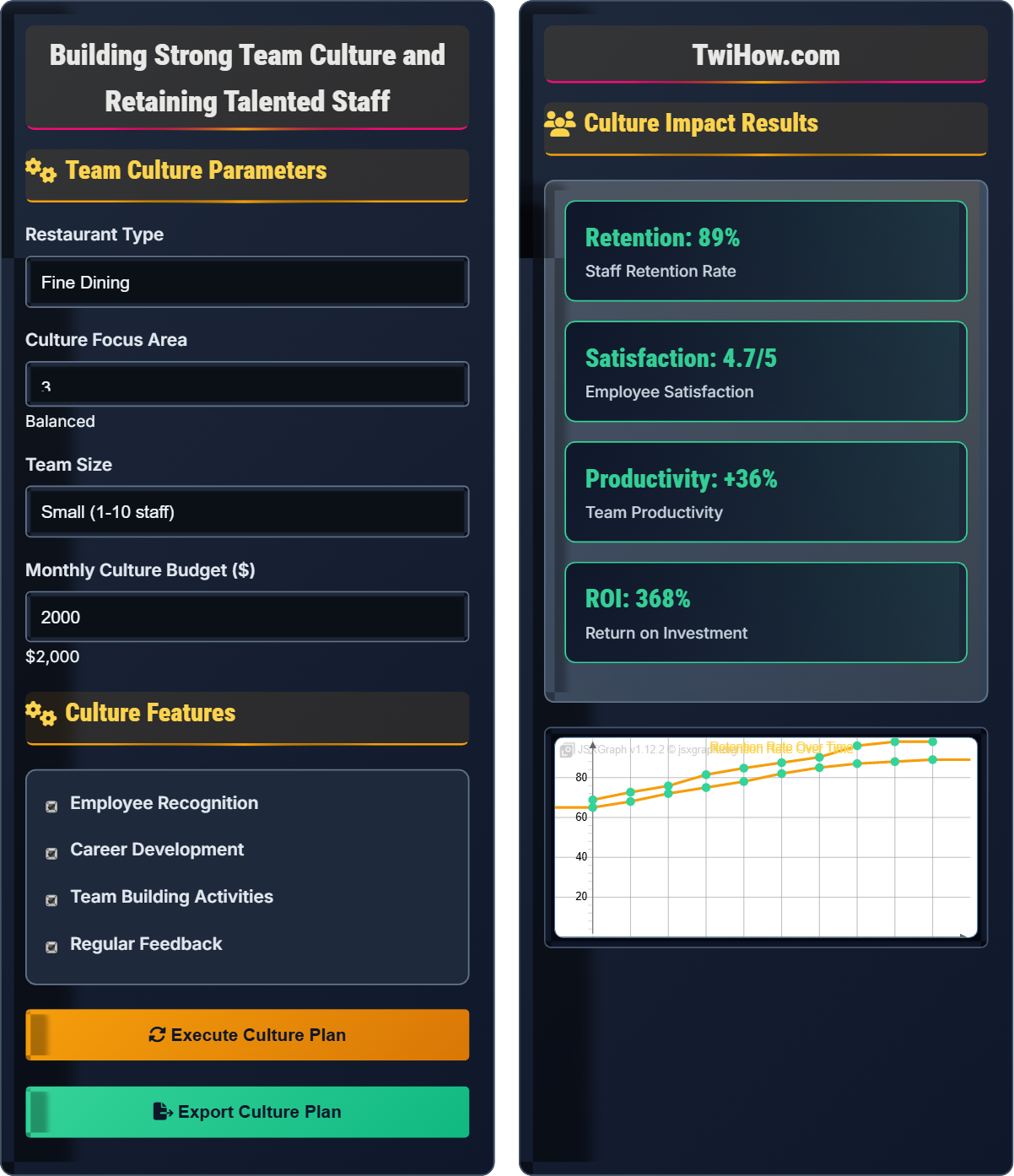
Team Culture Parameters
Culture Features
Culture Impact Results
| Strategy | Priority | Implementation | Impact |
|---|---|---|---|
| Recognition | High | Easy | High |
| Development | High | Medium | High |
| Feedback | Medium | Easy | Medium |
| Team Building | Medium | Medium | Medium |
Building Team Culture and Retaining Staff Explained
Team culture encompasses the shared values, beliefs, behaviors, and attitudes that characterize an organization. In restaurants, it includes how staff interact with each other, treat customers, and approach their work. A strong culture creates a positive work environment that attracts and retains talented employees.
Retention Rate = (Satisfaction + Compensation + Growth + Leadership) / (Stress + Burnout + Conflicts)
Where:
- Satisfaction: Employee happiness and engagement
- Compensation: Wages, benefits, and rewards
- Growth: Career advancement opportunities
- Leadership: Management support and guidance
Critical elements for strong team culture:
- Open Communication: Encouraging honest dialogue and feedback
- Mutual Respect: Valuing all team members regardless of position
- Recognition: Acknowledging employee contributions and achievements
- Growth Opportunities: Providing paths for skill development and advancement
- Work-Life Balance: Supporting employee wellbeing outside work
- Team Collaboration: Promoting cooperation and shared success
- Competitive Compensation: Offering fair wages and benefits
- Career Development: Providing training and advancement opportunities
- Flexible Scheduling: Accommodating employee needs when possible
- Positive Environment: Creating a welcoming, respectful workplace
- Regular Feedback: Providing constructive feedback and recognition
- Employee Involvement: Including staff in decision-making processes
Team Culture Fundamentals
Team culture, employee retention, staff engagement, workplace values, leadership development, employee satisfaction.
Retention = (Satisfaction + Compensation + Growth + Leadership) / (Stress + Burnout + Conflicts)
Where Satisfaction = employee happiness, Compensation = pay and benefits, Growth = advancement opportunities.
- Culture starts with leadership
- Consistency builds trust
- Recognition motivates
- Development retains talent
Retention Methods
Compensation, recognition, development, work environment, leadership, flexibility.
- Competitive wages and benefits
- Recognition and rewards
- Training and development
- Positive work environment
- Individual needs vary
- Balance cost and benefit
- Measure effectiveness
- Adapt to feedback
Team Culture & Retention Quiz
What is the most important foundation for building a strong team culture?
Leadership modeling is the most important foundation because employees look to their managers as examples of how to behave. When leaders embody the values and behaviors they expect from their team, it creates a consistent, trustworthy environment that encourages others to follow suit.
The answer is B) Leadership modeling.
Leadership modeling sets the tone for the entire organization. Employees watch and mimic their supervisors' behaviors, attitudes, and values. If leaders demonstrate respect, integrity, and positive communication, staff are more likely to adopt these behaviors. Without consistent leadership modeling, other culture initiatives may fall flat because employees see a disconnect between what's preached and practiced.
Leadership Modeling: Leaders demonstrating desired behaviors
Culture Foundation: Core elements that support organizational culture
Behavioral Consistency: Aligning actions with stated values
• Leaders must walk the talk
• Consistency builds trust
• Actions speak louder than words
• Lead by example consistently
• Align actions with values
• Demonstrate desired behaviors
• Leaders saying one thing but doing another
• Not modeling desired behaviors
• Failing to align actions with values
Explain the importance of employee recognition programs and how they contribute to staff retention in restaurants.
Validation: Recognition validates employees' hard work and contributions, making them feel valued.
Motivation: Acknowledgment encourages continued high performance and effort.
Engagement: Recognized employees become more invested in their work and the organization.
Retention: Employees who feel appreciated are more likely to stay with the company.
Team Morale: Recognition creates positive energy and encourages peer support.
Productivity: Motivated employees work more efficiently and effectively.
Recognition programs are essential for creating a positive work environment that encourages loyalty and performance.
Employee recognition addresses the fundamental human need to feel valued and appreciated. In the restaurant industry, where work can be physically demanding and stressful, recognition becomes even more important. Simple acknowledgments, whether verbal praise or formal awards, can significantly impact employee satisfaction and retention. The key is consistency and authenticity in recognition efforts.
Employee Recognition: Acknowledging staff contributions and achievements
Validation: Confirming the value of someone's efforts
Engagement: Employee commitment and involvement
• Recognition should be timely
• Be specific about achievements
• Make it meaningful to the employee
• Recognize efforts immediately
• Personalize recognition
• Include peer recognition
• Delaying recognition too long
• Being generic instead of specific
• Not recognizing consistently
A restaurant has a 70% annual staff turnover rate. The average cost to replace an employee is $3,000 (recruitment, training, lost productivity). They have 20 staff members earning $15/hour. Calculate the annual cost of turnover and explain how investing in retention strategies could improve this.
Annual Turnover Cost: 20 staff × 0.70 (turnover rate) × $3,000 (replacement cost) = $42,000
Retention Investment: Investing 25% of turnover cost ($10,500) in retention strategies
Potential Savings: Reducing turnover by 40% would save $16,800 (40% of $42,000)
ROI: $16,800 saved / $10,500 invested = 160% return
Retention strategies like better wages, recognition, and development could significantly reduce costs while improving service quality.
Staff turnover is extremely costly for restaurants, with replacement costs including recruitment, training, and lost productivity. The calculation shows that even a modest investment in retention can yield significant returns. By improving working conditions, compensation, and career development, restaurants can reduce turnover while creating a more experienced, efficient workforce.
Staff Turnover: Percentage of employees who leave annually
Replacement Cost: Total cost of replacing departing employees
ROI: Return on Investment calculation
• Calculate true replacement costs
• Invest in retention proactively
• Measure turnover reduction
• Track turnover costs monthly
• Identify turnover reasons
• Implement targeted solutions
• Underestimating replacement costs
• Not tracking turnover reasons
• Failing to invest in retention
A restaurant manager wants to create a career development program to retain staff. They have servers, cooks, and hosts with different skill levels. Design a development program that provides clear advancement opportunities for each role.
Server Track: Server → Senior Server → Team Leader → Shift Supervisor → Assistant Manager
Cook Track: Prep Cook → Line Cook → Senior Line Cook → Sous Chef → Chef de Partie
Host Track: Host → Senior Host → Host Captain → Front of House Manager
Development Elements: Skills training, mentorship programs, cross-training opportunities, performance reviews with advancement criteria, tuition reimbursement for relevant education.
Clear paths and regular progress reviews motivate employees to stay and grow within the organization.
Career development programs address employees' desire for growth and advancement. By creating clear pathways within the organization, restaurants can retain talent by showing employees how they can progress professionally. The key is providing both vertical advancement opportunities and horizontal skill development. Regular reviews and skill-building opportunities keep employees engaged and motivated to stay.
Career Development: Structured advancement opportunities
Vertical Advancement: Promotion to higher positions
Horizontal Development: Skill expansion at same level
• Create clear advancement paths
• Provide regular feedback
• Invest in skill development
• Document advancement criteria
• Provide mentorship
• Offer cross-training
• Not communicating advancement paths
• Failing to provide development
• Not documenting criteria
Which communication practice is most effective for building team culture and retention?
Open, two-way communication is most effective because it creates transparency, builds trust, and allows for feedback from all team members. This approach ensures everyone feels heard and valued, which strengthens culture and improves retention.
The answer is B) Open, two-way communication.
Two-way communication creates a collaborative environment where employees feel comfortable sharing ideas, concerns, and feedback. This openness builds trust and demonstrates that management values employee input. In contrast, one-way communication can create distance between management and staff, leading to disengagement and higher turnover. Effective communication is essential for building strong team relationships.
Two-Way Communication: Dialogue allowing input from all parties
Transparency: Open sharing of information
Feedback Loop: Ongoing exchange of information
• Encourage open dialogue
• Listen actively to staff
• Respond to feedback
• Hold regular team meetings
• Create suggestion boxes
• Conduct one-on-ones
• Not listening to feedback
• One-way communication only
• Not acting on input
FAQ
Q: How much should I invest in employee retention programs?
A: Budget for retention based on your turnover costs:
1. Calculate Current Costs: Determine your annual turnover expenses
2. Investment Range: Spend 15-25% of turnover costs on retention
3. Minimum Investment: At least $1,000-2,000 per employee annually
4. ROI Expectation: Well-designed programs typically return 3-5x investment
Focus on the most cost-effective strategies first: recognition, development, and communication.
Q: What's the difference between employee satisfaction and employee engagement?
A: Key differences between satisfaction and engagement:
Employee Satisfaction: How happy employees are with their job conditions, pay, and benefits. It's a feeling of contentment.
Employee Engagement: How committed and involved employees are in their work and the organization. It's about emotional investment.
Satisfied employees may be happy but not necessarily motivated to go above and beyond. Engaged employees are passionate about their work and contribute to organizational success.