Developing a Compelling Restaurant Concept and Menu
Complete hospitality guide • Step-by-step explanations
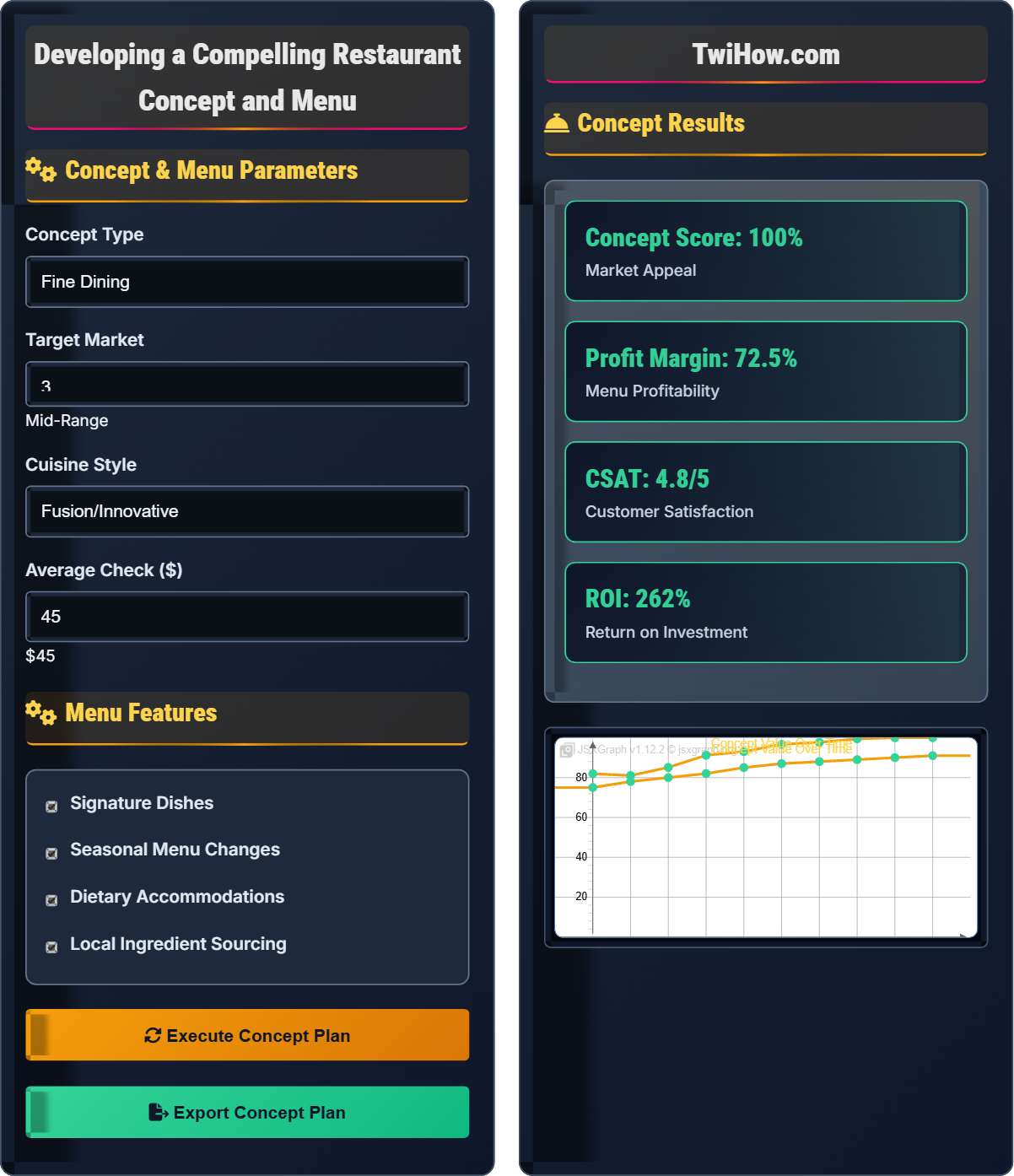
Restaurant Concept & Menu:
Show Concept SimulatorCreating a compelling restaurant concept and menu requires strategic thinking, market analysis, and culinary creativity. The concept defines the restaurant's identity, theme, and target audience, while the menu executes that concept through carefully curated dishes, pricing, and presentation.
A successful concept addresses market gaps, leverages unique strengths, and creates a distinctive dining experience. The menu should reflect the concept while optimizing for profitability, kitchen efficiency, and customer satisfaction. Both elements must work harmoniously to create a cohesive brand experience.
Key development areas:
- Concept Identity: Theme, atmosphere, and target demographic
- Menu Engineering: Dish selection, pricing, and profitability
- Market Positioning: Competitive differentiation and value proposition
- Operational Feasibility: Kitchen efficiency and service delivery
Successful restaurant concepts balance creativity with practicality, ensuring that the concept is executable within operational constraints while delivering an exceptional customer experience that justifies the price point and encourages repeat visits.
Concept & Menu Parameters
Menu Features
Concept Results
Restaurant Concept and Menu Development Explained
A restaurant concept is the foundational idea that defines the restaurant's identity, theme, atmosphere, and target audience. It encompasses the overall dining experience, from the décor and ambiance to the service style and food presentation. The concept serves as a roadmap for all business decisions and ensures consistency across all touchpoints.
Concept Success = (Market Need × Unique Value × Execution Quality) / (Competition + Market Saturation)
Where:
- Market Need: Gap in the market that the concept fills
- Unique Value: Distinctive elements that differentiate from competitors
- Execution Quality: Ability to deliver the promised experience consistently
- Competition: Existing restaurants targeting the same market
Key restaurant concept types:
- Fast Casual: Quality food at moderate prices with quick service
- Casual Dining: Relaxed atmosphere with table service
- Fine Dining: Premium experience with high-quality cuisine and service
- Quick Service: Fast food with minimal service
- Specialty: Focused on specific cuisine type or dietary needs
- Theme-Based: Built around specific entertainment or experience
- Clear Identity: Distinctive concept that stands out in the market
- Market Fit: Alignment between concept and local market demand
- Operational Feasibility: Concept that can be executed consistently
- Financial Viability: Concept that supports profitable operations
- Scalability: Potential for growth and replication
- Brand Cohesion: Consistent experience across all touchpoints
Concept Development Fundamentals
Restaurant concept, menu engineering, market positioning, target demographic, competitive analysis, value proposition.
Success = (Market Need × Unique Value × Execution Quality) / (Competition + Market Saturation)
Where Market Need = gap in market, Unique Value = differentiation, Execution Quality = operational excellence.
- Concept must fill a market gap
- Unique value is essential for success
- Execution must match promises
- Financial viability is critical
Menu Strategy
Menu engineering, pricing strategy, dish selection, profitability optimization, customer appeal.
- Calculate item profitability
- Assess popularity of items
- Classify items by quadrant
- Optimize menu mix
- Balancing profitability and appeal
- Considering kitchen efficiency
- Meeting customer expectations
- Managing food costs
Restaurant Concept & Menu Development Quiz
What is the most important factor for creating a differentiated restaurant concept?
A unique value proposition is most important because it defines what makes the restaurant different from competitors and gives customers a reason to choose it over other options. While price, menu size, and service speed are important, they don't create lasting differentiation without a clear value proposition that resonates with the target market.
The answer is B) Unique value proposition.
Restaurant differentiation relies on creating a clear, compelling value proposition that addresses unmet customer needs or provides a unique experience. This goes beyond just being cheaper or faster—it's about offering something that competitors don't. The value proposition should be authentic, achievable, and valuable to the target demographic. It becomes the foundation for all other business decisions and marketing efforts.
Value Proposition: Promise of value delivered to customers
Market Differentiation: Unique characteristics that set apart from competitors
Target Demographic: Specific customer group the concept serves
• Differentiation creates competitive advantage
• Value must be authentic and deliverable
• Concept should address specific needs
• Research competitor weaknesses
• Identify underserved market segments
• Focus on authentic strengths
• Copying successful concepts without differentiation
• Overpromising without ability to deliver
• Not validating concept with target market
Explain the four-quadrant method of menu engineering and how it helps optimize restaurant profitability.
Stars (High Profit, High Popularity): Keep these items as they generate both revenue and customer satisfaction. Protect and promote them.
Plowhorses (Low Profit, High Popularity): These popular items drag down profitability. Consider raising prices, reducing portion sizes, or improving margins.
Questions (High Profit, Low Popularity): Investigate why these profitable items aren't selling. Improve descriptions, placement, or marketing.
Dogs (Low Profit, Low Popularity): Remove these items as they don't contribute to revenue or customer satisfaction.
This method helps identify which menu items to promote, modify, or eliminate based on their profitability and popularity.
Menu engineering is a systematic approach to optimizing menu profitability by analyzing the relationship between item popularity and profitability. The four-quadrant model provides a framework for making strategic decisions about menu items. The goal is to maximize the number of stars while converting questions and plowhorses into more profitable positions. This method ensures that menu decisions are based on data rather than intuition, leading to improved financial performance.
Menu Engineering: Strategic analysis of menu item profitability and popularity
Four-Quadrant Method: Classification system based on profitability and popularity
Star Items: High-profit, high-popularity menu items
• Use data to make menu decisions
• Balance profitability with customer satisfaction
• Continuously monitor and adjust
• Track item-level sales and food costs
• Update analysis monthly
• Consider seasonal variations
• Not tracking individual item performance
• Removing popular items without replacement
• Focusing only on profitability
You're opening a restaurant in a college town with many existing dining options. The market has plenty of pizza, Chinese, and fast food, but lacks healthy, affordable options for students. Design a restaurant concept that fills this gap while ensuring profitability and operational feasibility.
Concept: Fast-casual healthy bowl/bar restaurant with customizable options.
Target Market: College students and young professionals seeking healthy, affordable meals.
Menu Strategy: Bowl bars with protein, grain, and vegetable options. Focus on fresh ingredients with reasonable markups.
Operational Design: Assembly-line service to maintain speed while offering customization.
Pricing: Competitive with other healthy options but lower than fine dining establishments.
Unique Value: Fresh, healthy, customizable options at student-friendly prices with efficient service.
Successful concept development requires identifying unmet market needs and creating a concept that addresses them while remaining operationally feasible. In this case, the gap is healthy, affordable dining for students. The concept must balance the need for healthy, fresh ingredients with operational efficiency and student budget constraints. The key is creating a unique value proposition that competitors don't offer while ensuring the business model is sustainable.
Market Gap: Unmet customer need in the local market
Operational Feasibility: Ability to execute concept within practical constraints
Assembly-Line Service: Efficient service model for quick, customizable orders
• Address unmet market needs
• Ensure operational efficiency
• Balance quality with affordability
• Research local competition thoroughly
• Validate concept with target demographic
• Consider operational complexity
• Entering oversaturated markets
• Not considering operational constraints
• Overpricing for target market
Your restaurant's food costs average 32% of menu prices. Your labor and overhead costs are 45% of sales. What is the minimum profit margin you can achieve, and how should you price menu items to ensure profitability while remaining competitive?
Calculation: Food costs (32%) + Labor/overhead (45%) = 77% of sales in costs. This leaves 23% for profit and other expenses.
Pricing Strategy: Use the food cost percentage to determine menu prices. If an item costs $4.00 to make, divide by 0.32 to get a menu price of $12.50.
Competitive Pricing: Research competitor prices and position your items competitively while maintaining target food cost percentage.
Menu Engineering: Focus on items that maintain the 32% target while offering value to customers.
Success requires balancing food cost targets with market competitiveness and customer value perception.
Restaurant pricing must account for all operational costs while remaining competitive in the market. The food cost percentage method ensures profitability by maintaining target margins. However, pricing decisions must also consider market conditions and customer value perception. The key is finding the sweet spot where prices cover costs, generate profit, and provide value to customers. Regular monitoring of food costs and market prices is essential for maintaining profitability.
Food Cost Percentage: Cost of ingredients divided by menu price
Target Margin: Desired profit percentage after all costs
Value Perception: Customer assessment of worth relative to price
• Maintain target food cost percentage
• Consider market competitiveness
• Balance profit with customer value
• Monitor food costs weekly
• Adjust prices seasonally
• Use psychological pricing
• Not calculating true food costs
• Ignoring market prices
• Not adjusting for ingredient changes
Which factor is most important when selecting a target market for a restaurant concept?
Alignment with concept and operational capabilities is most important because it ensures the restaurant can successfully serve the chosen market. A concept must be executable within operational constraints and provide value that the target market will appreciate. Without this alignment, even a large, affluent market segment won't guarantee success.
The answer is C) Alignment with concept and operational capabilities.
Target market selection requires matching the restaurant's concept and capabilities with customer needs and preferences. The most attractive market segment is useless if the restaurant cannot serve it effectively. Success depends on the ability to deliver the promised experience consistently while meeting the target market's specific needs. This alignment affects everything from menu design to service style to pricing strategy.
Target Market Alignment: Match between concept capabilities and customer needs
Operational Capabilities: Restaurant's ability to execute its concept
Customer Value Delivery: Ability to provide promised value consistently
• Concept must match operational capabilities
• Target market must appreciate value offered
• Execution must be consistent
• Assess operational strengths and limitations
• Validate concept with target market
• Consider scalability
• Chasing large markets without capability
• Not validating concept-market fit
• Overestimating operational capacity
FAQ
Q: How can I develop a compelling restaurant concept on a limited budget?
A: Develop a compelling concept on a limited budget through focused strategies:
1. Focus on One Strong Element: Excel in one area (cuisine, service, atmosphere) rather than trying to do everything
2. Leverage Personal Strengths: Build concept around your own culinary skills or cultural background
3. Simple but Memorable: Create a simple concept with one standout feature rather than complex themes
4. DIY Approach: Handle design and marketing yourself initially
5. Start Small: Begin with limited menu and expand based on success
Success comes from authenticity and focus rather than expensive bells and whistles.
Q: What's the difference between restaurant concept and menu design?
A: Restaurant concept and menu design serve different but related functions:
Restaurant Concept: Defines the overall identity, theme, target market, and experience promise. It's the foundational idea that guides all business decisions.
Menu Design: Executes the concept through specific food offerings, pricing, and presentation. It's the tangible expression of the concept.
The concept comes first and drives menu decisions, while the menu brings the concept to life for customers. Both must align for success.