Effective Food Cost, Waste, and Inventory Management
Complete hospitality guide • Step-by-step explanations
Food Cost & Inventory:
Show Management SimulatorEffective food cost, waste, and inventory management is critical for restaurant profitability. Food costs typically represent 28-35% of sales, making it one of the largest controllable expenses. Proper management reduces waste, optimizes purchasing, and maintains consistent food quality while maximizing profit margins.
Successful management involves calculating food costs accurately, implementing waste reduction strategies, and maintaining optimal inventory levels. This requires tracking food usage, monitoring expiration dates, and establishing efficient ordering and storage procedures.
Key management areas:
- Food Cost Calculation: Accurate tracking of ingredient costs and portion control
- Waste Reduction: Strategies to minimize food spoilage and overproduction
- Inventory Control: Optimal stock levels and rotation practices
- Procurement: Strategic purchasing and supplier management
Effective systems balance minimizing waste with maintaining quality and avoiding stockouts. The goal is achieving optimal food costs while delivering consistent quality to customers.
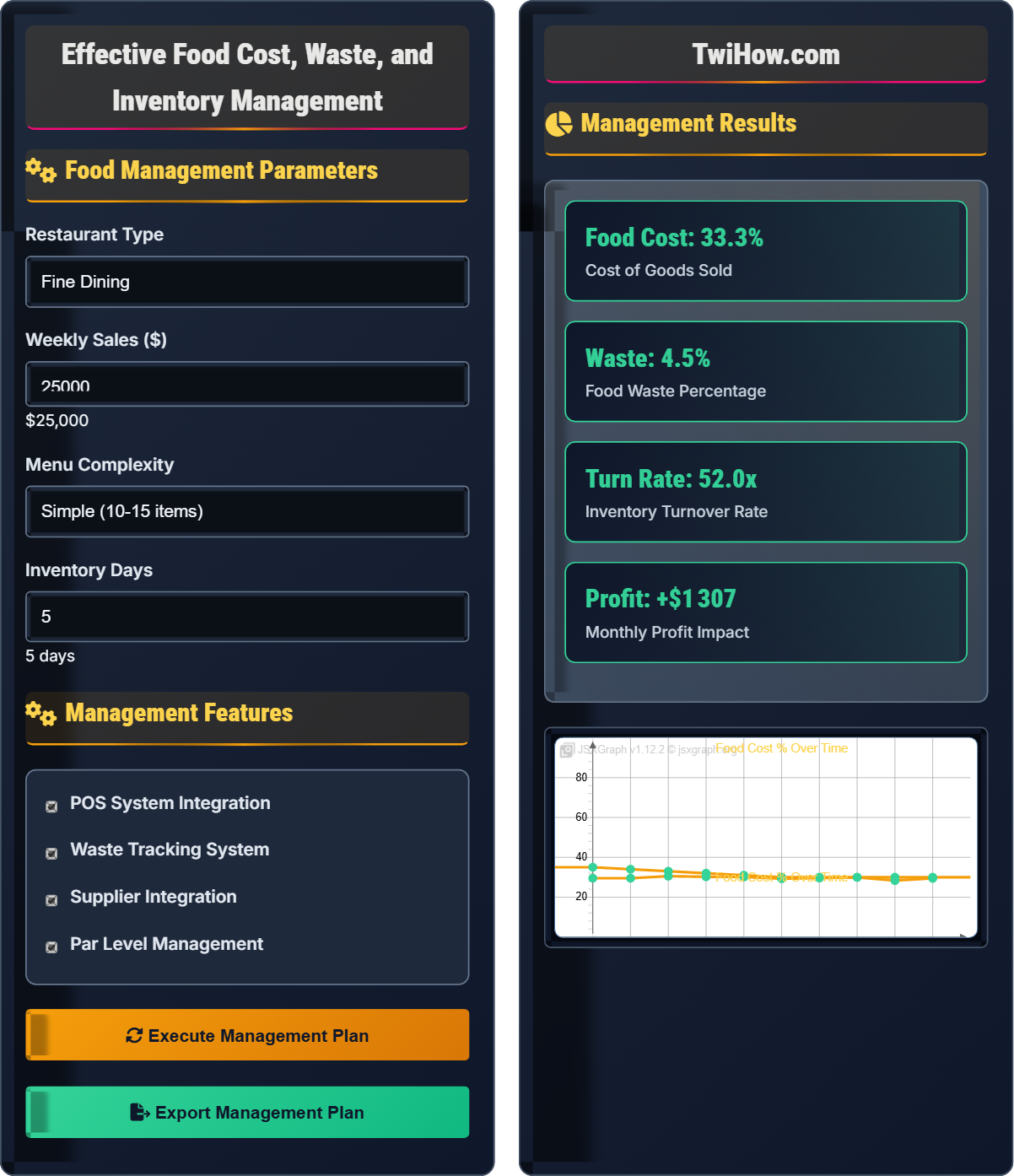
Food Management Parameters
Management Features
Management Results
| Category | Cost % | Target % | Variance |
|---|---|---|---|
| Proteins | 12.5% | 12.0% | +0.5% |
| Vegetables | 8.2% | 8.0% | +0.2% |
| Grains/Dairy | 6.8% | 7.0% | -0.2% |
| Other | 3.7% | 4.0% | -0.3% |
Food Cost, Waste, and Inventory Management Explained
Food cost management is the systematic approach to controlling the cost of ingredients used to prepare menu items. It involves calculating the actual cost of ingredients, monitoring portion sizes, tracking usage, and maintaining optimal food costs typically between 28-35% of sales for most restaurants.
Food Cost Percentage = (Beginning Inventory + Purchases - Ending Inventory) / Sales × 100
Where:
- Beginning Inventory: Value of food at start of period
- Purchases: Food bought during the period
- Ending Inventory: Value of food at end of period
- Sales: Total revenue from food sales
Common sources of food waste in restaurants:
- Overproduction: Cooking more than needed
- Expiration: Food spoiling before use
- Preparation Waste: Trimmings and peels
- Plate Waste: Food returned uneaten
- Damage: Physical damage during handling
- Portion Waste: Large portions uneaten
- First-In, First-Out (FIFO): Use oldest inventory first
- Standard Recipes: Consistent portion sizes and preparation
- Par Levels: Maintain minimum and maximum inventory levels
- Weekly Inventory: Regular counting and tracking
- Waste Tracking: Monitor and analyze waste patterns
- Menu Engineering: Optimize menu for cost efficiency
Food Cost Management Fundamentals
Food cost percentage, COGS, inventory turnover, FIFO, portion control, standard recipes, waste management.
Food Cost % = (Beginning Inventory + Purchases - Ending Inventory) / Sales × 100
Inventory Turnover = COGS / Average Inventory Value
- Food costs should be 28-35% of sales
- Track inventory weekly
- Use FIFO method consistently
- Control portion sizes
Waste Reduction
Overproduction, expiration, preparation waste, plate waste, damage, portion waste.
- Accurate demand forecasting
- Smaller batch cooking
- Proper storage techniques
- Staff training on waste
- Minimize waste without compromising quality
- Track waste by category
- Train staff on waste reduction
- Monitor expiration dates
Food Cost & Inventory Management Quiz
If a restaurant has a beginning inventory of $10,000, purchases $5,000 during the week, ends with $8,000 in inventory, and generates $25,000 in food sales, what is the food cost percentage?
Formula: Food Cost % = (Beginning Inventory + Purchases - Ending Inventory) / Sales × 100
Calculation: ($10,000 + $5,000 - $8,000) / $25,000 × 100 = $7,000 / $25,000 × 100 = 28%
The formula calculates the cost of goods sold (COGS) as the difference between beginning inventory plus purchases minus ending inventory, then divides by sales to get the percentage.
The answer is A) 28%.
The food cost percentage calculation is fundamental to restaurant management. It measures the actual cost of ingredients used during a period relative to sales generated. The formula accounts for inventory changes, meaning food used equals what was on hand at the start plus what was purchased minus what remained at the end. This provides an accurate measure of food consumption relative to sales.
Food Cost Percentage: Cost of ingredients divided by food sales
COGS: Cost of Goods Sold (ingredients used in period)
Beginning/Ending Inventory: Value of ingredients at start/end of period
• Include all inventory changes
• Compare to food sales only
• Track weekly for accuracy
• Count inventory regularly
• Include all food purchases
• Exclude non-food sales
• Forgetting to account for inventory changes
• Including beverage sales in calculation
• Not counting inventory regularly
Explain the FIFO (First In, First Out) method and why it's critical for food cost management and waste reduction.
Definition: FIFO is an inventory rotation method where the oldest inventory items are used first, ensuring newer items are consumed later.
Implementation: Organize storage areas so older items are in front or accessible first. Label items with receiving dates. Train staff to use oldest items first.
Benefits: Prevents food spoilage, reduces waste, ensures freshness, maintains quality, and optimizes inventory turnover.
Critical Importance: Without FIFO, older items may expire before use, creating waste and increasing food costs. It also affects food safety and customer satisfaction.
This method is essential for maintaining consistent food quality while minimizing waste and costs.
FIFO is a fundamental inventory management principle that prevents waste by ensuring older items are used before they expire. It requires systematic organization and staff training to be effective. The method directly impacts food costs by preventing spoilage and waste, while also ensuring food safety and quality. Proper FIFO implementation is essential for any food service operation.
FIFO: First In, First Out inventory rotation method
Inventory Rotation: Systematic use of oldest items first
Food Spoilage: Deterioration of food quality making it unusable
• Always use oldest items first
• Label items with dates
• Train all staff on FIFO
• Use date labels on all items
• Organize storage systematically
• Check rotation during inventory
• Placing new items in front of old
• Not labeling items with dates
• Failing to train staff consistently
A restaurant serves 200 steaks per week with an average portion size of 10 oz. The steak costs $8.00 per pound. If they reduce the portion size to 8 oz while maintaining the same menu price, calculate the weekly savings and explain the impact on food cost percentage.
Current Usage: 200 × 10 oz = 2,000 oz = 125 lbs per week
Current Cost: 125 lbs × $8.00 = $1,000 per week
New Usage: 200 × 8 oz = 1,600 oz = 100 lbs per week
New Cost: 100 lbs × $8.00 = $800 per week
Weekly Savings: $1,000 - $800 = $200 per week
Impact: Reducing portion size from 10 oz to 8 oz saves $200 weekly while maintaining the same menu price, improving food cost percentage by reducing COGS while keeping sales constant.
Portion control directly impacts food costs by determining how much ingredient is used per menu item. Small changes in portion size can have significant cost impacts when multiplied across many servings. This example shows how reducing portion size from 10 oz to 8 oz (20% reduction) results in 20% less ingredient usage, saving $200 weekly. The key is maintaining customer satisfaction while optimizing costs.
Portion Control: Standardized amount of food served per dish
COGS: Cost of Goods Sold (ingredient costs)
Menu Engineering: Optimizing menu for profitability
• Standardize all portions
• Train staff on measurements
• Monitor portion consistency
• Use portioning tools consistently
• Train kitchen staff on standards
• Monitor customer feedback
• Inconsistent portion sizes
• Not training staff properly
• Reducing portions too much
A restaurant uses 50 pounds of ground beef per week. The lead time for delivery is 3 days, and they want to maintain a safety stock of 10 pounds. Calculate the par level for ground beef and explain how to use this for ordering.
Daily Usage: 50 lbs ÷ 7 days = 7.14 lbs per day
Lead Time Usage: 7.14 lbs/day × 3 days = 21.4 lbs
Par Level: Lead Time Usage + Safety Stock = 21.4 + 10 = 31.4 lbs
Ordering Rule: When inventory drops to par level (31.4 lbs), order enough to return to maximum desired level. This ensures adequate supply without overstocking.
This system prevents stockouts while maintaining optimal inventory levels.
Par levels are critical for inventory management, representing the minimum quantity needed to last until the next delivery arrives. The calculation includes lead time usage (amount needed during delivery period) plus safety stock (buffer for unexpected demand). This prevents running out of essential ingredients while avoiding excess inventory that could spoil.
Par Level: Minimum inventory level before reordering
Lead Time: Time between order and delivery
Safety Stock: Buffer inventory for unexpected demand
• Calculate based on actual usage
• Adjust for seasonal changes
• Include safety stock for buffer
• Review par levels monthly
• Adjust for seasonal fluctuations
• Monitor supplier reliability
• Not accounting for lead time
• Setting par levels too high
• Not adjusting for demand changes
What does a high inventory turnover rate indicate about a restaurant's food management?
A high inventory turnover rate indicates that the restaurant is frequently purchasing and using inventory, which typically means minimal waste and fresh ingredients. The formula is COGS divided by average inventory value, so a high rate means inventory is moving quickly rather than sitting and potentially expiring.
The answer is B) Frequent inventory purchases and minimal waste.
Inventory turnover measures how quickly inventory is used and replaced. A high rate indicates efficient inventory management with minimal waste. It shows that the restaurant is purchasing appropriate amounts and using inventory before it expires. This is generally positive for food service operations as it indicates fresh ingredients and controlled waste.
Inventory Turnover: How quickly inventory is used and replaced
COGS: Cost of Goods Sold (ingredients used)
Efficient Management: Optimal inventory usage without waste
• Higher turnover is generally better
• Indicates efficient usage
• Reduces waste potential
• Monitor turnover by category
• Aim for 6-12x annually
• Adjust purchasing based on rates
• Not tracking turnover by category
• Setting too low of targets
• Not adjusting for perishability
FAQ
Q: How often should I count inventory to maintain accurate food cost calculations?
A: For accurate food cost management, follow this schedule:
1. Weekly Counts: Count high-value items and those with short shelf lives
2. Monthly Counts: Full inventory count for all items
3. Daily Tracking: Record purchases and waste daily
4. Weekly Reconciliation: Compare counts to POS data
5. Monthly Analysis: Calculate food cost percentage and investigate variances
More frequent counting is needed for high-value items or those with short shelf lives.
Q: What's the difference between food cost percentage and gross profit margin?
A: The key differences:
Food Cost Percentage: (Cost of Ingredients / Food Sales) × 100. Measures ingredient cost relative to food sales only.
Gross Profit Margin: (Total Revenue - COGS) / Total Revenue × 100. Includes all costs of goods sold, not just food.
Food cost percentage focuses specifically on ingredient costs for food items, while gross profit margin considers all product costs. Food cost percentage is typically 28-35% of food sales, while gross profit margin includes labor and other costs.