Optimizing the Customer Journey from Reservation to Post-Visit
Complete hospitality guide • Step-by-step explanations
Customer Journey Optimization:
Show Journey SimulatorOptimizing the customer journey involves creating seamless, enjoyable experiences from the moment a customer decides to visit until after their departure. This includes reservation booking, arrival experience, dining service, payment processing, and post-visit engagement.
Successful journey optimization requires understanding customer expectations at each touchpoint, implementing efficient processes, and maintaining consistent quality. The goal is to exceed customer expectations while building loyalty and encouraging repeat visits.
Key journey stages:
- Pre-Visit: Reservation, research, and expectation setting
- Arrival: Greeting, seating, and initial service
- Dining: Food service, ambiance, and interaction quality
- Departure: Payment, farewell, and follow-up
Effective optimization creates memorable experiences that turn customers into advocates and drives sustainable business growth.
Customer Journey Parameters
Journey Features
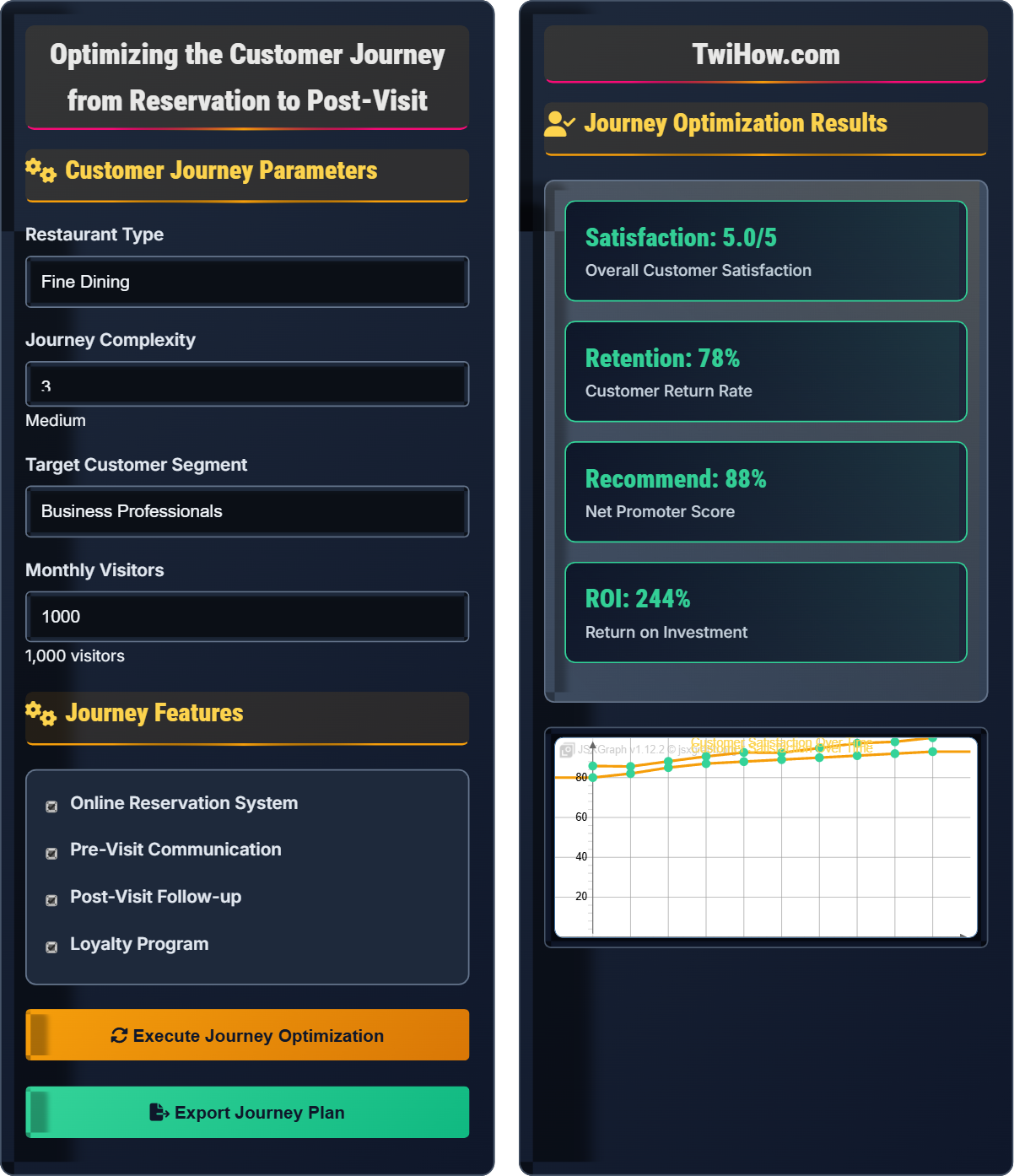
Journey Optimization Results
| Stage | Efficiency | Satisfaction | Priority |
|---|---|---|---|
| Reservation | 90% | 4.6/5 | High |
| Arrival | 85% | 4.4/5 | High |
| Dining | 92% | 4.8/5 | High |
| Departure | 88% | 4.5/5 | Medium |
Customer Journey Optimization Explained
Customer journey optimization is the systematic process of improving every touchpoint in the customer experience from initial awareness through post-visit engagement. It involves mapping the entire customer experience, identifying pain points, and implementing solutions that enhance satisfaction and loyalty.
Journey Success = (Touchpoint Quality + Process Efficiency + Customer Satisfaction) / (Wait Time + Friction Points)
Where:
- Touchpoint Quality: Excellence at each customer interaction point
- Process Efficiency: Smooth, well-coordinated service delivery
- Customer Satisfaction: Overall happiness with the experience
- Wait Time: Delays that negatively impact experience
Essential stages in the restaurant customer journey:
- Pre-Visit: Research, reservation, expectation setting
- Arrival: Greeting, seating, initial service
- Service: Ordering, food delivery, interaction quality
- Departure: Payment, farewell, receipt
- Post-Visit: Follow-up, feedback, loyalty
- Consistency: Uniform quality across all touchpoints
- Efficiency: Minimizing wait times and delays
- Personalization: Tailoring experiences to customer preferences
- Staff Training: Well-trained, empowered employees
- Technology: Tools that enhance rather than complicate
- Feedback Loops: Systems for continuous improvement
Journey Fundamentals
Customer journey, touchpoint optimization, experience design, service quality, customer satisfaction, journey mapping.
Success = (Touchpoint Quality × Process Efficiency × Customer Satisfaction) / (Wait Time + Friction)
Where Touchpoint Quality = excellence at each interaction, Process Efficiency = smooth service flow, Customer Satisfaction = overall happiness.
- Every touchpoint matters
- Consistency builds trust
- Efficiency reduces friction
- Personalization enhances value
Journey Stages
Pre-visit, arrival, service, departure, post-visit.
- Map customer touchpoints
- Identify pain points
- Design solutions
- Implement improvements
- Each stage affects overall perception
- Seamless transitions are crucial
- Staff coordination is essential
- Technology should enhance experience
Customer Journey Optimization Quiz
Which stage of the customer journey typically has the greatest impact on overall satisfaction?
Food service and quality typically have the greatest impact because it's the core value proposition of the restaurant. While all stages matter, the actual dining experience is what customers primarily judge the restaurant on. The quality of food, service, and atmosphere during the meal creates the strongest impression and memory.
The answer is C) Food service and quality.
While the entire journey matters, the core service delivery during the dining experience is the primary reason customers visit restaurants. The food quality, service level, and atmosphere during the meal create lasting memories that influence future decisions. However, a poor experience at any stage can negatively impact overall satisfaction, so all touchpoints must be optimized for maximum success.
Touchpoint: Any interaction between customer and restaurant
Core Value Proposition: Primary benefit customers seek
Customer Memory: Lasting impression formed during experience
• Core experience is most impactful
• All touchpoints matter
• First impressions are crucial
• Focus on food quality excellence
• Maintain consistent service
• Create memorable experiences
• Neglecting other journey stages
• Inconsistent service quality
• Not training staff properly
Explain how to map the customer journey for a restaurant and identify key touchpoints that need optimization.
Research Phase: Online reviews, website browsing, social media, phone calls for reservations.
Reservation: Booking process, confirmation, special request handling.
Arrival: Parking, greeting, seating, initial service.
Pre-Ordering: Menu review, drink ordering, appetizer selection.
Meal Service: Food delivery, server interactions, refill requests.
Payment: Bill presentation, payment processing, tip handling.
Departure: Farewell, feedback request, follow-up communication.
Identify friction points and opportunities for enhancement at each stage.
Journey mapping involves visualizing the entire customer experience from start to finish. This process reveals pain points, opportunities for improvement, and moments that delight customers. By examining each touchpoint, restaurants can identify where improvements will have the greatest impact on customer satisfaction and loyalty. The goal is to create seamless transitions between stages while exceeding expectations at each interaction.
Journey Mapping: Visual representation of customer experience
Touchpoint: Interaction between customer and business
Friction Point: Element that causes customer frustration
• Map the entire journey
• Identify all touchpoints
• Focus on customer perspective
• Include customer emotions
• Gather customer feedback
• Monitor competitor journeys
• Missing key touchpoints
• Not considering customer perspective
• Failing to validate assumptions
A customer receives cold food at a restaurant. Describe the optimal service recovery process that turns this negative experience into a positive one, and explain how this affects the overall customer journey.
Immediate Response: Acknowledge the issue within 2 minutes of customer notification.
Empathy: Apologize sincerely and take ownership of the problem.
Resolution: Replace the cold food immediately with fresh, properly heated items.
Compensation: Offer something extra (dessert, drink, discount) as goodwill.
Follow-up: Check back to ensure satisfaction with the resolution.
Documentation: Record the incident to prevent future occurrences.
Proper service recovery can actually increase customer loyalty beyond the original expectation.
Service recovery is a critical part of the customer journey that can actually enhance loyalty when handled properly. The way staff respond to problems often matters more than the problem itself. A well-executed recovery can create a stronger bond with the customer than if no problem occurred at all. This demonstrates the restaurant's commitment to customer satisfaction and can turn a negative experience into a positive one.
Service Recovery: Process of fixing service failures
Customer Bond: Relationship strength with customer
Problem Resolution: Addressing customer complaints effectively
• Respond immediately to problems
• Apologize sincerely
• Overcompensate for inconvenience
• Empower staff to resolve issues
• Train on recovery techniques
• Document and learn from failures
• Not acknowledging problems
• Blaming customers for issues
• Not empowering staff to fix
A restaurant wants to integrate technology throughout the customer journey to enhance efficiency and experience. Design a technology integration plan that covers reservation to post-visit follow-up, considering different customer segments and potential challenges.
Reservation: Online booking system with calendar integration and confirmation SMS.
Pre-Arrival: Email with restaurant information, parking details, and menu preview.
Arrival: Digital check-in with wait time notifications via app.
Ordering: Tablet menus with photos, allergen information, and ordering capability.
Payment: Mobile payment options and digital receipts.
Post-Visit: Automated survey, loyalty program integration, and personalized offers.
Ensure technology enhances rather than complicates the experience for all customer segments.
Technology integration should enhance the customer experience without creating barriers for different customer segments. The key is providing options that cater to both tech-savvy and traditional customers. Technology should streamline processes and provide value, not replace human interaction where it's most needed. Successful integration requires training staff and ensuring systems work seamlessly together.
Technology Integration: Incorporating digital tools into service process
Customer Segments: Different groups with varying preferences
Seamless Experience: Smooth transitions between touchpoints
• Enhance rather than replace service
• Provide options for all segments
• Ensure system reliability
• Test with different customer groups
• Maintain human backup options
• Train staff on new systems
• Overcomplicating simple processes
• Not considering all customer types
• Failing to train staff properly
What is the most effective method for collecting customer feedback during the journey?
A combination of multiple methods is most effective because different customers prefer different feedback channels and timing. Real-time feedback captures immediate impressions, digital kiosks provide convenient options, online surveys allow detailed responses, and immediate feedback during service enables course correction. This approach maximizes response rates and provides comprehensive insights.
The answer is D) Combination of multiple methods.
Effective feedback collection requires multiple touchpoints and methods to accommodate different customer preferences and capture insights at various stages. Real-time feedback allows for immediate service recovery, while post-visit surveys provide more thoughtful responses. The combination approach ensures comprehensive data collection while maximizing participation rates. The key is making feedback easy and convenient for customers while providing actionable insights for improvement.
Feedback Collection: Gathering customer opinions and experiences
Response Rate: Percentage of customers providing feedback
Actionable Insights: Information that guides improvements
• Use multiple collection methods
• Make feedback easy and convenient
• Act on collected feedback
• Provide multiple feedback channels
• Offer incentives for feedback
• Respond to customer comments
• Using only one feedback method
• Not acting on feedback received
• Making feedback too complicated
FAQ
Q: How can I optimize the customer journey with limited technology resources?
A: Focus on high-impact, low-cost optimizations:
1. Staff Training: Invest in customer service skills and empowerment
2. Process Design: Create efficient workflows and clear procedures
3. Physical Environment: Maintain cleanliness and ambiance
4. Communication: Establish clear expectations and updates
5. Feedback Systems: Simple comment cards and staff observation
Great service and attention to detail can often outperform expensive technology.
Q: What's the difference between customer service and customer experience?
A: Key differences between service and experience:
Customer Service: Specific interactions between staff and customers. It's reactive, focused on resolving issues and fulfilling requests.
Customer Experience: The overall perception of the entire journey. It's proactive, encompassing all touchpoints and interactions.
Customer service is a component of customer experience. Good service contributes to positive experiences, but experience includes everything from pre-visit expectations to post-visit memories.