Best Practices for Restaurant Location Selection and Lease Negotiation
Complete hospitality guide • Step-by-step explanations
Restaurant Location & Lease:
Show Location SimulatorSelecting the right location and negotiating favorable lease terms are critical success factors for restaurant businesses. The location affects foot traffic, visibility, accessibility, and target market reach, while lease terms determine financial obligations, flexibility, and long-term viability.
Successful location selection involves analyzing demographics, competition, traffic patterns, parking availability, and local regulations. Lease negotiation focuses on rent structure, term length, renewal options, tenant improvements, and exit clauses.
Key considerations:
- Demographics: Population density, income levels, and lifestyle preferences
- Traffic Patterns: Pedestrian and vehicle flow during peak hours
- Competition: Nearby restaurants and complementary businesses
- Lease Terms: Rent structure, escalation clauses, and tenant improvements
Successful restaurant locations balance market opportunity with operational feasibility, ensuring the site supports the concept while remaining financially viable. Lease negotiations should provide flexibility for business changes while securing favorable financial terms.
Location & Lease Parameters
Lease Features
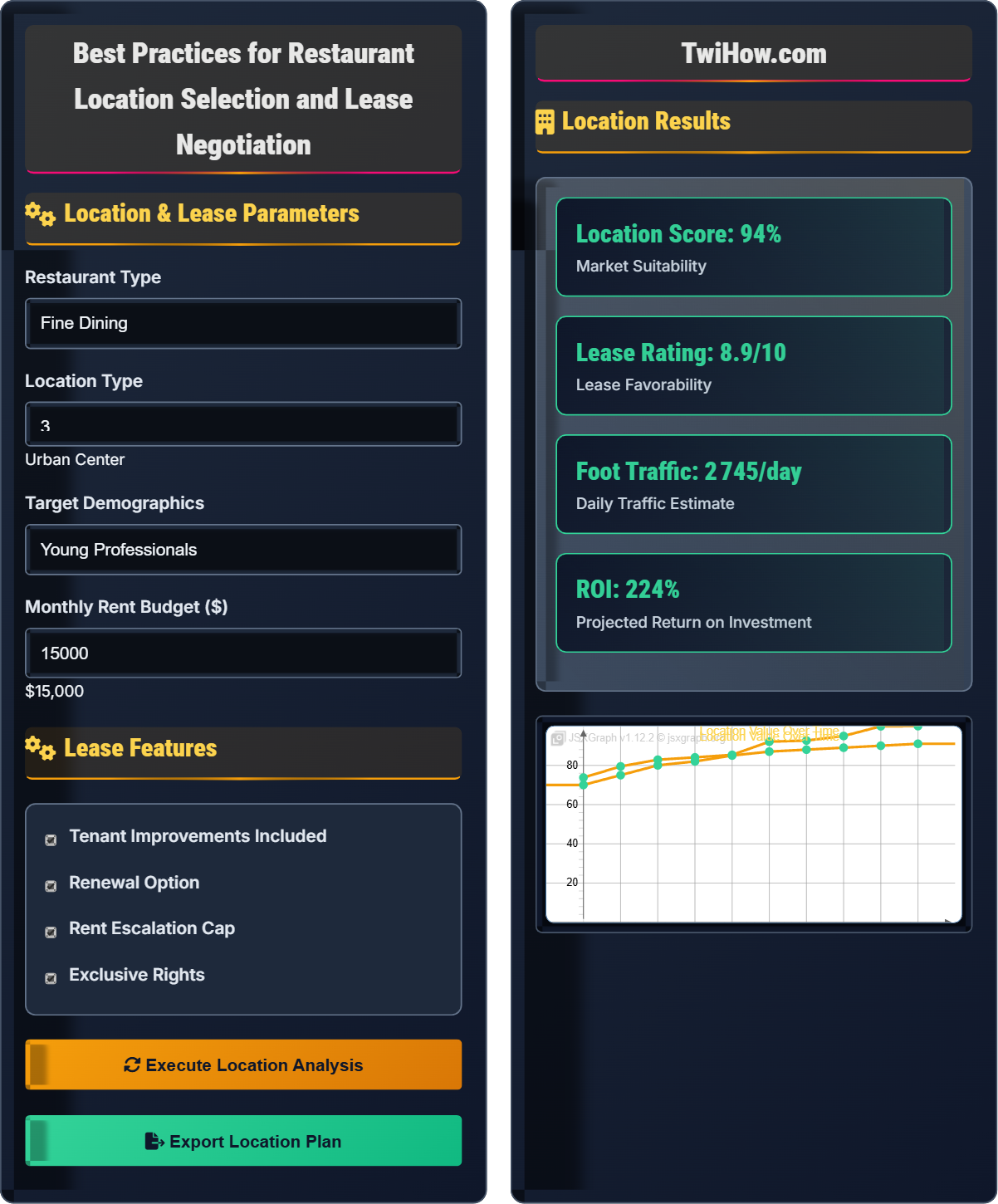
Location Results
| Factor | Score | Importance | Impact |
|---|---|---|---|
| Demographics | 85% | High | Major |
| Traffic | 78% | High | Major |
| Competition | 82% | Medium | Significant |
| Accessibility | 90% | High | Major |
Restaurant Location Selection and Lease Negotiation Explained
Restaurant location selection is the process of identifying and evaluating potential sites that align with the restaurant concept, target market, and business objectives. It involves analyzing demographic data, traffic patterns, competition, accessibility, and local regulations to find a site that maximizes customer reach while minimizing operational challenges.
Location Success = (Market Opportunity × Site Characteristics × Lease Terms) / (Competition + Operating Constraints)
Where:
- Market Opportunity: Potential customer base and spending power
- Site Characteristics: Visibility, accessibility, and physical features
- Lease Terms: Financial and operational flexibility provisions
- Competition: Existing restaurants targeting the same market
Critical factors for restaurant location selection:
- Demographics: Population density, income levels, and lifestyle preferences
- Traffic Patterns: Pedestrian and vehicle flow during peak hours
- Visibility: Signage exposure and storefront visibility
- Accessibility: Parking availability and ease of access
- Competition: Nearby restaurants and complementary businesses
- Regulations: Zoning, permits, and licensing requirements
- Market Research: Understanding local rental rates and market conditions
- Financial Flexibility: Securing favorable rent escalation and rent abatement
- Tenant Improvements: Obtaining landlord contributions to buildout costs
- Renewal Options: Securing rights to extend the lease term
- Exit Clauses: Including termination options if business fails
- Subletting Rights: Ability to transfer the lease if needed
Location Selection Fundamentals
Location selection, lease negotiation, demographics, foot traffic, market analysis, site evaluation, commercial real estate.
Success = (Market Opportunity × Site Characteristics × Lease Terms) / (Competition + Operating Constraints)
Where Market Opportunity = customer base potential, Site Characteristics = physical and location features, Lease Terms = financial and operational flexibility.
- Location is the most critical business decision
- Demographics must match target market
- Lease terms should support business flexibility
- Competition analysis is essential
Lease Negotiation
Rent escalation, tenant improvements, renewal options, exclusivity rights, rent abatement, triple net lease.
- Research market rates
- Prepare financial projections
- Negotiate tenant improvements
- Secure renewal options
- Budget for all lease-related costs
- Understand all financial obligations
- Consider long-term business needs
- Review all lease terms carefully
Restaurant Location & Lease Negotiation Quiz
What is the most important factor when selecting a restaurant location?
Target market alignment is most important because it ensures the location has the right customer base for the restaurant concept. While rent, space size, and proximity to competitors are important, a location that doesn't serve the target demographic will struggle to generate sufficient revenue regardless of other factors.
The answer is B) Target market alignment.
Restaurant location success depends on having the right customers nearby, not just favorable financial terms or convenient features. The target market must be able to access the location and have the income and preferences to support the restaurant concept. All other factors are secondary to this fundamental requirement. A perfect location at the wrong price is better than a wrong location at the right price.
Target Market Alignment: Match between location demographics and restaurant concept
Customer Base: People who will frequent the restaurant
Revenue Generation: Ability to generate sufficient sales to sustain business
• Customer base is paramount
• Demographics must match concept
• Access to target market is essential
• Analyze census data for demographics
• Study traffic patterns during peak hours
• Validate concept with local market
• Focusing only on rent costs
• Not validating market demand
• Ignoring customer accessibility
Explain the key terms to negotiate in a restaurant lease agreement and why each is important for business success.
Rent Structure: Negotiate base rent and percentage rent to ensure affordability during slow periods.
Tenant Improvements: Secure landlord contributions to buildout costs to reduce startup expenses.
Escalation Clauses: Limit rent increases to predictable amounts to maintain financial stability.
Renewal Options: Secure rights to extend lease term to protect long-term investment.
Exclusive Rights: Prevent competitors from opening in the same location to protect market share.
Maintenance Responsibilities: Clarify who pays for repairs and maintenance to avoid unexpected costs.
Each term affects long-term profitability and business flexibility.
Lease negotiation is critical because it establishes the financial and operational framework for the restaurant's entire existence at that location. Poor lease terms can strangle a business regardless of how good the concept or execution. Each term has long-term implications for profitability and operational flexibility. The goal is to secure terms that provide financial predictability while maintaining the ability to adapt to changing business conditions.
Tenant Improvements: Landlord contributions to buildout and renovation costs
Percentage Rent: Additional rent based on gross sales beyond a threshold
Triple Net Lease: Tenant pays rent plus taxes, insurance, and maintenance
• Every term has financial impact
• Negotiate before signing
• Understand all obligations
• Research comparable rents in area
• Negotiate tenant improvement allowances
• Include rent escalation caps
• Not understanding triple net leases
• Accepting unlimited rent escalation
• Not negotiating tenant improvements
You're opening a fast-casual salad bar targeting young professionals. You've found two locations: Location A is in a busy downtown area with high foot traffic but expensive rent ($30/sq ft). Location B is in a suburban office park with moderate traffic but lower rent ($18/sq ft). The downtown location has excellent visibility but limited parking. The office park has ample parking but less foot traffic. Which location is better and why?
Location A (Downtown): Advantages include high foot traffic, visibility, and proximity to target market. Disadvantages include high rent and limited parking.
Location B (Office Park): Advantages include lower rent and ample parking. Disadvantages include lower foot traffic and less visibility.
Analysis: For a fast-casual salad bar targeting young professionals, Location A is likely better because the target demographic (young professionals) is more likely to frequent downtown areas during lunch hours. The high traffic compensates for parking limitations, and the visibility helps with brand awareness. The higher rent can be justified by higher sales volume.
Location selection requires balancing multiple factors rather than optimizing for a single variable. For a fast-casual concept targeting young professionals, foot traffic during lunch hours is more important than parking availability. The downtown location aligns better with the target demographic's lifestyle and work patterns. The key is evaluating how each factor contributes to the specific business model and target market behavior.
Target Demographic: Specific group of customers the restaurant serves
Foot Traffic: Number of pedestrians passing by the location
Peak Hours: Times when customer traffic is highest
• Match location to target market
• Consider peak traffic times
• Evaluate trade-offs systematically
• Observe traffic patterns at different times
• Survey potential customers
• Analyze competitor locations
• Focusing only on rent costs
• Not considering target market behavior
• Ignoring peak traffic patterns
Your restaurant lease includes a triple net (NNN) arrangement where you pay rent plus property taxes, insurance, and maintenance. The base rent is $20/sq ft for 2,500 sq ft, annual property taxes are $15,000, insurance is $8,000, and maintenance is estimated at $10,000 annually. Calculate your total monthly costs and explain why this matters for cash flow planning.
Base Rent: $20 × 2,500 = $50,000 annually = $4,167 monthly
Additional Costs: Property taxes ($15,000) + Insurance ($8,000) + Maintenance ($10,000) = $33,000 annually = $2,750 monthly
Total Monthly Cost: $4,167 + $2,750 = $6,917 monthly
Importance: Triple net leases can significantly increase actual costs beyond base rent. In this case, the additional costs represent 66% of the base rent. This matters for cash flow planning because the total obligation is much higher than the base rent suggests, and these additional costs can fluctuate annually.
Triple net leases shift many property expenses to the tenant, making the actual cost much higher than the quoted rent. This is crucial for cash flow planning because the additional costs are ongoing and can increase over time. Many new restaurant owners underestimate their total occupancy costs because they focus only on base rent. Understanding all lease obligations is essential for accurate financial projections and avoiding cash flow problems.
Triple Net Lease (NNN): Tenant pays rent plus taxes, insurance, and maintenance
Cash Flow Planning: Forecasting income and expenses to ensure liquidity
Occupancy Costs: Total costs associated with occupying a space
• Calculate total occupancy costs
• Consider annual cost fluctuations
• Plan for variable expenses
• Request historical cost data
• Budget for cost increases
• Compare total costs, not just rent
• Not understanding NNN implications
• Focusing only on base rent
• Not budgeting for variable costs
When analyzing competition for restaurant location selection, what is the most important factor to consider?
Market saturation and demand is most important because it determines whether there are enough customers to support all the restaurants in the area. Simply counting competitors doesn't reveal if the market can sustain them. The key is understanding if the customer base is large enough to support both existing and new restaurants, and whether there's room for a different concept.
The answer is B) Market saturation and demand.
Competition analysis must focus on market dynamics rather than just competitor count. A location with many successful restaurants may indicate strong demand, while a location with few competitors might suggest weak demand. The key is understanding whether the market is saturated (too many restaurants for the customer base) or underserved (room for additional restaurants). This requires analyzing both supply (number and types of restaurants) and demand (population, income, dining-out frequency).
Market Saturation: Situation where too many competitors exist for the customer base
Demand Analysis: Evaluation of customer base size and spending power
Supply-Demand Balance: Relationship between available options and customer needs
• Analyze market capacity, not just competitors
• Consider customer demand size
• Evaluate concept differentiation
• Study local dining-out patterns
• Analyze competitor success rates
• Consider concept uniqueness
• Counting competitors without analyzing market
• Not considering customer demand
• Focusing only on direct competition
FAQ
Q: How can I evaluate a restaurant location without spending money on professional site analysis?
A: Conduct a thorough self-evaluation using these methods:
1. Demographics: Use online tools like Census data, Esri, or Walk Score to analyze population density and income levels
2. Traffic Counts: Visit the location during different times and days to observe foot and vehicle traffic
3. Competition Analysis: Visit nearby restaurants to observe busyness and customer types
4. Accessibility: Test parking availability, public transportation access, and ease of entry
5. Visibility: Check sign exposure and storefront visibility from main roads
6. Local Regulations: Contact city planning office for zoning and permit requirements
While professional analysis is ideal, thorough self-research can provide valuable insights.
Q: What's the difference between triple net lease and gross lease?
A: The key differences between lease types:
Gross Lease: Tenant pays fixed monthly rent. Landlord pays property taxes, insurance, and maintenance. More predictable for tenant.
Triple Net Lease (NNN): Tenant pays base rent plus property taxes, insurance, and maintenance. More variable costs for tenant, but typically lower base rent.
The NNN structure shifts operational costs to the tenant, making the total cost much higher than base rent suggests. Gross leases provide more cost predictability but usually have higher base rents.