Restaurant Marketing and Brand Building
Complete hospitality guide • Step-by-step explanations
Marketing & Brand Building:
Show Marketing SimulatorRestaurant marketing and brand building are essential for attracting customers, building loyalty, and establishing a competitive advantage. Effective marketing combines digital and traditional strategies to reach target audiences, while brand building creates a unique identity that resonates with customers.
Successful restaurant marketing involves understanding target demographics, creating compelling messaging, leveraging social media, and building customer relationships. Brand building focuses on consistent visual identity, values, and customer experience that differentiate the restaurant from competitors.
Key marketing considerations:
- Target Audience: Identifying and understanding customer demographics
- Digital Presence: Social media, website, and online reviews
- Customer Experience: Consistent quality across all touchpoints
- Brand Identity: Visual elements and messaging consistency
Successful restaurants integrate marketing and brand building to create a cohesive customer experience that drives awareness, engagement, and loyalty.
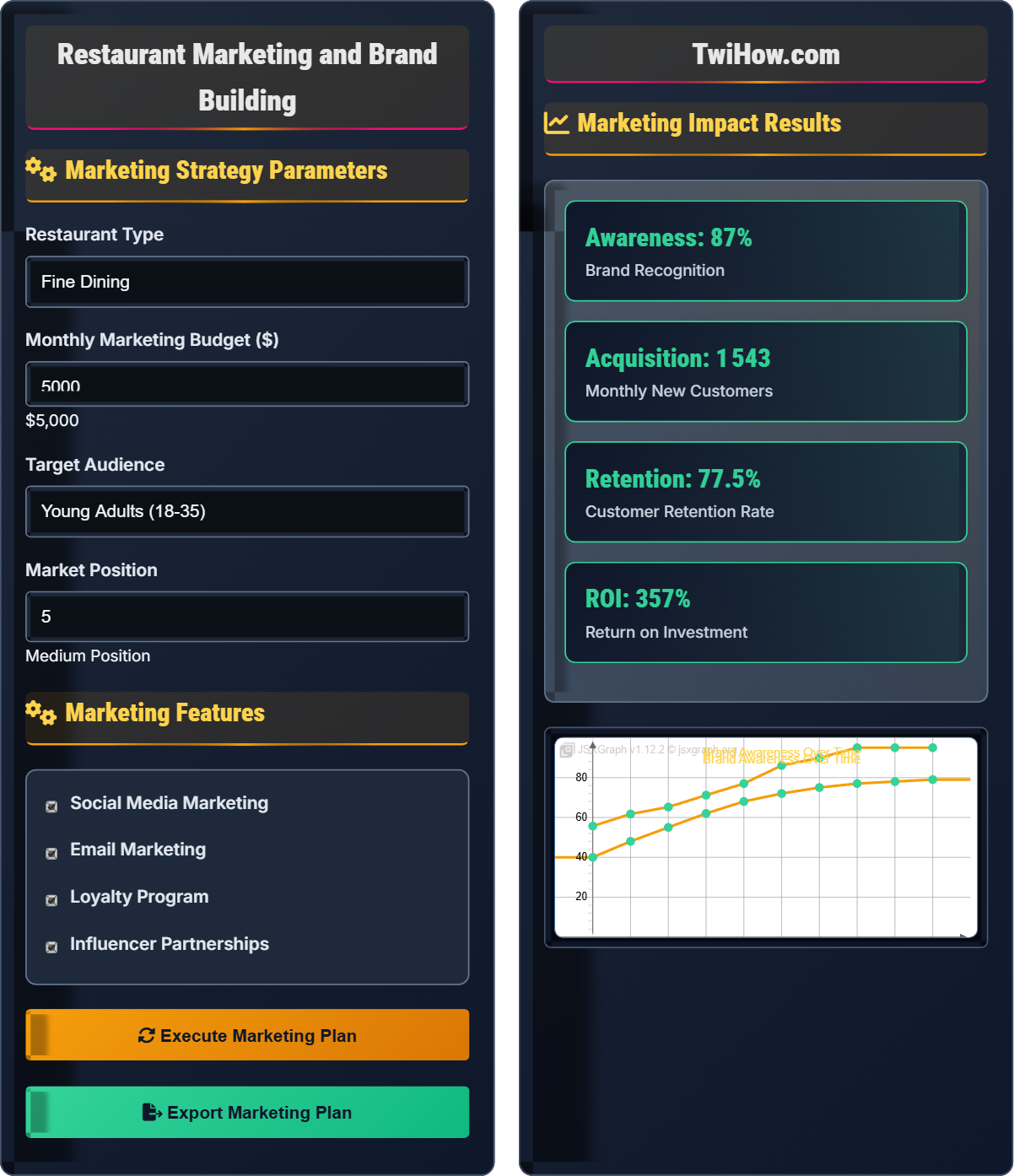
Marketing Strategy Parameters
Marketing Features
Marketing Impact Results
| Channel | Investment | Reach | Effectiveness |
|---|---|---|---|
| Social Media | 40% | High | Excellent |
| 25% | Medium | Good | |
| Events | 20% | Medium | Good |
| 15% | Low | Fair |
Restaurant Marketing and Brand Building Explained
Restaurant marketing encompasses all strategies and tactics used to attract customers, build brand awareness, and drive revenue. It includes digital marketing, traditional advertising, social media engagement, and customer relationship management. Effective marketing creates a connection between the restaurant and its target audience.
Marketing Success = (Brand Awareness + Customer Acquisition + Retention) / (Marketing Cost + Competition)
Where:
- Brand Awareness: Recognition and recall of the restaurant
- Customer Acquisition: New customers attracted through marketing
- Retention: Customers who return and become loyal
- Marketing Cost: Investment in marketing activities
Key marketing channels for restaurants:
- Social Media: Facebook, Instagram, TikTok for visual content
- Search Engine Marketing: Google Ads and SEO for local searches
- Email Marketing: Newsletters and promotional campaigns
- Reviews & Ratings: Managing online reputation
- Local Advertising: Community events and partnerships
- Influencer Marketing: Partnerships with local influencers
- Consistency: Maintaining uniform messaging and visual identity
- Authenticity: Genuine representation of restaurant values
- Memorability: Creating a distinctive brand identity
- Emotional Connection: Building relationships with customers
- Quality: Delivering on brand promises consistently
- Storytelling: Communicating the restaurant's story effectively
Marketing Fundamentals
Restaurant marketing, brand building, customer acquisition, brand awareness, digital marketing, social media, customer retention, market positioning.
Success = (Brand Awareness + Customer Acquisition + Retention) / (Marketing Cost + Competition)
Where Brand Awareness = recognition level, Customer Acquisition = new customers, Retention = returning customers.
- Know your target audience
- Maintain brand consistency
- Focus on customer experience
- Track and measure results
Marketing Channels
Social media, search marketing, email, reviews, local advertising, influencer marketing.
- Identify target audience channels
- Allocate budget effectively
- Track channel performance
- Optimize based on results
- Match channels to audience
- Diversify marketing mix
- Measure ROI per channel
- Stay updated on trends
Restaurant Marketing Quiz
What is the most important element of restaurant brand identity?
Consistent customer experience is the most important element because it represents the actual delivery of brand promises. While visual elements like logos are important, the customer experience encompasses all touchpoints and interactions that define how customers perceive the brand. This includes food quality, service, atmosphere, and staff interactions.
The answer is B) Consistent customer experience.
Brand identity extends far beyond visual elements to encompass the entire customer experience. While logos and visual design are important for recognition, the actual experience of dining at the restaurant creates the lasting impression that defines the brand. Customers remember how they felt, the quality of service, and the overall experience more than they remember the logo design.
Brand Identity: The visible elements that represent a brand
Customer Experience: All interactions customers have with the brand
Brand Promise: What the brand commits to delivering
• Experience delivers on brand promises
• Consistency builds trust
• Every touchpoint matters
• Train staff on brand values
• Maintain quality standards
• Monitor customer feedback
• Focusing only on visual elements
• Inconsistent service quality
• Not delivering on promises
Explain the role of social media in restaurant marketing and why it's particularly effective for food service businesses.
Visual Appeal: Food is inherently photogenic, making it perfect for social media platforms.
Instant Sharing: Customers naturally want to share their dining experiences.
Targeted Reach: Social platforms offer precise demographic targeting.
Direct Engagement: Allows real-time interaction with customers.
Cost-Effective: Relatively low cost compared to traditional advertising.
Review Platform: Customers share feedback and recommendations.
Social media is effective because it combines visual storytelling with community building and direct customer engagement.
Social media is uniquely suited for restaurants because food naturally appeals to visual senses. The act of dining creates shareable moments, and social platforms amplify word-of-mouth recommendations. This organic sharing mechanism, combined with targeted advertising capabilities, makes social media an essential tool for restaurant marketing. The key is creating content that encourages sharing while building brand loyalty.
Social Media Marketing: Promoting business through social platforms
Organic Reach: Content shared without paid promotion
Word-of-Mouth: Recommendations from satisfied customers
• Post visually appealing content
• Engage with followers regularly
• Respond to reviews promptly
• Use high-quality food photography
• Share behind-the-scenes content
• Create user-generated content campaigns
• Inconsistent posting schedule
• Not responding to comments
• Overly promotional content
A restaurant spends $2,000 monthly on marketing and acquires 150 new customers per month. The average customer spends $25 per visit and visits 2 times per month. Calculate the customer acquisition cost and return on marketing investment.
Customer Acquisition Cost: $2,000 ÷ 150 customers = $13.33 per customer
Monthly Revenue per Customer: $25 × 2 visits = $50 per customer
Monthly Revenue from New Customers: 150 × $50 = $7,500
Return on Marketing Investment: ($7,500 - $2,000) ÷ $2,000 × 100 = 275%
Payback Period: $13.33 ÷ $50 = 27% of first month's spending recovers acquisition cost
The marketing investment generates strong returns with significant profit potential from customer lifetime value.
Customer acquisition cost and return on marketing investment are critical metrics for evaluating marketing effectiveness. This calculation shows that the restaurant is acquiring customers at a reasonable cost relative to their spending potential. The key insight is that acquisition cost is recovered quickly, and ongoing customer value provides additional profit. This demonstrates the importance of tracking these metrics to optimize marketing spend.
Customer Acquisition Cost: Cost to acquire each new customer
Return on Investment: Profit generated relative to marketing spend
Payback Period: Time to recover acquisition costs
• Calculate acquisition cost regularly
• Track customer lifetime value
• Compare to industry benchmarks
• Monitor acquisition cost by channel
• Calculate lifetime value
• Optimize high-performing channels
• Not tracking acquisition costs
• Ignoring lifetime value
• Failing to optimize channels
A restaurant wants to implement a loyalty program to increase customer retention. They have 500 regular customers who visit monthly. The program offers a free meal after 10 visits. The average meal costs $25. Calculate the cost of the program and explain how to structure it for maximum effectiveness.
Program Cost per Customer: $25 (free meal every 10 visits)
Annual Program Cost: 500 customers × ($25 ÷ 10) × 12 months = $15,000
Retention Value: If program increases retention by 20%, saving 100 customers × $25 × 12 = $30,000 in acquisition costs
ROI: ($30,000 - $15,000) ÷ $15,000 × 100 = 100%
Program Structure: Digital tracking, personalized rewards, birthday incentives, referral bonuses, and tiered benefits to maximize engagement.
Loyalty programs can be highly effective when structured properly. The math shows that even with the cost of free meals, the program can generate positive returns through increased retention. The key is designing the program to encourage more frequent visits while maintaining profitability. Digital tracking and personalization enhance the program's effectiveness by providing valuable customer data and tailored experiences.
Loyalty Program: System rewarding repeat customers
Customer Retention: Keeping existing customers active
Customer Lifetime Value: Total revenue from customer relationship
• Calculate program costs carefully
• Track retention improvements
• Personalize rewards when possible
• Use digital tracking systems
• Offer surprise rewards
• Create referral incentives
• Not calculating program costs
• Too complex reward structure
• Not tracking effectiveness
For a new restaurant, what is the recommended percentage of revenue to allocate to marketing?
For a new restaurant, 7-10% of revenue is recommended for marketing because building awareness and attracting customers is critical during the launch phase. Established restaurants can often operate with 3-5%, but new businesses need higher investment to gain market presence and build their customer base.
The answer is C) 7-10% of revenue.
Marketing budget allocation varies based on business stage and goals. New restaurants need higher marketing investment to build awareness and attract initial customers. As the business matures and develops a loyal customer base, marketing spend can be optimized. The key is balancing growth investment with profitability, ensuring marketing spend generates sufficient returns to justify the investment.
Marketing Budget: Funds allocated to marketing activities
Revenue Percentage: Marketing spend relative to salesLaunch Phase: Initial period of business operation
• Adjust budget by business stage
• Track return on marketing spend
• Balance growth with profitability
• Start with higher allocation for new businesses
• Reduce as brand recognition grows
• Monitor marketing ROI regularly
• Underinvesting in new businesses
• Not adjusting as business matures
• Failing to measure effectiveness
FAQ
Q: How much should I spend on restaurant marketing as a percentage of revenue?
A: Marketing budget recommendations vary by business stage:
1. New Restaurants: 7-10% of revenue for building awareness
2. Established Restaurants: 3-5% of revenue for maintenance
3. Expanding Businesses: 5-8% of revenue for growth
4. Seasonal Adjustments: Increase during slow periods
Focus on channels that deliver the best ROI for your specific market and customer base.
Q: What's the difference between restaurant marketing and brand building?
A: Key differences between marketing and brand building:
Marketing: Tactical activities to promote the restaurant and drive sales. Includes advertising, promotions, and campaigns.
Brand Building: Strategic process of creating a unique identity and emotional connection with customers.
Marketing drives short-term results, while brand building creates long-term value and customer loyalty. Both work together to create a successful restaurant.