Impact of Delivery Platforms and Ghost Kitchens on Restaurant Strategy
Complete hospitality guide • Step-by-step explanations
Delivery & Ghost Kitchens:
Show Strategy SimulatorDelivery platforms and ghost kitchens have fundamentally transformed the restaurant industry, creating new business models and strategic considerations. These digital-first approaches offer opportunities for expansion without traditional brick-and-mortar investments, but also present unique challenges around brand control, operational efficiency, and profitability.
Delivery platforms like DoorDash, Uber Eats, and Grubhub have created new revenue streams while also introducing commission costs and reduced brand control. Ghost kitchens offer lower overhead but require different operational approaches and marketing strategies.
Key strategic impacts:
- Revenue Diversification: Multiple channels for customer acquisition
- Operational Changes: Kitchen layouts and service models
- Cost Structure: Commission fees and reduced overhead
- Brand Management: Control over customer experience
Successful integration requires careful analysis of market conditions, customer preferences, and operational capabilities to maximize benefits while minimizing risks.
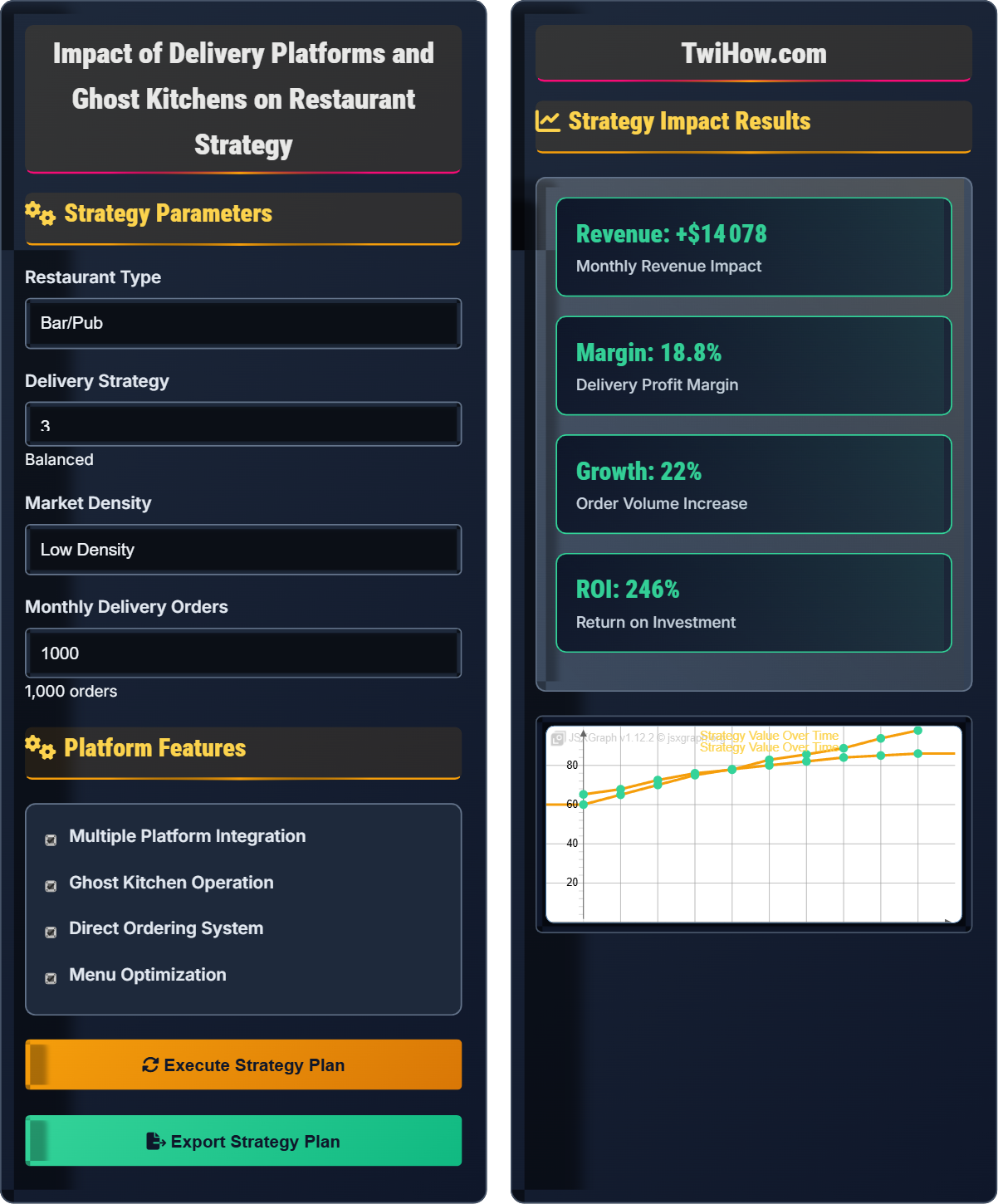
Strategy Parameters
Platform Features
Strategy Impact Results
| Platform | Commission | Reach | Profit |
|---|---|---|---|
| DoorDash | 25% | High | Medium |
| Uber Eats | 22% | High | Medium |
| Grubhub | 20% | Medium | High |
| Direct | 0% | Medium | High |
Delivery Platforms and Ghost Kitchens Strategy Explained
Delivery platforms are digital marketplaces that connect restaurants with customers for off-premise dining. Ghost kitchens are commercial cooking facilities designed exclusively for delivery orders, without dine-in capabilities. Together, they represent a fundamental shift in restaurant business models, focusing on digital-first operations and delivery optimization.
Strategy Success = (Revenue Growth + Operational Efficiency + Market Expansion) / (Commission Costs + Operational Changes)
Where:
- Revenue Growth: Increase in total sales from delivery
- Operational Efficiency: Cost savings from optimized operations
- Market Expansion: Access to new customer segments
- Commission Costs: Fees paid to delivery platforms
Critical factors for delivery platform and ghost kitchen strategies:
- Commission Rates: Platform fees that impact profitability
- Brand Control: Maintaining brand identity and customer relationship
- Operational Capacity: Kitchen ability to handle delivery volume
- Menu Adaptation: Food that travels well and maintains quality
- Technology Integration: POS and order management systems
- Customer Data: Access to customer information and insights
- Menu Optimization: Foods that travel well and maintain quality
- Operational Efficiency: Streamlined kitchen and delivery processes
- Customer Experience: Consistent quality and timely delivery
- Financial Management: Understanding commission impact on margins
- Technology Integration: Seamless order management systems
- Market Positioning: Clear value proposition in competitive market
Delivery Strategy Fundamentals
Delivery platforms, ghost kitchens, restaurant strategy, commission fees, market expansion, operational efficiency, customer acquisition.
Impact = (Revenue Growth + Efficiency Gains) / (Commission Costs + Operational Changes)
Where Revenue Growth = additional sales from delivery, Efficiency Gains = cost savings from optimization, Commission Costs = platform fees.
- Commission rates significantly impact profitability
- Menu must be optimized for delivery
- Operational capacity is crucial
- Brand control is limited on platforms
Ghost Kitchen Benefits
Reduced overhead, market expansion, menu testing, operational flexibility, geographic reach, cost efficiency.
- Reduce real estate costs
- Test new concepts
- Expand geographic reach
- Optimize for delivery efficiency
- Requires different operational approach
- Less customer interaction
- Dependent on platforms
- Must maintain quality without visibility
Delivery Platforms & Ghost Kitchens Quiz
What is the typical commission rate charged by major delivery platforms?
Major delivery platforms typically charge commissions between 15-30% of the order total, which can significantly impact restaurant profitability. This includes both commission fees and additional service fees that platforms may charge. These high commission rates are one of the biggest challenges restaurants face when partnering with delivery platforms.
The answer is C) 15-30%.
Commission rates are critical to understand because they directly impact the profitability of delivery orders. A 25% commission means that for every $100 in delivery sales, $25 goes to the platform, leaving only $75 for the restaurant to cover food costs, labor, packaging, and profit. This significantly changes the economics of the business and requires careful menu pricing and cost management to maintain profitability.
Commission Rate: Percentage of order value paid to delivery platform
Profitability: Revenue remaining after all costs are covered
Service Fees: Additional charges beyond commission
• Commission rates significantly impact margins
• Understand all fees, not just base commission
• Negotiate commission rates
• Monitor profitability by platform
• Consider direct ordering to reduce fees
• Not factoring in all platform fees
• Maintaining same pricing as dine-in
• Not tracking delivery profitability
Explain why menu optimization is crucial for delivery success and what changes restaurants typically need to make.
Food Stability: Dishes must maintain quality during transport and time delays.
Packaging: Foods should be designed to travel well in containers without spilling or losing texture.
Temperature Retention: Items should stay hot/cold during delivery timeframes.
Assembly: Some foods require final assembly upon delivery to maintain quality.
Profitability: Menu items must maintain margins despite delivery costs.
Efficiency: Preparation should be streamlined for high-volume delivery.
Successful delivery menus often exclude items that don't travel well and emphasize profitable, stable options.
Menu optimization is critical because the delivery experience is fundamentally different from dine-in. Foods that taste great in the restaurant may arrive soggy, cold, or separated after transport. Restaurants must consider how their dishes will look, taste, and feel when delivered. This often means reformulating recipes, changing preparation methods, or creating entirely new menu items designed specifically for delivery.
Menu Optimization: Adapting menu for delivery requirements
Food Stability: Maintaining quality during transport
Delivery Timeframe: Period between preparation and delivery
• Test dishes under delivery conditions
• Create delivery-specific menu items
• Use proper packaging materials
• Train staff on delivery preparation
• Using same menu for delivery as dine-in
• Not testing delivery quality
• Poor packaging choices
A restaurant is considering opening a ghost kitchen to expand delivery operations. Their current restaurant has $50,000/month in rent and $30,000/month in other fixed costs. A ghost kitchen would cost $15,000/month in rent but no additional staff. The ghost kitchen could generate $40,000/month in additional delivery revenue with 60% food costs. Calculate the financial impact and determine if this makes sense.
Current Fixed Costs: $50,000 (rent) + $30,000 (other) = $80,000
Ghost Kitchen Fixed Costs: $15,000 (rent only)
Additional Revenue: $40,000
Additional Food Costs: $40,000 × 60% = $24,000
Net Financial Impact: $40,000 (revenue) - $24,000 (food) - $15,000 (rent) = $1,000 monthly profit
Break-even Analysis: $15,000 ÷ (1 - 0.60) = $37,500 monthly revenue needed
The ghost kitchen makes financial sense as it generates $1,000 monthly profit and has a reasonable break-even point.
Ghost kitchen economics depend on the difference between traditional restaurant overhead and delivery-focused operations. The key is ensuring that the reduced overhead (no dining room, less staff) offsets the lack of dine-in revenue. In this example, the ghost kitchen generates positive cash flow despite significantly lower revenue than a full restaurant, demonstrating the efficiency of the model for delivery-focused operations.
Ghost Kitchen: Commercial kitchen for delivery-only orders
Fixed Costs: Expenses that don't vary with sales volume
Break-even Analysis: Revenue needed to cover all costs
• Calculate all costs including hidden ones
• Consider market demand for delivery
• Factor in operational complexity
• Start with existing menu items
• Monitor food quality remotely
• Test market demand before full investment
• Underestimating operational complexity
• Not considering quality control
• Overestimating market demand
A restaurant wants to decide between using one major delivery platform with 25% commission or multiple platforms with an average of 20% commission. The single platform offers 10,000 orders per month, while multiple platforms together offer 15,000 orders per month. The average order value is $30. Which strategy is more profitable?
Single Platform Revenue: 10,000 orders × $30 = $300,000
Single Platform Commission: $300,000 × 25% = $75,000
Single Platform Net: $300,000 - $75,000 = $225,000
Multiple Platforms Revenue: 15,000 orders × $30 = $450,000
Multiple Platforms Commission: $450,000 × 20% = $90,000
Multiple Platforms Net: $450,000 - $90,000 = $360,000
The multiple platform strategy generates $135,000 more in net revenue despite higher commission costs.
This example illustrates the trade-off between commission rates and volume. While the single platform has a higher commission rate, the multiple platform approach generates significantly more volume, resulting in higher net revenue. The key insight is that sometimes accepting lower margins per order can be more profitable than higher margins on fewer orders. However, this also increases operational complexity and management requirements.
Commission Rate: Percentage paid to delivery platform
Order Volume: Number of orders processed
Net Revenue: Revenue after commission fees
• Consider volume vs. margin trade-offs
• Calculate net revenue, not gross
• Factor in operational complexity
• Monitor performance by platform
• Negotiate commission rates based on volume
• Consider direct ordering to reduce fees
• Focusing only on commission rates
• Not considering total revenue impact
• Ignoring operational complexity
What is the biggest challenge regarding brand control when using delivery platforms?
All of these represent significant challenges to brand control on delivery platforms. Restaurants have limited ability to control pricing due to platform algorithms, minimal direct customer interaction reduces relationship building, and food quality can be compromised during transport and by delivery drivers. These factors combined make it difficult to maintain consistent brand experience.
The answer is D) All of the above.
Brand control is one of the most significant challenges with delivery platforms because restaurants must cede control over multiple aspects of the customer experience. The platform controls the interface, the delivery person represents the brand during a critical interaction, and the customer's experience is shaped by factors outside the restaurant's direct control. This creates a complex relationship where the restaurant's reputation can be affected by elements it cannot directly manage.
Brand Control: Ability to manage customer experience
Customer Experience: Total interaction with the brand
Platform Mediation: Third-party involvement in customer relationship
• Delivery affects brand perception
• Quality control is more complex
• Customer relationships are mediated
• Invest in quality packaging
• Maintain clear brand messaging
• Monitor customer feedback closely
• Not monitoring platform performance
• Poor packaging choices
• Not managing online reputation
FAQ
Q: Should I invest in my own delivery service or use third-party platforms?
A: The decision depends on several factors:
1. Order Volume: Need 1,000+ monthly orders to justify own fleet
2. Geographic Density: High-density areas favor own service
3. Profit Margins: Higher margins support delivery investment
4. Brand Control: Own service offers complete control
5. Capital Availability: Significant investment required
Many restaurants use a hybrid approach: third-party for reach, own service for high-margin areas.
Q: What's the difference between a ghost kitchen and a commissary kitchen?
A: Key differences between kitchen types:
Ghost Kitchen: Designed specifically for delivery orders, often with multiple virtual brands, focused on efficiency and volume.
Commissary Kitchen: Shared commercial kitchen space for multiple operators, often used for catering, food trucks, or small businesses.
Ghost kitchens are optimized for delivery operations with specific equipment and layouts, while commissary kitchens are more general-purpose shared spaces.