What is the Role of Culinary Innovation and Trend Adoption in Restaurant Success?
Complete culinary innovation guide • Step-by-step strategies
Culinary Innovation Fundamentals:
Show Innovation SimulatorCulinary innovation is the process of introducing new ideas, techniques, ingredients, and presentations to create unique dining experiences. It encompasses everything from novel cooking methods to creative menu concepts, fusion cuisines, and technological integration in food preparation.
Trend adoption involves identifying, evaluating, and implementing popular food movements that align with your restaurant's concept and target market. Successful trend adoption requires balancing innovation with consistency to maintain your brand identity while staying relevant.
Key innovation elements:
- New Techniques: Modern cooking methods and equipment
- Ingredient Innovation: Unique or locally-sourced ingredients
- Menu Creativity: Creative presentations and flavor combinations
- Technology Integration: Smart kitchen equipment and ordering systems
Culinary innovation drives restaurant success by differentiating your offerings, attracting new customers, increasing average ticket prices, and building brand loyalty. It helps restaurants stay competitive in a rapidly evolving market.
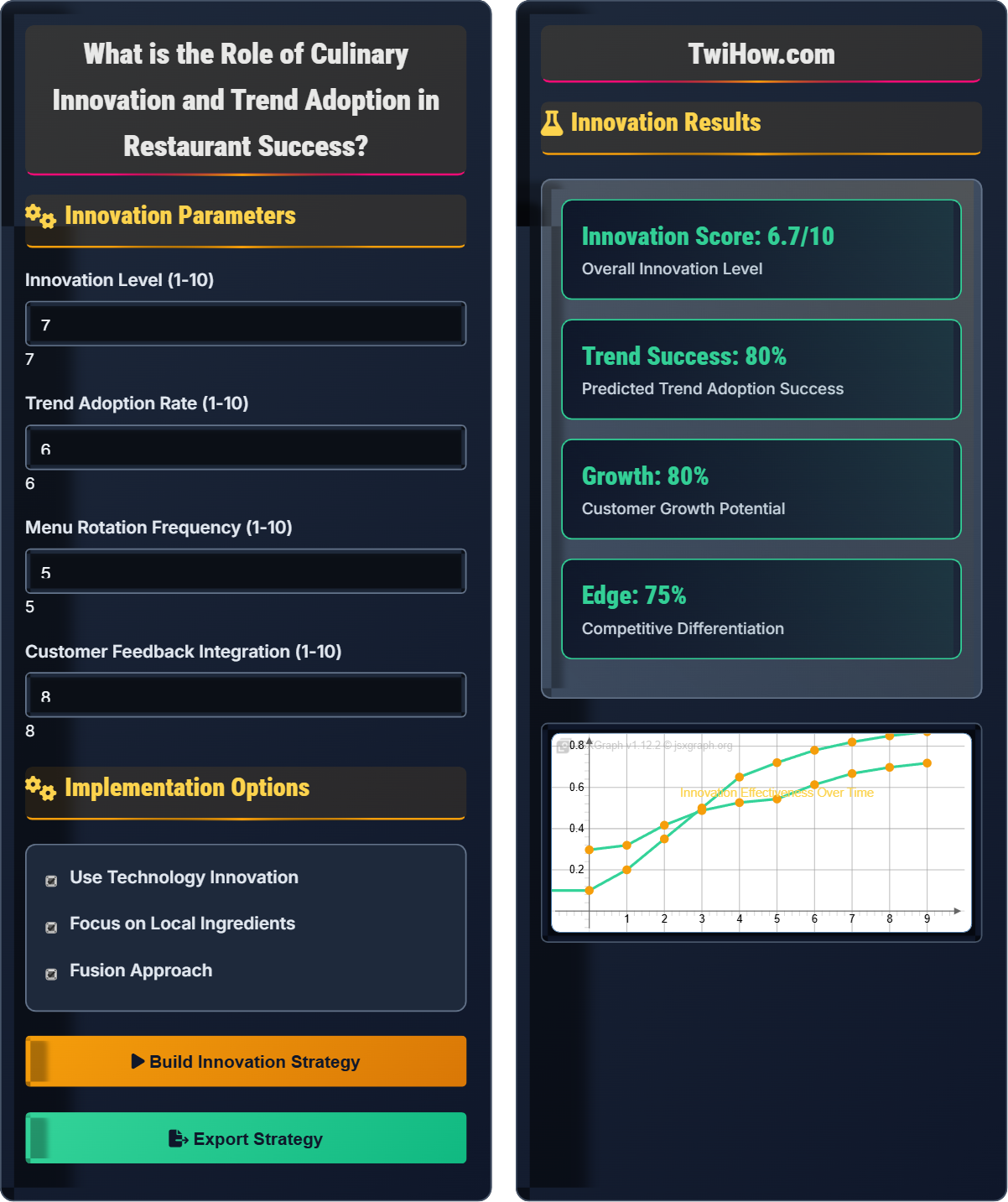
Innovation Parameters
Implementation Options
Innovation Results
| Element | Score | Impact | Recommendation |
|---|---|---|---|
| Technique | 7/10 | High | Invest in new equipment |
| Ingredients | 6/10 | Medium | Source locally unique items |
| Presentation | 8/10 | High | Enhance visual appeal |
| Menu | 5/10 | Medium | Rotate seasonal items |
How Culinary Innovation Works
Culinary innovation is the creative process of introducing new ideas, techniques, ingredients, and presentations to enhance the dining experience. It encompasses everything from novel cooking methods to creative menu concepts, fusion cuisines, and technological integration in food preparation. Culinary innovation helps restaurants differentiate themselves, attract new customers, and increase profitability.
Successful culinary innovation follows a structured approach that balances creativity with practicality:
Where:
- Creativity: Novel ideas and approaches to food
- Market Relevance: Alignment with customer preferences and trends
- Operational Feasibility: Practical implementation in your kitchen
- Customer Acceptance: Willingness of customers to try and pay for innovations
Key areas where culinary innovation impacts your restaurant:
- Menu Development: New dishes and flavor combinations
- Cooking Techniques: Modern methods and equipment
- Ingredient Sourcing: Unique and local ingredients
- Service Style: Interactive dining experiences
- Technology: Kitchen automation and ordering systems
- Experience Design: Immersive dining concepts
- Product Innovation: New dishes, ingredients, or beverages
- Process Innovation: Improved cooking methods or kitchen workflows
- Positioning Innovation: New market segments or concepts
- Paradigm Innovation: Fundamental shifts in dining experience
- Platform Innovation: New service models or technologies
- Incremental Innovation: Small improvements to existing offerings
Innovation Fundamentals
Creativity, market relevance, operational feasibility, customer acceptance, trend identification, menu development.
Innovation Success = Creativity + Market Relevance + Operational Feasibility + Customer Acceptance
Where Innovation Success = competitive advantage, Creativity = novel ideas, Market Relevance = customer alignment.
- Innovation must balance creativity with feasibility
- Customer feedback drives successful adoption
- Trends should align with brand identity
Applications
Menu engineering, cooking technique development, ingredient sourcing, service innovation, technology integration, customer experience enhancement.
- Research current food trends
- Test innovations with focus groups
- Implement gradually to minimize risk
- Monitor customer response closely
- Cost implications of innovation
- Kitchen staff training needs
- Supply chain adjustments
- Customer education requirements
Culinary Innovation Quiz
Which of the following is NOT a critical element of successful culinary innovation?
Successful culinary innovation requires creativity, market relevance, and operational feasibility. While complexity can sometimes be part of innovation, maximum complexity is not a goal—it often reduces feasibility and customer acceptance. Good innovation balances creativity with practical implementation.
The answer is D) Maximum Complexity.
Culinary innovation is not about creating the most complex dishes possible. Instead, it's about finding the right balance between creative expression and practical execution. The most successful innovations are those that push boundaries while remaining executable in a commercial kitchen and appealing to customers. Complexity should serve a purpose, not be an end in itself.
Creativity: Novel ideas and approaches to food preparation
Market Relevance: Alignment with customer preferences and trends
Operational Feasibility: Practical implementation in commercial kitchens
• Innovation must be executable
• Customer acceptance is crucial
• Start with simple innovations
• Test concepts before full rollout
• Consider kitchen workflow
• Overcomplicating dishes unnecessarily
• Ignoring operational constraints
• Not considering customer preferences
Explain how to evaluate and adopt food trends in a way that maintains your restaurant's identity while staying relevant. Provide specific steps for assessing trend viability and implementing successful adoptions.
Evaluation Process: Assess trends by considering alignment with your brand identity, target market, kitchen capabilities, and profit margins.
Implementation Steps:
• Research: Analyze trend sustainability and popularity trajectory
• Prototype: Create small-batch versions for testing
• Test: Offer as limited-time specials to gauge response
• Evaluate: Monitor sales, customer feedback, and operational impact
• Adapt: Modify to fit your brand identity and capabilities
• Integrate: Add successful trends to permanent offerings
Balance: Maintain your core identity while selectively adopting compatible trends.
Successful trend adoption requires strategic thinking rather than blind following. The key is to identify trends that complement your existing concept rather than compete with it. This approach allows you to stay current without losing the authentic elements that attracted your original customer base. The goal is evolution, not revolution.
Trend Evaluation: Assessment of market potential and compatibility
Brand Identity: Core values and characteristics that define your restaurant
Strategic Adoption: Selective implementation of compatible trends
• Align trends with brand identity
• Test before committing resources
• Maintain core concept integrity
• Monitor social media trends
• Attend industry events
• Survey your customers
• Following every trend blindly
• Ignoring brand alignment
• Not testing before full implementation
You manage a traditional Italian restaurant that has seen declining sales as customers seek newer, trendier options. You want to innovate while preserving your authentic Italian identity. Describe a comprehensive innovation strategy that incorporates modern trends while maintaining your traditional appeal, including specific techniques for menu development, kitchen operations, and customer communication.
Preservation Strategy: Maintain core traditional recipes and techniques that define your authenticity.
Innovation Approach: Introduce modern presentation styles, seasonal menu additions, and locally-sourced ingredient variations.
Menu Development: Add 2-3 innovative dishes per season while keeping signature classics unchanged.
Kitchen Operations: Train staff on both traditional methods and new techniques, invest in equipment for modern presentation.
Customer Communication: Explain the story behind innovations, emphasize quality ingredients and traditional preparation methods.
Strategy: Position innovations as respectful evolution rather than replacement of tradition.
Traditional restaurants face the unique challenge of modernizing without losing their authentic appeal. The key is to enhance, not replace, traditional elements. Innovation should complement the established identity rather than compete with it. This approach allows you to attract new customers while retaining loyal traditional patrons.
Authenticity: Genuine representation of traditional cuisine
Respectful Evolution: Improvement that honors original traditions
Complementary Innovation: Changes that enhance rather than replace
• Preserve core identity
• Enhance rather than replace
• Communicate the reasoning
• Introduce changes gradually
• Honor traditional roots
• Educate customers about changes
• Abandoning traditional elements completely
• Not explaining the changes
• Moving too quickly from tradition
A restaurant owner wants to implement culinary innovation but is concerned about maintaining consistency in food quality and customer expectations. Explain how to balance innovation with consistency, and provide three specific techniques that allow for creative experimentation while ensuring reliable execution and customer satisfaction.
Balancing Approach: Maintain consistency in core elements while innovating in peripheral areas. Keep signature dishes and foundational techniques consistent while experimenting with seasonal items and presentation.
Techniques:
1. Foundation Method: Standardize core recipes and techniques, innovate in finishing and presentation
2. Rotation System: Introduce innovations as rotating seasonal items alongside consistent staples
3. Quality Control Protocol: Implement rigorous testing and standardization for new innovations
Always ensure that innovations enhance rather than compromise the reliable elements that customers expect and appreciate.
The tension between innovation and consistency is a fundamental challenge in restaurant management. Customers visit restaurants partly for the reliability of knowing what to expect, while also seeking new experiences. The solution lies in creating zones of stability and zones of innovation within your operation. Core offerings remain consistent while peripheral elements can evolve.
Operational Consistency: Reliable execution of established processes
Controlled Innovation: Creative experimentation within defined parameters
Quality Standards: Measurable benchmarks for food and service quality
• Maintain core consistency
• Standardize innovative processes
• Train thoroughly on new items
• Document all new processes
• Test extensively before launch
• Gradual introduction of changes
• Changing too many things at once
• Not standardizing new processes
• Insufficient staff training
Which of the following best represents the primary benefit of successful culinary innovation?
The primary benefit of successful culinary innovation is competitive differentiation. Innovation allows restaurants to stand out in a crowded market, attract attention, command premium pricing, and build brand loyalty. While innovation may increase costs and complexity, the resulting differentiation and customer appeal typically lead to increased revenue and market position.
The answer is B) Competitive differentiation.
Competitive differentiation is the cornerstone of sustainable restaurant success in a saturated market. With numerous dining options available, restaurants must offer something unique to capture customer attention and loyalty. Innovation provides that unique value proposition that distinguishes your restaurant from competitors and justifies customer choice.
Competitive Differentiation: Unique value that sets you apart from competitors
Market Position: Your standing relative to competing restaurants
Unique Value Proposition: Distinctive benefit offered to customers
• Differentiation drives customer choice
• Innovation creates competitive advantage
• Uniqueness justifies premium pricing
• Focus on what makes you unique
• Communicate your differences
• Consistently deliver on promises
• Not communicating innovations clearly
• Failing to deliver on promises
• Copying competitors instead of innovating
FAQ
Q: How can I tell if a food trend is worth investing in for my restaurant?
A: Evaluate food trends using these criteria:
1. Alignment: Does it fit your brand identity and customer base?
2. Sustainability: Is it a fad or a lasting shift in preferences?
3. Feasibility: Can you execute it with your current kitchen setup?
4. Profitability: Will it improve your margins or justify premium pricing?
5. Scalability: Can you consistently deliver it to all customers?
Test promising trends as limited-time offers before full implementation to gauge actual customer response.
Q: What's the difference between culinary innovation and simply copying other restaurants?
A: Culinary innovation and copying differ significantly in approach and outcome:
Culinary Innovation: Involves creative adaptation, personal interpretation, and unique execution that reflects your restaurant's identity. It adds your own twist and value to concepts.
Copying: Direct replication of another restaurant's exact offering without modification or personalization. This rarely succeeds and often damages reputation.
True innovation takes inspiration from trends but transforms them to match your concept, skills, and customer preferences, creating something that reflects your unique perspective.