Role of Technology in Streamlining Restaurant Operations
Complete hospitality guide • Step-by-step explanations
Restaurant Technology:
Show Technology SimulatorTechnology plays a crucial role in modern restaurant operations by automating processes, improving efficiency, and enhancing customer experience. From point-of-sale systems to kitchen display systems, technology streamlines every aspect of restaurant operations.
Key technology areas include POS systems, inventory management, kitchen automation, customer relationship management, and data analytics. These systems work together to reduce manual tasks, minimize errors, and provide valuable insights for decision-making.
Technology benefits:
- Operational Efficiency: Automating repetitive tasks and processes
- Accuracy: Reducing human errors in orders and payments
- Data Insights: Providing analytics for better decision-making
- Customer Experience: Enhancing service speed and personalization
Successful implementation requires selecting appropriate technology solutions that integrate well and provide measurable improvements to operations.
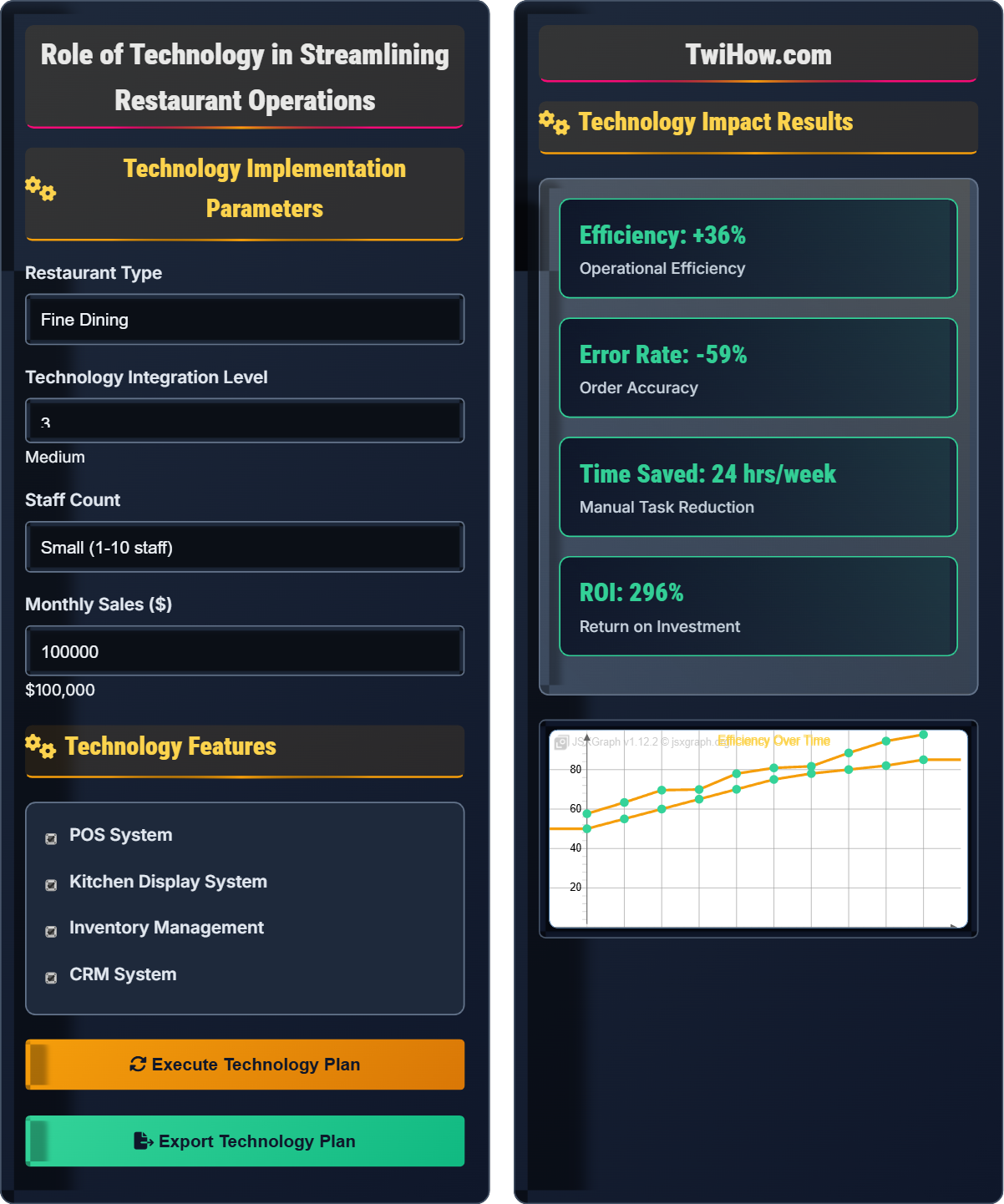
Technology Implementation Parameters
Technology Features
Technology Impact Results
| System | Integration | Impact | Priority |
|---|---|---|---|
| POS System | High | Major | High |
| Kitchen Display | High | Major | High |
| Inventory Mgmt | Medium | Significant | Medium |
| CRM System | Medium | Significant | Medium |
Technology in Restaurant Operations Explained
Restaurant technology encompasses all digital tools and systems used to streamline operations, improve efficiency, and enhance customer experience. This includes point-of-sale systems, kitchen display systems, inventory management software, customer relationship management platforms, and data analytics tools.
Technology Impact = (Efficiency Gains + Accuracy Improvements + Cost Savings) / (Implementation Cost + Training Time)
Where:
- Efficiency Gains: Time saved through automation
- Accuracy Improvements: Reduction in errors
- Cost Savings: Reduced labor and waste costs
- Implementation Cost: Initial investment and ongoing expenses
Critical technology areas for restaurant operations:
- Point-of-Sale (POS) Systems: Order taking, payment processing, and sales tracking
- Kitchen Display Systems: Digital order management and timing
- Inventory Management: Automated tracking and ordering
- Customer Relationship Management: Loyalty programs and marketing
- Reporting & Analytics: Business intelligence and insights
- Reservation Systems: Table management and guest services
- System Integration: Ensuring all technology solutions work together
- User-Friendly Design: Simple interfaces that staff can learn quickly
- Reliability: Systems that work consistently without downtime
- Scalability: Solutions that grow with the business
- Data Security: Protection of customer and business data
- Measurable ROI: Clear benefits that justify the investment
Technology Fundamentals
POS systems, kitchen automation, inventory management, CRM, data analytics, operational efficiency, system integration.
Impact = (Efficiency Gains + Accuracy Improvements + Cost Savings) / (Implementation Cost + Training Time)
Where Efficiency Gains = time saved through automation, Accuracy Improvements = error reduction, Cost Savings = reduced labor costs.
- Technology should enhance, not complicate operations
- Integration is crucial for success
- Staff training is essential
- ROI must be measurable
Technology Benefits
Operational efficiency, order accuracy, cost reduction, customer experience, data insights, competitive advantage.
- Process automation
- Real-time data access
- Error reduction
- Customer insights
- Balance technology with human touch
- Ensure system reliability
- Protect customer data
- Plan for ongoing maintenance
Restaurant Technology Quiz
What is the primary benefit of implementing a modern POS system in a restaurant?
Modern POS systems primarily improve order accuracy and speed by eliminating manual order entry errors and streamlining the ordering process. They connect directly to kitchen display systems, reducing miscommunication and order delays.
The answer is B) Improving order accuracy and speed.
POS systems serve as the central hub of restaurant operations, connecting front-of-house to back-of-house. Their primary value lies in reducing human error in order taking and transmission, while speeding up the entire process. This creates a cascade effect of benefits including improved customer satisfaction, reduced waste from incorrect orders, and better staff efficiency.
POS System: Point of Sale system for processing transactions
Order Accuracy: Correctness of customer orders
Front-of-House: Customer-facing areas (dining room)
• Accuracy reduces waste and rework
• Speed improves customer satisfaction
• Integration connects all systems
• Choose systems with kitchen integration
• Train staff thoroughly on new systems
• Monitor order accuracy metrics
• Underestimating training requirements
• Not integrating with kitchen systems
• Focusing only on payment features
Explain how kitchen display systems improve restaurant operations and what benefits they provide compared to traditional paper ticket systems.
Order Management: Digital displays organize orders by station and priority, eliminating lost tickets.
Timing Information: Shows how long orders have been in queue, helping prioritize rush orders.
Customization Tracking: Displays special instructions clearly, reducing errors.
Efficiency Tracking: Provides data on prep times and kitchen performance.
Space Management: Reduces physical clutter compared to paper tickets.
Communication: Enables real-time updates between front and back of house.
Benefits include reduced errors, improved speed, better organization, and valuable operational insights.
Kitchen display systems transform the chaotic environment of a traditional kitchen by bringing digital order management to the preparation area. Unlike paper tickets that can be lost, damaged, or misread, digital displays provide clear, organized information that updates in real-time. This technology directly addresses common kitchen inefficiencies such as order confusion, lost tickets, and poor communication between servers and cooks.
Kitchen Display System: Digital screens showing order information in kitchen
Order Station: Specific prep area for different menu categories
Real-Time Updates: Immediate information changes as orders progress
• Clear information reduces errors
• Organization improves efficiency
• Communication enhances coordination
• Position displays at each prep station
• Train kitchen staff on system use
• Monitor prep time metrics
• Not training kitchen staff properly
• Poor display placement
• Not utilizing performance data
A restaurant with $50,000 in monthly sales implements an inventory management system that reduces food waste by 20% and saves 15 hours per week in manual inventory counting. The system costs $2,000 annually. If food costs are 32% of sales and hourly wages are $15, calculate the annual benefit and ROI.
Food Waste Savings: $50,000/month × 12 months × 0.32 (food cost %) × 0.20 (waste reduction) = $38,400 annually
Labor Savings: 15 hours/week × 52 weeks × $15/hour = $11,700 annually
Total Annual Benefit: $38,400 + $11,700 = $50,100
Annual Cost: $2,000
Net Annual Benefit: $50,100 - $2,000 = $48,100
ROI: ($48,100 ÷ $2,000) × 100 = 2,405%
The system provides substantial returns through waste reduction and labor savings.
Inventory management systems provide multiple benefits that compound to create significant value. The primary benefit is waste reduction, which directly impacts the largest controllable expense (food costs). Secondary benefits include labor savings from reduced manual tasks. The calculation shows how small percentage improvements in large cost categories can yield substantial returns on technology investments.
Food Waste Reduction: Decreasing unused or spoiled inventory
ROI: Return on Investment calculation
Operational Efficiency: Improved resource utilization
• Calculate all potential benefits
• Include indirect savings
• Compare to ongoing costs
• Track waste before implementation
• Monitor labor time changes
• Calculate comprehensive ROI
• Only calculating direct savings
• Not tracking baseline metrics
• Underestimating labor savings
A restaurant with 2,000 regular customers implements a CRM system that increases customer retention by 15% and average spending per visit by 12%. If the average customer spends $25 per visit and visits twice per month, calculate the annual revenue increase from the CRM system.
Current Annual Spending per Customer: $25 × 2 visits/month × 12 months = $600
With CRM Increase: $600 × 1.12 (spending increase) = $672
Retention Benefit: 2,000 customers × 0.15 (retention) × $672 = $201,600
Spending Increase Benefit: 2,000 customers × ($672 - $600) = $144,000
Total Annual Increase: $201,600 + $144,000 = $345,600
The CRM system provides significant revenue increases through both retention and spending improvements.
CRM systems create value through multiple pathways: increased customer retention prevents revenue loss, while increased spending per visit directly boosts sales. The compounding effect of both improvements creates substantial revenue growth. This example shows how technology investments can create exponential returns by improving customer relationships and encouraging repeat business.
CRM: Customer Relationship Management system
Customer Retention: Keeping existing customers active
Customer Lifetime Value: Total revenue from customer relationship• Retention is more valuable than acquisition
• Small spending increases compound
• Track customer behavior changes
• Personalize customer communications
• Track customer preferences
• Implement loyalty programs
• Not utilizing customer data effectively
• Generic marketing messages
• Not tracking retention metrics
Which factor is most important when evaluating the ROI of restaurant technology investments?
The ongoing operational benefits are most important because they represent the recurring value that justifies the investment. While initial cost matters, the long-term benefits such as labor savings, waste reduction, and efficiency gains provide the sustained return that makes technology investments worthwhile.
The answer is B) Ongoing operational benefits.
Technology ROI evaluation must focus on operational benefits rather than upfront costs or features. The true value comes from how technology improves daily operations, reduces costs, and increases revenue over time. Smart technology investments pay for themselves through ongoing operational improvements rather than one-time savings.
ROI: Return on Investment calculation
Operational Benefits: Improvements to daily operations
Recurring Value: Ongoing benefits over time
• Focus on operational improvements
• Calculate long-term benefits
• Consider ongoing costs
• Track key performance metrics
• Calculate monthly benefits
• Compare to ongoing costs
• Focusing only on initial costs
• Not tracking operational metrics
• Underestimating long-term benefits
FAQ
Q: How much should I budget for restaurant technology systems?
A: Budget for restaurant technology based on your size and needs:
1. Small Restaurants: $3,000-$10,000 for basic POS and essential systems
2. Medium Restaurants: $10,000-$30,000 for integrated systems
3. Large Operations: $30,000-$100,000+ for comprehensive technology suites
4. Ongoing Costs: Budget 15-25% of initial investment annually for maintenance, updates, and support
Focus on systems that provide clear ROI through efficiency gains and cost savings.
Q: What's the difference between cloud-based and on-premise restaurant systems?
A: Key differences between system types:
Cloud-Based: Hosted online, accessible anywhere, automatic updates, subscription fees, requires internet connection.
On-Premise: Hardware located at restaurant, upfront costs, manual updates, no internet dependency, higher maintenance.
Cloud systems offer flexibility and lower initial costs, while on-premise provides more control and security. Most modern restaurants use cloud-based solutions.