How to Draft a Legally Binding Non-Disclosure Agreement
Complete legal guide • Step-by-step explanations
NDA Fundamentals:
Show NDA GeneratorA Non-Disclosure Agreement (NDA) is a legally binding contract that establishes confidential relationships between parties. It protects sensitive information from unauthorized disclosure and provides legal remedies in case of breach. NDAs are essential in business partnerships, employment, and negotiations involving proprietary information.
Key NDA concepts:
- Confidential Information: Proprietary data, trade secrets, business plans, client lists
- Obligations: Restrictions on use and disclosure of protected information
- Duration: Time period during which obligations remain in effect
- Remedies: Legal actions available for breach of agreement
Effective NDAs must clearly define protected information, specify obligations, establish duration, and include enforceable remedies. The agreement should balance protection needs with reasonable restrictions on legitimate activities.
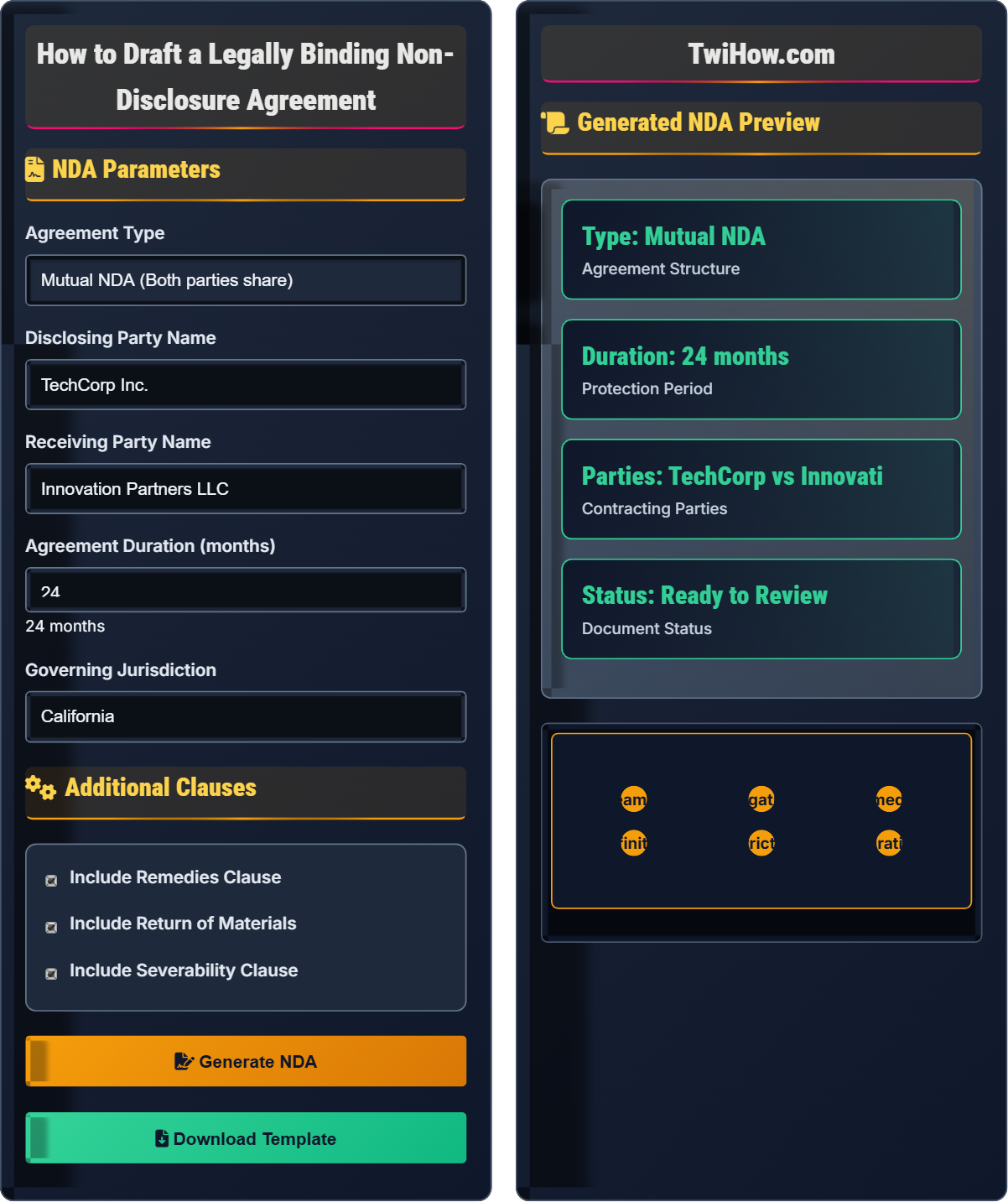
NDA Parameters
Additional Clauses
Generated NDA Preview
| Clause | Status | Details |
|---|---|---|
| Preamble | ✓ Included | Identifies parties |
| Definition | ✓ Included | Defines confidential info |
| Obligations | ✓ Included | Restricts use/disclosure |
| Duration | ✓ Included | 24 months |
| Remedies | ✓ Included | Injunctive relief |
How to Draft a Legally Binding NDA
A Non-Disclosure Agreement (NDA) is a legally binding contract that creates a confidential relationship between parties. It protects sensitive information from unauthorized disclosure and provides legal remedies in case of breach. NDAs are essential in business partnerships, employment, and negotiations involving proprietary information.
Effective NDAs must include these critical elements:
Where:
- Definition: Clear identification of confidential information
- Obligations: Specific restrictions on use and disclosure
- Duration: Time period during which obligations remain in effect
- Remedies: Legal actions available for breach of agreement
Key scenarios where NDAs are essential:
- Business Partnerships: Protecting joint venture information
- Employment: Safeguarding trade secrets and client lists
- Investor Relations: Sharing financial information securely
- Product Development: Protecting innovation during development
- Mergers & Acquisitions: Exchanging sensitive business data
- Consulting Services: Preventing misuse of client information
- Mutual NDA: Both parties share confidential information
- Unilateral NDA: One party discloses to another
- Multi-party NDA: Three or more parties involved
- Employee NDA: Employment-specific protections
- Master NDA: Framework for ongoing relationships
NDA Essentials
Parties, definition of confidential information, obligations, duration, remedies, governing law.
Agreement = Preamble + Definition + Obligations + Duration + Remedies
Where Agreement = legally binding contract, Preamble = party identification, Obligations = restrictions.
- Information must be clearly defined
- Obligations must be reasonable
- Duration should be appropriate
Applications
Business partnerships, employment, investor relations, product development, M&A, consulting services.
- Joint ventures
- Employment agreements
- Investor due diligence
- Technology licensing
- Reasonableness of restrictions
- Enforceability by jurisdiction
- Compliance with competition law
- Balance of interests
NDA Learning Quiz
Which of the following is NOT a required element of a legally binding NDA?
While NDAs may include financial terms in certain contexts, detailed financial compensation terms are not a required element of a legally binding NDA. Essential elements include: clear definition of confidential information, specific obligations regarding use and disclosure, and duration of confidentiality obligations. Financial terms are typically found in related agreements like employment contracts or consulting agreements.
The answer is C) Detailed financial compensation terms.
Understanding the essential elements of an NDA helps distinguish between core contractual requirements and optional provisions. The essential elements create the legal framework for protecting confidential information, while additional terms may address specific business arrangements. This distinction is crucial for ensuring the NDA serves its primary purpose while avoiding unnecessary complexity.
Confidential Information: Proprietary data requiring protection from unauthorized disclosure
Obligations: Legal duties imposed on receiving party to protect information
Duration: Time period during which confidentiality obligations remain in effect
• Information must be clearly defined to avoid ambiguity
• Obligations must be specific and enforceable
• Duration should be reasonable and appropriate
• Define information broadly enough to cover all sensitive data
• Include exceptions for publicly available information
• Specify remedies for breach of agreement
• Overly broad definitions that are unenforceable
• Failing to include specific obligations
• Not specifying duration of obligations
Explain the factors courts consider when determining whether an NDA is enforceable. Discuss the importance of reasonableness in NDA terms.
Court Considerations: Courts evaluate several factors when determining NDA enforceability:
1. Definition Clarity: Information must be clearly identified and reasonably specific.
2. Reasonable Scope: Restrictions must be proportionate to legitimate business interests.
3. Appropriate Duration: Time limits should be reasonable given the nature of information.
4. Legitimate Business Interest: Agreement must protect valid competitive advantages.
5. Consideration: Both parties must receive something of value.
Importance of Reasonableness: Courts will not enforce NDAs that are overly restrictive or impose undue hardship on the receiving party. Reasonableness ensures the agreement serves its protective purpose without unduly restricting legitimate activities or violating public policy.
The concept of reasonableness is central to contract law and particularly important in NDAs. Courts balance the disclosing party's legitimate need for protection against the receiving party's right to engage in normal business activities. This balance ensures that NDAs serve their intended purpose while remaining enforceable under the law.
Consideration: Something of value exchanged between contracting parties
Legitimate Business Interest: Valid competitive advantage worth protectingReasonableness: Proportionality between restriction and protection needed
• Restrictions must be proportional to protection needed
• Duration should match information sensitivity
• Agreements must serve legitimate business purposes
• Research industry standards for duration
• Include specific exceptions to avoid overbreadth
• Ensure both parties receive consideration
• Overly broad information definitions
• Indefinite duration periods
• Restricting legitimate competitive activities
A software startup is negotiating a partnership with a major retailer to license its inventory management system. The startup needs to share proprietary algorithms, customer data, and financial projections. The retailer requires a one-year exclusivity period to evaluate the technology. Describe the NDA structure the startup should implement, including key clauses and duration considerations.
NDA Structure: Unilateral NDA with the startup as disclosing party and retailer as receiving party.
Key Clauses: Comprehensive definition of confidential information including algorithms, data, and projections; specific obligations to maintain confidentiality and restrict use to evaluation purposes; clear exceptions for independently developed information; return of materials clause upon completion of evaluation.
Duration Considerations: Agreement should extend beyond the one-year evaluation period to account for potential ongoing discussions or future partnerships. Consider 2-3 years duration to provide adequate protection for proprietary algorithms and customer data.
Additional Provisions: Non-compete clause during evaluation period, specific remedies for breach, governing law provision, and severability clause.
This scenario illustrates the importance of tailoring NDAs to specific business relationships. The startup's intellectual property requires long-term protection, while the retailer's evaluation needs are temporary. Balancing these interests requires careful consideration of duration, scope, and additional protective clauses. The NDA should support the business relationship while providing adequate protection.
Proprietary Algorithm: Unique method or process owned exclusively by the startup
Non-compete Clause: Restriction on competing activities during specified period
Severability: Provision ensuring remainder of agreement survives invalid clauses
• Information should be clearly marked as confidential
• Evaluation purpose should be specifically defined
• Duration must exceed evaluation period
• Require signed receipts for all materials provided
• Include audit rights to verify compliance
• Consider escrow arrangements for source code
• Failing to define evaluation purpose clearly
• Not including return of materials clause
• Setting duration too short for protection needs
A US-based tech company is entering into an NDA with a European partner. The European partner is concerned about GDPR compliance and data protection requirements. Explain how the NDA should address cross-border data sharing and regulatory compliance, including specific clauses that should be included.
GDPR Compliance: The NDA should include specific data protection clauses that acknowledge GDPR requirements and assign responsibilities between parties.
Required Clauses: Data processing provisions that comply with GDPR, specific consent requirements for EU personal data, data breach notification procedures, and provisions addressing cross-border data transfer restrictions.
Additional Considerations: Include clauses requiring compliance with local data protection laws, specify permitted uses of personal data, include provisions for data subject rights, and establish procedures for regulatory inspections.
Practical Measures: Require encryption of personal data, limit access to authorized personnel, and include audit rights for compliance verification.
International NDAs must navigate complex regulatory environments, particularly when dealing with personal data. The intersection of confidentiality requirements and data protection laws requires careful coordination. This challenge highlights the importance of including specific compliance provisions in international agreements to ensure both parties understand their obligations under different legal systems.
GDPR: European Union General Data Protection Regulation
Data Processing: Operations performed on personal data
Data Subject Rights: Individual rights under data protection laws
• GDPR compliance takes precedence over NDA provisions
• Both parties must maintain data protection standards
• Breach notification procedures must be established
• Include specific data protection appendices
• Establish data handling protocols
• Regular compliance reviews and updates
• Ignoring international data protection requirements
• Not addressing cross-border transfer restrictions
• Failing to include data breach procedures
Which of the following scenarios would most likely render an NDA unenforceable?
An overly broad definition of confidential information, such as "all information," would most likely render an NDA unenforceable. Courts require that confidential information be specifically identified and reasonably limited. A definition that encompasses "all information" is so vague and overbroad that it fails to provide clear guidance to the receiving party and may be deemed unenforceable as against public policy.
The answer is B) Definition of confidential information as "all information".
This question highlights the importance of specificity in legal documents. While comprehensive protection is desirable, overly broad definitions can render an agreement unenforceable. Effective NDAs must strike a balance between adequate protection and reasonable specificity, ensuring that parties understand exactly what information is covered by the agreement.
Overbreadth: Legal term for provisions that are too broad to be enforceable
Vagueness: Unclear terms that fail to provide adequate notice
Public Policy: Legal doctrine preventing enforcement of harmful agreements
• Definitions must be specific and clear
• Restrictions must be reasonable
• Agreements must serve legitimate purposes
• Use specific categories of information
• Include examples of covered information
• Exclude clearly non-confidential information
• Defining everything as confidential
• Not including specific exceptions
• Failing to define key terms clearly
FAQ
Q: How do I know if my NDA will be enforceable in court?
A: For an NDA to be enforceable in court, it must satisfy several legal requirements:
1. Clear Definition: Confidential information must be specifically identified and reasonably defined
2. Legitimate Purpose: The agreement must protect a valid business interest
3. Reasonable Restrictions: Obligations must be proportionate and not overly burdensome
4. Appropriate Duration: Time limits should be reasonable given the nature of the information
5. Proper Execution: All parties must sign, and consideration must be exchanged
Additionally, the NDA should not violate public policy or anti-competition laws. Consulting with a qualified attorney is recommended to ensure your NDA meets all enforceability requirements.
Q: What's the difference between mutual and unilateral NDAs, and when should I use each?
A: The choice between mutual and unilateral NDAs depends on the flow of information:
Unilateral NDA: Used when only one party will disclose confidential information to the other. This is common in vendor-client relationships, employment, or when a company is seeking investment.
Mutual NDA: Used when both parties will exchange confidential information. This is typical in joint ventures, partnership negotiations, or merger discussions.
Using the wrong type can leave one party without protection. If both parties plan to share sensitive information, a mutual NDA is essential. If only one party will share information, a unilateral NDA is sufficient and clearer in establishing obligations.