Drafting Enforceable Terms of Service for Your Website
Complete business law guide • Step-by-step explanations
Enforceable Terms of Service:
Show Terms GeneratorTerms of Service (ToS) are legally binding agreements between your website and its users. Well-crafted ToS protect your business from liability, establish user responsibilities, and provide legal recourse when users violate your policies.
Creating enforceable terms requires understanding legal requirements, industry standards, and best practices for contract formation. The agreement must be clear, accessible, and properly presented to users.
Key elements include:
- User Acceptance: Clear mechanism for user agreement
- Scope of Services: Description of what your site provides
- Usage Restrictions: Prohibited activities and behaviors
- Liability Limitations: Protection against legal claims
- Dispute Resolution: Procedures for resolving conflicts
Properly drafted terms provide essential legal protection while maintaining user trust and compliance.
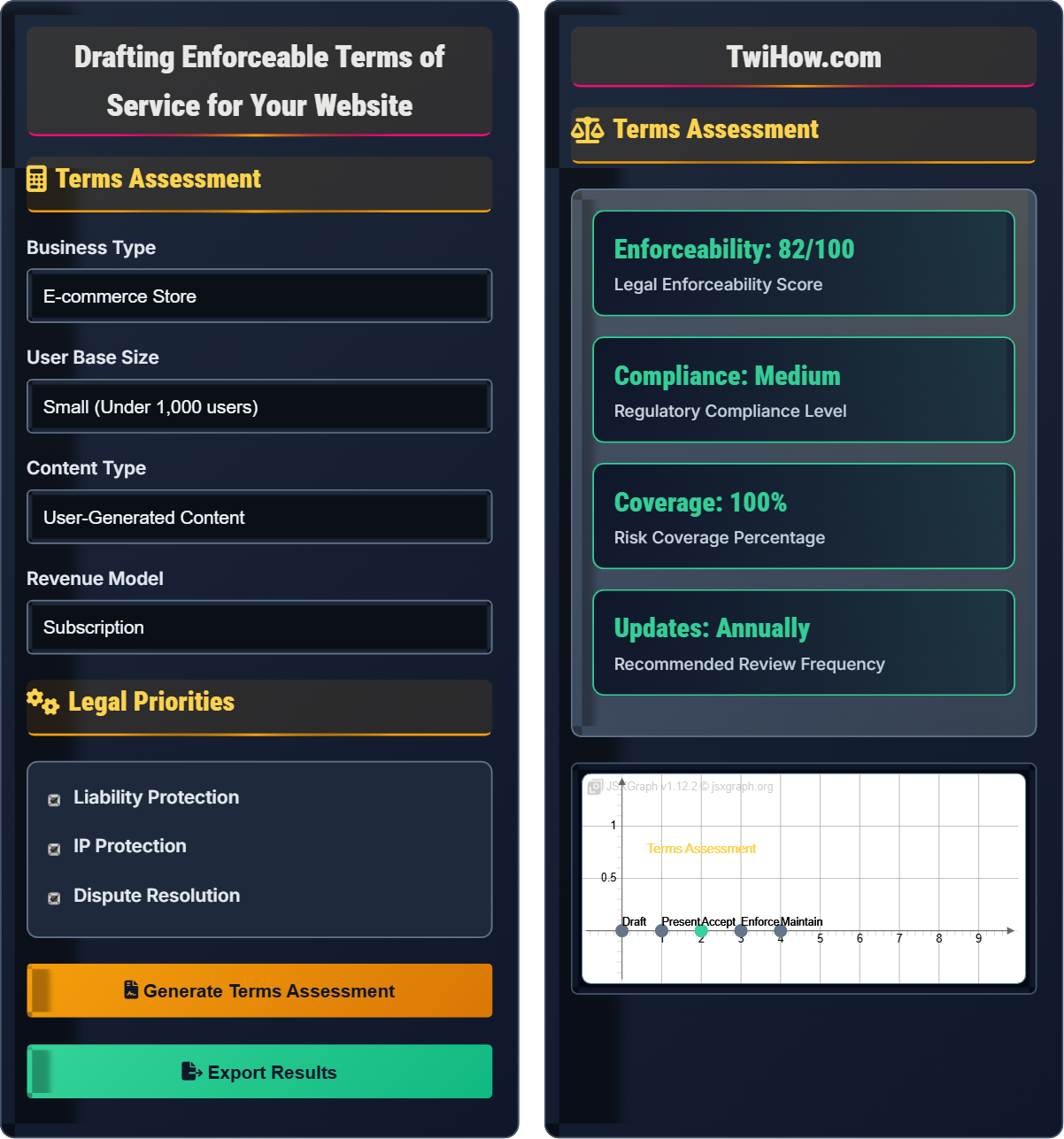
Terms Assessment
Legal Priorities
Terms Assessment
| Clause | Importance | Complexity | Priority |
|---|---|---|---|
| Acceptance Terms | High | Medium | High |
| Use Restrictions | High | High | High |
| Liability Limits | High | High | High |
| IP Rights | Medium | High | Medium |
| Dispute Resolution | High | High | Medium |
Enforceable Terms of Service
Every enforceable Terms of Service agreement must contain several key elements to be legally binding:
1. Offer and Acceptance: Clear presentation of terms and mechanism for user acceptance
2. Consideration: Something of value exchanged between parties (access to services)
3. Capacity: Legal ability of users to enter into contracts
4. Legal Purpose: Agreement must not facilitate illegal activities
5. Clear Terms: Language must be understandable and specific
Essential clauses for comprehensive terms of service:
• User Eligibility: Age restrictions and account requirements
• Acceptable Use: Permitted and prohibited activities
• Intellectual Property: Rights to content and user submissions
• Disclaimer of Warranties: Limitation of service guarantees
• Limitation of Liability: Caps on damages and responsibility
• Dispute Resolution: Arbitration and jurisdiction clauses
Issues that can render terms unenforceable:
- Overly Broad Language: Vague terms that courts won't enforce
- Unconscionable Provisions: Terms so unfair they're rejected
- Improper Notice: Users unaware they're agreeing to terms
- Illegal Provisions: Terms violating consumer protection laws
- Contradictory Clauses: Internal inconsistencies
- Missing Essential Elements: Incomplete contract formation
- Plain Language: Use clear, understandable terms
- Conspicuous Presentation: Make terms easily accessible
- Regular Updates: Keep terms current with business changes
- Legal Review: Have attorneys review periodically
- User Acceptance: Implement clear acceptance mechanisms
- Compliance Checks: Ensure adherence to applicable laws
- Documentation: Record user acceptance and changes
- International Considerations: Address cross-border issues
Essential Clauses
User acceptance, intellectual property rights, limitation of liability, dispute resolution, privacy policy integration, termination clauses.
Effective Clause = (Clear Language × Specificity × Legally Defensible) ÷ (Ambiguity + Illegal Provisions)
Where Clear Language = plain English communication, Specificity = precise terms and conditions.
- Terms must be presented before or during account creation
- Users must actively consent to terms
- Changes require proper notice and acceptance
- Liability limitations must be reasonable
- Terms must comply with consumer protection laws
Presentation Requirements
Clickwrap agreements, browsewrap agreements, implied acceptance, explicit consent.
- Clear Notice: Prominent display of terms before acceptance
- Active Consent: Require users to click "I agree" or similar
- Confirmation: Provide receipt of agreement
- Accessibility: Ensure terms are readable and accessible
- Documentation: Record acceptance timestamp and IP address
- Clickwrap agreements are more enforceable than browsewrap
- Age restrictions must be enforced for minors
- International users may have different legal protections
- Mobile interfaces require special formatting considerations
Follow this systematic approach to create enforceable terms of service:
Terms of Service Learning Quiz
Which of the following is NOT required for a Terms of Service agreement to be legally binding?
Notarization is not required for Terms of Service agreements to be legally binding. Digital contracts, including online terms of service, are governed by electronic signature laws which do not require notarization. The essential elements of a contract are offer, acceptance, consideration, and legal capacity - not notarization.
Offer and acceptance occurs when users agree to the terms, consideration is provided through access to services, and legal capacity refers to users' ability to enter contracts (typically age requirements).
The answer is C) Notarization.
This question addresses a common misconception about digital contracts. Traditional paper contracts sometimes require notarization for certain purposes, but online terms of service are valid without it. The key is ensuring proper acceptance mechanisms that demonstrate users' intent to be bound by the terms.
Electronic Signature Laws: Laws governing digital contract formation
Offer and Acceptance: Contract formation elements
Consideration: Something of value exchanged between parties
• Digital contracts don't require notarization
• Proper acceptance mechanisms are essential
• Electronic signatures are legally binding
• Focus on clear acceptance mechanisms
• Ensure terms are accessible to users
• Document user agreement properly
• Believing digital contracts need notarization
• Not implementing proper acceptance mechanisms
• Failing to document user agreement
Explain the difference between browsewrap and clickwrap agreements, and discuss which is more enforceable and why.
Browsewrap Agreements: Terms are accessible through a link on the website, and users are deemed to accept them by using the site. No explicit action is required to accept the terms.
Clickwrap Agreements: Users must take a specific action (clicking "I agree" or similar) to indicate acceptance of the terms before accessing services.
Enforceability Comparison:
Clickwrap agreements are significantly more enforceable because they provide clear evidence of user consent. Courts have consistently held that clickwrap agreements demonstrate actual notice and assent, which are essential for contract formation.
Browsewrap agreements are less enforceable because they rely on constructive notice (users are deemed to know the terms by virtue of using the site). Courts are skeptical of browsewrap agreements because users may not be aware they're agreeing to terms simply by using a website.
Best Practice: Use clickwrap agreements whenever possible, especially for terms that significantly affect user rights or limit business liability.
This distinction is crucial for understanding how courts evaluate digital contract formation. The key difference is the level of user awareness and affirmative consent. Clickwrap provides clear evidence of agreement, while browsewrap relies on assumptions about user knowledge that courts often reject.
Browsewrap: Agreement through website use without explicit consent
Clickwrap: Agreement through explicit user action
Constructive Notice: Assumed knowledge of terms without actual notice
• Clickwrap is more enforceable than browsewrap
• Clear acceptance mechanisms are essential
• Courts require actual notice for enforceability
• Use clickwrap for important terms
• Make terms prominently displayed
• Require affirmative consent for significant terms
• Relying solely on browsewrap agreements
• Not requiring explicit user consent
• Assuming users will read terms without notice
TravelPlanner Inc. operates a travel booking website that allows users to book flights, hotels, and car rentals. Their Terms of Service include a liability limitation clause that states "Company shall not be liable for any damages, including consequential, incidental, or punitive damages." A user books a hotel through the site, but the hotel is closed due to a fire, forcing the user to spend $2,000 on alternative accommodations. The user sues TravelPlanner for the additional expenses. Analyze the enforceability of the liability limitation clause and the potential outcome.
Analysis of Liability Limitation:
Enforceability Factors:
1. Scope: The clause appears overly broad by attempting to limit all damages, including potentially reasonable ones.
2. Notice: The clause must be prominently displayed and easily accessible.
3. Reasonableness: Courts examine whether the limitation is unconscionable or against public policy.
4. Consumer Protection: Many states have laws protecting consumers from excessive liability waivers.
Application to Scenario:
The user's claim involves direct damages (additional accommodation costs) rather than consequential damages. The liability limitation may not apply to direct damages that were reasonably foreseeable.
Potential Outcomes:
• Favorable to Company: If the clause is properly presented and enforceable
• Favorable to User: If the clause is deemed unconscionable or violates consumer protection laws
• Partial Recovery: Courts may strike down overly broad portions while enforcing reasonable parts
Best Practices: Liability limitations should be specific, reasonable, and comply with applicable consumer protection laws.
This scenario illustrates the balance between business protection and consumer rights. Liability limitations are enforceable when reasonable, but courts scrutinize clauses that attempt to shield companies from all responsibility. The key is ensuring limitations are proportional and don't violate consumer protection laws.
Consequential Damages: Indirect losses resulting from primary harm
Direct Damages: Immediate losses from the breach
Unconscionable: So unfair as to be unenforceable
• Liability limitations must be reasonable
• Consumer protection laws may override limitations
• Courts examine unconscionability in contract terms
• Be specific in liability limitations
• Ensure compliance with consumer protection laws
• Consult legal counsel for limitation clauses
• Using overly broad liability limitations
• Not considering consumer protection laws
• Assuming all liability can be limited
An e-commerce website based in the United States wants to expand globally and needs to consider international laws when drafting their Terms of Service. What key international legal considerations should they address, and how might these affect the enforceability of their terms in different jurisdictions?
Key International Considerations:
1. GDPR Compliance (Europe): General Data Protection Regulation requires specific consent mechanisms, data processing terms, and user rights that may conflict with standard U.S. terms.
2. Consumer Protection Laws: Many countries have stronger consumer protection than the U.S., potentially overriding certain terms of service provisions.
3. Jurisdiction and Governing Law: Courts may refuse to enforce forum selection clauses that unfairly disadvantage local consumers.
4. Unconscionability Standards: European courts are more likely to find liability limitations unconscionable than U.S. courts.
5. Distance Selling Laws: Many countries require cooling-off periods and return rights that may override terms.
6. Language Requirements: Some jurisdictions require terms to be in the local language.
Impact on Enforceability:
Terms that are enforceable in the U.S. may not be enforceable internationally. Companies often create country-specific versions of their terms or implement geo-blocking to avoid serving users in jurisdictions with conflicting laws.
Best Practices: Consult with international legal counsel and consider creating localized versions of terms for different jurisdictions.
This question highlights the complexity of international digital commerce. Legal systems vary significantly worldwide, and what's enforceable in one country may be invalid in another. Companies must carefully consider these differences when expanding globally.
GDPR: European Union data protection regulation
Forum Selection Clause: Provision specifying jurisdiction for disputes
Geo-blocking: Restricting access based on geographic location
• Local laws may override terms of service
• Consumer protection varies by jurisdiction
• International expansion requires legal compliance
• Research local laws before expansion
• Consider localized terms by jurisdiction
• Consult international legal counsel
• Using U.S.-only terms internationally
• Not considering local consumer protection laws
• Assuming terms are universally enforceable
Which of the following is the best approach for integrating privacy policy with terms of service?
The best approach is to reference a separate privacy policy that users must accept separately. This provides clear notice of privacy terms while maintaining the enforceability of both documents. Privacy policies often contain specific legal requirements that may change frequently, so keeping them separate allows for easier updates without requiring users to re-accept the entire terms of service.
Simply linking to a privacy policy without separate acceptance may not provide adequate notice, while combining everything into one document can make it unwieldy and harder to update specific sections.
The answer is B) Reference a separate privacy policy that users must accept separately.
This question addresses the relationship between terms of service and privacy policies. While both are important legal documents, privacy laws often have specific requirements that make it advantageous to maintain them as separate documents with clear cross-references.
Privacy Policy: Document describing data collection and use practices
Terms of Service: Agreement governing use of services
Legal Requirements: Statutory obligations for privacy disclosures
• Privacy policies have specific legal requirements
• Clear notice is essential for enforceability
• Separate documents allow for easier updates
• Cross-reference privacy policy in terms of service
• Consider separate acceptance for important policies
• Keep documents updated with legal requirements
• Not providing adequate notice of privacy terms
• Combining documents unnecessarily
• Failing to update privacy policies regularly
FAQ
Q: How often should I update my Terms of Service?
A: Terms of Service should be reviewed annually and updated as needed. You should definitely update them when:
1. Legal Changes: New laws or regulations affect your business
2. Business Changes: New services, features, or business models
3. Security Issues: Data breaches or security vulnerabilities
4. Case Law: Court decisions affect enforceability of certain clauses
5. Industry Changes: Best practices or standards evolve
When making significant changes, provide proper notice to users and require them to accept the updated terms. Minor changes may not require explicit re-acceptance.
Q: Do I need a lawyer to draft my Terms of Service?
A: While you can find templates online, it's strongly recommended to have a lawyer review your Terms of Service, especially if:
• Your business handles significant revenue or user data
• You operate in regulated industries (finance, healthcare, etc.)
• You plan to operate internationally
• You're seeking venture capital or other investment
• Your service involves user-generated content
A lawyer can ensure your terms are enforceable, compliant with applicable laws, and properly protect your business interests. The cost of professional legal review is often far less than potential legal liability.
Q: Can I copy Terms of Service from another website?
A: You should not copy Terms of Service from another website. Each business has unique risks, services, and legal requirements that require customized terms. Copying someone else's terms:
• May not address your specific business risks
• Could include provisions irrelevant to your business
• Might miss important clauses specific to your industry
• Could violate copyright if the terms are original works
• May not comply with laws applicable to your business model
Instead, use templates as a starting point and customize them for your specific business needs, then have them reviewed by legal counsel.