Handling Intellectual Property Disputes with Competitors
Complete IP dispute guide • Litigation & strategy
IP Dispute Resolution:
Dispute Risk CalculatorHandling intellectual property disputes with competitors requires a strategic approach that balances legal rights with business objectives. Effective IP dispute management involves understanding your rights, evaluating potential outcomes, and choosing the most appropriate resolution strategy.
Key considerations include:
- IP Type: Patents, trademarks, copyrights, and trade secrets require different approaches
- Resolution Strategy: Litigation, mediation, licensing, or cross-licensing
- Cost-Benefit Analysis: Legal costs vs. potential damages and market impact
- Business Impact: Effect on reputation, relationships, and market position
Strategic IP dispute resolution can protect your competitive advantage while minimizing costs and risks.
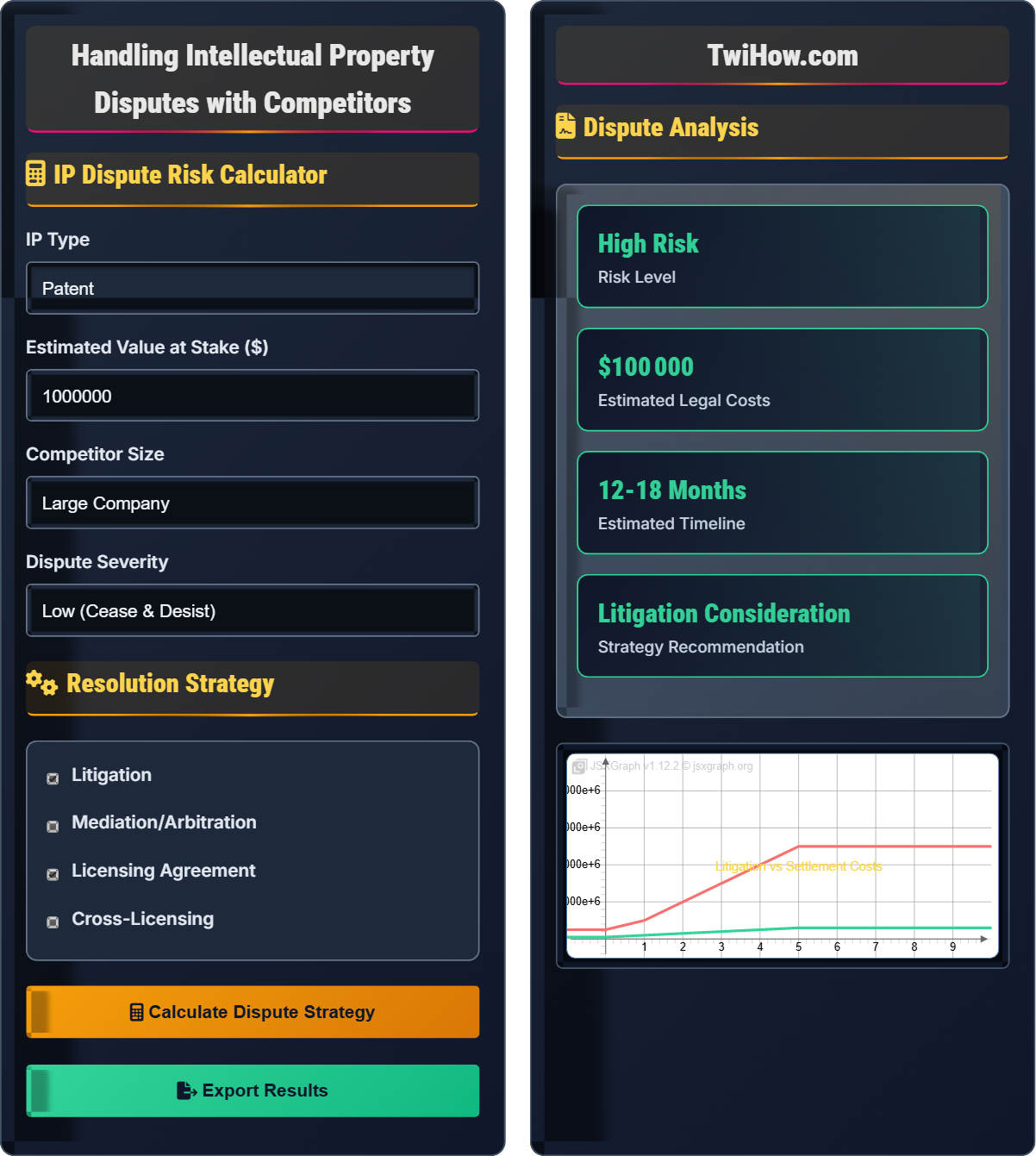
IP Dispute Risk Calculator
Resolution Strategy
Dispute Analysis
| Factor | Level | Impact | Recommendation |
|---|---|---|---|
| IP Strength | High | +$500,000 | Strong Position |
| Competitor Resources | High | +$200,000 | Lengthy Battle |
| Market Value | High | +$1,000,000 | High Stakes |
| Legal Costs | Medium | -$750,000 | Cost Consideration |
Understanding IP Dispute Resolution
Intellectual property disputes with competitors involve legal conflicts over patents, trademarks, copyrights, and trade secrets. These disputes can arise from alleged infringement, licensing disagreements, or competitive conflicts over IP rights.
Types of IP disputes include:
- Patent Infringement: Unauthorized use of patented inventions
- Trademark Disputes: Conflicting use of marks or brand confusion
- Copyright Infringement: Unauthorized use of protected creative works
- Trade Secret Misappropriation: Theft or unauthorized use of confidential information
- Licensing Disputes: Conflicts over license terms and compliance
Patent disputes typically involve complex technical analysis and can be expensive to litigate. These disputes often center on validity of patents and scope of claimed invention.
Trademark disputes focus on consumer confusion and brand identity. These often involve likelihood of confusion tests and market presence analysis.
Copyright disputes examine originality and substantial similarity. These often involve creative works and require expert analysis of protected expression.
Trade secret disputes involve misappropriation and breach of confidentiality. These require proof of reasonable secrecy measures and economic value.
Evaluate the strength of your IP rights and the validity of the dispute. Analyze the competitor's claims and your potential defenses. Assess the business impact and strategic implications.
Consider sending cease and desist letters, engaging in negotiations, or exploring licensing opportunities. Document all communications and gather evidence for potential litigation.
Explore mediation or arbitration as alternatives to litigation. These methods can be faster, less expensive, and preserve business relationships while achieving resolution.
If ADR fails, prepare for litigation by gathering evidence, identifying expert witnesses, and developing legal arguments. Consider forum selection and timing strategies.
Engage in discovery, motions practice, and trial preparation. Focus on presenting clear evidence of IP rights and damages while defending against counterclaims.
Formal court proceedings to resolve disputes. Provides binding decisions and potential for significant damages but can be costly and time-consuming.
Facilitated negotiation with neutral mediator. Faster and less expensive than litigation with potential to preserve relationships.
Agreement to use IP in exchange for compensation. Creates ongoing revenue and avoids protracted disputes.
Exchange of IP rights between parties. Mutual benefit and competitive advantage sharing.
When handling IP disputes with competitors, consider:
- Cost-Benefit Analysis: Weigh legal costs against potential recovery and market value
- Business Relationships: Impact on supplier, customer, and partner relationships
- Market Position: Effect on competitive positioning and market share
- Reputation: Public perception and brand impact
- Future Innovation: Effect on R&D and future IP development
IP Dispute Resolution Comparison
| Method | Cost | Timeline | Control | Confidentiality |
|---|---|---|---|---|
| Litigation | High ($1M-$10M+) | 1-3 years | High | Low (Public Record) |
| Mediation | Medium ($50K-$500K) | 3-12 months | Medium | High |
| Arbitration | Medium ($100K-$1M) | 6-18 months | Medium | High |
| Licensing Negotiation | Low ($10K-$100K) | 1-6 months | High | High |
| Settlement | Variable | 3-12 months | Medium | High |
Steps to take when facing IP disputes with competitors:
IP Dispute Timeline
Real-World IP Dispute Scenarios
Company A sued Company B for patent infringement related to mobile app technology. Company A held a patent for a specific user interface feature. Company B argued the patent was invalid and non-infringing.
Key Lessons: Litigation can be expensive; cross-licensing may benefit both parties; patent validity is crucial.
Two fashion companies disputed the use of similar brand names. Company X had been using the mark for 5 years, while Company Y claimed prior use based on foreign registration. The dispute threatened both companies' market expansion.
Key Lessons: Mediation can preserve business relationships; geographic differentiation may resolve conflicts.
Company A accused former employee of taking proprietary customer lists to Company B. The employee had signed non-disclosure agreements. Company A sought injunctive relief and damages.
Key Lessons: Strong confidentiality agreements are essential; swift action preserves remedies; settlement can be more efficient than trial.
IP Dispute Resolution Quiz
What is the primary test used to determine patent infringement?
Patent infringement is determined through claim construction, where the court interprets the scope of patent claims, followed by comparing the accused product to the interpreted claims. The test examines whether the accused product literally infringes each element of the patent claim or infringes under the doctrine of equivalents.
The answer is C) Claim construction and literal infringement.
Patent infringement analysis is a two-step process: first, the court construes the patent claims to determine their scope, then compares the accused product to the construed claims. This differs from trademark (likelihood of confusion) and copyright (substantial similarity) analyses.
Claim Construction: Judicial interpretation of patent claim scope
Literal Infringement: Every element of a claim is found in accused product
Doctrine of Equivalents: Infringement despite minor differences
• Patent claims define the scope of protection
• Literal infringement requires all elements
• Equivalents doctrine allows for minor variations
• Focus on patent claim language
• Consider doctrine of equivalents
• Analyze prosecution history
• Applying trademark confusion test to patents
• Ignoring prosecution history
• Misunderstanding claim scope
Explain the factors considered in determining trademark infringement and likelihood of confusion. How do these factors apply in practice?
Factors in Trademark Infringement Analysis:
• Similarity of Marks: Visual, phonetic, and conceptual similarity
• Relatedness of Goods/Services: Whether products/services are related
• Strength of Plaintiff's Mark: Distinctiveness and recognition level
• Actual Confusion: Evidence of consumer confusion
• Purchaser Sophistication: Consumer awareness and purchasing care
• Defendant's Intent: Bad faith or deliberate copying
• Marketing Channels: How products are sold and advertised
Practical Application: Courts balance these factors, with no single factor being dispositive. The analysis focuses on whether consumers are likely to be confused about source or sponsorship.
The likelihood of confusion test is the primary analysis in trademark disputes. Unlike patents, trademark protection focuses on preventing consumer confusion about source or origin. The multifactor test allows courts to consider the complex marketplace realities that affect consumer perception.
Likelihood of Confusion: Probability consumers will mistake source of goods
Strength of Mark: Distinctiveness and recognition level
Dilution: Weakening of distinctive character of famous marks
• No single factor is dispositive
• Analysis focuses on consumer confusion
• Similarity and relatedness are key factors
• Consider visual and phonetic similarities
• Analyze target market sophistication
• Look for actual confusion evidence
• Ignoring relatedness of goods/services
• Not considering marketing channels
• Focusing on single factor
Company A has a patent worth $5M in annual revenue. Company B is infringing with a product generating $2M annually. Litigation costs are estimated at $1.5M with a 60% chance of winning. Calculate the expected value and recommend a strategy.
Expected Value Calculation:
• Potential damages: $2M (annual) × likely duration × 60% win probability
• Assume 3 years of past damages: $2M × 3 = $6M
• Expected recovery: $6M × 60% = $3.6M
• Less litigation costs: $3.6M - $1.5M = $2.1M expected value
• Risk-adjusted value: $2.1M (positive, suggesting litigation)
Alternative Strategy: Consider licensing offer of $1M annually to avoid litigation costs and preserve relationship.
Recommendation: Litigation has positive expected value, but licensing may be more strategic if relationship preservation is important.
IP dispute resolution requires quantitative analysis of potential outcomes. The expected value calculation helps determine if litigation makes economic sense. However, business factors beyond pure economics often influence strategic decisions.
Expected Value: Probability-weighted average of possible outcomes
Reasonable Royalty: Hypothetical licensing fee in infringement cases
Lost Profits: Direct damages from infringement
• Expected value = (recovery × probability) - costs
• Consider litigation duration and costs
• Factor in relationship preservation
• Include opportunity costs in analysis
• Consider settlement leverage
• Factor in reputational impacts
• Not considering probability of success
• Ignoring litigation duration costs
• Focusing only on damages, not costs
Two technology companies are in a patent dispute over smartphone features. Both companies have ongoing business relationships and want to avoid lengthy litigation. Recommend an appropriate dispute resolution strategy and explain the benefits.
Recommended Strategy: Mediation followed by structured licensing negotiation.
Process:
1. Engage neutral IP mediator with technical expertise
2. Focus on business interests rather than legal positions
3. Explore cross-licensing opportunities
4. Structure licensing terms to benefit both parties
Benefits:
• Preserves business relationships
• Faster resolution than litigation
• Confidential process
• Potential for mutually beneficial licensing
• Lower costs than litigation
Alternative: Binding arbitration if mediation fails, providing finality while maintaining confidentiality.
When ongoing business relationships are important, ADR methods like mediation can achieve resolution while preserving relationships. The focus shifts from winner-take-all to mutually beneficial solutions that allow both parties to continue their business.
Mediation: Facilitated negotiation with neutral third party
Cross-Licensing: Exchange of IP rights between parties
Structured Negotiation: Systematic approach to reaching agreement
• ADR works best with willing participants
• Focus on interests, not positions
• Consider ongoing business relationships
• Select mediator with IP expertise
• Prepare technical experts
• Consider creative licensing solutions
• Not considering business relationships
• Focusing only on legal positions
• Selecting inappropriate ADR method
What is the most important factor in trade secret misappropriation cases?
The most critical factor in trade secret cases is whether the owner took reasonable measures to maintain secrecy. Without reasonable secrecy measures, information cannot qualify as a trade secret regardless of its economic value. Courts examine the specific steps taken to protect confidentiality.
The answer is B) Reasonable measures to maintain secrecy.
Trade secret protection requires active efforts to maintain confidentiality. This differs from patents, which require public disclosure in exchange for protection. The law incentivizes reasonable secrecy measures through legal protection.
Reasonable Secrecy Measures: Steps to protect confidentiality
Misappropriation: Improper acquisition or disclosure of trade secrets
Reverse Engineering: Legal acquisition method for trade secrets
• Reasonable secrecy measures are required for protection
• Information must derive economic value
• Misappropriation requires improper acquisition
• Document all secrecy measures
• Use NDAs consistently
• Limit access to need-to-know basis
• Not implementing reasonable secrecy measures
• Failing to document protection efforts
• Assuming all confidential info is protected
Frequently Asked Questions
Expert Q&A
Q: I received a patent infringement notice from a large competitor. My technology is different but the patent is broad. What should I do?
A: Take the following immediate steps:
1. Preserve Evidence: Document all development processes, prior art, and technical differences between your product and the patent claims.
2. Legal Analysis: Have an IP attorney conduct a claim construction analysis to determine if your product actually infringes the patent claims.
3. Invalidity Research: Search for prior art that may invalidate the patent or narrow its scope.
4. Business Strategy: Consider potential licensing opportunities or design-around solutions while evaluating legal options.
5. Response Strategy: Craft a measured response that doesn't admit infringement while preserving your legal defenses.
Timeline: Respond within the specified deadline (usually 30-60 days) and begin legal analysis immediately. The strength of your response can influence settlement negotiations.
Q: A competitor is copying my clothing designs. Can I protect these through IP law?
A: Fashion IP protection is complex but available:
Copyright Protection: Original artistic elements like prints, patterns, and decorative elements may be copyrightable if they can be separated from utilitarian aspects.
Design Patents: Ornamental designs for articles of manufacture can be protected by design patents, offering 15 years of protection.
Trade Dress: Overall appearance and image of products may be protected if they're distinctive and non-functional.
Trademarks: Brand names, logos, and distinctive packaging elements can be trademarked.
Limitations: Functional aspects of clothing (cut, fit, utility) are generally not protected by copyright or design patents.
Strategy: Consider design patents for distinctive ornamental features and focus on brand protection through trademarks. Document your creative process to establish originality.