Legal Issues in Affiliate Marketing & Influencer Partnerships
Complete legal guide • Step-by-step explanations
Marketing Legal Fundamentals:
Show Legal AnalyzerAffiliate marketing and influencer partnerships involve complex legal considerations including FTC compliance, disclosure requirements, contract law, and intellectual property protection. Businesses must navigate advertising standards, consumer protection laws, and platform-specific regulations while establishing clear terms and expectations with partners.
Key legal areas:
- FTC Compliance: Disclosure requirements, substantiation, and advertising standards
- Contract Law: Partnership agreements, terms of service, and liability allocation
- Intellectual Property: Trademark usage, content rights, and brand protection
- Consumer Protection: Truth in advertising, refund policies, and privacy compliance
Successful partnerships require comprehensive legal frameworks that protect both parties while ensuring compliance with advertising standards and regulatory requirements.
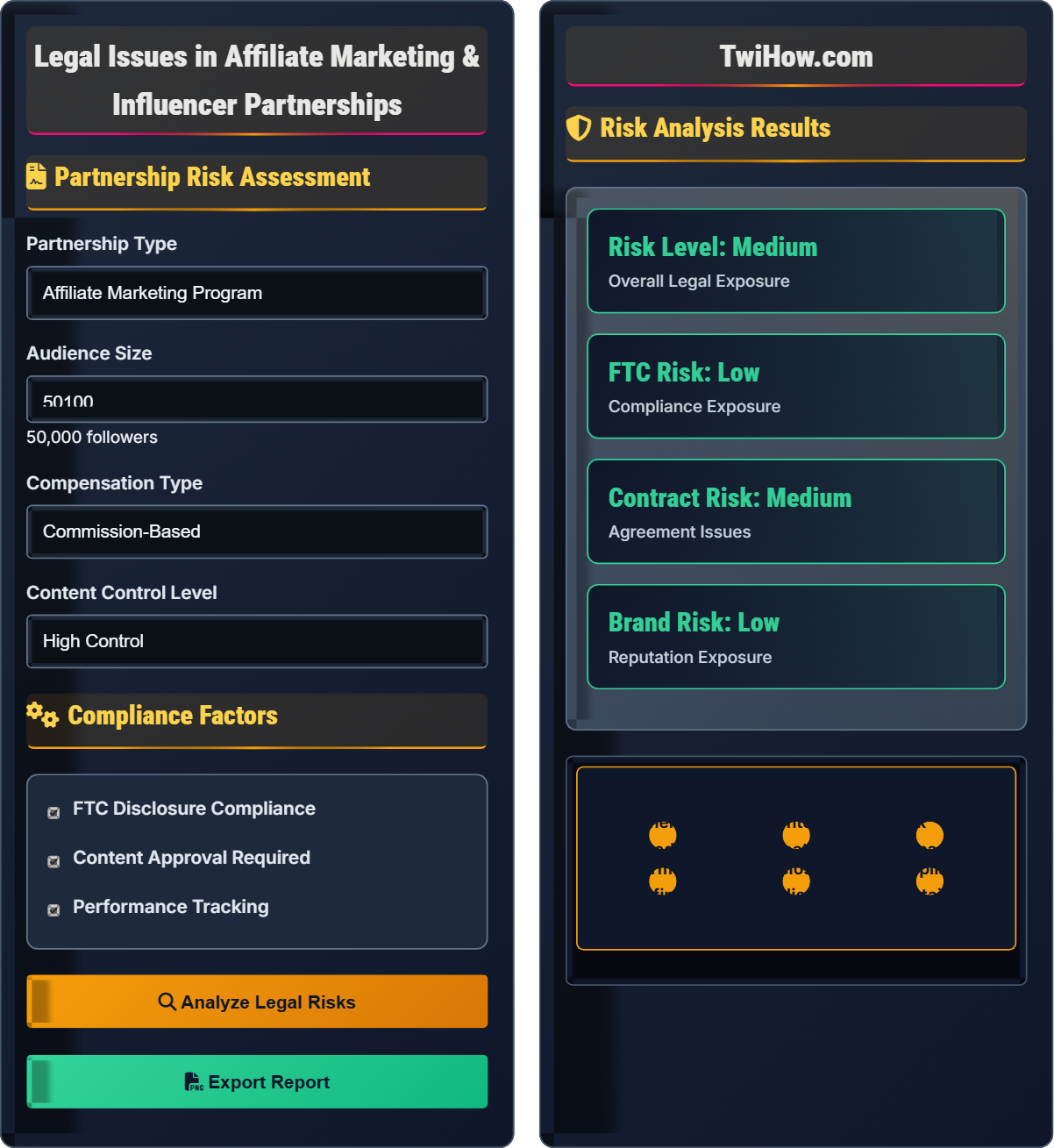
Partnership Risk Assessment
Compliance Factors
Risk Analysis Results
Agreed
Defined
Created
Applied
Managed
Maintained
| Risk Area | Severity | Mitigation |
|---|---|---|
| FTC Violations | Medium | Clear disclosure requirements |
| Brand Misuse | Low | Usage guidelines |
| Content Quality | Medium | Approval processes |
| Performance Claims | High | Substantiation requirements |
| Intellectual Property | Low | IP protection clauses |
Legal Issues in Affiliate Marketing & Influencer Partnerships
Affiliate marketing involves businesses paying commissions to external publishers for driving traffic or sales to their products. Influencer partnerships involve collaborating with individuals who have influence over potential buyers. Both require careful legal consideration of advertising standards, disclosure requirements, and contractual obligations.
Marketing partnerships operate under multiple legal frameworks:
Where:
- FTC: Federal Trade Commission advertising standards and disclosure requirements
- Contract: Partnership agreements, terms, and performance obligations
- IP: Intellectual property rights, trademark usage, and content ownership
- Consumer Protection: Truth in advertising, privacy, and refund policies
Primary legal considerations for marketing partnerships:
- FTC Compliance: Disclosure requirements, endorsement guidelines, substantiation
- Contract Law: Partnership agreements, performance metrics, termination clauses
- Intellectual Property: Trademark usage, content rights, brand protection
- Consumer Protection: Truth in advertising, privacy compliance, refund policies
- Platform Regulations: Social media terms, advertising policies
- Tax Implications: Reporting requirements, tax withholding
- Clear Agreements: Comprehensive partnership contracts with specific terms
- Disclosure Guidelines: Clear, prominent, and conspicuous disclosure requirements
- Content Standards: Brand guidelines and approval processes
- Training Programs: Educate partners on legal requirements
- Monitoring Systems: Regular compliance checks and audits
- Legal Consultation: Ongoing advice from specialized attorneys
Marketing Legal Essentials
Partnership agreements, FTC compliance, disclosure requirements, brand guidelines, performance tracking, legal monitoring.
Risk = (FTC Compliance × Audience Size) + (Contract Complexity × Control Level) + (Brand Exposure × Partnership Type)
Where Risk = overall legal exposure, FTC = compliance requirements, Contract = agreement complexity.
- Implement clear disclosure requirements
- Establish comprehensive partnership agreements
- Protect intellectual property rights
Compliance Areas
FTC Endorsement Guides, CAN-SPAM Act, GDPR, CCPA, platform-specific regulations, consumer protection laws.
- Agreement development
- Partner education
- Content review
- Monitoring and enforcement
- Platform-specific disclosure requirements
- International compliance variations
- Content format differences
- Performance measurement standards
Marketing Legal Quiz
According to FTC guidelines, how must paid endorsements in social media posts be disclosed?
According to FTC Endorsement Guidelines, paid endorsements must be disclosed in a clear, prominent, and conspicuous manner that consumers can easily notice, read, and understand. The disclosure must be placed where consumers are likely to see it and should not be buried among other information. The FTC emphasizes that disclosures must be integrated into the content in a way that makes the commercial nature of the communication obvious.
The answer is B) In a clear, prominent, and conspicuous manner.
The FTC's focus on "clear, prominent, and conspicuous" disclosure reflects the principle that consumers deserve transparency about commercial relationships. This standard ensures that people understand when content is sponsored, allowing them to evaluate it appropriately. The emphasis on placement and visibility prevents businesses from hiding important commercial information.
Endorsement: Any advertising message presented by someone other than the advertiser that suggests or implies approval
Conspicuous: Presented in a way that is likely to catch attention and be understood
Commercial Relationship: Any connection between endorser and advertiser that might affect credibility
• Disclosures must be prominent and noticeable
• Commercial relationships must be clear
• Format must be appropriate for platform used
• Use clear language like "Paid partnership" or "Sponsored"
• Place disclosures early in content
• Make sure disclosures are visible on mobile devices
• Placing disclosures at the end of long captions
• Using vague terms like "collab" or "ad"
• Making disclosures too small or hard to read
Explain the FTC's requirements for substantiating performance claims made in affiliate marketing and influencer partnerships. What documentation and evidence must businesses maintain?
FTC Substantiation Standard: The FTC requires that advertisers have a "reasonable basis" for all objective claims made in advertisements. For performance claims, this means having competent and reliable scientific evidence supporting the claim before publication.
Required Documentation: Businesses must maintain records demonstrating the basis for all claims, including test results, studies, surveys, or other evidence supporting the claims made by affiliates or influencers.
Type of Evidence: The level of substantiation required depends on the claim's importance to consumers and the potential health or safety risks. Material claims require competent and reliable scientific evidence, typically meaning well-designed studies conducted by qualified researchers.
Responsibility Allocation: Advertisers are responsible for claims made by their representatives, including affiliates and influencers. This means businesses must ensure that partners only make claims that can be substantiated.
Record-Keeping: Maintain comprehensive files documenting the substantiation for all claims, including those made by third-party marketers. This includes study methodologies, results, and any disclaimers.
The FTC's substantiation requirement ensures that marketing claims are truthful and supported by evidence. This protects consumers from false or misleading information while holding businesses accountable for all claims made on their behalf, even by third parties. The burden of proof lies with the advertiser, not the consumer.
Reasonable Basis: Evidence that an advertiser has adequate grounds for believing a claim
Competent and Reliable Evidence: Scientific evidence meeting professional standards
Material Claim: Statement that would influence consumer decision-making
• Substantiate claims before making them
• Maintain detailed documentation
• Hold partners accountable for claims
• Create approved claim templates for partners
• Provide evidence documentation to partners
• Regularly audit partner content for compliance
• Not verifying partner claims
• Lacking proper substantiation documentation
• Assuming partners are responsible for their own claims
A fashion brand enters into an affiliate marketing agreement with an influencer. The contract specifies a 5% commission on net sales, but the influencer claims they should receive 5% on gross sales. The influencer has generated $100,000 in sales with $15,000 in returns and chargebacks. How should the dispute be resolved, and what legal principles apply?
Contract Interpretation: Courts will look to the plain language of the contract first. If "net sales" is clearly defined as sales minus returns, refunds, and chargebacks, then the brand's interpretation is correct.
Calculation: Gross sales of $100,000 minus $15,000 in returns and chargebacks equals $85,000 in net sales. At 5%, the influencer would earn $4,250.
Legal Principles: The parol evidence rule prevents introduction of external evidence to contradict clear contract terms. The plain meaning rule gives priority to the ordinary meaning of contract language.
Industry Standards: In affiliate marketing, "net sales" commonly refers to sales after returns and chargebacks, as brands typically cannot pay commissions on transactions that don't result in actual revenue.
Best Practices: Contracts should clearly define terms like "gross sales," "net sales," and "returns" to prevent such disputes. The agreement should specify how chargebacks and refunds affect commission calculations.
This scenario highlights the importance of precise contract language in marketing partnerships. Ambiguous terms can lead to costly disputes, emphasizing the need for clear definitions and detailed specifications of how payments are calculated and affected by various business events.
Gross Sales: Total sales before any deductions
Net Sales: Sales after returns, refunds, and chargebacks
Parol Evidence Rule: Prevents contradictory external evidence for clear contracts
• Define terms precisely in contracts
• Specify calculation methods clearly
• Address common business scenarios
• Include detailed payment calculation examples
• Define all financial terms clearly
• Address dispute resolution procedures
• Using ambiguous financial terms
• Not addressing return and refund impacts
• Failing to define key calculation terms
An influencer creates content for a skincare brand that includes false claims about treating serious skin conditions. The content violates both FTC guidelines and the platform's advertising policies, resulting in account suspension. Who bears legal responsibility for the violation, and what steps should the brand take to address the situation?
Shared Responsibility: Both the brand and influencer bear responsibility. The FTC holds advertisers liable for claims made by their representatives, while platforms hold account holders responsible for content.
Brand Liability: The brand is responsible for ensuring all claims made on its behalf are substantiated and compliant with advertising standards, regardless of who makes them.
Immediate Steps: The brand should immediately request removal of the violating content, work with the influencer to correct any false claims, and implement stricter content approval processes.
Long-term Measures: Enhance partner training on advertising standards, implement pre-approval systems for health-related claims, and strengthen contract provisions requiring compliance with advertising guidelines.
Platform Recovery: Work with the platform to appeal the suspension, demonstrate corrective actions taken, and implement additional safeguards to prevent future violations.
Legal Considerations: Review contract indemnification clauses and consider potential liability for any consumer harm resulting from false claims.
This scenario demonstrates the complex web of responsibilities in influencer marketing. Brands cannot simply delegate compliance responsibilities to partners but must actively ensure that all marketing activities meet legal standards. The intersection of FTC requirements and platform policies creates multiple layers of compliance obligations.
Representative Liability: Advertiser responsibility for claims made by third-party marketers
Platform Policies: Rules set by social media platforms for commercial content
Substantiation: Evidence supporting marketing claims
• Advertisers are liable for representative claims
• Health claims require heightened substantiation
• Content must meet platform standards
• Pre-approve health-related content
• Provide specific training on health claims
• Implement content review systems
• Assuming partners understand compliance requirements
• Not reviewing content before publication
• Failing to address platform policy violations
Under IRS regulations, when must a business issue Form 1099-NEC to an affiliate or influencer?
Under IRS regulations, businesses must issue Form 1099-NEC to independent contractors, including affiliates and influencers, when they pay $600 or more in a calendar year for services. This includes commissions, fees, and other payments for services rendered. The form reports nonemployee compensation and helps ensure proper tax reporting by both parties.
The answer is A) For any payment over $600 in a calendar year.
Form 1099-NEC reporting requirements ensure that independent contractors properly report their income for tax purposes. Businesses must track payments to all service providers and issue forms when the threshold is met. This applies to all types of service payments, including affiliate commissions and influencer fees.
Form 1099-NEC: Tax form for reporting nonemployee compensation
Independent Contractor: Self-employed individual providing services
Nonemployee Compensation: Payments for services not as regular employee wages
• Report all payments over $600 annually
• Issue forms by January 31st
• Keep records of all payments
• Track payments throughout the year
• Collect W-9 forms from partners
• Use accounting software for tracking
• Not tracking small payments that add up
• Missing the January deadline
• Failing to collect proper tax forms
FAQ
Q: What should I include in an affiliate marketing agreement to protect my business legally?
A: Essential elements for affiliate marketing agreements include:
1. Clear Disclosure Requirements: Specific instructions on how and where to disclose the partnership
2. Brand Guidelines: Specifications for trademark usage and content standards
3. Performance Metrics: How commissions are calculated, including adjustments for returns
4. Content Approval: Process for reviewing marketing materials before publication
5. Compliance Standards: Requirements to follow FTC guidelines and platform policies
6. Termination Clauses: Conditions under which the agreement can be ended
7. Indemnification: Protection against liability from partner actions
8. Payment Terms: Schedule and method of commission payments
These elements help ensure legal compliance while protecting your brand and business interests.
Q: How do I ensure my sponsored content meets FTC disclosure requirements?
A: To ensure FTC compliance:
• Use clear, prominent language like "Sponsored" or "Paid Partnership"
• Place disclosures early in your content where viewers will see them
• Make sure disclosures are visible on mobile devices
• Avoid burying disclosures in hashtags or at the end of long captions
• Use platform-specific disclosure tools when available
• Remember that the disclosure must be "conspicuous" - easily noticed, read, and understood
• Don't rely on vague terms like "collab" or "ad" which may not be sufficiently clear
• Ensure all commercial relationships are clearly disclosed
Following these guidelines helps protect you from FTC enforcement action while maintaining audience trust.