How Do I Handle Legal Issues When Launching a New Product Feature?
Complete legal guide • Step-by-step explanations
Product Launch Legal Fundamentals:
Show Legal ChecklistLaunching a new product feature involves navigating complex legal requirements including intellectual property protection, regulatory compliance, contract management, and liability mitigation. Proper legal preparation protects your business from costly disputes, regulatory penalties, and competitive challenges while ensuring market access and customer trust.
Key legal considerations include:
- Intellectual Property: Patents, trademarks, copyrights, and trade secrets
- Regulatory Compliance: Industry-specific regulations and data protection
- Contract Review: Vendor agreements, licensing, and terms of service
- Risk Management: Liability protection and insurance coverage
Early legal planning minimizes risks and maximizes market opportunities while ensuring long-term business sustainability.
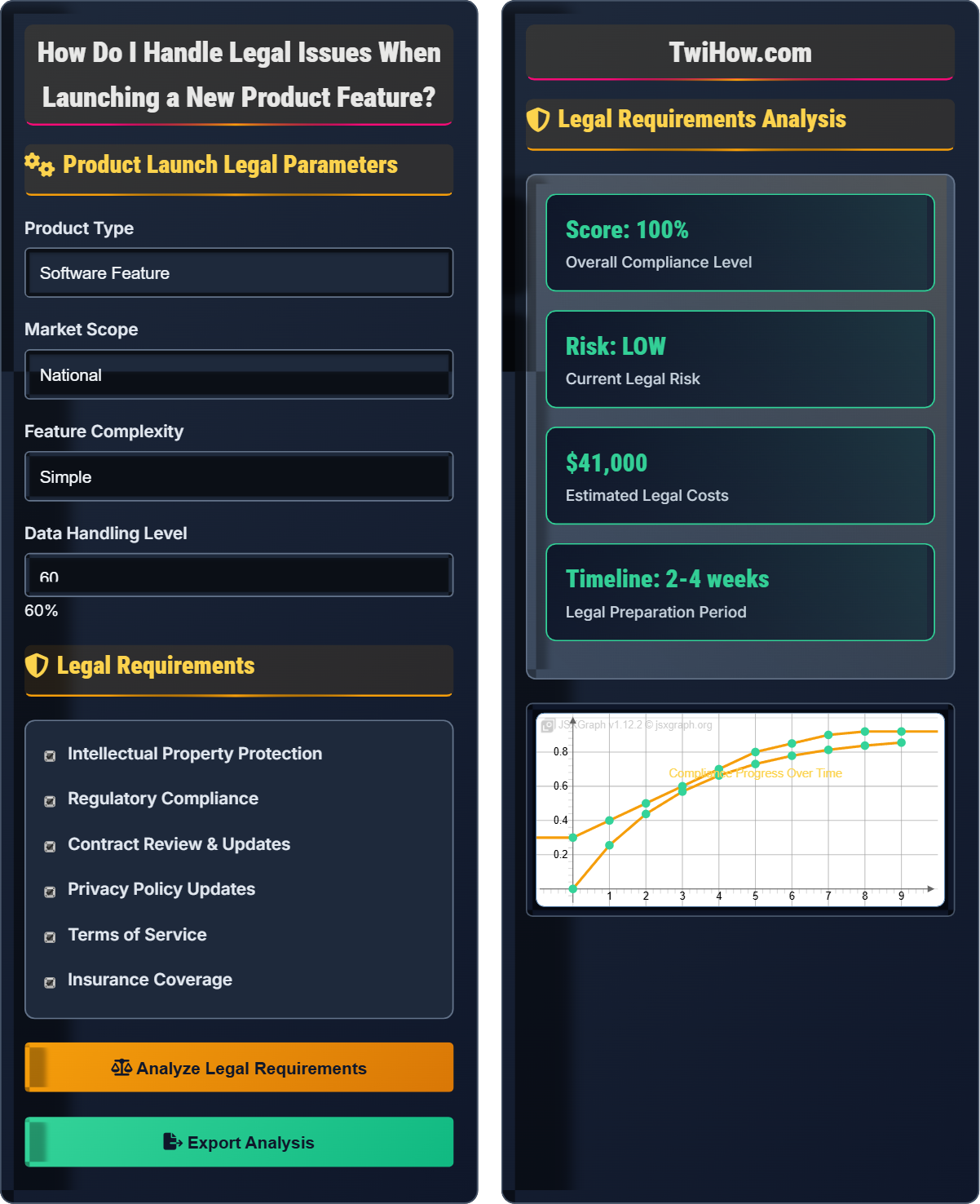
Product Launch Legal Parameters
Legal Requirements
Legal Requirements Analysis
Legal Issues for New Product Feature Launches
Legal issues during new product feature launches encompass all regulatory, intellectual property, contractual, and compliance matters that must be addressed to ensure lawful market entry. These issues include protecting proprietary innovations, ensuring regulatory compliance, managing vendor relationships, and mitigating potential liability risks associated with the new feature.
The legal framework for product launches includes multiple interconnected elements:
Where:
- IP Protection: Safeguarding proprietary innovations and assets
- Compliance: Meeting regulatory and industry requirements
- Contract Management: Managing vendor and customer agreements
- Risk Mitigation: Minimizing liability and exposure
Essential legal considerations for product launches:
- Intellectual Property: Patents, trademarks, copyrights, trade secrets
- Regulatory Compliance: Industry-specific regulations and standards
- Data Protection: Privacy laws and security requirements
- Contract Management: Vendor agreements and customer terms
- Liability Issues: Product liability and warranty concerns
- Export Controls: International trade and sanctions compliance
- Proactive Measures: IP filing, compliance planning, risk assessment
- Defensive Strategies: Licensing agreements, indemnification clauses
- Compliance Frameworks: Ongoing monitoring and reporting systems
- Dispute Resolution: Arbitration clauses and conflict procedures
- Insurance Coverage: Professional liability and product insurance
Legal Launch Fundamentals
Intellectual property, regulatory compliance, contract law, product liability, data protection, licensing.
Launch Readiness = (IP Protection × Compliance Status) + (Contract Security × Risk Coverage)
Where Launch Readiness = market readiness, IP Protection = intellectual property safeguards, Compliance Status = regulatory adherence.
- Begin legal planning early in development cycle
- Conduct thorough IP searches before launch
- Ensure compliance with all applicable regulations
Applications
Patent filing, trademark registration, regulatory compliance, contract negotiation, privacy policy creation.
- Conduct comprehensive IP assessment
- Identify applicable regulatory requirements
- Review and update all relevant contracts
- Implement compliance monitoring systems
- International market expansion
- Industry-specific regulations
- Technology sector requirements
- Professional legal guidance
Product Launch Legal Process Flow
Compliance Requirements Checklist
Product Launch Legal Quiz
Before launching a new software feature, what is the most important intellectual property step to take first?
A freedom-to-operate (FTO) search is the most critical first step because it identifies existing patents that could block your ability to commercialize the feature. Without this search, you risk infringing on existing patents, which could result in costly litigation, forced redesigns, or inability to launch. While patent filing and trademark registration are important, they come after confirming you can legally operate in the space. Public disclosure before patent filing would destroy patent rights.
The answer is B) Conduct a freedom-to-operate search.
Intellectual property strategy must be defensive before offensive. Before investing in patent applications or other IP protections, businesses must ensure they can actually use their innovations without infringing on others' rights. FTO searches map the existing IP landscape to identify potential obstacles. This approach prevents costly mistakes and allows for design-around strategies if problematic patents are found.
Freedom-to-Operate (FTO): Analysis of existing patents to assess infringement risk
Patent Infringement: Unauthorized use of patented invention
Design-Around: Modifying product to avoid patent infringement
• Conduct FTO search before launch planning
• File patents before public disclosure
• Consider international patent landscapes
• Start FTO search early in development
• Consider multiple design alternatives
• Work with IP specialists for complex technologies
• Filing patents after public disclosure
• Ignoring international patent coverage
• Not conducting thorough FTO analysis
Explain the key data privacy requirements that must be addressed when launching a feature that collects user data, and describe how GDPR and CCPA compliance differs for international versus domestic markets.
Key Data Privacy Requirements: When launching a feature that collects user data, businesses must implement appropriate consent mechanisms, provide clear privacy notices, establish data retention policies, implement security measures, and ensure users have rights to access, correct, or delete their data.
GDPR vs. CCPA Differences: GDPR (EU) has broader territorial scope, applies to any business processing EU residents' data regardless of location, and includes stricter consent requirements with opt-in mechanisms. CCPA (California) focuses on consumer rights with opt-out mechanisms and covers businesses meeting revenue or data volume thresholds. GDPR also includes more extensive data subject rights and stricter breach notification requirements.
Compliance Strategies: Businesses must implement privacy-by-design principles, conduct data protection impact assessments, appoint data protection officers where required, and ensure cross-border data transfer mechanisms are in place.
Data privacy compliance has become increasingly complex as different jurisdictions implement varying requirements. The key is understanding that privacy laws often have extraterritorial reach, meaning businesses must comply with multiple regulations based on where their users are located. Privacy-by-design means incorporating privacy protections from the development stage rather than as an afterthought.
GDPR: European Union General Data Protection Regulation
CCPA: California Consumer Privacy Act
Privacy-by-Design: Integrating privacy from product inception
• Obtain proper consent before data collection
• Provide clear privacy notices
• Implement appropriate security measures
• Map data flows during development
• Implement granular consent mechanisms
• Regular privacy compliance audits
• Assuming one privacy law covers all markets
• Failing to implement user rights mechanisms
A fintech company is launching a new payment feature that operates in 15 U.S. states and plans to expand internationally. The feature involves money transmission and cross-border payments. Outline the regulatory requirements the company must address before launch and the timeline for compliance.
U.S. Requirements:
1. Money Transmission Licenses: Individual state licenses required for each of the 15 states (6-12 months per state, $50,000-100,000 per license)
2. MSB Registration: Federal Money Services Business registration with FinCEN ($100 fee)
3. AML/KYC Programs: Anti-money laundering and know-your-customer compliance programs
4. State Regulations: Compliance with state-specific requirements including reporting and bonding
International Requirements: Know-your-customer requirements, anti-money laundering compliance, consumer protection laws, and licensing requirements in target countries.
Timeline: Minimum 12-18 months for full state licensing, with expedited processes possible in some states. Federal registration can be completed within 30 days.
Financial services are among the most heavily regulated sectors, with requirements varying significantly by jurisdiction. The key is understanding that compliance is often jurisdiction-specific and requires substantial lead time. Companies must often implement a phased launch strategy, beginning with states that have streamlined licensing processes, while working toward full compliance across all target markets.
MSB: Money Services Business registration
FinCEN: Financial Crimes Enforcement Network
AML/KYC: Anti-money laundering and know-your-customer
• Obtain all required licenses before operation
• Maintain ongoing compliance reporting
• Implement robust AML programs
• Start licensing process early
• Consider regulatory sandboxes
• Engage compliance experts
• Underestimating licensing timelines
• Failing to maintain ongoing compliance
• Not considering international requirements
A SaaS company is launching a new AI-powered analytics feature that integrates third-party APIs and uses customer data. The company has existing customer agreements and vendor contracts. What contract modifications are needed, and what legal risks should be addressed in the new agreements?
Customer Agreement Modifications:
1. Data Use Terms: Clarify how customer data will be processed by the new AI feature
2. API Terms: Define usage rights, limitations, and liability for AI-generated insights
3. SLA Updates: Establish service level agreements specific to AI features
4. Indemnification: Address liability for AI decision-making and data processing
Vendor Contract Updates: Review existing API agreements for data processing permissions, ensure compliance with customer data use restrictions, and negotiate appropriate liability allocations.
Risks to Address: AI bias, data privacy compliance, intellectual property ownership of AI-generated content, and accuracy disclaimers for AI insights.
Introducing AI features creates new contractual obligations and liability considerations. The key is ensuring that all agreements in the value chain support the intended use of customer data and clearly allocate responsibility for AI-related risks. This often requires updating standard form agreements to address the unique characteristics of AI processing and its implications for data privacy and liability.
SLA: Service Level Agreement
API: Application Programming Interface
Indemnification: Liability protection agreement
• Align all contracts with data use intentions
• Address AI-specific liability concerns
• Ensure customer consent for data use
• Review existing contracts before launch
• Include AI-specific terms in agreements
• Consider model explainability requirements
• Using customer data without proper consent
• Failing to address AI liability allocation
• Not updating vendor agreements for new use cases
Which of the following is the most effective way to limit product liability exposure when launching a new software feature that makes recommendations based on user data?
Clear disclaimers and accuracy limitations provide the most balanced approach to limiting liability while maintaining business functionality. This includes stating that recommendations are for informational purposes only, that results may vary, and specifying the contexts in which the feature should not be relied upon. While insurance is important and warranty disclaimers are useful, clear and specific disclaimers that address the particular risks of AI recommendations are most effective for software features.
The answer is B) Include clear disclaimers and accuracy limitations.
Product liability for software features requires specific disclaimers that address the unique risks of the technology. Generic disclaimers may not be sufficient for AI-powered features that make recommendations. The key is being specific about the limitations and risks while still providing value to users. This approach acknowledges the probabilistic nature of AI while setting appropriate expectations.
Product Liability: Legal responsibility for defective products
Warranty Disclaimer: Statement limiting guarantees
Limitation of Liability: Caps on potential damages
• Disclaimers must be conspicuous and clear
• Cannot disclaim gross negligence liability
• Jurisdiction-specific enforceability rules
• Make disclaimers prominent in agreements
• Test disclaimers with legal counsel
• Regularly update based on new risks
• Using generic disclaimers for AI features
• Not making disclaimers sufficiently prominent
• Failing to address specific AI risks
FAQ
Q: Do I need to worry about legal issues if I'm just adding a small feature to an existing product?
A: Yes, even small features can create significant legal risks. A seemingly minor addition like a new data collection field could trigger privacy law compliance requirements, or a simple algorithm change could raise intellectual property concerns if it uses someone else's patented method. The key is proportionality - while a simple UI change may require minimal legal review, any feature involving data processing, new functionality, or changes to user agreements should undergo legal assessment. The cost of addressing legal issues post-launch is typically much higher than addressing them pre-launch.
Q: How long should we allow for legal preparation before a product launch?
A: Legal preparation timelines vary significantly based on complexity. For simple digital features, 2-4 weeks may suffice for IP searches, contract reviews, and privacy updates. However, for features involving regulated industries (finance, healthcare, telecommunications), timelines can extend to 3-6 months or longer, especially if regulatory approvals are required. Features involving physical products or international expansion typically require longer preparation periods. The key is starting legal planning during the early stages of product development rather than waiting until the final stages.
Q: What's the difference between trademark and patent protection for software features?
A: Trademarks protect brand identifiers like names, logos, and slogans that distinguish your goods/services from others. For software features, you might trademark the feature name or distinctive visual elements. Patents protect new, useful, and non-obvious inventions or processes. For software, this could cover novel algorithms, user interface methods, or technical processes. Copyrights protect original works of authorship fixed in tangible form, like source code. Trade secrets protect confidential business information that provides competitive advantage. The key is understanding that different types of IP protect different aspects of your innovation and that they often work together in comprehensive protection strategies.