Compliance Requirements for Financial Services & Fintech Startups
Complete legal guide • Step-by-step explanations
Fintech Compliance Fundamentals:
Show Compliance AnalyzerFintech startups and financial services companies must navigate a complex regulatory landscape including licensing requirements, consumer protection laws, anti-money laundering regulations, and data privacy standards. Compliance is critical for legal operation and maintaining customer trust.
Key compliance areas:
- Licensing: State and federal financial services licenses
- AML/KYC: Anti-money laundering and Know Your Customer requirements
- Consumer Protection: Fair lending, privacy, and disclosure requirements
- Data Security: Cybersecurity and data privacy regulations
Successful fintech companies build compliance into their operations from the beginning, implementing robust systems and controls to ensure regulatory adherence while maintaining operational efficiency.
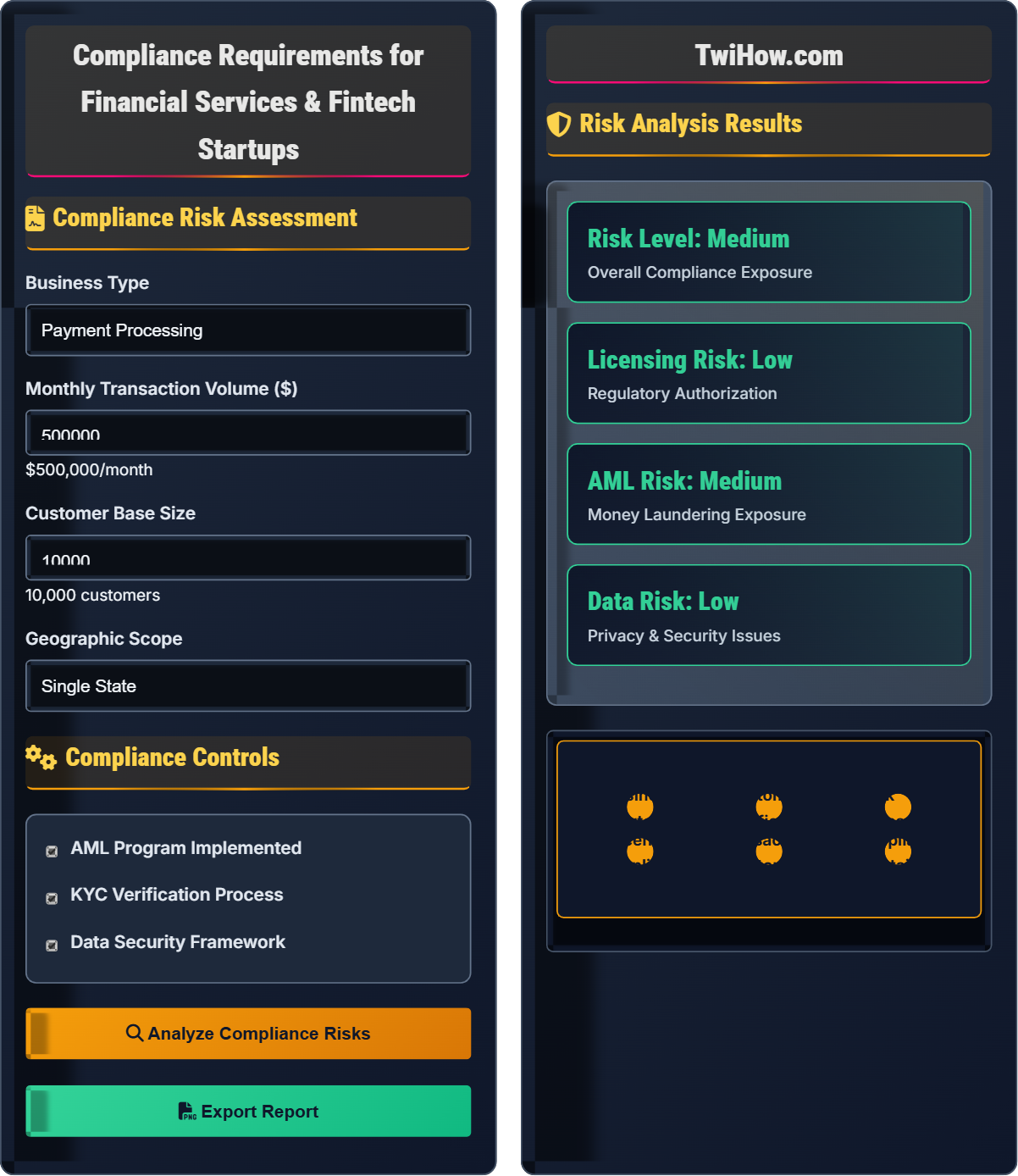
Compliance Risk Assessment
Compliance Controls
Risk Analysis Results
Started
Applied
Verified
Monitored
Managed
Maintained
| Risk Area | Severity | Mitigation |
|---|---|---|
| Licensing Gaps | Medium | State-by-state authorization |
| AML/BSA Compliance | High | Robust monitoring programs |
| Data Privacy | Medium | GDPR/CCPA compliance |
| Consumer Protection | Low | Clear disclosure policies |
| Operational Risk | Medium | Internal controls |
Compliance Requirements for Financial Services & Fintech Startups
Financial services and fintech companies must comply with a complex regulatory framework designed to protect consumers, maintain financial stability, and prevent illegal activities. Compliance requirements vary by business model, transaction volume, and geographic scope, but all financial institutions must adhere to core regulatory standards including licensing, anti-money laundering, consumer protection, and data security requirements.
Fintech compliance operates under multiple regulatory frameworks:
Where:
- Licensing: State and federal authorization requirements for financial services
- AML: Anti-money laundering and Bank Secrecy Act compliance
- Consumer Protection: Fair lending, privacy, and disclosure requirements
- Data Security: Cybersecurity and data privacy regulations
Primary regulatory authorities for fintech compliance:
- Federal Reserve: Banking supervision and monetary policy
- OCC: National bank regulation and supervision
- FDIC: Deposit insurance and bank safety
- CFTC: Derivatives and commodity futures regulation
- SEC: Securities and investment advisory services
- State Regulators: Money transmission and state-specific requirements
- Early Planning: Build compliance into business model from inception
- Expert Guidance: Engage regulatory counsel and compliance specialists
- Robust Systems: Implement automated compliance monitoring tools
- Staff Training: Regular compliance education for employees
- Documentation: Maintain comprehensive compliance records
- Regular Audits: Conduct periodic compliance assessments
Fintech Compliance Essentials
Licensing requirements, AML/BSA compliance, KYC procedures, data security, consumer protection, regulatory reporting.
Risk = (Transaction Volume × Geographic Scope) + (Business Complexity × Regulatory Requirements)
Where Risk = overall compliance exposure, Transaction Volume = monthly transaction value, Geographic Scope = number of jurisdictions.
- Obtain proper licensing before operating
- Implement comprehensive AML programs
- Maintain accurate transaction records
Regulatory Requirements
Bank Secrecy Act, USA PATRIOT Act, Dodd-Frank Act, state money transmission laws, consumer protection regulations, data privacy laws.
- Regulatory assessment
- Licensing application
- Policy development
- System implementation
- Multi-jurisdictional compliance requirements
- Emerging regulatory changes
- Technology integration needs
- Cost of compliance implementation
Fintech Compliance Quiz
Under federal law, when is a fintech company required to register as a Money Services Business (MSB) with FinCEN?
A fintech company must register as a Money Services Business (MSB) with FinCEN if they engage in money transmission, currency exchange, check cashing, or other designated money services. The requirement is triggered by the nature of the activity, not the payment method or fee amount. Under the Bank Secrecy Act, money transmission includes accepting currency or monetary instruments for transmission to another location or person.
The answer is B) When they transmit money or currency exchange.
The MSB registration requirement is activity-based rather than transaction-size based. Companies that facilitate the movement of funds, regardless of whether they handle physical cash, must register as MSBs. This ensures that FinCEN can monitor potential money laundering and other financial crimes across the entire money services sector.
Money Services Business (MSB): Entity providing money transmission or related services
Money Transmission: Accepting currency for transmission to another location
FinCEN: Financial Crimes Enforcement Network, Treasury Department agency
• Activity-based registration requirement
• Applies to electronic transfers
• Includes virtual currency exchanges
• Register before beginning operations
• Consider state licensing requirements
• Maintain ongoing compliance obligations
• Assuming electronic-only transfers don't require registration
• Delaying registration until after launch
• Confusing MSB requirements with other licenses
Explain when financial institutions must file Suspicious Activity Reports (SARs) and describe the process and timeline for filing. What are the consequences of failing to file required SARs?
SAR Filing Triggers: Financial institutions must file SARs when they detect possible violations of law or suspicious transactions related to money laundering, terrorist financing, or other criminal activity. Specific triggers include:
• Transactions aggregating $5,000 or more that involve potential money laundering
• Transactions aggregating $2,000 or more involving known or suspected violations
• Insider abuse regardless of amount
• Transactions that appear designed to evade recordkeeping or reporting requirements
Filing Timeline: SARs must be filed within 30 calendar days after the date of initial detection of facts that may constitute a basis for filing. If no suspect is identified within 30 days, the institution has 60 days to file.
Process: Institutions must complete FinCEN Form 111, detailing the suspicious activity, parties involved, and relevant transaction information. The report is filed electronically through FinCEN's BSA E-Filing System.
Consequences: Failure to file required SARs can result in significant civil monetary penalties, criminal prosecution, regulatory enforcement actions, and reputational damage. Regulatory agencies closely monitor SAR compliance as part of their examination processes.
SARs serve as a critical tool for law enforcement and regulatory agencies to detect and investigate financial crimes. The filing requirements are designed to capture potential criminal activity early in the process, enabling authorities to trace financial networks and prevent further illegal activities. The strict timelines ensure that relevant information is reported promptly while details are fresh.
Suspicious Activity Report (SAR): Report of potentially illegal financial activity
Initial Detection: Date when institution first identifies suspicious activity
FinCEN Form 111: Standard form for SAR submissions
• File within 30 days of detection
• Aggregate amounts across accounts
• Maintain confidentiality requirements
• Implement automated detection systems
• Train staff on SAR criteria
• Maintain detailed documentation
• Missing filing deadlines
• Not aggregating related transactions
• Failing to document decision process
A fintech startup based in California plans to offer payment processing services to merchants nationwide. The company processes an average of $2 million in transactions per month. What state licensing requirements must the company fulfill, and what are the key compliance obligations associated with multi-state operations?
Primary Requirements: The company must obtain money transmission licenses in each state where it operates, unless it qualifies for specific exemptions. Most states require licensing for companies that transmit money or provide payment services.
Capital Requirements: Most states require net worth minimums ranging from $250,000 to $1 million, plus surety bonds. With $2 million monthly transactions, the company will likely exceed most state thresholds requiring licensing.
Compliance Obligations: Multi-state operations require compliance with varying state regulations, including transaction reporting, consumer protection standards, and examination requirements.
Efficiency Strategies: The company may consider applying for a federal thrift charter, which would preempt state licensing requirements, or joining the Multi-State Money Services Compact if eligible.
Ongoing Requirements: Annual examinations, quarterly reports, compliance officer designation, and maintenance of physical office or registered agent in each licensed state.
Timeline: State licensing typically takes 6-12 months, so the company should begin applications early in their expansion strategy.
This scenario highlights the complexity of multi-state fintech operations. Each state maintains its own licensing requirements, creating a patchwork of regulations that companies must navigate. The capital requirements and compliance obligations can significantly impact business operations and expansion timelines, emphasizing the need for early planning and expert guidance.
Money Transmission: Accepting money for transmission elsewhere
Thrift Charter: Federal banking charter that preempts state requirements
Multi-State Compact: Agreement simplifying multi-state licensing
• Operate only with proper state authorization
• Meet capital and bonding requirements
• Prioritize high-volume state applications
• Consider federal charter options
• Engage regulatory counsel early
• Operating without proper licensing
• Underestimating capital requirements
• Not planning for multi-state complexity
A US-based fintech company that offers cryptocurrency trading services has customers in Europe. Under GDPR, what data protection obligations apply to the company's handling of European customer data? How should the company structure its compliance program?
GDPR Applicability: The company falls under GDPR jurisdiction because it processes personal data of European residents, regardless of the company's location. Article 3 of GDPR applies to processing activities related to offering goods/services to EU residents.
Key Obligations: Obtain explicit consent for data processing, implement privacy-by-design principles, appoint a representative in the EU if not established there, conduct Data Protection Impact Assessments for high-risk processing, and maintain records of processing activities.
Individual Rights: Provide mechanisms for data access, portability, erasure, and objection to processing. Establish procedures for responding to requests within 30 days.
Breach Notification: Report data breaches to supervisory authorities within 72 hours and to affected individuals when likely to result in high risk to their rights and freedoms.
Compliance Structure: Implement appropriate technical and organizational measures, conduct regular compliance audits, and ensure staff training on GDPR requirements. Consider Standard Contractual Clauses for international data transfers.
Penalties: Non-compliance can result in fines up to €20 million or 4% of annual global turnover, whichever is higher.
GDPR extraterritoriality means that companies serving EU residents must comply with EU data protection standards regardless of their location. This principle extends beyond traditional business models to emerging sectors like fintech and cryptocurrency, requiring companies to adapt their systems and processes to meet stringent European standards.
GDPR Extraterritoriality: Application of GDPR to non-EU companies serving EU residents
Data Protection Impact Assessment: Analysis of data processing risks
Standard Contractual Clauses: Approved data transfer mechanisms
• Consent must be explicit and specific
• Data breach notifications required within 72 hours
• Right to erasure and portability apply
• Implement privacy-by-design from start
• Maintain detailed processing records
• Regular compliance monitoring
• Assuming GDPR doesn't apply to US companies
• Not implementing appropriate technical measures
• Failing to prepare for individual rights requests
Under the Dodd-Frank Act, when does the Consumer Financial Protection Bureau (CFPB) have supervisory authority over a fintech company?
Under the Dodd-Frank Act, the CFPB has supervisory authority over companies that offer consumer financial products or services, regardless of size. The CFPB defines "larger participants" in specified markets that are subject to direct supervision, but smaller companies may still be subject to CFPB enforcement actions for violations of federal consumer financial law.
The answer is C) When the company offers consumer financial products or services.
The CFPB's broad supervisory authority extends to all companies offering consumer financial products or services, reflecting Congress's intent to protect consumers across the entire financial services spectrum. This includes traditional banks, fintech companies, payday lenders, and other non-bank financial institutions that serve consumers.
Consumer Financial Product: Loan, deposit, payment, or investment service
Larger Participant: Company exceeding CFPB's size thresholds
Supervisory Authority: Power to examine and enforce compliance
• Applies to all consumer financial services
• Size doesn't determine applicability
• Focuses on consumer protection
• Understand consumer protection laws
• Maintain compliance documentation
• Prepare for potential examinations
• Assuming CFPB only supervises large banks
• Not preparing for examinations
• Ignoring consumer protection requirements
FAQ
Q: What licenses do I need to start a payment processing company?
A: For a payment processing company, you'll typically need:
1. Money Transmitter License: Required in each state where you operate
2. MSB Registration: With FinCEN at the federal level
3. State Business License: General business operation license
4. Payment Card Industry Compliance: PCI DSS certification
5. Bank Partnership: Agreements with FDIC-insured banks
Requirements vary by state, but typically include minimum net worth/capital ($250K-$1M), surety bonds, compliance programs, and ongoing reporting. Some companies pursue federal thrift charters to simplify licensing.
Q: How much does fintech compliance typically cost?
A: Fintech compliance costs vary significantly but typically include:
• Licensing: $50K-$500K for initial setup across multiple states
• Legal & Compliance Staff: $200K-$1M+ annually
• Technology & Systems: $100K-$2M+ for AML/KYC platforms
• Ongoing Compliance: $100K-$500K annually for monitoring
• Examinations & Audits: $50K-$200K+ periodically
For early-stage companies, compliance costs often represent 10-20% of operating expenses. Larger companies may spend millions annually on compliance infrastructure and operations.