Legal Requirements for Hiring Employees vs Contractors
Complete employment law guide • Classification & compliance
Employee vs Contractor:
Classification ToolProperly classifying workers as employees or independent contractors is crucial for legal compliance. Misclassification can result in significant penalties, back taxes, and legal liability. The classification depends on the level of control, independence, and economic relationship between the parties.
Key differences include:
- Tax Obligations: Employers must withhold taxes for employees; contractors handle their own
- Benefits: Employees receive benefits like health insurance, PTO, and workers' comp
- Control: Employees work under employer direction; contractors have operational independence
- Liability: Different legal responsibilities and protections for each classification
Understanding these distinctions helps businesses remain compliant and avoid costly misclassification penalties.
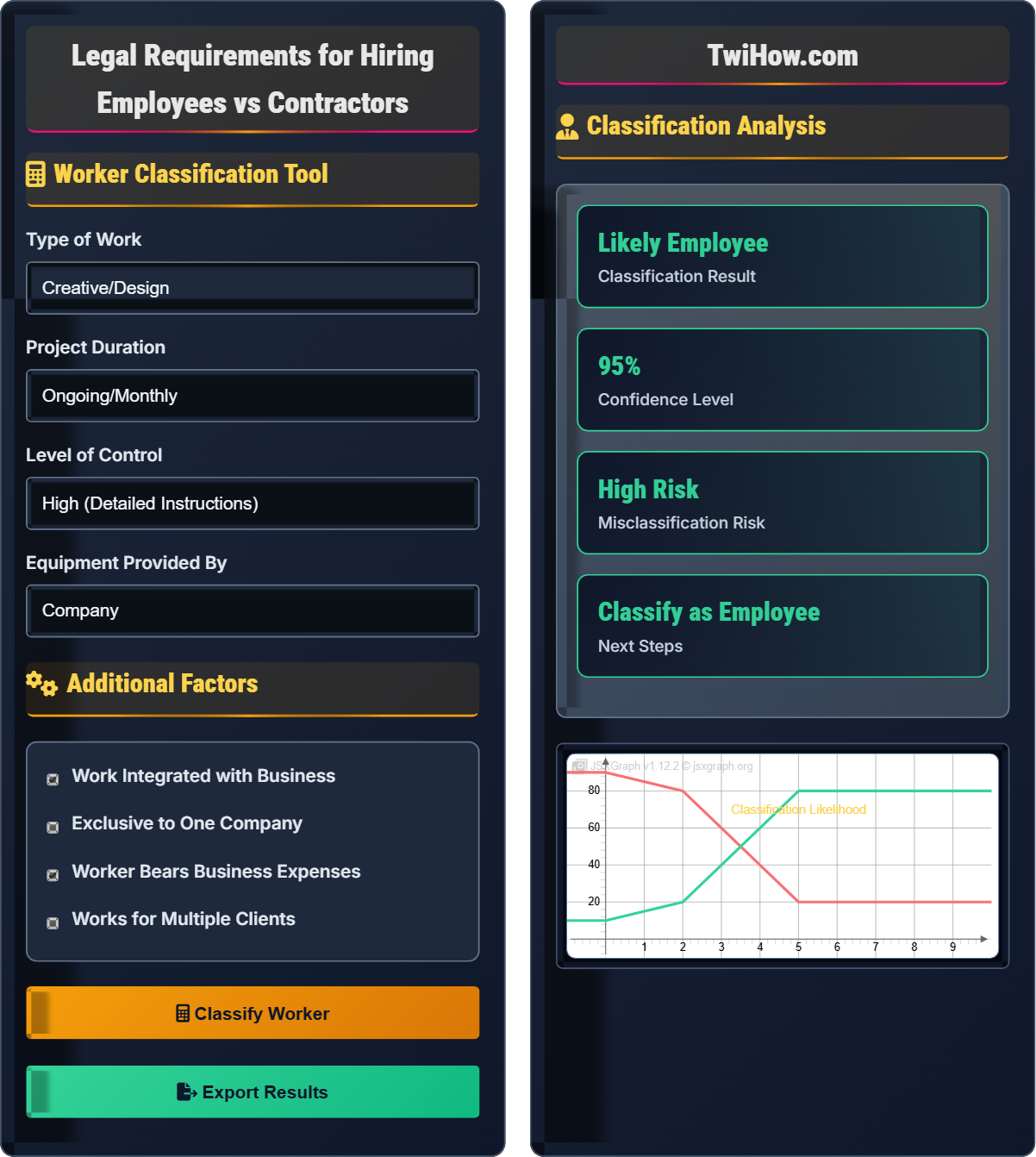
Worker Classification Tool
Additional Factors
Classification Analysis
| Factor | Score | Weight | Impact |
|---|---|---|---|
| Level of Control | High | 25% | Employee Indicator |
| Integration with Business | High | 20% | Employee Indicator |
| Duration of Work | Ongoing | 15% | Employee Indicator |
| Equipment Provided | Company | 10% | Employee Indicator |
Understanding Employee vs Contractor Classification
Worker classification determines whether an individual is an employee or an independent contractor. This classification affects legal obligations, tax responsibilities, and rights of both parties. Proper classification is essential for compliance with federal and state laws.
Key factors that determine classification include:
- Behavioral Control: Whether the company controls or has the right to control what the worker does and how the work is done
- Financial Control: Whether the business has the right to control the financial and business aspects of the worker's job
- Type of Relationship: Written contracts, benefits, permanency of the relationship, and whether the work is a key aspect of the business
Employees work under the direction and control of the employer. The employer provides training, tools, and sets schedules. Employees typically receive benefits and have taxes withheld from their paychecks.
Independent contractors control how they perform their work. They provide their own tools, set their own schedules, and handle their own taxes. They typically work for multiple clients and operate as their own business.
For employees, employers must withhold federal income tax, Social Security, and Medicare taxes. For contractors, no taxes are withheld, but they must pay self-employment tax.
Employees are entitled to benefits like health insurance, workers' compensation, unemployment insurance, and protection under labor laws. Contractors are not entitled to these benefits.
Employers must withhold federal income tax, Social Security tax (6.2%), and Medicare tax (1.45%) from employee wages. Employers must also pay their share of Social Security and Medicare taxes.
Most states require employers to carry workers' compensation insurance to cover workplace injuries and illnesses. This provides medical benefits and wage replacement.
Employers must pay federal and state unemployment taxes to fund unemployment benefits for workers who lose their jobs through no fault of their own.
Employees are protected by wage and hour laws, anti-discrimination laws, and safety regulations. Employers must comply with minimum wage, overtime, and workplace safety standards.
Depending on company size and state laws, employers may be required to provide health insurance, paid time off, and other benefits to qualifying employees.
Contractors pay self-employment tax (15.3%) and must make quarterly estimated tax payments. They receive Form 1099-NEC for payments over $600.
Contractors control their work methods, schedule, and tools. They can work for multiple clients and subcontract work to others.
Contractors must obtain their own insurance including professional liability, general liability, and health insurance.
Contractors operate as independent businesses, handling their own business expenses, equipment, and marketing.
Worker misclassification can occur when:
- Control: Treating contractors like employees by controlling their work methods and schedules
- Integration: Workers performing core business functions without proper employee status
- Exclusivity: Contractors who work exclusively for one company
- Benefits: Providing employee-like benefits to contractors
- Tools: Providing all tools and equipment to contractors
Employee vs Contractor Requirements Comparison
| Aspect | Employee | Independent Contractor |
|---|---|---|
| Tax Withholding | Employer withholds income tax, Social Security, Medicare | Contractor pays own taxes, receives 1099 |
| Workers' Compensation | Employer provides coverage | Contractor provides own coverage |
| Unemployment Insurance | Employer pays taxes, employee eligible for benefits | Contractor not eligible for unemployment |
| Benefits | May receive health, dental, PTO, retirement | No employer-provided benefits |
| Control | Employer controls work methods and schedule | Contractor controls own work methods |
| Training | Employer provides training and direction | Contractor provides own training |
| Tools & Equipment | Employer typically provides | Contractor typically provides own |
| Legal Protections | Protected by wage, hour, and anti-discrimination laws | Limited legal protections |
Factors to consider when determining worker classification:
IRS Common-Law Rules
Real-World Classification Scenarios
A tech company hires a software developer to work on a specific project for 6 months. The developer works from home but follows company coding standards, uses company tools, reports daily to managers, and works exclusively for the company during the project period.
Key Factors: Behavioral control, financial dependence, and exclusive relationship.
A marketing firm hires a graphic designer on a contract basis. The designer works from their own studio, sets their own hours, provides their own equipment, invoices monthly for completed projects, and works for multiple clients simultaneously.
Key Factors: Independence, multiple clients, and self-directed work.
A manufacturing company hires a maintenance technician to work on-call basis. The technician uses company tools, follows company safety protocols, reports to maintenance supervisor, and works primarily for the company but occasionally for others.
Key Factors: Integration with business, supervision, and core function.
Employee vs Contractor Classification Quiz
Which of the following is NOT one of the three main factors the IRS considers when determining worker classification?
The IRS uses three main factors to determine worker classification: Behavioral Control, Financial Control, and Type of Relationship. Years of experience is not a factor in determining whether someone is an employee or independent contractor. The IRS focuses on the level of control and independence in the working relationship, not the worker's skill level or experience.
The answer is D) Years of Experience.
The IRS Common-Law Rules provide a framework for evaluating worker classification based on the nature of the working relationship. These factors help distinguish between an employment relationship (where the employer controls the work) and a business relationship (where the worker maintains independence). The classification is based on the reality of the working relationship, not the worker's qualifications.
Behavioral Control: Right to direct what work is done and how it's performed
Financial Control: Right to control financial and business aspects of work
Type of Relationship: Written contracts, benefits, permanency, and business integration
• Focus on actual working relationship, not job title
• All three factors are considered together
• No single factor is determinative
• Document the working relationship clearly
• Ensure actual practices match classification
• Consult with employment attorney when uncertain
• Assuming job title determines classification
• Focusing on only one factor
• Not considering actual working practices
Explain the tax obligations for employers when hiring employees versus independent contractors. What forms must be filed and when?
Employee Tax Obligations:
• Withhold federal income tax based on Form W-4
• Withhold Social Security tax (6.2%) and Medicare tax (1.45%)
• Pay employer's share of Social Security (6.2%) and Medicare (1.45%)
• File Form 941 quarterly for employment taxes
• File Form W-2 annually for each employee
• Pay federal unemployment tax (FUTA) and state unemployment tax (SUTA)
Contractor Tax Obligations:
• No tax withholding required
• Issue Form 1099-NEC for payments over $600 annually
• File Form 1099-NEC with IRS by January 31
• No employment taxes paid by employer
• Contractor pays self-employment tax (15.3%)
Timing: Employment taxes are due quarterly, while 1099s are due annually.
The tax obligations differ significantly between employees and contractors. For employees, employers must handle complex withholding and reporting requirements. For contractors, employers have simpler reporting obligations but must ensure proper classification. The tax differences can significantly impact both parties' financial obligations.
Form W-4: Employee's Withholding Certificate
Form W-2: Wage and Tax Statement for employees
Form 1099-NEC: Nonemployee Compensation statement
• Forms must be filed on time to avoid penalties
• Employment taxes are due quarterly
• 1099s must be sent by January 31
• Use payroll services to manage compliance
• Set up automatic tax deposits
• Maintain accurate records throughout the year
• Missing filing deadlines
• Incorrectly calculating withholding
• Failing to track contractor payments
A company classified 5 workers as independent contractors when they should have been classified as employees. The workers earned $30,000 each annually. Calculate the potential tax liability for the company including back taxes, penalties, and interest for one year.
Back Tax Calculations:
• Total wages: $30,000 × 5 = $150,000
• Social Security tax (employer portion): $150,000 × 6.2% = $9,300
• Medicare tax (employer portion): $150,000 × 1.45% = $2,175
• Total employer tax liability: $9,300 + $2,175 = $11,475
Penalties and Interest:
• Failure to deposit penalty: 2-15% of unpaid taxes
• Failure to file penalty: 5% per month (up to 25%)
• Interest on unpaid taxes: Federal rate (currently ~3-6%)
Estimated Total Liability: $11,475 (taxes) + $3,000-$5,000 (penalties) + $500-$1,000 (interest) = $15,000-$17,500
Additional Costs: Potential worker's compensation premiums, unemployment insurance, and possible benefits.
Misclassification can result in significant financial penalties beyond just the back taxes owed. The IRS and state agencies take misclassification seriously because it affects government revenues and worker protections. Companies may also face liability for unpaid benefits and insurance premiums that should have been provided to employees.
Misclassification: Incorrectly treating employee as contractor
Back Taxes: Unpaid taxes from previous periods
Penalties: Additional charges for non-compliance
• Penalties increase over time
• Interest accrues on unpaid taxes
• Multiple agencies may assess penalties
• Correct misclassification immediately when discovered
• Consider voluntary classification settlement programs
• Consult with tax professionals for complex situations
• Assuming contractors save money automatically
• Not reviewing classifications regularly
• Ignoring warning signs of misclassification
A marketing company wants to hire a graphic designer to work on projects 3-4 days per week for 8 months. The designer will work from the company's office, use company equipment, follow company policies, and report to a supervisor. The designer has other clients but works primarily for this company. Should this person be classified as an employee or independent contractor?
Classification Decision: Employee - This worker should be classified as an employee based on the following factors:
Employee Indicators:
• Works from company office (location control)
• Uses company equipment (financial control)
• Follows company policies (behavioral control)
• Reports to supervisor (direction and control)
• Regular schedule (integration with business)
Contractor Indicators:
• Works for other clients (independence factor)
Overall Assessment: The level of control exercised by the company and the integration with business operations strongly indicate employee status. The fact that the worker has other clients doesn't override the other employee characteristics.
Recommendation: Classify as employee to ensure compliance with employment laws and tax obligations.
Classification is determined by looking at the totality of the working relationship. While having multiple clients is a contractor indicator, the other factors in this scenario strongly suggest an employee relationship. The company exercises significant control over how, when, and where the work is performed, which is characteristic of an employer-employee relationship.
Integration: Degree to which worker's services are integral to business
Control: Right to direct and supervise work performanceIndependence: Freedom to control work methods and schedule
• Consider all factors together
• Focus on actual working relationship
• Control factors typically weigh heavily
• Document the working arrangement clearly
• Ensure practices match classification
• Seek legal guidance for borderline cases
• Focusing on only one or two factors
• Assuming written contracts override reality
• Not considering the degree of control
Which of the following legal protections apply to employees but NOT to independent contractors?
All of the listed protections apply to employees but not to independent contractors. Employees are covered by minimum wage and overtime laws under the Fair Labor Standards Act, anti-discrimination protections under Title VII and other statutes, and workers' compensation coverage under state laws. Independent contractors are not covered by these employment laws because they are considered to be in business for themselves.
The answer is D) All of the above.
Employee status comes with a comprehensive set of legal protections designed to ensure fair treatment and safe working conditions. These protections exist because of the inherent power imbalance between employers and employees. Independent contractors, as business owners, are expected to protect their own interests and negotiate their own terms of service.
FLSA: Fair Labor Standards Act (wage and hour law)
Title VII: Anti-discrimination law (race, gender, religion)
Workers' Compensation: Insurance for workplace injuries
• Employment laws protect only employees
• Contractors must protect themselves
• Misclassification removes these protections
• Understand which protections apply to each classification
• Ensure proper insurance coverage
• Review classifications regularly
• Assuming contractors have same protections as employees
• Not considering insurance implications
• Overlooking wage and hour obligations
Frequently Asked Questions
Expert Q&A
Q: I run a small consulting firm and sometimes hire specialists for specific projects. How do I determine if they should be employees or contractors?
A: For project-based specialists, consider these key factors:
Independent Contractor Indicators:
• Specialists provide their own tools and equipment
• They set their own schedules and work methods
• They invoice for completed projects (not hourly wages)
• They work for multiple clients simultaneously
• They can subcontract work to others
Employee Indicators:
• You provide training and direction on how to perform work
• They follow your company policies and procedures
• You control their schedule and work location
• They work exclusively for your company
Best Practice: Document the working arrangement in a clear contract specifying the contractor status and ensuring they maintain independence. Review the actual working relationship periodically to ensure it matches the classification.
Q: We have a worker who has been with us for 2 years as a "contractor" but works full-time and follows our policies. Is this a problem?
A: Yes, this is likely a significant misclassification problem:
Employee Indicators Present:
• Long-term relationship (2 years) suggests permanency
• Full-time work indicates economic dependence
• Following company policies indicates behavioral control
• Integration with business operations
Potential Consequences:
• Back taxes for 2 years (Social Security, Medicare, unemployment)
• Penalties and interest on unpaid taxes
• Potential workers' compensation and benefit obligations
• Possible wage and hour liability
Immediate Action:
1. Consult with employment attorney immediately
2. Consider the IRS Voluntary Classification Settlement Program
3. Either reclassify the worker as an employee or significantly change the working relationship to meet contractor criteria
4. Review all similar arrangements in your organization
This type of arrangement is a common target for IRS audits due to the clear mismatch between classification and actual working relationship.