Legal Considerations for Using User-Generated Content
Complete legal guide • Step-by-step explanations
UGC Legal Fundamentals:
Show Legal AnalyzerUser-Generated Content (UGC) presents complex legal challenges for digital platforms. Key considerations include copyright ownership, liability exposure, privacy compliance, and content moderation. Platforms must establish clear terms of service, implement effective takedown procedures, and ensure compliance with regulations like the DMCA and GDPR.
Key legal areas:
- Copyright: Ownership, fair use, licensing, and infringement
- Liability: Platform responsibility for user content
- Privacy: Data protection and user consent
- Compliance: Regulatory requirements and takedown procedures
Successful UGC platforms balance legal protection with user engagement through comprehensive policies, effective moderation tools, and clear guidelines that protect both the platform and its users.
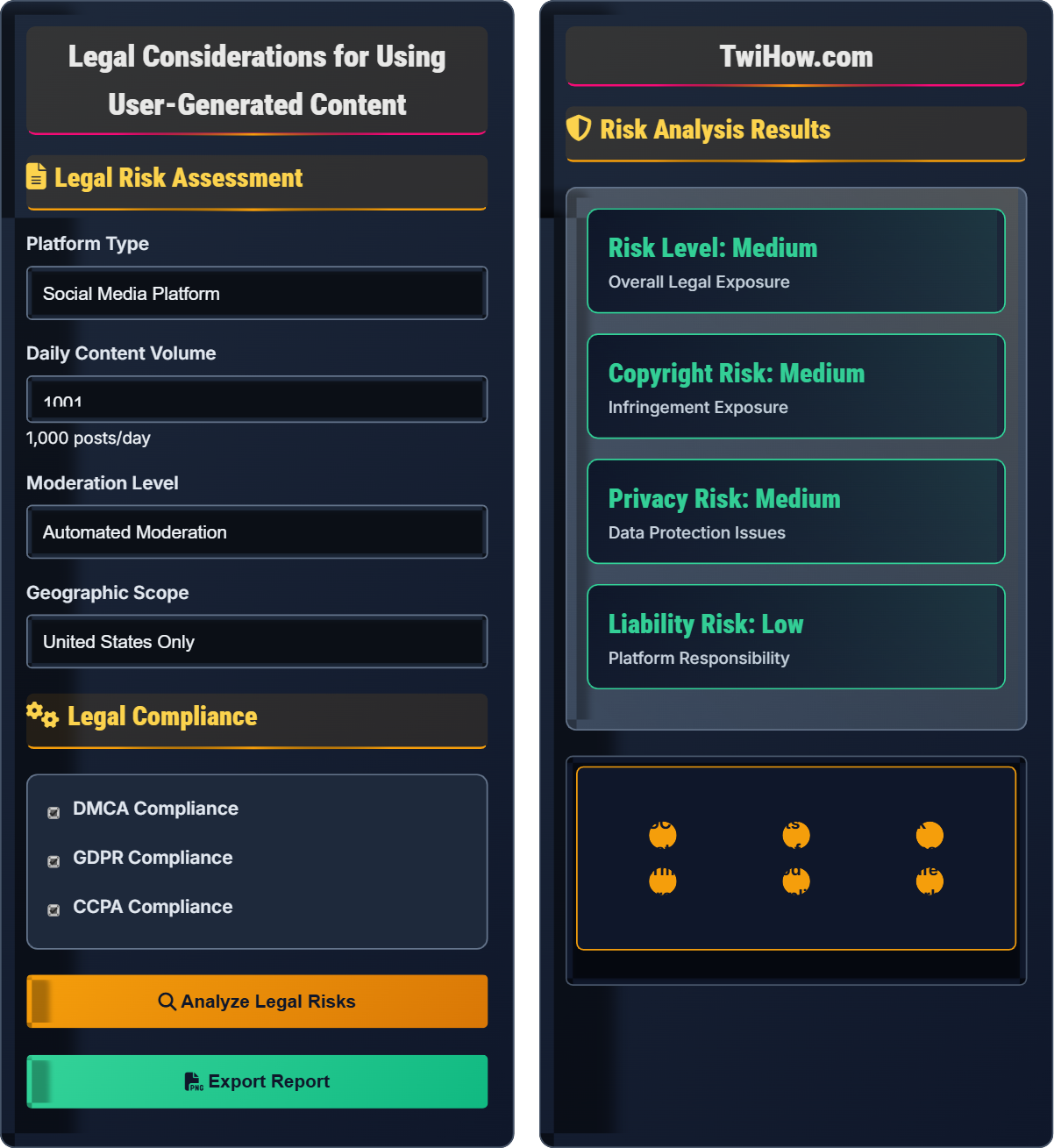
Legal Risk Assessment
Legal Compliance
Risk Analysis Results
Posted
Agreed
Transferred
Applied
Managed
Harbor
| Risk Area | Severity | Mitigation |
|---|---|---|
| Copyright Infringement | Medium | DMCA takedown procedures |
| Defamation Claims | Low | Section 230 protection |
| Privacy Violations | Medium | GDPR compliance |
| Trademark Issues | Low | Notice and takedown |
| Child Safety | High | COPPA compliance |
Legal Considerations for User-Generated Content
User-Generated Content (UGC) refers to any form of content—text, videos, images, audio, comments, reviews, or other media—that is created and published by users rather than the platform itself. UGC platforms must navigate complex legal landscapes including copyright law, liability protection, privacy regulations, and content moderation requirements.
UGC platforms operate under multiple overlapping legal frameworks:
Where:
- Copyright: Protection of original works and fair use considerations
- Liability: Platform responsibility under Section 230 and safe harbor provisions
- Privacy: Data protection laws like GDPR and CCPA
- Compliance: Regulatory requirements and reporting obligations
Primary legal considerations for UGC platforms:
- Copyright Law: Fair use, licensing, takedown procedures, safe harbor provisions
- Platform Liability: Section 230 protection, intermediary liability
- Privacy Rights: Data protection, consent management, user control
- Content Moderation: Community guidelines, enforcement, appeals
- International Compliance: Cross-border regulations, localization
- Children's Safety: COPPA compliance, age verification
- Clear Terms: Comprehensive user agreements with explicit content policies
- Responsive Moderation: Efficient takedown procedures and appeal processes
- Regular Updates: Periodic review of policies to reflect legal changes
- Transparency: Clear reporting of content removal and legal requests
- User Education: Guidelines helping users understand legal requirements
- Legal Counsel: Ongoing consultation with specialized attorneys
UGC Legal Essentials
Terms of service, copyright policies, privacy compliance, content moderation, liability protection, user rights.
Risk = (Copyright × Volume) + (Privacy × Scope) + (Liability × Exposure)
Where Risk = overall legal exposure, Copyright = infringement probability, Privacy = data protection compliance.
- Implement DMCA safe harbor procedures
- Obtain proper user consent for content use
- Respect user privacy rights
Compliance Areas
DMCA, GDPR, CCPA, COPPA, Section 230, international privacy laws, content moderation requirements.
- Policy development
- User education
- Technical implementation
- Monitoring and enforcement
- Geographic variations in law
- Changing regulatory landscape
- Technical implementation costs
- User experience impact
UGC Legal Quiz
When a user uploads original content to a social media platform, who owns the copyright to that content?
Under copyright law, the creator of original content (the user) retains ownership of their copyright. However, when users upload content to platforms, they typically grant the platform a license to use, reproduce, and distribute the content according to the platform's terms of service. The license terms vary by platform but generally allow the platform to host, display, and distribute the content while the user maintains underlying ownership.
The answer is B) The user retains ownership but grants licenses.
Understanding the distinction between copyright ownership and licensing is crucial for UGC platforms. Users retain ownership of their original works, but they grant platforms the rights needed to operate the service. This arrangement allows platforms to function while respecting creators' rights. The terms of the license (scope, duration, revocability) are defined in the platform's terms of service.
Copyright: Exclusive legal right to use and distribute original creative work
Licensing: Granting permission to use copyrighted material under specified terms
Ownership: Legal right to control and benefit from copyrighted work
• Original creators retain copyright ownership
• Platforms need licenses to use content
• License terms are defined in ToS agreements
• Clearly state licensing terms in ToS
• Allow users to revoke licenses when content is deleted
• Distinguish between viewing and commercial use rights
• Assuming platforms own user content
• Not clearly defining license scope
• Failing to address content removal rights
Explain how Section 230 of the Communications Decency Act protects online platforms from liability for user-generated content. What are the limitations and requirements for this protection?
Section 230 Protection: Section 230(c)(1) states that "No provider or user of an interactive computer service shall be treated as the publisher or speaker of any information provided by another information content provider." This means platforms are generally not liable for third-party content posted by users.
Requirements for Protection: To qualify for Section 230 protection, platforms must act as intermediaries rather than creators of the content. They can moderate content without losing protection, but cannot be the "originator" of illegal content.
Limitations: Section 230 does not protect against federal criminal law violations, intellectual property claims (covered by DMCA), or content created by the platform itself. Recent legal challenges have also questioned the scope of protection for algorithmic amplification.
Additional Protections: The DMCA provides safe harbor for copyright infringement claims when platforms implement proper takedown procedures.
Section 230 is foundational to the modern internet economy, allowing platforms to host user content without facing liability for every post. However, this protection is not absolute and comes with responsibilities. Understanding the boundaries helps platforms structure their operations to maximize protection while fulfilling their duties.
Interactive Computer Service: Online platform that provides access to content created by others
Information Content Provider: Person responsible for creation of content
Safe Harbor: Legal protection from liability under certain conditions
• Platforms are not publishers of user content
• Must not create illegal content themselves
• Cannot claim protection for IP violations
• Maintain clear user-generated content policies
• Document moderation practices
• Distinguish between user and platform content
• Assuming absolute immunity from all liability
• Not implementing proper takedown procedures
• Overstepping into content creation
A European e-commerce platform receives user reviews that include personal information about other customers. The platform uses this data for recommendation algorithms. Under GDPR, what legal obligations does the platform have regarding this user-generated content containing personal data? How should they handle consent and data processing?
GDPR Obligations: The platform must treat user reviews containing personal information as personal data under GDPR, regardless of whether they were voluntarily provided by users.
Consent Requirements: Processing personal data from reviews requires lawful basis under Article 6. This could be legitimate interests (for business operations) or explicit consent for special processing activities like algorithmic recommendations.
Data Subject Rights: Individuals mentioned in reviews have rights to access, rectification, erasure, and restriction of processing. The platform must implement procedures to handle these requests even when data appears in user-generated content.
Technical Measures: Implement data minimization by limiting personal information in reviews, provide clear privacy notices about data usage, and ensure automated processing complies with GDPR transparency requirements.
Documentation: Maintain records of processing activities and conduct DPIAs for high-risk processing like profiling based on UGC.
This scenario illustrates the complexity of GDPR compliance with UGC. Even when personal data is shared by users, it still triggers GDPR obligations. Platforms must balance user-generated content freedom with data protection rights, often requiring technical solutions to minimize data exposure while maintaining functionality.
Personal Data: Any information relating to an identified or identifiable person
Data Minimization: Principle requiring collection of only necessary data
DPIA: Data Protection Impact Assessment for high-risk processing
• All personal data triggers GDPR obligations
• Consent must be freely given and specific
• Data subjects have rights regardless of data source
• Implement content guidelines to limit personal data
• Provide clear privacy notices about data use
• Create procedures for handling data subject requests
• Assuming UGC is exempt from data protection
• Not implementing data subject rights procedures
• Failing to conduct DPIAs for automated processing
A content-sharing platform receives a DMCA takedown notice for a video that contains 10 seconds of copyrighted music in the background. The video is primarily original content, but the music appears incidentally. How should the platform respond to balance copyright protection with fair use considerations? What steps should they take?
Initial Response: The platform should temporarily remove the content upon receiving a valid DMCA notice to maintain safe harbor protection, but prepare for potential counter-notice.
Legal Assessment: Evaluate if the use qualifies for fair use considering: (1) purpose and character of use, (2) nature of copyrighted work, (3) amount used, and (4) effect on market value. Background music for 10 seconds in original content may qualify as de minimis use or fair use.
Counter-Notice Procedure: Inform the uploader of the takedown and their right to file a counter-notice. If a counter-notice is filed, the platform must restore content within 10-14 days unless the copyright holder files a lawsuit.
Best Practices: Implement automated systems that flag potentially problematic content, provide educational resources about fair use, and maintain clear policies distinguishing between clear infringement and borderline cases.
Prevention: Offer content identification tools and educational resources to help users avoid copyright issues.
This scenario demonstrates the tension between copyright protection and free expression. DMCA safe harbor requires platforms to respond to valid notices, but users have rights to contest takedowns. The system relies on good faith assessments by both copyright holders and users, with legal recourse for disputed cases.
DMCA Safe Harbor: Protection for platforms that follow notice-and-takedown procedures
Fair Use: Legal doctrine allowing limited use of copyrighted material without permission
De Minimis: Trivial use that doesn't constitute substantial copying
• Respond to valid DMCA notices promptly
• Maintain counter-notice procedures
• Assess fair use on a case-by-case basis
• Train staff on fair use assessment
• Implement content recognition tools
• Provide educational resources to users
• Not implementing proper takedown procedures
• Failing to maintain counter-notice processes
• Not considering fair use implications
Under COPPA, what is the minimum age for children to provide personal information to online services without parental consent?
Under the Children's Online Privacy Protection Act (COPPA), the minimum age for children to provide personal information to online services without parental consent is 13 years old. For children under 13, operators of websites and online services must obtain verifiable parental consent before collecting, using, or disclosing personal information from children. This threshold aligns with similar protections in other jurisdictions, such as GDPR's age of consent provisions.
The answer is B) 13 years old.
COPPA's 13-year threshold reflects a balance between protecting young children's privacy and allowing older children greater autonomy online. The law recognizes that children under 13 may not fully understand the implications of sharing personal information, requiring parental oversight. Platforms must implement age verification systems and parental consent mechanisms to comply with these requirements.
COPPA: Children's Online Privacy Protection Act
Verifiable Parental Consent: Methods to confirm parent's identity and consent
Personal Information: Data collected from children under 13
• No collection from children under 13 without consent
• Verifiable consent required for compliance
• Strict penalties for violations
• Implement robust age verification systems
• Create child-friendly privacy notices
• Maintain separate systems for under-13 users
• Not implementing age verification
• Collecting data without parental consent
• Inadequate verification of parental consent
FAQ
Q: How can I protect my platform from liability for user-generated content while still encouraging creativity?
A: You can achieve this balance through several strategies:
1. Clear Terms of Service: Establish comprehensive user agreements that define acceptable use and content policies
2. DMCA Compliance: Implement safe harbor procedures for copyright takedown notices
3. Section 230 Protection: Structure your platform as an intermediary rather than content creator
4. Community Guidelines: Provide clear, reasonable rules that encourage positive content
5. Responsive Moderation: Implement efficient systems to address genuine violations while minimizing overreach
6. User Empowerment: Give users tools to report inappropriate content and manage their own privacy settings
The key is to create a framework that protects your platform while fostering a positive community environment.
Q: What rights do I retain when I post content on social media platforms?
A: Generally, you retain ownership of your original creative works when posting on social media platforms. However, you grant the platform a license to use, reproduce, and distribute your content according to their terms of service. This license typically includes:
• Right to display your content to other users
• Right to store and transmit your content
• Right to create technical copies necessary for operation
• Right to use your content for promotional purposes (in some cases)
The license usually ends when you delete your content or close your account, though some platforms may retain cached copies. You should review each platform's specific terms to understand the exact scope of rights granted.