Legal Steps to Raise Funds from Investors
Complete funding guide • Legal compliance
Investor Funding Legal Steps:
Funding CalculatorRaising funds from investors requires careful adherence to securities laws, proper documentation, and compliance with federal and state regulations. The process involves multiple legal steps including business structuring, investor qualification, disclosure requirements, and regulatory filings.
Key legal requirements include:
- Securities Law Compliance: Following federal and state securities regulations
- Proper Documentation: Subscription agreements, term sheets, and disclosure documents
- Investor Qualification: Verifying accredited or sophisticated investor status
- Disclosure Requirements: Full and fair disclosure of material information
Failure to comply with these requirements can result in severe penalties and legal consequences.
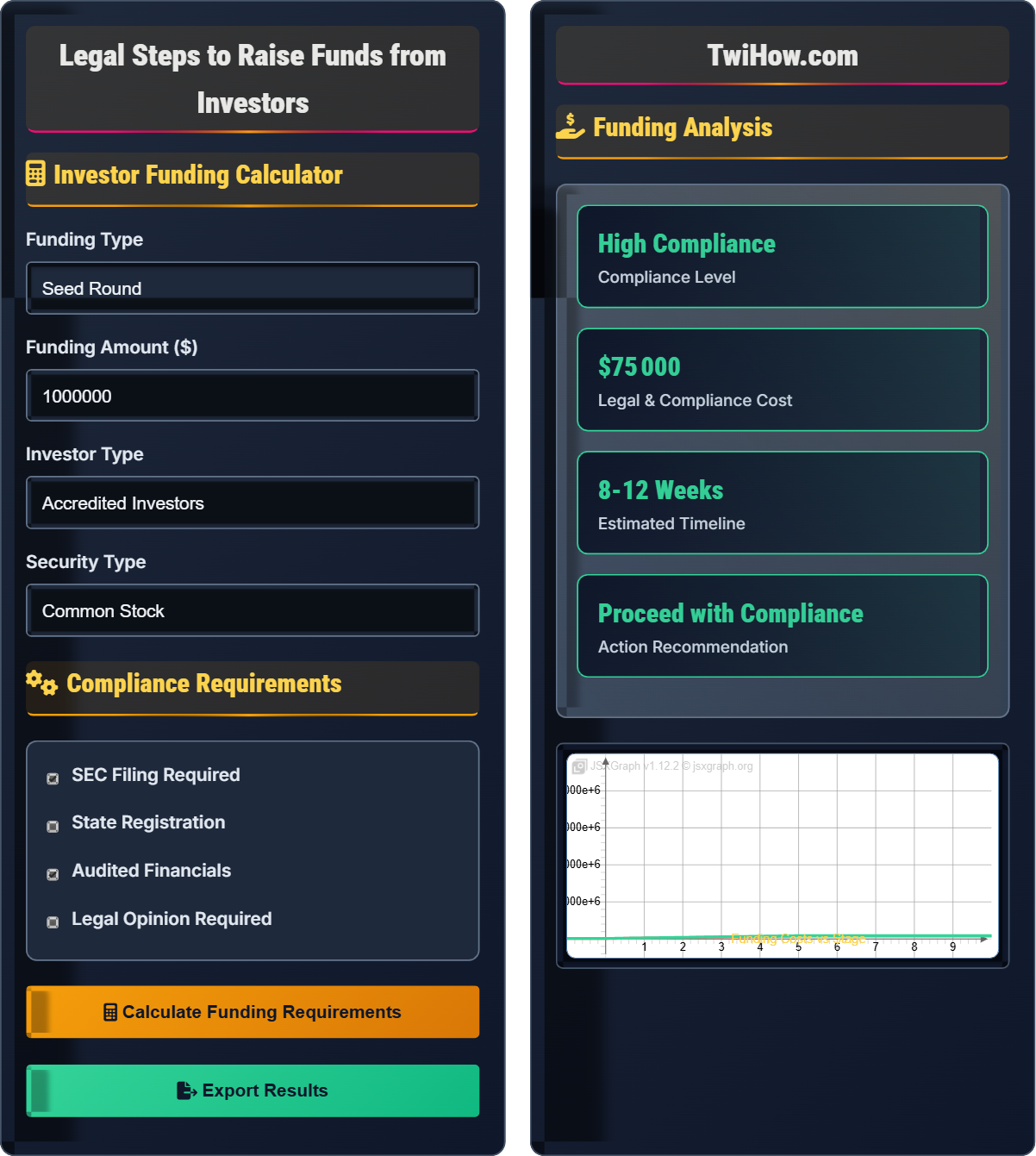
Investor Funding Calculator
Compliance Requirements
Funding Analysis
| Requirement | Level | Cost | Timeline |
|---|---|---|---|
| Securities Law Compliance | High | $25,000 | 4-6 weeks |
| Investor Verification | Medium | $5,000 | 1-2 weeks |
| Documentation | High | $30,000 | 6-8 weeks |
| Regulatory Filing | High | $15,000 | 2-4 weeks |
Understanding Investment Legal Requirements
Securities law governs the sale of investment interests in businesses. The Securities Act of 1933 requires that all securities offerings be registered with the SEC unless they qualify for an exemption. This framework protects investors through mandatory disclosure and regulatory oversight.
Key securities law concepts include:
- Registration Requirements: Most securities offerings must be registered with the SEC
- Exemptions: Private placements, Regulation D, and other exemptions exist
- Disclosure: Material information must be disclosed to investors
- Antifraud Provisions: Prohibitions on fraudulent practices in securities transactions
- State Law: Blue sky laws regulate securities at the state level
Represents ownership in the company with voting rights. Common stockholders have residual claims on assets after debt holders and preferred stockholders are paid.
Has priority over common stock in dividend payments and liquidation. Often includes special rights like anti-dilution protection and board representation.
A debt instrument that converts to equity at a later date, typically at a discount. Often used in early-stage financing to defer valuation.
A convertible security that gives investors rights to future equity without setting a price today. Popular for seed-stage investments.
Ensure your business is properly structured as a corporation or LLC. Review corporate governance documents and ensure all corporate formalities are met.
Decide on the type of securities to offer, funding amount, and investor profile. Consider valuation implications and dilution effects.
Determine appropriate securities law exemptions such as Regulation D, Rule 506(c), or intrastate offerings. Consider registration requirements.
Create subscription agreements, private placement memorandums, term sheets, and investor questionnaires. Ensure full disclosure of material information.
Verify investor accreditation status and sophistication. Complete background checks and compliance verification.
File required forms with the SEC and state regulators. Complete Form D for Regulation D offerings and state blue sky filings.
Verify investors meet accreditation standards for certain exemptions. Individual: $200K+ annual income or $1M+ net worth. Entity: $5M+ in assets.
Provide full and fair disclosure of all material information affecting investment decisions. Include financial statements, risk factors, and business operations.
Comply with federal securities laws, state blue sky laws, and anti-fraud provisions. Maintain proper record-keeping and reporting.
Ensure all investors receive equal treatment and information. Maintain fiduciary duties to investors and avoid preferential treatment.
Businesses often encounter legal issues when raising funds:
- Inadequate Documentation: Missing or incomplete offering documents
- Investor Verification: Failing to properly verify investor status
- Disclosure Deficiencies: Incomplete or misleading material information
- Regulatory Non-Compliance: Missing filing deadlines or requirements
- Improper Valuation: Unrealistic valuations that create legal exposure
Securities Law Exemptions Comparison
| Exemption | Investor Type | Amount Limit | Disclosure Requirements | State Filing |
|---|---|---|---|---|
| Rule 506(b) | Up to 35 Sophisticated + Unlimited Accredited | No Limit | Substantive Disclosure Required | Blue Sky Filing Required |
| Rule 506(c) | Only Accredited Investors | No Limit | General Solicitation Allowed | Blue Sky Filing Required |
| Regulation A+ | Any Investor | $75M (Tier 2) | Qualification Required | SEC Qualification |
| Rule 504 | Any Investor | $5M | Minimal Disclosure | Varies by State |
| Intrastate Offering | Residents of Same State | No Limit | State-Specific | State Filing Only |
Essential steps before approaching investors:
Investment Process Timeline
Key Investment Documents
Real-World Investment Scenarios
A software startup raised $2M in a seed round using SAFE instruments. They properly verified all investors as accredited, prepared comprehensive disclosure documents, and filed the necessary regulatory forms. The process took 10 weeks and cost approximately $40,000 in legal and compliance fees.
Key Lessons: Early preparation of documents and investor verification streamlined the process significantly.
A manufacturing company raised $15M in a Series A round with preferred stock. They encountered delays due to inadequate financial disclosures and had to restructure the offering. The process extended to 16 weeks and cost $85,000 in additional legal fees.
Lessons Learned: Comprehensive financial preparation is crucial for institutional investor rounds.
A biotechnology company prepared for an IPO by ensuring full SEC compliance. They spent 18 months preparing financial statements, conducting audits, and filing registration statements. The process cost over $2 million but resulted in a successful $100M public offering.
Key Insights: Public offerings require extensive compliance and disclosure preparation.
Investment Legal Requirements Quiz
Under which Regulation D exemption can a company sell securities to both accredited and non-accredited investors?
Rule 506(b) allows a company to sell securities to up to 35 sophisticated non-accredited investors plus unlimited accredited investors. Rule 506(c) only allows sales to accredited investors but permits general solicitation. Rule 506(a) and (d) do not exist as standalone exemptions.
The answer is B) Rule 506(b).
Rule 506(b) is a popular exemption because it allows access to both accredited and sophisticated non-accredited investors while maintaining the benefit of avoiding public registration. However, general solicitation is prohibited, meaning the company cannot advertise the offering publicly.
Accredited Investor: Individual with $200K+ income or $1M+ net worth
Sophisticated Investor: Person with sufficient knowledge to evaluate investment
General Solicitation: Advertising or promoting the offering publicly
• Rule 506(b) allows up to 35 sophisticated non-accredited investors
• General solicitation is prohibited under Rule 506(b)
• All investors must be verified through reasonable methods
• Verify all investors meet accreditation requirements
• Maintain detailed records of verification process
• Ensure sophisticated investors have access to information
• Assuming all wealthy individuals are accredited
• Not verifying sophisticated investor status
• Engaging in general solicitation under Rule 506(b)
Explain the disclosure requirements for private placements under Regulation D. What information must be provided to investors and why is it important?
Disclosure Requirements: While Regulation D reduces disclosure requirements compared to registered offerings, issuers must still provide adequate information for investors to make informed decisions.
Required Information Includes:
• Business operations and financial condition
• Management team background and compensation
• Use of proceeds from the offering
• Risk factors associated with the investment
• Capitalization and dilution information
• Material terms of the securities being offered
Importance: Adequate disclosure prevents fraud claims and ensures investors understand the risks. Even with reduced requirements, the antifraud provisions of securities laws still apply.
Private Placement Memorandum: Typically used to provide comprehensive disclosure in private offerings.
While Regulation D reduces disclosure burdens compared to public offerings, the fundamental principle of full disclosure remains important. The reduction in requirements is balanced by limiting the offering to sophisticated investors who can evaluate risks. However, material omissions or misrepresentations can still trigger liability under antifraud provisions.
Private Placement: Sale of securities without public registration
Material Information: Information that would affect investor decision-making
Antifraud Provisions: Securities laws prohibiting deceptive practices
• Antifraud provisions apply to all offerings
• Material omissions can create liability
• Disclosure should match sophistication of investors
• Prepare comprehensive PPM for complex offerings
• Include detailed risk factors
• Update information regularly
• Assuming no disclosure required for private placements
• Omitting material risk factors
• Providing outdated financial information
A startup is raising $1.5M from 15 investors under Rule 506(b). Of these, 10 are accredited investors, and 5 are sophisticated non-accredited investors. Calculate the verification requirements and explain the documentation needed for each category.
Verification Requirements:
Accredited Investors (10): Must verify status using reasonable methods such as:
• Income verification (tax returns, W-2, bank statements)
• Net worth verification (assets and liabilities documentation)
• Third-party verification (credit reports, brokerage statements)
Sophisticated Investors (5): Must verify sophistication through:
• Education and experience assessment
• Financial expertise demonstration
• Investment experience verification
Documentation Required:
• Investor questionnaires for all participants
• Financial statements and tax documents for accredited investors
• Professional certifications or experience documentation for sophisticated investors
Compliance Cost: Approximately $5,000-$10,000 for verification process.
Investor verification is critical for maintaining exemption status. The process must be documented thoroughly, and the company must have reasonable belief in investor status. The verification methods must be appropriate for the type of investor and the investment amount.
Reasonable Verification: Methods that give issuer reasonable belief in investor status
Sophisticated Investor: Person with sufficient knowledge to evaluate investment risks
Accredited Investor: Individual meeting specific income or net worth thresholds
• Verification must be documented
• Methods must be reasonable and appropriate
• Sophisticated investors must be verified individually
• Use standardized verification questionnaires
• Maintain detailed verification records
• Engage professionals for complex verifications
• Inadequate documentation of verification
• Assuming all wealthy individuals are accredited
• Not verifying sophisticated investor status
A company completes a $5M private placement under Rule 506(b). Describe the required regulatory filings, deadlines, and consequences of non-compliance.
Federal Filing:
• Form D must be filed with SEC within 15 days of first sale
• Form D includes issuer information, offering details, and sales figures
• Filing is done through EDGAR system
State Filing:
• Blue Sky filings required in states where investors reside
• Varies by state with different forms and fees
• Typically due within 15-30 days of closing
Deadlines:
• Form D: 15 days after first sale
• State filings: Varies by state (typically 15-30 days)
Consequences of Non-Compliance:
• Invalidity of securities exemption
• Potential rescission rights for investors
• SEC enforcement action
• State regulatory penalties
Estimated Cost: $5,000-$15,000 for filing fees and professional assistance.
Regulatory filings are critical for maintaining exemption status. Form D serves as notice to the SEC of the private placement, while Blue Sky filings satisfy state requirements. Missing deadlines can invalidate the entire offering and create significant legal exposure.
Form D: Notice filing with SEC for Rule 506 offerings
Blue Sky Laws: State securities regulations
Rescission: Right to return investment for refund
• Form D must be filed within 15 days
• State filings vary by jurisdiction
• Non-compliance can void exemption
• Calendar important filing deadlines
• Engage professionals for complex filings
• Maintain accurate investor location data
• Missing Form D deadline
• Failing to file in all required states
• Not tracking investor residency changes
What is the primary advantage of using a SAFE (Simple Agreement for Future Equity) over a convertible note for early-stage funding?
The primary advantage of a SAFE is that it has no maturity date or interest payments, unlike convertible notes. This eliminates the risk of the instrument becoming due and payable, which could force the company into bankruptcy or dilutive conversion. SAFEs convert to equity upon a qualified financing event or other triggering events.
The answer is B) No maturity date or interest payments.
SAFEs were designed to address the maturity and interest payment issues of convertible notes. With convertible notes, if the company doesn't achieve a qualifying financing by the maturity date, investors can demand repayment, which can be catastrophic for early-stage companies. SAFEs avoid this by having no maturity date, making them more founder-friendly for early-stage financing.
SAFE: Simple Agreement for Future Equity
Convertible Note: Debt instrument that converts to equity
Qualified Financing: Triggering event for SAFE conversion
• SAFEs have no maturity date
• No interest payments required
• Conversion triggers are contractually defined
• Consider valuation caps in SAFEs
• Understand conversion triggers
• Compare terms with convertible notes
• Assuming SAFEs have no conversion terms
• Not understanding valuation caps
• Confusing SAFEs with equity
Frequently Asked Questions
Expert Q&A
Q: I'm raising a $2M seed round from angel investors. What are the key legal steps I need to take to ensure compliance?
A: For a $2M seed round, follow these key legal steps:
1. Choose Securities Type: Consider SAFE or convertible note for seed stage to defer valuation discussions.
2. Investor Verification: Verify all investors are accredited using reasonable methods (income/net worth documentation).
3. Documentation: Prepare comprehensive subscription agreements, investor questionnaires, and PPM with full disclosure.
4. Regulatory Compliance: File Form D with SEC within 15 days of first sale and complete state blue sky filings.
5. Corporate Matters: Ensure corporate governance documents are current and board resolutions are prepared.
6. Legal Counsel: Engage experienced securities attorney early in the process.
Timeline: Allow 8-12 weeks for the entire process. Budget $30,000-$75,000 for legal and compliance costs.
Q: We're a biotech company raising Series A funding. What additional compliance requirements should we consider?
A: Biotech companies face additional compliance requirements:
Regulatory Disclosure: Include FDA regulatory pathway, clinical trial status, and regulatory risks in all disclosures.
Scientific Data: Ensure all scientific claims are substantiated and peer-reviewed where possible.
Patent Considerations: Provide detailed intellectual property portfolio information and freedom-to-operate analysis.
Compliance Costs: Budget higher legal and compliance costs ($100K-$200K+) due to complex disclosure requirements.
Due Diligence: Prepare for extensive scientific and regulatory due diligence by institutional investors.
Specialized Counsel: Engage securities attorneys with biotech experience.
Timeline: Allow 12-16 weeks for Series A due to extensive due diligence requirements.