What Legal Steps Protect My Business During Economic Downturns or Restructuring?
Complete legal guide • Step-by-step explanations
Business Protection Fundamentals:
Show Legal PlannerDuring economic downturns or restructuring, businesses face significant legal risks including creditor claims, contract disputes, employment issues, and potential insolvency. Strategic legal planning helps protect assets, maintain operations, and preserve shareholder value while ensuring compliance with corporate governance requirements.
Key protection strategies include:
- Asset Protection: Shielding valuable business assets from creditors
- Restructuring Options: Debt restructuring, operational changes, strategic pivots
- Corporate Governance: Maintaining fiduciary duties and compliance
- Contract Management: Renegotiating terms and managing obligations
Effective legal protection requires proactive planning, early intervention, and expert legal counsel to navigate complex regulations and maximize recovery opportunities.
Business Protection Parameters
Protection Options
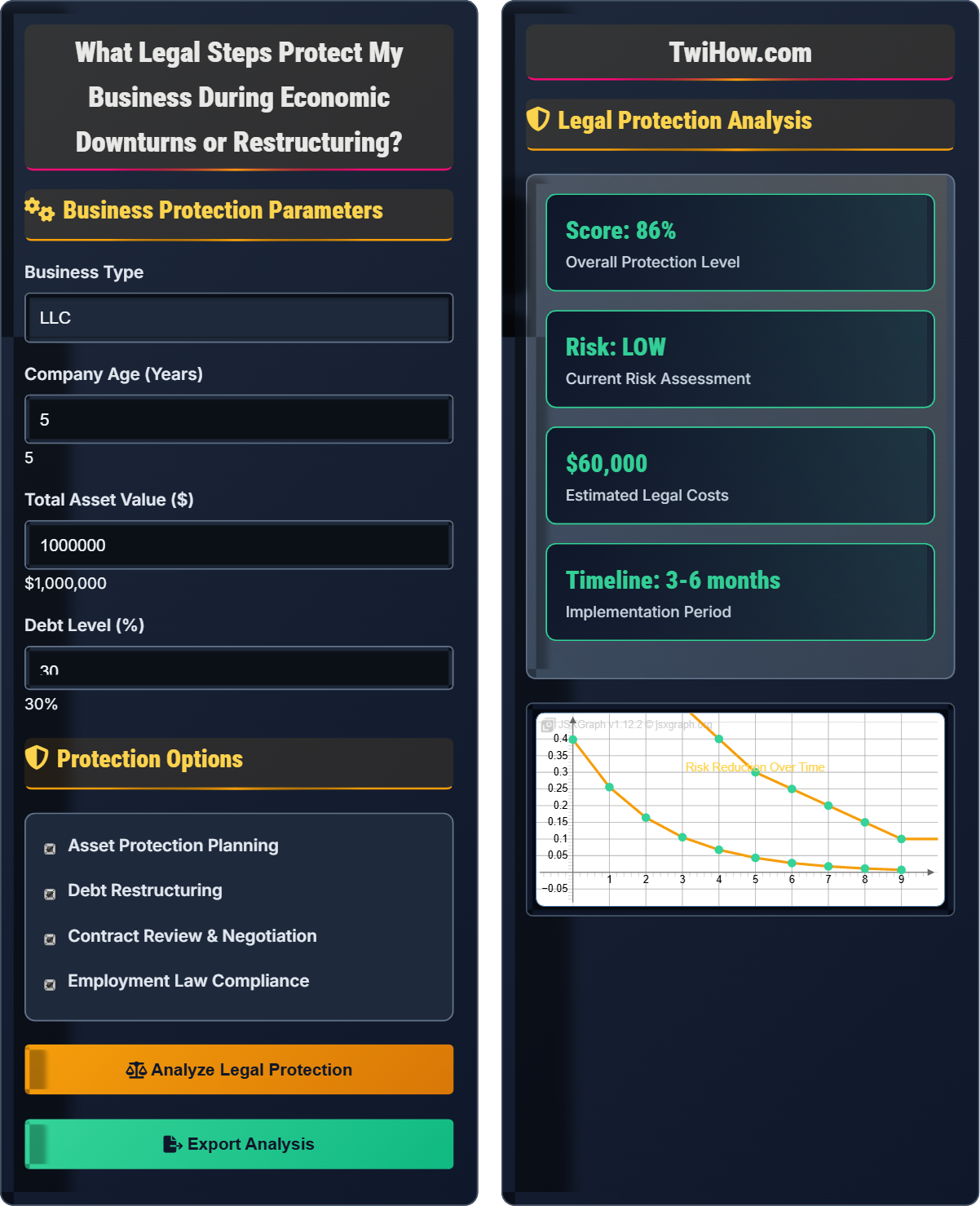
Legal Protection Analysis
Business Protection During Economic Downturns
Legal protection steps during economic downturns involve implementing strategic legal measures to safeguard business assets, maintain operational continuity, and ensure compliance with corporate governance requirements. These measures help businesses navigate financial challenges while protecting stakeholder interests and minimizing legal exposure.
The legal protection framework encompasses multiple layers of defense:
Where:
- Asset Protection: Shielding valuable business assets from creditors
- Governance Structure: Maintaining proper corporate formalities
- Compliance Framework: Ensuring regulatory adherence
Essential legal protection strategies:
- Asset Protection Trusts: Shielding assets from creditor claims
- Corporate Restructuring: Reorganizing business operations for efficiency
- Debt Restructuring: Renegotiating payment terms with creditors
- Contract Renegotiation: Modifying unfavorable contract terms
- Employment Compliance: Managing workforce reductions legally
- Insurance Coverage: Ensuring adequate protection against claims
- Preventive Measures: Proactive steps to avoid legal issues
- Responsive Actions: Reactive measures when problems arise
- Restructuring Options: Formal and informal restructuring methods
- Creditor Management: Strategies for dealing with creditor claims
- Asset Preservation: Techniques to maintain business value
Legal Protection Fundamentals
Asset protection, corporate governance, debt restructuring, contract management, fiduciary duties.
Protection Level = (Asset Shielding × Governance Strength) + Compliance Adherence
Where Protection Level = business resilience, Asset Shielding = asset protection measures, Governance Strength = corporate structure integrity.
- Act before financial distress becomes critical
- Maintain corporate formalities at all times
- Document all business decisions properly
Applications
Asset protection trusts, corporate restructuring, debt workouts, contract renegotiation, employment law compliance.
- Establish proper legal entity structure
- Create asset protection mechanisms
- Implement governance procedures
- Develop crisis management protocols
- Timing of protective measures
- Cost-benefit analysis
- State law variations
- Professional legal guidance
Legal Protection Process Flow
Risk Assessment Matrix
Legal Protection Learning Quiz
Which of the following is the most effective method for protecting business assets from creditor claims during an economic downturn?
An asset protection trust is a legal entity designed to hold business assets while protecting them from creditor claims. It provides a legitimate, court-recognized method of asset protection that maintains proper legal formalities. Informal transfers to family members can be reversed by courts as fraudulent conveyances, while liquidating assets eliminates business value and ignoring creditors typically worsens legal problems.
The answer is B) Establish an asset protection trust.
Asset protection requires careful legal planning before financial distress occurs. Courts scrutinize transactions made when a business is insolvent or facing creditor pressure. Legitimate asset protection tools must be established well in advance of any financial problems and must serve valid business purposes. The key principle is maintaining the appearance of legitimate business planning rather than avoiding creditors.
Asset Protection Trust: Legal entity holding assets to shield them from creditors
Fraudulent Conveyance: Transfer of assets to avoid creditor claims
Insolvency: Financial state where liabilities exceed assets
• Asset protection must be implemented before financial distress
• Transfers must have legitimate business purpose
• Maintain proper documentation and legal counsel
• Plan asset protection during good times
• Work with qualified legal counsel
• Document all business reasons for transfers
• Attempting asset protection after creditor pressure
• Making informal transfers without legal structure
• Failing to document legitimate business reasons
Explain the fiduciary duties of directors and officers during economic distress and how they impact restructuring decisions. Why is this particularly important during economic downturns?
Fiduciary Duties During Distress: Directors and officers owe fiduciary duties to the corporation and its shareholders, which include the duty of care (making informed decisions) and the duty of loyalty (acting in the best interests of the corporation). During economic distress, these duties expand to include consideration of creditor interests, as creditors become the "equity holders" of last resort.
Impact on Restructuring: These duties require directors to act prudently, avoid preferential payments to insiders, and consider all stakeholders in restructuring decisions. They must document their decision-making process and obtain appropriate advice.
Importance During Downturns: Breach of fiduciary duties during distress can result in personal liability for directors and officers. The "zone of insolvency" doctrine holds that directors must consider creditor interests when the company approaches insolvency.
Corporate governance becomes critically important during financial distress because the traditional focus on maximizing shareholder value shifts to considering all stakeholders, particularly creditors. Directors must be especially careful about their decision-making process, seeking appropriate professional advice, and documenting their actions. The expanded duty of care during distress means directors must be more cautious about taking risks that could harm creditors.
Fiduciary Duty: Legal obligation to act in best interests of corporation
Duty of Care: Requirement to make informed, prudent decisions
Zone of Insolvency: Period when directors must consider creditor interests
• Directors must act prudently during distress
• Creditor interests become important near insolvency
• Personal liability possible for duty breaches
• Document all major decisions thoroughly
• Seek legal and financial counsel regularly
• Consider all stakeholder impacts
• Ignoring expanded creditor duties during distress
• Failing to document decision-making process
• Taking excessive risks that harm creditors
A manufacturing company faces $5 million in debt coming due in 6 months, but only has $1.5 million in available cash flow. The company's primary lender threatens immediate foreclosure. As legal counsel, outline the immediate legal steps the company should take to protect itself while pursuing a restructuring solution.
Immediate Legal Steps:
1. Engage Restructuring Counsel: Retain experienced bankruptcy/restructuring attorneys immediately to guide the process.
2. Conduct Asset/Debt Analysis: Comprehensive review of all assets, debts, and contractual obligations to understand the full scope of the situation.
3. Initiate Lender Discussions: Begin formal negotiations with the primary lender for forbearance agreements or loan modifications.
4. Implement Cash Management: Establish strict cash management protocols to preserve liquidity for operations.
5. Review Contractual Rights: Examine all contracts for acceleration clauses, cross-default provisions, and termination rights.
6. Prepare Bankruptcy Alternative: Develop a Chapter 11 filing plan as a backup option while pursuing out-of-court restructuring.
The timeline is critical, and early engagement with professional counsel maximizes restructuring options while minimizing costs.
Debt restructuring during financial distress requires immediate and coordinated legal action. The key is balancing the need for breathing room with the urgency of creditor pressure. Professional legal counsel is essential because the wrong move can eliminate restructuring options or create personal liability for directors. The goal is to achieve a sustainable capital structure while preserving business operations.
Forbearance Agreement: Temporary suspension of loan enforcement
Acceleration Clause: Contract provision demanding immediate payment
Chapter 11: Bankruptcy option for business reorganization
• Act quickly before creditor action occurs
• Maintain business operations during restructuring
• Consider all stakeholder interests
• Engage counsel before default occurs
• Prepare comprehensive financial information
• Consider multiple restructuring alternatives
• Delaying legal engagement until default
• Failing to prepare adequate financial information
• Ignoring potential stakeholder conflicts
A retail chain needs to reduce its workforce by 30% due to economic pressures. The company has 500 employees across multiple states. Outline the legal requirements and best practices for implementing these reductions while minimizing legal exposure and maintaining employee morale.
Legal Requirements:
1. WARN Act Compliance: Determine if 60-day notice is required for plant closings or mass layoffs affecting 50+ employees.
2. State-Specific Laws: Review individual state notice requirements that may be more stringent than federal law.
3. Anti-Discrimination Laws: Ensure selection criteria are job-related and non-discriminatory across protected classes.
4. COBRA Compliance: Provide health insurance continuation notices to affected employees.
5. Final Pay Requirements: Comply with state laws regarding timing of final paychecks.
Best Practices: Use objective, documented criteria for selections; provide outplacement services; offer enhanced severance packages; communicate transparently while maintaining confidentiality where required.
Workforce reduction during economic downturns requires careful navigation of multiple federal and state employment laws. The complexity increases significantly when dealing with multi-state operations. Companies must balance legal compliance with business necessity while maintaining relationships with remaining employees and protecting their reputation. Proper documentation and consistent application of selection criteria are crucial to defend against potential discrimination claims.
WARN Act: Federal law requiring advance notice of mass layoffs
Mass Layoff: Layoffs affecting significant percentage of workforce
Protected Class: Groups protected from employment discrimination
• Comply with all notice requirements
• Use objective, non-discriminatory criteria
• Document all selection decisions
• Consult employment counsel early in process
• Prepare detailed selection criteria documentation
• Consider voluntary separation programs
• Failing to consider WARN Act requirements
• Using subjective or inconsistent criteria
• Not documenting legitimate business reasons
Which of the following restructuring options provides the greatest protection from creditor actions while allowing the business to continue operating?
Chapter 11 bankruptcy provides an automatic stay that immediately halts all creditor actions, gives the debtor exclusive control over the reorganization process for a specified period, and allows the business to continue operating while developing a plan of reorganization. While out-of-court workouts can be effective, they don't provide the same legal protections. Assignment for benefit of creditors and Chapter 7 liquidation both involve ceasing business operations.
The answer is B) Chapter 11 bankruptcy filing.
Chapter 11 bankruptcy offers unique advantages for distressed businesses that wish to continue operating. The automatic stay provides immediate relief from creditor pressure, allowing management to focus on reorganization rather than defensive litigation. The exclusivity period gives the debtor time to develop a reorganization plan without interference from creditors. However, Chapter 11 is expensive and complex, so it's typically reserved for situations where the business has viable prospects for recovery.
Automatic Stay: Immediate halt to all creditor collection efforts
Exclusive Period: Time when only debtor can propose reorganization plan
Plan of Reorganization: Proposal to restructure debt and equity
• Chapter 11 is for business reorganization
• Automatic stay provides immediate protection
• Success depends on business viability
• Consider Chapter 11 as preventive measure
• Ensure business has viable future prospects
• Prepare detailed reorganization plan early
• Filing Chapter 11 for unviable business
• Failing to prepare adequate reorganization plan
• Underestimating costs and complexity
FAQ
Q: When should I start thinking about legal protection for my business during economic uncertainty?
A: Legal protection planning should begin as soon as you anticipate economic challenges, not when they arrive. The key principle is that many protective measures must be implemented before financial distress occurs, as courts scrutinize transactions made when a company is insolvent. Early warning signs include declining revenue, delayed payments from customers, increased creditor pressure, and negative cash flow. At this point, you should engage legal counsel to implement asset protection measures, review corporate governance, and develop contingency plans. Waiting until after problems manifest severely limits your options and may result in accusations of fraudulent conveyance if you attempt to transfer assets.
Q: What's the difference between out-of-court restructuring and filing for Chapter 11 bankruptcy?
A: Out-of-court restructuring involves negotiating directly with creditors and stakeholders to modify terms, reduce debt, or extend payment periods without formal legal proceedings. It's generally faster, less expensive, and maintains greater confidentiality. However, it requires cooperation from all parties and provides no legal protection against unwilling creditors. Chapter 11 bankruptcy provides automatic legal protection through the stay of proceedings, allowing the business to continue operating while developing a reorganization plan. It can cram down dissenting creditors and force acceptance of the plan by majority vote. However, it's more expensive, involves court oversight, and creates public records. The choice depends on creditor cooperation, the complexity of the capital structure, and whether legal protection from aggressive creditors is needed.
Q: How can I protect personal assets from business creditors during an economic downturn?
A: The primary method for protecting personal assets is maintaining proper separation between personal and business finances through appropriate business entity structures. LLCs and corporations provide limited liability protection, but this protection can be lost through commingling of funds, inadequate capitalization, or failure to observe corporate formalities. Additional strategies include establishing domestic asset protection trusts (where permitted by state law), maintaining adequate business insurance, avoiding personal guarantees on business debt when possible, and keeping detailed financial records. However, protection must be implemented before financial distress occurs, as transfers made to avoid creditors can be reversed as fraudulent conveyances. Personal guarantees, if already signed, cannot be eliminated after the fact but may be renegotiated as part of broader restructuring efforts.